Guides
DIY lawn care or hire a service: which should you actually do?
Everyone frames this as a money question. The published arithmetic says it is a time question, and the answer changes with the size of your lot.
Affiliate disclosure: we earn a commission if you buy through our links, at no extra cost to you. It never changes which product we rank first — here is how we're funded.
We have not tested these units. Every spec on this page comes from the manufacturer's own documentation and is linked to it. Every computed figure is arithmetic you can redo. Prices are checked daily — last verified October 23, 2026. Here is exactly how we pick.
This is usually argued as a money question, and framed that way it is unanswerable on a site like this one: we have no verified source for what a lawn service charges on your street. What we can do is put a real number on the other side of the trade, because the equipment is documented and the arithmetic is ours.
The short answer
What each side is actually buying
Stated plainly, without the marketing on either side. The right-hand column is the one this site cannot price, and we say so rather than inventing a figure.
| Doing it yourself | Hiring a service | |
|---|---|---|
| What you pay | Equipment once, electricity ongoing | Per visit or per season, priced locally |
| What you spend | Hours, every week in season | Almost none |
| Scheduling | Yours to remember | Theirs to guarantee |
| Consistency of results | As consistent as your calendar | The thing you are actually paying for |
| Control over how it is cut | Total, including cut height | Limited to what you specify |
| Regulated product application | Not covered by this site | Handled by a licensed applicator |
| Equipment storage | Yours to solve | None |
| Running cost | A few dollars of electricity a year | Included in the price |
We publish no service pricing anywhere on this site. It is local, seasonal and lot-dependent, and we hold no verified source for it.
The arithmetic: what DIY costs you in hours
This is the number the decision actually turns on, and it is computable. Cutting time is effective swath multiplied by ground speed; effective swath is deck width minus overlap. We use a 10% overlap allowance and a 2.5 MPH walking pace, and both are our assumptions rather than published figures.
Now scale it to a season. Extension guidance sets mowing frequency by height rather than by the calendar — maintain at 3 inches or higher, mow before the grass reaches 4.5 inches, and remove no more than one third of the leaf tissue — so the cut count depends on your growth rate. Thirty cuts is a reasonable working figure for a full season and it is our assumption, not a published one.
The DIY equipment, in buying order
Three tools cover the weekly job and one more covers the seasonal one. Everything below is a currently-listed product whose manufacturer page we checked on 7 September 2026, and every specification is that manufacturer's own.
1. The mower — sized to your lot, not to the shelf
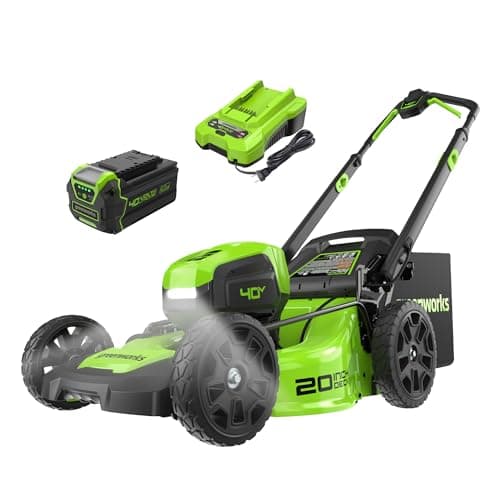
Under a third of an acre and flat, a push mower is the efficient answer. The Greenworks LM2054 publishes 57.5 lb, a 20 inch 4-in-1 deck at 3200 RPM, up to 40 minutes from a 160Wh pack and a stated rating of up to a third of an acre. It works out at about 4.0 watt-hours a minute, the most frugal mower we hold specs for.
Its published limitation is the cut-height ceiling of 3.6 inches, which just reaches the three inches or higher extension services recommend but leaves little headroom.
#ad Check the Greenworks 40V 20" Push LM2054 price on Amazon — how we're funded.
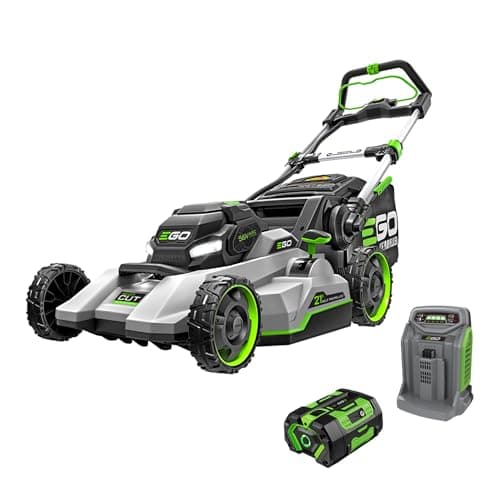
From a third of an acre upward, or on any real slope, self-propelled earns its keep. The EGO LM2135SP publishes 420Wh in the box, up to 60 minutes, eight cut-height positions from 1 to 4 inches and a five-year tool warranty. The drive motor costs about 75% more energy per minute than a push deck — 7.0 watt-hours against 4.0 — which is the honest price of not pushing 66 to 75 lb uphill.
#ad Check the EGO Power+ 21" Select Cut LM2135SP price on Amazon — how we're funded.
2. The string trimmer — for everything the deck cannot reach
The EGO ST1521S publishes a 15 inch swath, 0.095 in dual-feed line, a POWERLOAD head that winds new line at the push of a button, and a split carbon fiber shaft that also accepts multi-head attachments. Warranty is five years on the tool, three on the battery and a published lifetime term on the shaft.
The honest con: the kit ships a 140Wh pack and publishes 30 minutes, the shortest runtime of the three trimmers we hold specs for. On a small lot that is ample; on a long fence line it is not.
See the EGO Power+ 15" POWERLOAD Carbon Fiber ST1521S on EGO's own site — no Amazon listing right now, so this link earns us nothing. How we're funded.
3. The blower — and buy for the bottom of the dial
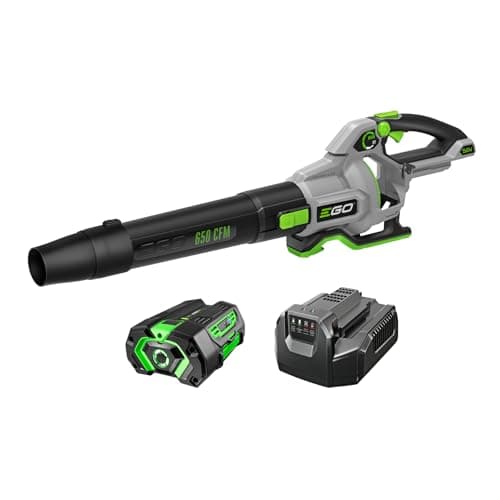
The EGO LB6504 publishes a genuine variable range of 225 to 470 CFM plus 650 CFM turbo, 180 MPH, 64 dB and an IPX4 weather rating. The 225 CFM low end is the lowest published minimum airflow in our registry, which is what lets you clear a path beside a mulch bed without redistributing the bed.
The honest con: EGO publishes no weight for this model, and the headline 650 CFM is turbo only — a setting that costs roughly ten times the energy per minute of low on the sibling tool that publishes both figures.
#ad Check the EGO Power+ 650 CFM Blower LB6504 price on Amazon — how we're funded.
4. The spreader — the seasonal half of the job
Feeding and seeding is where a DIY lawn is won or lost, and it is the cheapest part of the kit to get right. The Scotts Elite publishes a 6 ft dual-rotor spread pattern, an 80 lb hopper covering up to 20,000 sq ft per fill, EdgeGuard right-side blocking and 10 in foam-filled tires.
The honest con: 80 lb loaded is heavy on soft or sloped ground, and a broadcast spreader is harder to control near beds than a drop spreader.
#ad Check the Scotts Elite Spreader price on Amazon — how we're funded.
5. Dethatching — only if you actually have thatch
The Sun Joe AJ801E is a 12 A corded machine with a 12.6 inch working width, two swappable cylinders and five published depth settings: 0 to 0.4 inches raking and -0.4 to 0 inches scarifying. Extension guidance treats thatch over half an inch as a problem, so measure before you buy.
The honest con, and it is a big one: this is not an aerator. Core aeration needs plugs pulled from 2 to 3 inches down, and at a 12.6 inch width a 5,000 sq ft lawn is about 79 passes. We untangle the two tools in dethatching vs aerating.
#ad Check the Sun Joe AJ801E Dethatcher + Scarifier price on Amazon — how we're funded.
The running cost, which is smaller than everyone expects
This is the one part of the money argument we can source, and it is decisive in the DIY column.
Four dollars a year is a rounding error against any service, and it stays a rounding error even if you double every session count. The purchase price of the equipment is the real cost, and we do not print product prices — the method for evaluating them is in how much to spend on a lawn mower.
What a service is genuinely better at
Two things, and neither is cutting grass.
Scheduling, which is what DIY lawns actually fail on
Extension guidance ties nearly every lawn job to timing rather than to inclination. Mowing frequency is set by a height trigger, not a weekend. Fertilizer rates are published as annual applications in specific months — for a high-maintenance lawn, August, September, early October and May to June, capped at 1 lb of nitrogen per 1,000 sq ft per application. Core aeration and seeding sit in a narrow late-summer to early-autumn window.
A service delivers that calendar whether or not you remember it. That is the product, and it is a real one. If you go DIY, the honest mitigation is to put the dates in a calendar before the season starts — the year is laid out in the lawn care schedule.
Licensed application
Anything requiring a licensed applicator is outside what this site covers and outside what a homeowner should improvise. That is a genuine reason to hire, independent of lot size or hours.
Who should pick which
| If this is you | Lean toward | Why |
|---|---|---|
| Under 1/4 acre, flat, and you do not mind the time | DIY, three tools | About 28 hours a season by our arithmetic, and a push mower covers it |
| 1/4 to 1/2 acre and you want control over cut height | DIY, self-propelled | Extension guidance wants 3 in or higher, and only you will actually do that |
| An acre or more and your weekends are spoken for | Service, or a rider | About 75 hours a season is the honest number to weigh |
| You travel, or the schedule will slip | Service | Scheduling is the product; a lawn cut irregularly looks worse than one cut consistently |
| You enjoy the job | DIY | Nothing in the arithmetic argues against it, and the running cost is negligible |
| Mobility or health makes the work hard | Service, or a robot on a small lot | A wire-free robot is rated to about 1/8 acre and 16 degrees of slope |
The split most households actually land on
The framing of this page is a false binary and worth saying so. In practice the weekly jobs and the seasonal jobs separate cleanly, and they separate along the line of what equipment you would have to own.
- Own the weekly work. Mowing, trimming and clearing. Three tools, one battery platform, and the running cost above.
- Own the feeding and seeding. A spreader is the cheapest tool in the kit and the one with the largest effect on how the lawn looks.
- Rent the once-a-year machines. Core aeration in particular, which needs a tow vehicle most households do not have.
- Hire the licensed work, and anything the schedule tells you that you will not actually get to.
If you are starting from nothing, the buying order that avoids owning two battery platforms is in your first cordless yard kit.
What we cannot tell you
We cannot tell you what a lawn service costs where you live. Pricing is local, seasonal and lot-dependent, we hold no verified source for it, and a number invented here would be the least trustworthy thing on the page. That is also why this comparison is built on hours rather than on a cost-per-year table.
The mowing pace, overlap allowance, cut count and session counts above are all our assumptions and are labeled wherever they appear. Substitute your own and the conclusion moves with them — which is the point of showing the working.
The products discussed
Specs are the manufacturer's own and linked to the page they came from. Prices come from a live daily check; where we have no verified price we say so rather than print a stale one.
Greenworks 40V 20" Push LM2054
Greenworks · Greenworks 40V · Our score 8.0/10
#ad Price as of October 23, 2026. Prices change; we check daily. How we're funded.
40 minutes on a 160Wh pack and 57.5 lb to push -- the honest answer for a third of an acre and nothing more.
Published specs
| Model / SKU | LM2054 / 2549902 |
|---|---|
| Deck | 20 in |
| Max blade speed | 3200 RPM |
| Battery included | 40V 4.0Ah |
| Cut height | 1.2-3.6 in, 7 positions |
| Runtime claim | Up to 40 min |
| Weight | 57.5 lb |
| Rated for | Up to 1/3 acre |
| Warranty | 3-yr tool / 3-yr battery |
Source: 40V 20" 4-in-1 Push Lawn Mower (LM2054), greenworkstools.com
40V x 4.0Ah = 160Wh. Note it claims 40 minutes on 160Wh where the 80V flagship claims 33 minutes on 320Wh -- a 20 in deck and no self-propel drive motor is why.
What the numbers favor
- Lightest published weight on this page at 57.5 lb, and the only sub-60 lb mower here
- Claims 40 minutes from 160Wh -- the best published minutes-per-watt-hour of any mower on this page
- Same 3200 RPM blade speed as the 80V flagship
- 4-in-1 deck at the entry price
What they don't
- Push only -- no drive assist on any slope
- 1.2 in minimum cut height is lower than most cool-season lawns should ever be cut
- 120-minute recharge, three times the 80V model's 40 minutes
your lawn is over a third of an acre or has any real slope. Greenworks rates it to 1/3 acre and you will be pushing all 57.5 lb of it up the hill yourself.
How it scores
Scores are our editorial weighting of the published specs above, not a test result. They are deliberately kept out of this page's structured data.
EGO Power+ 21" Select Cut LM2135SP
EGO · EGO 56V ARC Lithium · Our score 9.1/10
#ad Price as of October 23, 2026. Prices change; we check daily. How we're funded.
The most watt-hours in the box of any flagship walk-behind here, on the platform with the widest tool range to grow into.
Published specs
| Deck | 21 in |
|---|---|
| Cutting torque | Up to 7.0 ft-lbs |
| Battery included | 56V 7.5Ah |
| Cut height | 1-4 in, 8 positions |
| Self-propel speed | 0.9-3.1 MPH |
| Runtime claim | Up to 60 min |
| Warranty | 5-yr tool / 3-yr battery |
Source: EGO POWER+ 21" Select Cut System (LM2135SP), egopowerplus.com
56V x 7.5Ah = 420Wh, using EGO's advertised pack voltage.
What the numbers favor
- 420Wh in the box -- the largest included pack of any flagship walk-behind on this page
- Eight cut-height positions from 1 to 4 in, the widest published range here
- Three interchangeable lower blades (mulching, high-lift bagging, extended runtime)
- 5-year tool warranty, the longest published on this page
What they don't
- EGO publishes torque (7.0 ft-lbs), not motor wattage, so it cannot be compared directly against Greenworks' 1500W figure
- The 7.5Ah pack that earns the runtime claim is also the expensive one to replace
your yard is under a quarter acre. You would be paying for 420Wh of headroom you will never discharge, and a 20 in push mower cuts the same grass.
How it scores
Scores are our editorial weighting of the published specs above, not a test result. They are deliberately kept out of this page's structured data.
EGO Power+ 15" POWERLOAD Carbon Fiber ST1521S
EGO · EGO 56V ARC Lithium · Our score 8.9/10
No Amazon listing for this one right now, so the link goes direct to EGO and we earn nothing on it. We show no price because we only publish figures from our own daily check. How we're funded.
A lifetime shaft warranty and a head that reloads line at the push of a button -- the two things that actually go wrong with a string trimmer.
Published specs
| Cutting swath | 15 in |
|---|---|
| Line | 0.095 in dual-feed spiral twist |
| Head | POWERLOAD automatic winding |
| Shaft | Carbon fiber, split shaft |
| Battery (kit) | 56V 2.5Ah |
| Runtime claim | Up to 30 min on 2.5Ah |
| Charge time | 50 min |
| Warranty | 5-yr tool / 3-yr battery, lifetime shaft |
Source: POWER+ 15" POWERLOAD String Trimmer with Carbon Fiber Shaft, egopowerplus.com
56V x 2.5Ah = 140Wh. 30 minutes of published runtime from 140Wh is about 4.7Wh per minute -- roughly a quarter of what a blower on turbo burns.
What the numbers favor
- Lifetime warranty on the carbon fiber shaft, published
- POWERLOAD winds the line for you -- the job everyone hates
- 0.095 in line, the heavier of the two common home gauges
- Split shaft, so it takes EGO's multi-head attachments
What they don't
- Ships with the small 2.5Ah pack; 30 minutes is a modest published runtime
- EGO does not publish a weight for this configuration
you only edge a short driveway. An 8 in edger attachment on a power head you already own does that job better and costs a fraction.
How it scores
Scores are our editorial weighting of the published specs above, not a test result. They are deliberately kept out of this page's structured data.
EGO Power+ 650 CFM Blower LB6504
EGO · EGO 56V ARC Lithium · Our score 9.0/10
#ad Price as of October 23, 2026. Prices change; we check daily. How we're funded.
650 CFM in turbo with a genuine variable dial down to 225 CFM, and 64 dB published -- the useful range is the whole point.
Published specs
| Max air volume | 650 CFM (turbo) |
|---|---|
| Variable range | 225-470 CFM |
| Max air speed | Up to 180 MPH |
| Battery (kit) | 56V 5.0Ah |
| Runtime claim | Up to 90 min average |
| Noise | 64 dB |
| Warranty | 5-yr tool / 3-yr battery |
Source: POWER+ 650 CFM Blower, egopowerplus.com
56V x 5.0Ah = 280Wh, using EGO's advertised pack voltage.
What the numbers favor
- A real variable dial (225-470 CFM) plus turbo, not a three-position switch
- 64 dB published -- quieter than the 730 CFM Greenworks, which does not publish a figure at all
- IPX4 weather-resistant rating, published
- 5-year tool warranty
What they don't
- The 650 CFM headline is turbo-only; sustained work happens at 470 CFM or below
- EGO does not publish a weight for this model
your yard is a small courtyard or a deck. 650 CFM will move your mulch, your gravel and your neighbor's patience.
How it scores
Scores are our editorial weighting of the published specs above, not a test result. They are deliberately kept out of this page's structured data.
Scotts Elite Spreader
Scotts · Manual (push) · Our score 8.5/10
#ad No verified live price right now, so we show none rather than a stale one. How we're funded.
A 6 ft dual-rotor pattern over 20,000 sq ft, with EdgeGuard to keep product off the sidewalk.
Published specs
| Type | Broadcast (rotary), dual rotor |
|---|---|
| Spread width | 6 ft |
| Coverage per fill | Up to 20,000 sq ft |
| Hopper capacity | 80 lb |
| Edge control | EdgeGuard (blocks right side) |
| Tires | 10 in, foam filled |
Source: Scotts Elite Spreader (75902), scotts.com
5,000 sq ft at a 6 ft spread width needs about 833 linear feet of walking. On a 60 ft run that is roughly 14 passes -- versus 17 passes at a standard 5 ft width. That is the whole practical difference the dual rotor buys.
What the numbers favor
- 6 ft pattern against the 5 ft standard -- about 20% fewer passes
- 80 lb hopper covers 20,000 sq ft without a refill
- EdgeGuard keeps fertilizer off hard surfaces, which is where runoff starts
- Foam-filled tires cannot go flat in the shed over winter
What they don't
- 80 lb loaded is heavy to push on soft or sloped ground
- Broadcast spreaders are harder to control near beds than a drop spreader
your lawn is under about 2,000 sq ft or heavily bordered by beds. A drop spreader puts product exactly where you steer it and nowhere else.
How it scores
Scores are our editorial weighting of the published specs above, not a test result. They are deliberately kept out of this page's structured data.
Sun Joe AJ801E Dethatcher + Scarifier
Sun Joe · Corded 120V · Our score 7.6/10
#ad No verified live price right now, so we show none rather than a stale one. How we're funded.
Two swappable cylinders and five depth settings -- but read the depth numbers before you assume this aerates.
Published specs
| Motor | 12 A |
|---|---|
| Working width | 12.6 in |
| Depth settings | 5 |
| Raking depth | 0 to 0.4 in |
| Scarifying depth | -0.4 to 0 in |
| Speed | 2,990 RPM |
| Collection bag | 8 gal |
| Tines | 27-tine dethatching cylinder |
Source: Sun Joe AJ801E Electric Lawn Dethatcher + Scarifier, shopjoe.com
What the numbers favor
- Two cylinders in one machine -- dethatch and scarify without buying twice
- Five published depth settings with actual inch figures for each mode
- 8 gallon bag means fewer stops to rake up
- Corded, so no pack to size and no runtime limit
What they don't
- This is NOT an aerator. Maximum working depth is 0.4 in; core aeration needs 2-3 in
- 12.6 in working width makes a large lawn a long afternoon
- Corded, with the working-radius limit that implies
your problem is compacted soil rather than thatch. A 0.4 in scarifier cannot relieve compaction; you need a core aerator that pulls plugs.
How it scores
Scores are our editorial weighting of the published specs above, not a test result. They are deliberately kept out of this page's structured data.
Where to buy the tools on this page
Amazon affiliate links, except where a product has no Amazon listing — those go direct to the maker and earn us nothing, and the button says so. We show no price we have not verified today, so where there is no live figure the link says "check price" and takes you to the listing to read it there.
Best for small yards
Greenworks 40V 20" Push LM2054
Greenworks · Greenworks 40V
Best overall
EGO Power+ 21" Select Cut LM2135SP
EGO · EGO 56V ARC Lithium
Best overall
EGO Power+ 15" POWERLOAD Carbon Fiber ST1521S
EGO · EGO 56V ARC Lithium
Best overall
EGO Power+ 650 CFM Blower LB6504
EGO · EGO 56V ARC Lithium
Best overall
Scotts Elite Spreader
Scotts · Manual (push)
Best for thatch, not compaction
Sun Joe AJ801E Dethatcher + Scarifier
Sun Joe · Corded 120V
#ad As an Amazon Associate we earn from qualifying purchases, at no extra cost to you. How we're funded.
Common questions
Is it cheaper to do your own lawn care?
How many hours a year does DIY lawn care take?
What equipment do I need to do my own lawn care?
What is a lawn service actually better at?
Should I do some jobs myself and hire the rest?
Why don't you publish lawn service prices?
Sources
- Greenworks 40V 20" 4-in-1 Push Lawn Mower (LM2054), greenworkstools.com
- EGO POWER+ 21" Select Cut System (LM2135SP), egopowerplus.com
- EGO POWER+ 15" POWERLOAD String Trimmer with Carbon Fiber Shaft, egopowerplus.com
- EGO POWER+ 650 CFM Blower (LB6504), egopowerplus.com
- Scotts Elite Spreader (75902), scotts.com
- Sun Joe AJ801E Electric Lawn Dethatcher + Scarifier, shopjoe.com
- Mowing practices for healthy lawns, University of Minnesota Extension
- Fertilizing lawns, University of Minnesota Extension
- Electric Power Monthly, Table 5.3: Average Price of Electricity to Ultimate Customers, U.S. Energy Information Administration
Read next
- Guides
The questions that come before the shopping. Answered in the first paragraph, then explained.
- Your first cordless yard kit, in the order to buy it
The buying order, why the mower sets the platform, and the watt-hours a full Saturday needs.
- How much should I spend on a lawn mower?
Why we keep prices out of the page text, and the cost-per-watt-hour math to run instead.
- Doing your own lawn care: what to do, and when
Four jobs, the right order, the right season. The sequence matters more than the equipment.
- How long does it take to mow an acre?
Deck width x ground speed = square feet per minute. Worked out for 20, 21 and 42 inch decks.
- Which yard tools to rent instead of buying
Frequency, storage and whether you own a tow vehicle. The rent-or-buy test in three questions.