Lawn Care
Dethatching vs aerating: they solve different problems
One machine works the top 0.4 inches. The other pulls 3-inch cores. Buying the wrong one fixes nothing.
Affiliate disclosure: we earn a commission if you buy through our links, at no extra cost to you. It never changes which product we rank first — here is how we're funded.
We have not tested these units. Every spec on this page comes from the manufacturer's own documentation and is linked to it. Every computed figure is arithmetic you can redo. Prices are checked daily — last verified October 19, 2026. Here is exactly how we pick.
These two jobs get talked about as if they were the same maintenance task at different intensities. They are not. One works the top half inch of the lawn; the other pulls material out of the root zone. The published depths on the tools make the difference impossible to miss once you look.
Measure before you buy anything
Minnesota Extension gives a method that takes five minutes: remove a two-inch deep, pie-shaped wedge from the lawn and measure the thatch between the soil surface and the green vegetation. Under half an inch is normal and useful — it insulates the crown and holds moisture. Over half an inch is where the problems start.
If the wedge shows thin thatch but the soil underneath is hard and the lawn puddles after rain, your problem is compaction, not thatch, and a dethatcher will not touch it. That distinction is the whole reason this page exists.
The published depths, side by side
| Tool | Working depth | What it removes | Solves |
|---|---|---|---|
| Sun Joe AJ801E dethatcher/scarifier | 0 to 0.4 in raking; -0.4 to 0 in scarifying | Surface thatch and matted growth | Thatch over half an inch |
| Agri-Fab 45-0299 plug aerator | Plugs up to 3 in deep | Cores of soil, thatch and grass | Compaction, and some thatch with it |
Depths as published by each manufacturer on the pages cited below. The AJ801E's two figures are its two modes: a raking cylinder that works above the soil line and a scarifying cylinder that cuts slightly into it.
A 0.4 inch tool and a 3 inch tool are not competitors. They are different machines for different layers of the same lawn, and the marketing language around "lawn renovation" blurs that in a way that costs people money.
If the answer is thatch
Vertical mowing — dethatching — uses steel knife-like or spring-like tines that rotate perpendicular to the ground surface, and Minnesota Extension puts the timing at late August to early October.
The Sun Joe AJ801E publishes two swappable cylinders, five depth settings with real inch figures for each mode, a 12.6 inch working width and an 8 gallon collection bag. Two machines in one is genuinely useful; the 12.6 inch width means a large lawn is a long afternoon, and it is corded, so your working radius is an extension cord.
#ad Check the Sun Joe AJ801E price on Amazon — how we're funded.
If the answer is compaction
Core aeration means hollow tines pulling plugs to the surface and leaving them there, which is the mechanism that both relieves compaction and speeds thatch breakdown — the soil in those cores carries the microbes that digest the thatch layer.
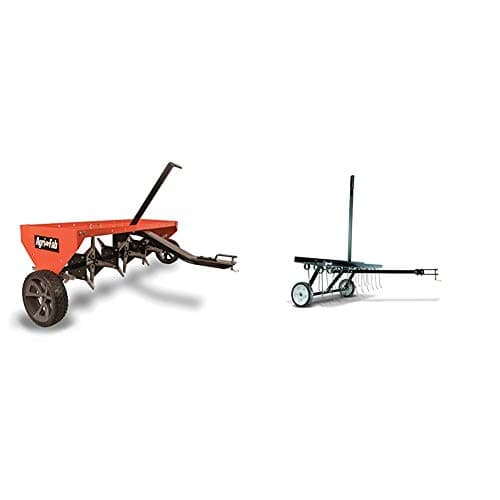
The Agri-Fab 45-0299 publishes 32 galvanized knives across a 48 inch width, plugs up to 3 inches deep, and a 175 lb weight tray so you can force depth in hard ground. The catch is unmissable: at 94 lb empty it is a tow-behind, and without a lawn tractor it is an ornament.
#ad Check the Agri-Fab 45-0299 price on Amazon — how we're funded.
Preventing thatch is cheaper than removing it
Minnesota Extension lists the causes: vigorous varieties, excessive nitrogen (especially in spring), compacted soil, acidic soil, poor drainage, and pesticides that suppress the microbial and earthworm activity that would otherwise break thatch down.
- Do not over-fertilize in spring. Excess nitrogen grows the tissue that becomes thatch. Getting the rate right starts with calibrating the spreader.
- Keep returning clippings. They are not the cause, and removing them costs you the fertilizer equivalent covered on the mulching page.
- Fix drainage and compaction. Both slow the decomposition that would otherwise keep thatch under control.
A calibrated spreader is the cheapest thatch-prevention tool on this page. The Scotts Elite publishes a 6 ft pattern and EdgeGuard, which is the combination that keeps product on the lawn and off the path.
Doing both, and seeding after
If you need both, aerate after dethatching so the cores come out of a cleared surface, and seed straight afterwards while the holes are open. All three jobs share the same late-August-to-early-October window, which is convenient and also the only weekend anyone has for them. The seeding half is on the overseeding guide, and the full calendar is on the seasonal schedule.
How long each job takes
Working width is what decides whether these are afternoon jobs or weekend jobs, and the two machines here differ by nearly four times.
That is the practical reason dethatching gets skipped: it is genuinely slow, and the 8 gallon collection bag means stopping to empty on top of the passes. It is also why the extension guidance to avoid creating thatch in the first place — sensible nitrogen rates, returned clippings, sorted drainage — is worth more than any machine on this page.
If you are doing both, and seeding too
- Mow lower than usual. One cut below your maintenance height so the machines reach the surface.
- Dethatch first if the wedge test showed more than half an inch. Collect and remove the material.
- Aerate second so the cores come out of a cleared surface. Leave the plugs where they fall; they break down and carry the microbes that digest what thatch is left.
- Seed and feed third, while the holes are open — the method is on the overseeding guide.
- Back to a 3 inch maintenance height once the new grass is established.
What we cannot tell you
- How compacted your soil is. There is no consumer measurement for it; puddling, hard ground and thin turf over hard subsoil are the practical signs.
- Plug spacing on the Agri-Fab. The knife count and width are published; a plugs-per-square-foot figure is not.
- How much thatch one pass removes. Not published by either manufacturer.
The products discussed
Specs are the manufacturer's own and linked to the page they came from. Prices come from a live daily check; where we have no verified price we say so rather than print a stale one.
Sun Joe AJ801E Dethatcher + Scarifier
Sun Joe · Corded 120V · Our score 7.6/10
#ad No verified live price right now, so we show none rather than a stale one. How we're funded.
Two swappable cylinders and five depth settings -- but read the depth numbers before you assume this aerates.
Published specs
| Motor | 12 A |
|---|---|
| Working width | 12.6 in |
| Depth settings | 5 |
| Raking depth | 0 to 0.4 in |
| Scarifying depth | -0.4 to 0 in |
| Speed | 2,990 RPM |
| Collection bag | 8 gal |
| Tines | 27-tine dethatching cylinder |
Source: Sun Joe AJ801E Electric Lawn Dethatcher + Scarifier, shopjoe.com
What the numbers favor
- Two cylinders in one machine -- dethatch and scarify without buying twice
- Five published depth settings with actual inch figures for each mode
- 8 gallon bag means fewer stops to rake up
- Corded, so no pack to size and no runtime limit
What they don't
- This is NOT an aerator. Maximum working depth is 0.4 in; core aeration needs 2-3 in
- 12.6 in working width makes a large lawn a long afternoon
- Corded, with the working-radius limit that implies
your problem is compacted soil rather than thatch. A 0.4 in scarifier cannot relieve compaction; you need a core aerator that pulls plugs.
How it scores
Scores are our editorial weighting of the published specs above, not a test result. They are deliberately kept out of this page's structured data.
Agri-Fab 48" Tow-Behind Plug Aerator (45-0299)
Agri-Fab · Tow-behind (needs a tractor) · Our score 8.0/10
#ad Price as of October 19, 2026. Prices change; we check daily. How we're funded.
32 galvanized knives pulling 3 in plugs across 48 in -- the only tool here that actually relieves compaction.
Published specs
| Working width | 48 in |
|---|---|
| Knives | 32, galvanized |
| Plug depth | Up to 3 in |
| Weight tray capacity | 175 lb |
| Unit weight | 94 lb |
| Tires | 10 in flat-proof |
Source: 48" Tow Behind Plug Aerator (45-0299), agri-fab.com
10,000 sq ft at a 48 in (4 ft) working width needs 2,500 linear feet. On a 48 ft run that is about 52 passes -- an hour or so behind a tractor, against a full day with a walk-behind core aerator.
What the numbers favor
- Pulls genuine 3 in cores, which is what aeration means
- 48 in width covers ground fast
- 175 lb weight tray lets you force depth in hard soil
- Flat-proof tires
What they don't
- Needs a lawn tractor or riding mower to tow it -- useless on its own
- 94 lb empty is awkward to move and store by hand
you have no tow vehicle. Without a tractor this is a 94 lb ornament; rent a walk-behind core aerator for the weekend instead.
How it scores
Scores are our editorial weighting of the published specs above, not a test result. They are deliberately kept out of this page's structured data.
Scotts Elite Spreader
Scotts · Manual (push) · Our score 8.5/10
#ad No verified live price right now, so we show none rather than a stale one. How we're funded.
A 6 ft dual-rotor pattern over 20,000 sq ft, with EdgeGuard to keep product off the sidewalk.
Published specs
| Type | Broadcast (rotary), dual rotor |
|---|---|
| Spread width | 6 ft |
| Coverage per fill | Up to 20,000 sq ft |
| Hopper capacity | 80 lb |
| Edge control | EdgeGuard (blocks right side) |
| Tires | 10 in, foam filled |
Source: Scotts Elite Spreader (75902), scotts.com
5,000 sq ft at a 6 ft spread width needs about 833 linear feet of walking. On a 60 ft run that is roughly 14 passes -- versus 17 passes at a standard 5 ft width. That is the whole practical difference the dual rotor buys.
What the numbers favor
- 6 ft pattern against the 5 ft standard -- about 20% fewer passes
- 80 lb hopper covers 20,000 sq ft without a refill
- EdgeGuard keeps fertilizer off hard surfaces, which is where runoff starts
- Foam-filled tires cannot go flat in the shed over winter
What they don't
- 80 lb loaded is heavy to push on soft or sloped ground
- Broadcast spreaders are harder to control near beds than a drop spreader
your lawn is under about 2,000 sq ft or heavily bordered by beds. A drop spreader puts product exactly where you steer it and nowhere else.
How it scores
Scores are our editorial weighting of the published specs above, not a test result. They are deliberately kept out of this page's structured data.
Where to buy the tools on this page
Amazon affiliate links, except where a product has no Amazon listing — those go direct to the maker and earn us nothing, and the button says so. We show no price we have not verified today, so where there is no live figure the link says "check price" and takes you to the listing to read it there.
Best for thatch, not compaction
Sun Joe AJ801E Dethatcher + Scarifier
Sun Joe · Corded 120V
Best real aeration
Agri-Fab 48" Tow-Behind Plug Aerator (45-0299)
Agri-Fab · Tow-behind (needs a tractor)
Best overall
Scotts Elite Spreader
Scotts · Manual (push)
#ad As an Amazon Associate we earn from qualifying purchases, at no extra cost to you. How we're funded.
Common questions
What is the difference between dethatching and aerating?
How do I know if my lawn has thatch?
Can a dethatcher aerate my lawn?
When should I dethatch or aerate?
Do grass clippings cause thatch?
Do I need a tractor to aerate?
Sources
Read next
- Lawn Care
Cutting the grass is a third of the job. This is the other two thirds.
- Best lawn dethatcher
Measure first: half an inch is the threshold. Published depths, and the two-cylinder machine.
- Best lawn aerator (and why most of them are not aerators)
Core aeration pulls 2-3 inch plugs; dethatchers work at 0.4 inches. Which one you need.
- How to overseed a lawn
Published extension seeding rates, the late-summer window, and the passes-per-lawn arithmetic.
- Best lawn spreader for fertilizer and seed
Spread width decides how long the job takes. The passes-per-lawn math, worked out.
- Doing your own lawn care: what to do, and when
Four jobs, the right order, the right season. The sequence matters more than the equipment.
- Mulching vs bagging: which should you actually do?
The extension research on returning clippings, and what each deck mode costs you in runtime.