Battery Platforms
40V vs 80V: what the voltage on the sticker actually buys you
Doubling the voltage does not double the runtime. Here is the number that does.
Affiliate disclosure: we earn a commission if you buy through our links, at no extra cost to you. It never changes which product we rank first — here is how we're funded.
We have not tested these units. Every spec on this page comes from the manufacturer's own documentation and is linked to it. Every computed figure is arithmetic you can redo. Prices are checked daily — last verified October 19, 2026. Here is exactly how we pick.
Almost every argument about 40V versus 80V is really an argument about pack size wearing a voltage costume. Once you convert both to watt-hours the question usually answers itself in about ten seconds.
The formula, and why it is the only one you need
Look at the middle two rows. A 40V 6.0Ah pack (240Wh) holds 50% more energy than an 80V 2.0Ah pack (160Wh). If you were choosing between those two tools on the strength of "80 is bigger than 40", you would pick the one that runs out first.
So what does voltage actually do?
Power is volts multiplied by amps. To deliver a given amount of power, a higher-voltage system needs proportionally less current. Less current means less resistive heating in the wiring, the switches and the motor windings.
- Higher voltage helps under sustained heavy load. Thick wet grass, a chainsaw buried in hardwood, a blower held on turbo. These are the conditions where a lower-voltage system has to pull more amps and gets hotter doing it.
- Higher voltage does not help you finish the lawn. That is entirely a watt-hour question.
- Higher voltage tends to cost more per watt-hour. You are paying for cells in series and for the electronics that manage them.
The max-volts trap
Here is the detail that makes cross-brand comparisons slippery, and one almost nobody writes down.
Toro publishes a real watt-hour figure for its pack: 60V Max L324, 6.0Ah, 324Wh. Do the division and you get something interesting.
This is not Toro being unusual — it is Toro being unusually honest. Every lithium tool pack behaves this way: a cell reads about 4.0-4.2V full and about 3.6V nominal. Brands that market "60V Max" and "80V Max" are quoting the full-charge figure. Brands that market "56V" without the word Max are doing much the same thing.
The practical consequence is simple and reassuring: nameplate watt-hours are consistently about 10% optimistic across every brand, so as long as you compare nameplate to nameplate, the ranking does not change. Just do not mix a nameplate figure from one brand with a published watt-hour figure from another and expect them to line up.
Four real mowers, converted
| Mower | Pack | Watt-hours | Claimed runtime | Wh per minute |
|---|---|---|---|---|
| Ryobi 40V HP 21" | 2 x 40V 6.0Ah | 480Wh | 80 min | 6.0 |
| Greenworks 80V LM2108S | 1 x 80V 4.0Ah | 320Wh | 33 min | 9.7 |
| Kobalt 80V SP | 2 x 80V 4.0Ah | 640Wh | 80 min | 8.0 |
| Toro 60V Max 21356 | 1 x 60V 6.0Ah | 324Wh (published) | 45 min | 7.2 |
Wh per minute is our arithmetic: watt-hours divided by the manufacturer's own claimed runtime. It is a rough measure of how hungry each deck is, not a lab measurement.
The lowest-voltage mower in that table runs the longest. It runs the longest because it carries the second-most energy and uses it most efficiently — not because of anything to do with 40 versus 80.
So which should you buy?
Choose a 40V platform if
- Your yard is under about half an acre
- You want the cheapest route to five or six cordless tools
- You are happy to carry a second pack rather than one enormous one
Choose an 80V platform if
- You cut thick or wet grass regularly, where sustained load is the issue
- You want a chainsaw or a large blower on the same packs
- You will buy a 4.0Ah pack or bigger, rather than the smallest one offered
The same math applies to every tool
Watt-hours are not a mower concept. They are how you size a pack for any cordless tool, and the per-minute draw varies enormously:
- A blower on turbo can burn roughly 18Wh per minute — see the blower roundup
- A string trimmer runs nearer 4Wh per minute — the trimmer roundup
- A chainsaw is better measured in energy per cut, around 0.9Wh for a 4x4 — the chainsaw roundup
That range — roughly 4x between a trimmer and a blower on full power — is why one pack size cannot serve a whole platform, and why the right question is never "40 or 80" but "how many watt-hours, and how fast does this tool spend them".
The products discussed
Specs are the manufacturer's own and linked to the page they came from. Prices come from a live daily check; where we have no verified price we say so rather than print a stale one.
Ryobi 40V HP Brushless 21" Self-Propelled
Ryobi · Ryobi 40V · Our score 8.6/10
#ad No verified live price right now, so we show none rather than a stale one. How we're funded.
Two 6Ah packs and the longest published runtime claim on this page, on the platform with the cheapest route to a fourth and fifth tool.
Published specs
| Model | RY40HPLM01B |
|---|---|
| Deck | 21 in |
| Motor | Brushless, 40V HP |
| Batteries included (kit) | 2 x 40V 6.0Ah |
| Drive | Variable-speed rear-wheel self-propel |
| Runtime claim | Up to 80 min on 2 x 6Ah |
Source: 40V HP Brushless 21" Self-Propelled Mower, ryobitools.com
40V x 6.0Ah = 240Wh per pack; the kit ships two, so 480Wh total -- but only 240Wh is available at any moment, because the mower draws one pack at a time.
What the numbers favor
- 480Wh across two packs, the most total energy in any kit here
- Two packs means you swap and keep mowing instead of waiting on a charger
- Ryobi's 40V range is the broadest consumer battery line of the three platforms
What they don't
- Only one 240Wh pack is live at a time -- the 480Wh is sequential, not simultaneous
- Ryobi does not publish a cut-height range or weight on the product page, so both are unknown to us
you own nothing on Ryobi yet and expect to buy heavy tools later. 40V is the lowest voltage of the three platforms, and the ceiling shows on chainsaws and riding gear.
How it scores
Scores are our editorial weighting of the published specs above, not a test result. They are deliberately kept out of this page's structured data.
Greenworks 80V 21" 4-in-1 LM2108S
Greenworks · Greenworks 80V · Our score 8.4/10
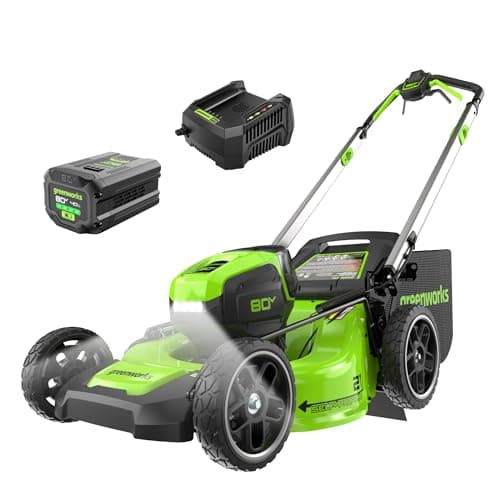
#ad Price as of October 19, 2026. Prices change; we check daily. How we're funded.
The only mower here that publishes motor wattage, blade RPM, weight and an acreage rating -- and the only one whose battery warranty matches its tool warranty.
Published specs
| Model / SKU | LM2108S / 2550402 |
|---|---|
| Deck | 21 in |
| Max blade speed | 3200 RPM |
| Battery included | 80V 4.0Ah |
| Cut height | 1.38-4.0 in, 7 positions |
| Runtime claim | Up to 33 min |
| Weight | 75 lb |
| Rated for | Up to 1/2 acre |
| Warranty | 4-yr tool / 4-yr battery |
Source: 80V 21" 4-in-1 Self-Propelled Lawn Mower (LM2108S), greenworkstools.com
80V x 4.0Ah = 320Wh, using Greenworks' advertised pack voltage.
What the numbers favor
- 4-year battery warranty -- a year longer than EGO's 3-year, on the component that fails first
- Publishes blade RPM, weight and acreage rating; the other two brands publish none of the three
- 40-minute recharge on the included charger, the fastest published here
- 4-in-1 deck adds turbo leaf pickup on top of mulch, bag and side discharge
What they don't
- 320Wh included, the least of the three flagships -- and the 33-minute runtime claim reflects that
- 75 lb is the only published weight here, and it is not light
you want one battery to finish a half-acre without a swap. Greenworks rates the mower for 1/2 acre but claims only 33 minutes on the included pack; those two numbers only reconcile if you buy a second battery.
How it scores
Scores are our editorial weighting of the published specs above, not a test result. They are deliberately kept out of this page's structured data.
Kobalt 80V Max 21" Self-Propelled (dual-port)
Kobalt · Kobalt 80V Max · Our score 8.4/10
#ad No verified live price right now, so we show none rather than a stale one. How we're funded.
Two 4Ah bays, 80 published minutes and an acre rating -- the most runtime per purchase of any 80V walk-behind here.
Published specs
| Deck | 21 in, steel |
|---|---|
| Motor | Brushless |
| Batteries included | 2 x 80V 4.0Ah (dual port) |
| Runtime claim | Up to 80 min |
| Rated for | Up to 1 acre |
| Drive | Self-propelled RWD, 7 speed settings |
| Recharge | Approx. 60-90 min |
Source: Kobalt 80-Volt 21-in Self-propelled Battery Mower (2 batteries), lowes.com
80V x 4.0Ah = 320Wh per pack; two bays = 640Wh installed. Kobalt's listing does not state whether the two ports discharge simultaneously or in sequence, so we do not claim either -- what is verifiable is that 640Wh is on the machine when you start.
What the numbers favor
- 640Wh installed across two bays, the most of any walk-behind on this page
- Rated to 1 acre, twice the Greenworks 80V flagship's half-acre rating
- Seven published speed settings on the self-propel drive
- All Kobalt 80V packs are cross-compatible across the 80V outdoor line
What they don't
- Sold through Lowe's only, so availability and price track one retailer
- The listing does not publish weight, cut-height range or a noise figure
- Kobalt's 80V outdoor range is narrower than EGO's or Ryobi's
you want a platform rather than a mower. Kobalt is a single-retailer house brand -- fine for the tool, thinner as a decade-long ecosystem bet.
How it scores
Scores are our editorial weighting of the published specs above, not a test result. They are deliberately kept out of this page's structured data.
Toro 60V Max 21" Recycler Self-Propel (21356)
Toro · Toro 60V Max Flex-Force · Our score 8.3/10
#ad No verified live price right now, so we show none rather than a stale one. How we're funded.
The only manufacturer here that publishes the actual watt-hour figure for its pack -- and the number tells you something the others hide.
Published specs
| Model | 21356 |
|---|---|
| Deck | 21 in, 14-gauge steel |
| Battery | 60V Max L324, 6.0Ah, 324Wh |
| Charge time | 150 min |
| Runtime claim | Up to 45 min on the 6.0Ah |
| Drive | Personal Pace variable-speed RWD |
| Weight | 66 lb |
| Storage | SmartStow vertical |
Source: 60V Max 21 in. Recycler Self-Propel Lawn Mower (21356T), toro.com
Toro labels the pack 60V Max 6.0Ah and publishes 324Wh. 324 / 6.0 = 54V -- the nominal voltage, not the 60V max-charge figure on the sticker. Every brand's 'max volts' is roughly 11% above nominal, so a nameplate watt-hour number is always about 11% optimistic. This is the single most useful spec on this page.
What the numbers favor
- Publishes a real watt-hour figure (324Wh) instead of leaving you to multiply the marketing voltage
- 45 minutes from 324Wh, against Greenworks' 33 minutes from a nameplate 320Wh
- 14-gauge steel deck, the only steel deck spec published on this page
- SmartStow vertical storage -- a genuine constraint solver in a one-car garage
What they don't
- 150-minute recharge is the slowest here by a wide margin
- Toro's 60V line is narrower than EGO's or Ryobi's, so the platform grows less far
you are buying into a platform rather than a mower. Toro builds excellent mowers; the 60V Flex-Force tool range is not the one to bet a decade of yard tools on.
How it scores
Scores are our editorial weighting of the published specs above, not a test result. They are deliberately kept out of this page's structured data.
Where to buy the tools on this page
Amazon affiliate links, except where a product has no Amazon listing — those go direct to the maker and earn us nothing, and the button says so. We show no price we have not verified today, so where there is no live figure the link says "check price" and takes you to the listing to read it there.
Best for a household already on Ryobi
Ryobi 40V HP Brushless 21" Self-Propelled
Ryobi · Ryobi 40V
Best published spec sheet
Greenworks 80V 21" 4-in-1 LM2108S
Greenworks · Greenworks 80V
Best two-bay runtime
Kobalt 80V Max 21" Self-Propelled (dual-port)
Kobalt · Kobalt 80V Max
Best published watt-hour honesty
Toro 60V Max 21" Recycler Self-Propel (21356)
Toro · Toro 60V Max Flex-Force
#ad As an Amazon Associate we earn from qualifying purchases, at no extra cost to you. How we're funded.
Common questions
Is 80V better than 40V?
How do I calculate watt-hours from volts and amp-hours?
Why does a 60V Max battery say 324Wh instead of 360Wh?
Do I need 80V for a half-acre lawn?
Does higher voltage damage tools or wear batteries faster?
Sources
Read next
- Battery Platforms
Pick the system once and the next four tools are decided for you. Start here.
- EGO 56V vs Greenworks 80V: higher voltage, smaller pack
80V beats 56V on paper. The included pack sizes reverse the result, and here is the math.
- How long do electric lawn mower batteries last?
Runtime per charge is arithmetic. Lifespan in years is mostly warranty terms and honest uncertainty.
- What a battery platform really costs over ten years
The four-line cost model for a decade of cordless yard tools, with the battery replacement nobody counts.
- Best battery lawn mowers of 2026
Six flagship battery mowers ranked on watt-hours in the box and energy spent per minute.
- How many volts for an electric lawn mower?
Why watt-hours, not volts, decide mower runtime -- worked through four real machines.
- 40V vs 80V, tool by tool
Matched 40V and 80V pairs across mowers, blowers and trimmers, on published watt-hours and output.