Battery Platforms
EGO 56V vs Ryobi 40V: which platform should you start on?
Two flagship mowers, two very different bets. One ships 420Wh in a single pack; the other ships 480Wh split across two.
Affiliate disclosure: we earn a commission if you buy through our links, at no extra cost to you. It never changes which product we rank first — here is how we're funded.
We have not tested these units. Every spec on this page comes from the manufacturer's own documentation and is linked to it. Every computed figure is arithmetic you can redo. Prices are checked daily — last verified October 19, 2026. Here is exactly how we pick.
Buy the EGO if you want the most energy in a single pack and the longest tool warranty in the category. Buy the Ryobi if you expect to end up with five or six cordless tools, because that is where 40V's cheaper packs and wider range quietly win.
That is the whole answer. Everything below is the working, because a platform choice is a ten-year commitment disguised as a mower purchase and you should be able to check our arithmetic rather than take our word for it.
The short answer, by situation
| If this is you | Pick | Why |
|---|---|---|
| You own no cordless yard tools yet, and expect 2-3 total | EGO 56V | 420Wh in one pack means one battery covers a mow. Fewer packs to buy, fewer to store, fewer to replace in year five. |
| You expect 5+ tools eventually | Ryobi 40V | The broader range and cheaper packs compound. Every additional tool on a shared pack is where a platform pays for itself. |
| You already own any Ryobi 40V tool | Ryobi 40V | You have already paid the platform entry cost. Buying across is paying it twice. |
| Warranty length is what you care about | EGO 56V | 5-year tool and 3-year battery, published. Ryobi does not publish equivalent terms on its mower page. |
| You want the quietest yard | Ryobi 40V | The Whisper Series blower publishes 57 dB against EGO's 64 dB on their respective flagship blowers. |
Every claim in this table is sourced in the sections below.
Side-by-side: the flagship mowers
Both brands sell a 21-inch self-propelled brushless mower as the anchor of the platform. Here is what each manufacturer publishes, and only what each manufacturer publishes.
| Spec | EGO LM2135SP | Ryobi 40V HP 21" |
|---|---|---|
| Deck width | 21 in | 21 in |
| Battery in the kit | 1 x 56V 7.5Ah | 2 x 40V 6.0Ah |
| Nameplate watt-hours | 420Wh | 480Wh (2 x 240Wh) |
| Published runtime | Up to 60 min | Up to 80 min on both packs |
| Cut height | 1-4 in, 8 positions | Not published |
| Self-propel speed | 0.9-3.1 MPH | Variable, range not published |
| Power figure | Up to 7.0 ft-lbs torque | Not published |
| Weight | Not published | Not published |
| Warranty | 5-yr tool / 3-yr battery | Not published on the product page |
Sources: EGO LM2135SP product page and Ryobi 40V HP 21" self-propelled mower product page, both checked 3 September 2026. "Not published" means exactly that — we would rather leave a cell empty than fill it with a number nobody stands behind.
The arithmetic: watt-hours, not volts
Voltage on its own tells you almost nothing about how long a tool runs. The number that matters is watt-hours — volts multiplied by amp-hours — because that is the actual quantity of energy in the pack.
Ryobi ships more total energy and EGO ships more usable energy at any given moment. Whether that matters depends entirely on whether swapping a pack mid-mow bothers you. If it does not — and for most people it does not — Ryobi is handing you 60Wh more for free.
There is a wrinkle worth knowing before you compare any two brands this way. Manufacturers advertise different voltages for the same chemistry. Toro publishes its "60V Max" 6.0Ah pack as 324 watt-hours, which is 54V x 6.0Ah — the nominal voltage, not the fully-charged figure printed on the sticker. Every brand's "max volts" number is roughly 11% above nominal, so nameplate watt-hours are always a little optimistic. As long as you compare like with like, the ranking does not change. We explain this properly in 40V vs 80V explained.
Tool range: where the decision actually gets made
You are not really choosing a mower. You are choosing which brand's battery sits on your shelf for the next decade, and therefore which brand's trimmer, blower, chainsaw and hedge trimmer you will buy without shopping around.
Both brands cover the core four. Where they differ is at the edges. EGO runs a multi-head system where one power head takes an 8-inch edger attachment, a 10-inch pole saw and a string trimmer head — one motor, several jobs. Ryobi's 40V line is broader in absolute tool count and reaches further down in price.
- EGO's strength is the top end: a 42-inch zero-turn riding mower that runs on the same 56V packs as the handheld tools. Nothing on Ryobi 40V does that, because 40V does not scale to a riding deck.
- Ryobi's strength is breadth and price. If your plan is six tools rather than three, the per-tool premium on EGO adds up faster than the per-pack premium on Ryobi.
Noise: the one place Ryobi clearly wins
Ryobi's Whisper Series blower publishes 57 dB at 730 CFM. EGO's flagship 650 CFM blower publishes 64 dB.
Treat the gap as directional rather than precise — these are manufacturer figures, not a controlled comparison. But a brand that publishes 57 dB has decided noise is something it competes on, and a brand that publishes nothing at all on a given tool has decided it is not. Both signals are useful. More on this in the quiet blower roundup.
Ten-year cost: the part nobody publishes
This is the section that made us build the site. Not one of the ten competitor pages we read for this comparison works out what a platform actually costs over its life, despite most of them describing it as a long-term decision.
We cannot print prices here, because prices move daily and a number typed into a page in September is wrong by October. What we can give you is the structure of the calculation, so you can run it with today's prices in about four minutes. The full worked cost model is here, with the formula and a filled-in example.
- Entry cost. The mower kit price. This includes the first pack and charger, which is most of what you are paying for.
- Tools 2 through N, bare. Bare-tool prices only. Buying kits repeatedly is the single most expensive mistake on any platform: you end up with four chargers and four packs you did not need.
- One spare pack. Sized to your largest tool's appetite, not your smallest.
- Battery replacement in years 5-8. Assume every pack gets replaced once inside ten years. This is the line item that decides the comparison, and the line item nobody includes.
Run those four numbers for both brands with the tools you actually intend to own. In most household scenarios Ryobi comes out lower, because step 4 scales with pack price and 40V packs cost less per watt-hour. EGO closes the gap when you need fewer, larger packs — and wins outright if a riding mower is anywhere in your ten-year plan.
The verdict
Choose EGO 56V if
- You want one pack to finish the whole lawn without a swap
- You value the published 5-year tool warranty
- A riding mower on the same battery is plausible within ten years
- You would rather own three excellent tools than six adequate ones
#ad Check the EGO Power+ 21" Select Cut LM2135SP price on Amazon — how we're funded.
Choose Ryobi 40V if
- You already own anything on Ryobi 40V
- You expect five or more cordless tools eventually
- Noise matters and you want the 57 dB blower
- You are comfortable swapping a pack mid-job to save money
Whichever you pick, buy the second and third tools bare. That single habit saves more over ten years than the difference between these two brands.
#ad Check the Ryobi 40V HP Brushless 21" Self-Propelled price on Amazon — how we're funded.
The products discussed
Specs are the manufacturer's own and linked to the page they came from. Prices come from a live daily check; where we have no verified price we say so rather than print a stale one.
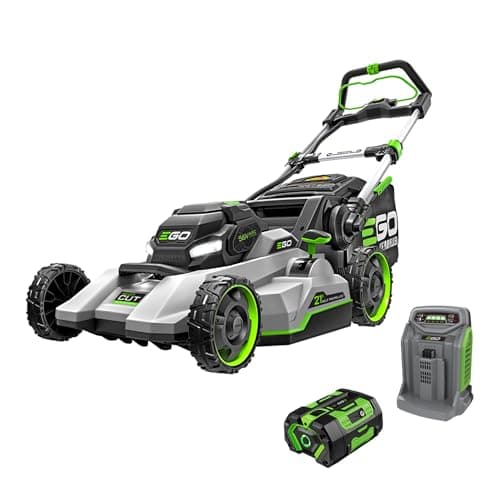
EGO Power+ 21" Select Cut LM2135SP
EGO · EGO 56V ARC Lithium · Our score 9.1/10
#ad Price as of October 19, 2026. Prices change; we check daily. How we're funded.
The most watt-hours in the box of any flagship walk-behind here, on the platform with the widest tool range to grow into.
Published specs
| Deck | 21 in |
|---|---|
| Cutting torque | Up to 7.0 ft-lbs |
| Battery included | 56V 7.5Ah |
| Cut height | 1-4 in, 8 positions |
| Self-propel speed | 0.9-3.1 MPH |
| Runtime claim | Up to 60 min |
| Warranty | 5-yr tool / 3-yr battery |
Source: EGO POWER+ 21" Select Cut System (LM2135SP), egopowerplus.com
56V x 7.5Ah = 420Wh, using EGO's advertised pack voltage.
What the numbers favor
- 420Wh in the box -- the largest included pack of any flagship walk-behind on this page
- Eight cut-height positions from 1 to 4 in, the widest published range here
- Three interchangeable lower blades (mulching, high-lift bagging, extended runtime)
- 5-year tool warranty, the longest published on this page
What they don't
- EGO publishes torque (7.0 ft-lbs), not motor wattage, so it cannot be compared directly against Greenworks' 1500W figure
- The 7.5Ah pack that earns the runtime claim is also the expensive one to replace
your yard is under a quarter acre. You would be paying for 420Wh of headroom you will never discharge, and a 20 in push mower cuts the same grass.
How it scores
Scores are our editorial weighting of the published specs above, not a test result. They are deliberately kept out of this page's structured data.
Ryobi 40V HP Brushless 21" Self-Propelled
Ryobi · Ryobi 40V · Our score 8.6/10
#ad No verified live price right now, so we show none rather than a stale one. How we're funded.
Two 6Ah packs and the longest published runtime claim on this page, on the platform with the cheapest route to a fourth and fifth tool.
Published specs
| Model | RY40HPLM01B |
|---|---|
| Deck | 21 in |
| Motor | Brushless, 40V HP |
| Batteries included (kit) | 2 x 40V 6.0Ah |
| Drive | Variable-speed rear-wheel self-propel |
| Runtime claim | Up to 80 min on 2 x 6Ah |
Source: 40V HP Brushless 21" Self-Propelled Mower, ryobitools.com
40V x 6.0Ah = 240Wh per pack; the kit ships two, so 480Wh total -- but only 240Wh is available at any moment, because the mower draws one pack at a time.
What the numbers favor
- 480Wh across two packs, the most total energy in any kit here
- Two packs means you swap and keep mowing instead of waiting on a charger
- Ryobi's 40V range is the broadest consumer battery line of the three platforms
What they don't
- Only one 240Wh pack is live at a time -- the 480Wh is sequential, not simultaneous
- Ryobi does not publish a cut-height range or weight on the product page, so both are unknown to us
you own nothing on Ryobi yet and expect to buy heavy tools later. 40V is the lowest voltage of the three platforms, and the ceiling shows on chainsaws and riding gear.
How it scores
Scores are our editorial weighting of the published specs above, not a test result. They are deliberately kept out of this page's structured data.
Where to buy the tools on this page
Amazon affiliate links, except where a product has no Amazon listing — those go direct to the maker and earn us nothing, and the button says so. We show no price we have not verified today, so where there is no live figure the link says "check price" and takes you to the listing to read it there.
Best overall
EGO Power+ 21" Select Cut LM2135SP
EGO · EGO 56V ARC Lithium
Best for a household already on Ryobi
Ryobi 40V HP Brushless 21" Self-Propelled
Ryobi · Ryobi 40V
#ad As an Amazon Associate we earn from qualifying purchases, at no extra cost to you. How we're funded.
Common questions
Is EGO 56V actually more powerful than Ryobi 40V?
Are EGO and Ryobi batteries interchangeable?
Which platform is cheaper over ten years?
Can I run an EGO mower on a smaller battery?
Does two batteries mean double the runtime?
Sources
Read next
- Battery Platforms
Pick the system once and the next four tools are decided for you. Start here.
- 40V vs 80V: what the voltage on the sticker actually buys you
Volts x amp-hours = watt-hours. The one calculation that makes every battery spec comparable.
- Are EGO batteries interchangeable? And will they work with Ryobi?
Which packs fit which tools, stated plainly, plus the one place brands quietly break their own rule.
- EGO vs Ryobi vs Greenworks vs Toro: the mowers compared
Every published spec from four flagship 21-inch mowers, converted so it is comparable.
- Best battery lawn mowers of 2026
Six flagship battery mowers ranked on watt-hours in the box and energy spent per minute.