Trimmers & Edgers
The line gauge and the head design decide whether you enjoy this job or dread it.
Affiliate disclosure: we earn a commission if you buy through our links, at no extra cost to you. It never changes which product we rank first — here is how we're funded.
Trimmer listings lead with swath width and runtime. Neither is in the top two things that will determine whether you like the tool. Line gauge and how you reload the spool are, and both are buried at the bottom of every product page.
A string trimmer is also the most efficient tool in the shed — roughly 3.6 to 4.7 watt-hours per minute, about a quarter of what a blower on turbo burns. That has a practical consequence most people miss: the small pack in a trimmer kit is what makes the tool feel limited, and a mower-sized pack fixes it completely.
This section covers string trimmers, edgers and hedge trimmers — three tools that in practice run on the same battery and, on multi-head systems, the same motor.
In this section
27 pages under Trimmers & Edgers. Every recommendation is built from published specifications and arithmetic you can redo — we have not tested these units.
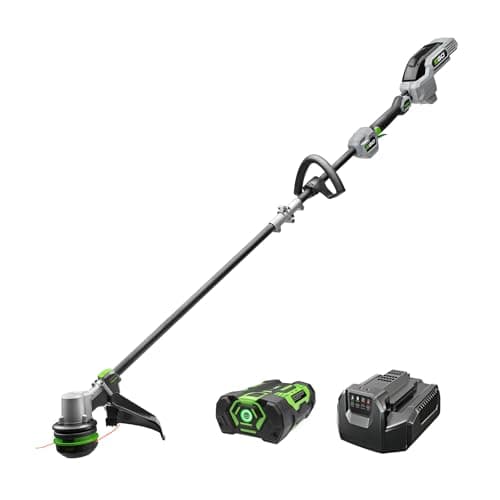
Best String Trimmer
Best cordless string trimmers of 2026
Three trimmers ranked on swath, line gauge, weight and energy per minute.
Top pick
EGO Power+ 15" POWERLOAD Carbon Fiber ST1521S
#ad Affiliate link. How we're funded
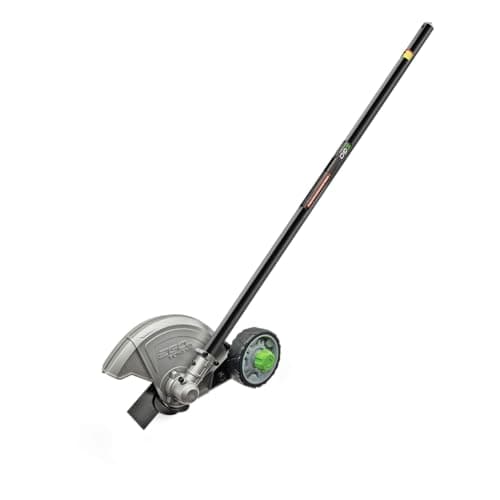
Best Edger
Best cordless lawn edger
The attachment usually beats the dedicated machine here. Published runtimes and the depth spec that matters.
Top pick
EGO Power+ 8" Carbon Fiber Edger Attachment EA0820
#ad Affiliate link. How we're funded
guide
String trimmer buying guide: the four specs that matter
Line gauge, head type, shaft and loaded weight -- the four specs that decide how a trimmer feels.
Top pick
EGO Power+ 15" POWERLOAD Carbon Fiber ST1521S
#ad Affiliate link. How we're funded
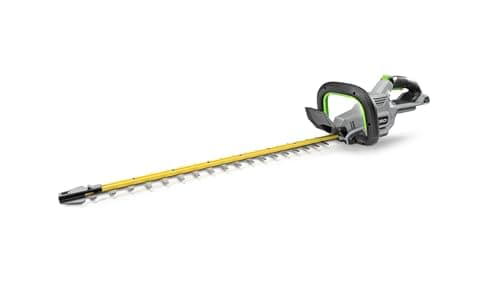
Best Hedge Trimmer
Best cordless hedge trimmer
Cut capacity decides whether a trimmer suits your hedge. The published figures and the runtime gap.
Top pick
EGO Power+ 24" Hedge Trimmer HT2410
#ad Affiliate link. How we're funded
guide
String trimmer line: gauge, shape and feed explained
Line gauge against the job, plus what automatic reload and bump feed really cost you.
Top pick
EGO Power+ 15" POWERLOAD Carbon Fiber ST1521S
#ad Affiliate link. How we're funded
guide
How to choose a cordless hedge trimmer
The four specs that decide a hedge trimmer, and the one most makers do not publish.
Top pick
EGO Power+ 24" Hedge Trimmer HT2410
#ad Affiliate link. How we're funded
guide
How to edge a lawn properly
Depth, sequence and the feet-of-edge-per-charge arithmetic from four published pack sizes.
Top pick
EGO Power+ 8" Carbon Fiber Edger Attachment EA0820
#ad Affiliate link. How we're funded
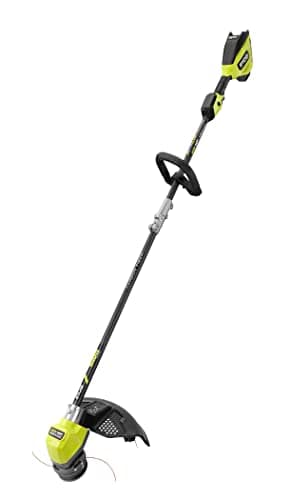
Best for Tall Weeds
Best cordless string trimmer for tall weeds and rough growth
Line gauge decides weed work. 0.095 in against 0.080 in, and the runtimes for long sessions.
Top pick
Ryobi 40V HP Whisper 17" Carbon Fiber RY402110
#ad Affiliate link. How we're funded
Head-to-head
String trimmer or edger: do you actually need both?
A trimmer on its side against a 3 inch guided blade. When one tool is genuinely enough.
Top pick
EGO Power+ 8" Carbon Fiber Edger Attachment EA0820
#ad Affiliate link. How we're funded
guide
Multi-head attachment systems: one power head, several tools
Attachments carry no motor and no battery. What the EGO multi-head system covers and where it stops.
Top pick
EGO Power+ 8" Carbon Fiber Edger Attachment EA0820
#ad Affiliate link. How we're funded
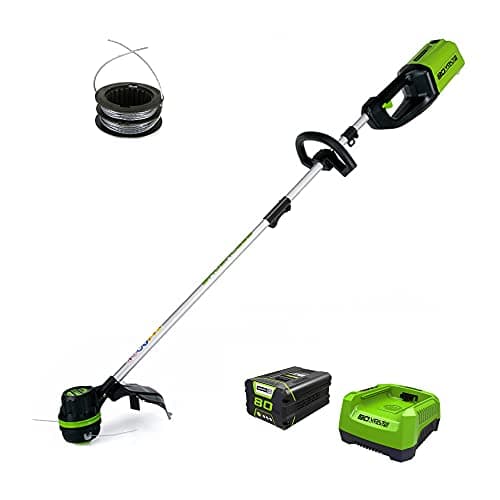
Lightest Trimmer
Best lightweight cordless string trimmer
7.1 lb to 12.9 lb published, on the one tool you hold at full arm extension.
Top pick
Greenworks 80V 16" String Trimmer ST80L210
#ad Affiliate link. How we're funded
Best Trimmer for Small Yards
Best cordless string trimmer for a small yard
Short sessions reward control and weight, not runtime. The smallest pack is the right pack.
Top pick
Greenworks 80V 16" String Trimmer ST80L210
#ad Affiliate link. How we're funded
Best for Thick Hedges
Best cordless hedge trimmer for thick growth
Cut capacity decides it: 1 in published, and a different tool above that.
Top pick
EGO Power+ 24" Hedge Trimmer HT2410
#ad Affiliate link. How we're funded
guide
How to trim a hedge properly
Taper the sides, work bottom to top, and follow the extension limit on how much to remove.
Top pick
EGO Power+ 24" Hedge Trimmer HT2410
#ad Affiliate link. How we're funded
guide
Cordless string trimmer maintenance
Line, head, guard and shaft -- the four things that go wrong, and how to stop them.
Top pick
EGO Power+ 15" POWERLOAD Carbon Fiber ST1521S
#ad Affiliate link. How we're funded
guide
When should you trim hedges and shrubs?
Late dormant season for most pruning, spring bloomers right after flowering, hedges twice a year.
Top pick
EGO Power+ 24" Hedge Trimmer HT2410
#ad Affiliate link. How we're funded
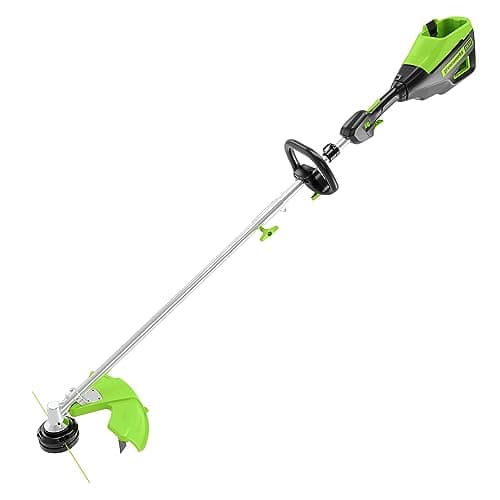
Best Brush Cutter
Best brush cutter
Blade attachment plus power head, with the swath and energy arithmetic for both halves.
Top pick
Greenworks 80V 16" Attachment-Capable String Trimmer (2123802)
#ad Affiliate link. How we're funded
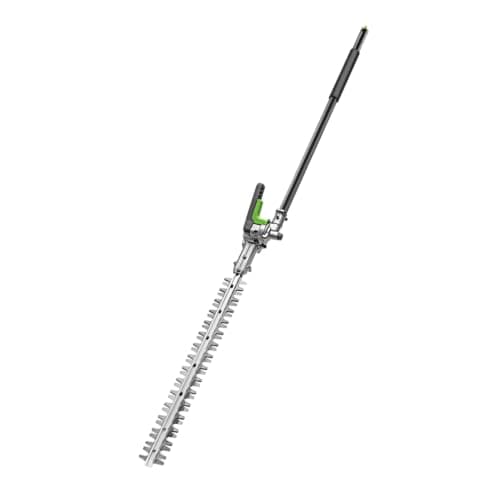
Best Pole Hedge Trimmer
Best pole hedge trimmer
Articulation, cut capacity and added reach for trimming hedge tops without a ladder.
Top pick
EGO POWER+ Carbon Fiber Hedge Trimmer Attachment (HTA2020)
#ad Affiliate link. How we're funded
Best Bed Edger
Best edger for flower beds
Published cutting depths compared for cutting and holding a bed edge, not a sidewalk edge.
Top pick
EGO Power+ 8" Carbon Fiber Edger Attachment EA0820
#ad Affiliate link. How we're funded
Best Trimmer/Edger Combo
Best string trimmer and edger combo
Attachment systems that trim and edge on one motor, with the published depths each one reaches.
Top pick
EGO Power+ 8" Carbon Fiber Edger Attachment EA0820
#ad Affiliate link. How we're funded
guide
Trimmer heads explained
What bump feed, POWERLOAD and fixed-line heads do, and which published specs actually matter.
Top pick
EGO Power+ 15" POWERLOAD Carbon Fiber ST1521S
#ad Affiliate link. How we're funded
Best Trimmer for Large Yards
Best string trimmer for a large yard
Published runtime, watt-hours and energy per minute for four cordless trimmers on a big property.
Top pick
Ryobi 40V HP Whisper 17" Carbon Fiber RY402110
#ad Affiliate link. How we're funded
guide
String trimmer voltage: what 40V, 56V and 80V actually mean
Why voltage does not predict trimmer runtime or swath, and the watt-hour figure that does.
Top pick
Ryobi 40V HP Whisper 17" Carbon Fiber RY402110
#ad Affiliate link. How we're funded
roundup
EGO POWER+ ST1521S review
A specification review: POWERLOAD winding, a lifetime carbon fiber shaft, and 140Wh in the kit.
Top pick
EGO Power+ 15" POWERLOAD Carbon Fiber ST1521S
#ad Affiliate link. How we're funded
comparison
String trimmer vs brush cutter
Cutting width, material limits and guard requirements for a string head against a Tri-Arc blade.
Top pick
Ryobi 40V HP Whisper 17" Carbon Fiber RY402110
#ad Affiliate link. How we're funded
Best for Fence Lines
Best string trimmer for fence lines
Line gauge, adjustable cutting width and reload method for the job that consumes the most line.
Top pick
Ryobi 40V HP Whisper 17" Carbon Fiber RY402110
#ad Affiliate link. How we're funded
Head-to-head
EGO ST1521S vs Ryobi RY402110
140Wh against 240Wh, POWERLOAD against a bump feed, and a lifetime shaft warranty against 12.9 published pounds.
Top pick
EGO Power+ 15" POWERLOAD Carbon Fiber ST1521S
#ad Affiliate link. How we're funded
Line gauge is the specification people regret
EGO and Ryobi both ship 0.095 inch. Greenworks ships 0.080 inch on its 80V trimmer. Every break is a stop to re-feed, so this specification decides how often your job is interrupted — and it is the last line in most listings.
How you reload, which you will do a dozen times a season
EGO's POWERLOAD winds the spool for you: feed the line through, press a button. Ryobi and Greenworks use bump feed, which advances line while you work but still leaves you hand-winding when the spool empties.
Sitting on the grass winding nylon that wants to spring off the reel is the job everybody puts off. If you trim weekly through the season, an automatic head is worth more than fifteen minutes of runtime. Full detail in the buying guide.
Weight, with a pack fitted
| Trimmer | Bare | With a pack |
|---|---|---|
| Greenworks ST80L210 | 7.1 lb | Not published |
| Ryobi RY402110 | 8.8 lb | 12.9 lb (6.0Ah) |
| EGO ST1521S | Not published | Not published |
Ryobi is the only one of the three to publish both figures. 4.1 lb of battery on the end of a 72-inch shaft is a lot of leverage.
There is a fix nobody mentions: fit a smaller pack. A trimmer draws about 3.6 to 4.7 watt-hours per minute, so even a 2.0Ah pack gives a usable session, and most residential trimming is under twenty minutes. Trade runtime you do not need for weight you feel.
Multi-head systems change the economics
A split-shaft trimmer takes attachments, which turns one power head into a trimmer, an 8-inch edger and a 10-inch pole saw. EGO publishes runtime figures for the edger attachment at four different pack sizes — 50 minutes on a 4.0Ah through 132 on a 10.0Ah — which is unusually complete documentation for an accessory.
The corollary is worth stating plainly: an attachment is excellent value on a power head you already own and poor value if you are buying the power head to justify it. That asymmetry is why we score the same tool 9.5 on-platform and 4.0 standalone.
Hedge trimmers are decided by one number
Cut capacity — the maximum branch diameter the blade gap can sever. Below it the trimmer cuts; above it the branch wedges and the tool stalls. EGO publishes 1 inch on the HT2410, at the top of what cordless hedge trimmers claim, and it publishes no runtime figure at all — a gap we name rather than fill.