Guides
How to read a yard tool spec sheet (and what its silences mean)
Every figure on a spec sheet is chosen. So is every figure that is missing, and the absences are usually more informative than the numbers.
Affiliate disclosure: we earn a commission if you buy through our links, at no extra cost to you. It never changes which product we rank first — here is how we're funded.

We have not tested these units. Every spec on this page comes from the manufacturer's own documentation and is linked to it. Every computed figure is arithmetic you can redo. Prices are checked daily — last verified October 20, 2026. Here is exactly how we pick.
After transcribing spec sheets from eight brands into one registry, a pattern emerges that no individual product page reveals: brands publish different things, and what each one leaves out is remarkably consistent. This is how to read both the numbers and the gaps.
The rule
Figures that are genuinely comparable
| Figure | Why it compares | Watch out for |
|---|---|---|
| Watt-hours (V x Ah) | Energy is energy, whatever the brand | Advertised volts run about 11% above nominal, so all nameplate figures are similarly optimistic |
| Working width | Inches are inches | Effective width is less than deck width once you overlap |
| Warranty term | Years are years, and they are contractual | Battery term and tool term are often different; the battery one matters more |
| Published depth or capacity | A physical limit the maker has committed to | Retail listings blur "dethatcher" and "aerator" constantly; check the inches |
| Cleaning units (PSI x GPM) | Combines the two figures that both matter | Peak PSI and rated GPM are sometimes measured separately |
Figures that look comparable and are not
- Max volts. A 60V Max pack is a 54V nominal pack. Toro is the only brand in our registry that publishes a watt-hour figure, and that figure is how we know.
- Gas-equivalent horsepower. EGO publishes 22 HP gas equivalent for the Z6. There is no standard behind it, so it is a claim rather than a measurement.
- Peak CFM and peak MPH. Both are peak figures, generally not achieved simultaneously, and each brand tests its own way.
- Torque against wattage. EGO publishes cutting torque in ft-lbs and Greenworks publishes motor wattage. Those are different quantities and neither converts to the other.
- Decibels across brands. Ryobi's 57 dB and EGO's 64 dB are each measured under their own conditions. The gap is directional, not lab-comparable — and a 7 dB difference is a large one, which is why directional is still useful.
#ad Check the Ryobi 40V HP Whisper Series 730 CFM RY404100 price on Amazon — how we're funded.
The audit: what six mower brands do not publish
This is the table that changed how we write about this category. It is the same class of product from six manufacturers, and the columns are startlingly uneven.
| Published spec | EGO | Ryobi | Greenworks | Toro | Kobalt |
|---|---|---|---|---|---|
| Runtime claim | Yes | Yes | Yes | Yes | Yes |
| Cut height range | Yes | No | Yes | No | No |
| Weight | No | No | Yes | Yes | No |
| Blade speed (RPM) | No | No | Yes | No | No |
| Acreage rating | No | No | Yes | No | Yes |
| Recharge time | No | No | Yes | Yes | Approximate |
| Warranty on the page | Yes | Not stated | Yes | Not stated | Not stated |
| Watt-hours | No | No | No | Yes | No |
| Decibels | No | No | No | No | No |
Compiled from each brand's own walk-behind mower product page for the models in our registry, checked 3 September 2026. "No" means the figure is absent from the page we cite.
Read the columns and you learn something else. Greenworks publishes seven of the nine rows and Toro publishes the one figure nobody else does. Two brands publish three rows each. None of this makes a mower better or worse, but it tells you how much of your purchase is a claim you can check.
#ad Check the Greenworks 80V 21" 4-in-1 LM2108S price on Amazon — how we're funded.
The best specification format, when you find it
Three formats stand out as unusually honest, and they are worth actively seeking.
Work per charge, against a stated material
EGO publishes up to 300 cuts on a 4x4 for the CS1804 chainsaw. That names the job and the material, which is more information than any runtime figure carries, and it lets you size a pack from a woodpile instead of from a guess.
Runtime by mode rather than an average
EGO publishes 15 minutes of turbo and 150 minutes on low for the LB7650. An average would have hidden a ten-to-one ratio. Ryobi does the same on its blower with 30 and 120.
Runtime across several pack sizes
EGO publishes edger runtimes on 4.0Ah, 7.5Ah and 10.0Ah packs. That is enough data to prove the draw is flat, which is a claim no single figure could support.
#ad Check the Toro 60V Max 21" Recycler Self-Propel (21356) price on Amazon — how we're funded.
A six-step reading routine
- Convert the battery to watt-hours before you read anything else. Volts times amp-hours, every time.
- Divide energy by runtime to get watt-hours per minute, which is the number that sizes a purchase.
- Find the warranty on the battery, not the tool. The pack is what fails first and it is the expensive part.
- List what is missing. Weight, cut height, recharge time, noise — write down the blanks.
- Treat peak figures as ceilings. Max CFM, max PSI and top speed describe a best case, not a working condition.
- Prefer a brand that commits to a number over one that leaves it out, all else equal. A published figure is checkable; a silence is not.
#ad Check the Kobalt 80V Max 21" Self-Propelled (dual-port) price on Amazon — how we're funded.
What we cannot tell you
We cannot tell you whether a published figure is accurate. We transcribe what manufacturers state and we do the arithmetic on it; we run no test lab and own none of this equipment. If a brand's runtime claim is optimistic, our per-minute figure inherits that optimism, and we would rather say so than pretend otherwise.
What this method does give you is a way to compare like with like, and a way to notice what nobody wants you to notice. Start with the gaps.
The products discussed
Specs are the manufacturer's own and linked to the page they came from. Prices come from a live daily check; where we have no verified price we say so rather than print a stale one.
Toro 60V Max 21" Recycler Self-Propel (21356)
Toro · Toro 60V Max Flex-Force · Our score 8.3/10
#ad No verified live price right now, so we show none rather than a stale one. How we're funded.
The only manufacturer here that publishes the actual watt-hour figure for its pack -- and the number tells you something the others hide.
Published specs
| Model | 21356 |
|---|---|
| Deck | 21 in, 14-gauge steel |
| Battery | 60V Max L324, 6.0Ah, 324Wh |
| Charge time | 150 min |
| Runtime claim | Up to 45 min on the 6.0Ah |
| Drive | Personal Pace variable-speed RWD |
| Weight | 66 lb |
| Storage | SmartStow vertical |
Source: 60V Max 21 in. Recycler Self-Propel Lawn Mower (21356T), toro.com
Toro labels the pack 60V Max 6.0Ah and publishes 324Wh. 324 / 6.0 = 54V -- the nominal voltage, not the 60V max-charge figure on the sticker. Every brand's 'max volts' is roughly 11% above nominal, so a nameplate watt-hour number is always about 11% optimistic. This is the single most useful spec on this page.
What the numbers favor
- Publishes a real watt-hour figure (324Wh) instead of leaving you to multiply the marketing voltage
- 45 minutes from 324Wh, against Greenworks' 33 minutes from a nameplate 320Wh
- 14-gauge steel deck, the only steel deck spec published on this page
- SmartStow vertical storage -- a genuine constraint solver in a one-car garage
What they don't
- 150-minute recharge is the slowest here by a wide margin
- Toro's 60V line is narrower than EGO's or Ryobi's, so the platform grows less far
you are buying into a platform rather than a mower. Toro builds excellent mowers; the 60V Flex-Force tool range is not the one to bet a decade of yard tools on.
How it scores
Scores are our editorial weighting of the published specs above, not a test result. They are deliberately kept out of this page's structured data.
Greenworks 80V 21" 4-in-1 LM2108S
Greenworks · Greenworks 80V · Our score 8.4/10
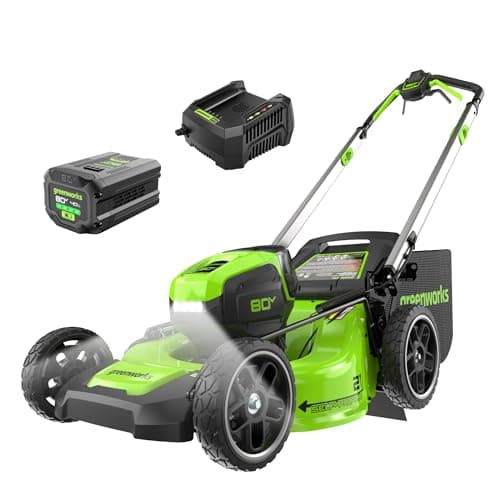
#ad Price as of October 20, 2026. Prices change; we check daily. How we're funded.
The only mower here that publishes motor wattage, blade RPM, weight and an acreage rating -- and the only one whose battery warranty matches its tool warranty.
Published specs
| Model / SKU | LM2108S / 2550402 |
|---|---|
| Deck | 21 in |
| Max blade speed | 3200 RPM |
| Battery included | 80V 4.0Ah |
| Cut height | 1.38-4.0 in, 7 positions |
| Runtime claim | Up to 33 min |
| Weight | 75 lb |
| Rated for | Up to 1/2 acre |
| Warranty | 4-yr tool / 4-yr battery |
Source: 80V 21" 4-in-1 Self-Propelled Lawn Mower (LM2108S), greenworkstools.com
80V x 4.0Ah = 320Wh, using Greenworks' advertised pack voltage.
What the numbers favor
- 4-year battery warranty -- a year longer than EGO's 3-year, on the component that fails first
- Publishes blade RPM, weight and acreage rating; the other two brands publish none of the three
- 40-minute recharge on the included charger, the fastest published here
- 4-in-1 deck adds turbo leaf pickup on top of mulch, bag and side discharge
What they don't
- 320Wh included, the least of the three flagships -- and the 33-minute runtime claim reflects that
- 75 lb is the only published weight here, and it is not light
you want one battery to finish a half-acre without a swap. Greenworks rates the mower for 1/2 acre but claims only 33 minutes on the included pack; those two numbers only reconcile if you buy a second battery.
How it scores
Scores are our editorial weighting of the published specs above, not a test result. They are deliberately kept out of this page's structured data.
Kobalt 80V Max 21" Self-Propelled (dual-port)
Kobalt · Kobalt 80V Max · Our score 8.4/10
#ad No verified live price right now, so we show none rather than a stale one. How we're funded.
Two 4Ah bays, 80 published minutes and an acre rating -- the most runtime per purchase of any 80V walk-behind here.
Published specs
| Deck | 21 in, steel |
|---|---|
| Motor | Brushless |
| Batteries included | 2 x 80V 4.0Ah (dual port) |
| Runtime claim | Up to 80 min |
| Rated for | Up to 1 acre |
| Drive | Self-propelled RWD, 7 speed settings |
| Recharge | Approx. 60-90 min |
Source: Kobalt 80-Volt 21-in Self-propelled Battery Mower (2 batteries), lowes.com
80V x 4.0Ah = 320Wh per pack; two bays = 640Wh installed. Kobalt's listing does not state whether the two ports discharge simultaneously or in sequence, so we do not claim either -- what is verifiable is that 640Wh is on the machine when you start.
What the numbers favor
- 640Wh installed across two bays, the most of any walk-behind on this page
- Rated to 1 acre, twice the Greenworks 80V flagship's half-acre rating
- Seven published speed settings on the self-propel drive
- All Kobalt 80V packs are cross-compatible across the 80V outdoor line
What they don't
- Sold through Lowe's only, so availability and price track one retailer
- The listing does not publish weight, cut-height range or a noise figure
- Kobalt's 80V outdoor range is narrower than EGO's or Ryobi's
you want a platform rather than a mower. Kobalt is a single-retailer house brand -- fine for the tool, thinner as a decade-long ecosystem bet.
How it scores
Scores are our editorial weighting of the published specs above, not a test result. They are deliberately kept out of this page's structured data.
Ryobi 40V HP Whisper Series 730 CFM RY404100
Ryobi · Ryobi 40V · Our score 8.8/10
#ad No verified live price right now, so we show none rather than a stale one. How we're funded.
57 dB published at 730 CFM. That is the lowest published noise figure on this page and it is not close.
Published specs
| Max air volume | 730 CFM |
|---|---|
| Max air speed | 190 MPH |
| Speed tips | 160 / 175 / 190 MPH |
| Noise | 57 dB |
| Batteries (kit) | 2 x 40V 4.0Ah |
| Runtime | 30 min high / 120 min low |
| Weight | 9.4 lb |
Source: 40V HP Brushless Whisper Series 730 CFM Blower (RY404100), ryobitools.com
Decibels are logarithmic: a 7 dB drop is roughly a 5x reduction in sound intensity, and is perceived as roughly half as loud. Both figures are manufacturer-published under their own test conditions, so treat the gap as directional, not lab-comparable.
What the numbers favor
- 57 dB published -- the quietest figure any manufacturer on this page publishes
- 730 CFM while doing it, second only to the 765 CFM EGO
- Ships with two 4Ah packs (320Wh total) in the kit
- Publishes high AND low runtimes rather than an average
What they don't
- 9.4 lb is the heaviest published handheld weight here, roughly double the EGO LB7650 bare
- Manufacturer noise figures are measured under each brand's own conditions -- not a like-for-like lab comparison
you need to move soaked leaves off a large property fast. Quiet costs air speed, and 190 MPH is the lowest peak here.
How it scores
Scores are our editorial weighting of the published specs above, not a test result. They are deliberately kept out of this page's structured data.
Where to buy the tools on this page
Amazon affiliate links, except where a product has no Amazon listing — those go direct to the maker and earn us nothing, and the button says so. We show no price we have not verified today, so where there is no live figure the link says "check price" and takes you to the listing to read it there.
Best published watt-hour honesty
Toro 60V Max 21" Recycler Self-Propel (21356)
Toro · Toro 60V Max Flex-Force
Best published spec sheet
Greenworks 80V 21" 4-in-1 LM2108S
Greenworks · Greenworks 80V
Best two-bay runtime
Kobalt 80V Max 21" Self-Propelled (dual-port)
Kobalt · Kobalt 80V Max
Best quiet blower
Ryobi 40V HP Whisper Series 730 CFM RY404100
Ryobi · Ryobi 40V
#ad As an Amazon Associate we earn from qualifying purchases, at no extra cost to you. How we're funded.
Common questions
Which yard tool specs actually matter?
What does 'not published' tell me about a tool?
Is gas-equivalent horsepower a real specification?
Why can't I compare voltage between brands?
What is the most useful spec almost nobody publishes?
Should I trust manufacturer runtime claims?
Sources
- Toro 60V Max 21 in. Recycler Self-Propel Lawn Mower (21356T), toro.com
- Greenworks 80V 21" Self-Propelled Lawn Mower (LM2108S), greenworkstools.com
- Kobalt 80-Volt 21-in Self-propelled Battery Mower (2 batteries), lowes.com
- Ryobi 40V HP Brushless Whisper Series 730 CFM Blower (RY404100), ryobitools.com
- EGO POWER+ 21" Select Cut System (LM2135SP), egopowerplus.com
- EGO POWER+ 18" Cordless Chain Saw (CS1804), egopowerplus.com
Read next
- Guides
The questions that come before the shopping. Answered in the first paragraph, then explained.
- Watt-hours explained: the one number that compares any two battery tools
Volts x amp-hours = watt-hours. Every pack in the registry converted, and why max volts overstates it.
- How we pick
The published methodology that replaces a testing claim.
- EGO vs Ryobi vs Greenworks vs Toro: the mowers compared
Every published spec from four flagship 21-inch mowers, converted so it is comparable.
- Yard tool warranties compared: count the battery years, not the tool years
Every published tool and battery warranty term, and which brand covers the part that actually fails.
- What size mower do I need for my yard?
Deck width and watt-hours by lawn size, with the mowing-time arithmetic for each.