Lawn Care
How to measure your lawn (and why every other decision needs it)
Fertilizer rates are per thousand square feet. Mower ratings are in acres. Almost nobody knows their own number, and every purchase downstream is a guess without it.
Affiliate disclosure: we earn a commission if you buy through our links, at no extra cost to you. It never changes which product we rank first — here is how we're funded.
We have not tested these units. Every spec on this page comes from the manufacturer's own documentation and is linked to it. Every computed figure is arithmetic you can redo. Prices are checked daily — last verified October 21, 2026. Here is exactly how we pick.
Almost every recommendation on this site — and on every fertilizer bag, spreader setting chart and mower spec sheet — is expressed per unit area. And almost nobody knows their own area. This is the twenty-minute job that makes every other decision possible.
Why the number matters more than you would think
| Published in | Example from our sources | What it needs from you |
|---|---|---|
| Pounds of nitrogen per 1,000 sq ft | 1 to 4 lbs per year by maintenance level (UMN Extension) | Lawn area in thousands of square feet |
| Square feet per hopper fill | Up to 20,000 sq ft (Scotts Elite) | Lawn area, to know if you refill mid-job |
| Acres per charge | Up to 1/3 acre (Greenworks LM2054), up to 1/2 acre (LM2108S) | Lawn area converted to acres |
| Working width | 12.6 in (Sun Joe AJ801E), 48 in (Agri-Fab aerator) | Lawn area, to work out passes and time |
Rates from University of Minnesota Extension; equipment figures from the manufacturers' own product pages.
Method 1: split it into shapes
This is the reliable one, and it is the only method that lets you subtract the parts that are not grass.
- Sketch the lawn roughly on paper. It does not need to be to scale.
- Draw lines dividing it into rectangles, triangles and part-circles. Overlap nothing.
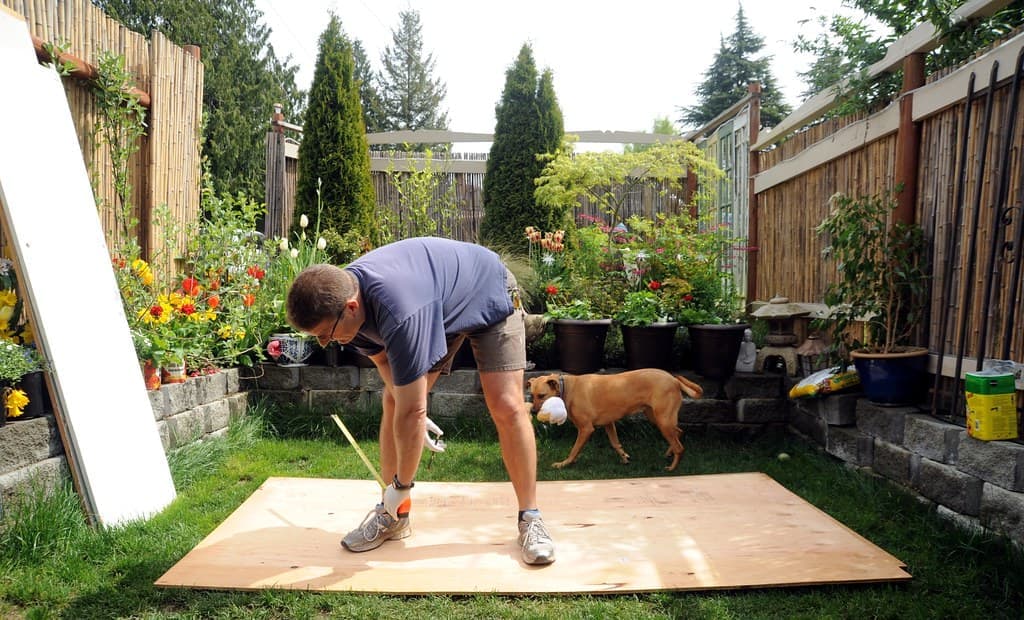
- Measure each shape. A long tape is ideal; pacing works if you know your stride.
- Calculate each area and add them up.
- Subtract beds, paths, the patio and anything else that is not grass.
Method 2: pace it out
If a long tape is not to hand, your own stride is a usable measuring tool once you have calibrated it.
- Mark a known distance — a 30 ft driveway, a 20 ft fence run.
- Walk it normally and count paces.
- Divide the distance by the paces to get feet per pace.
- Now pace every side of every shape and multiply.
Method 3: measure it from above
Satellite mapping tools with an area function will let you click round a lawn boundary and read off the area. It is fast and it is good at irregular shapes.
Two cautions. Imagery can be years out of date, so a bed you added last spring may still be lawn on the map. And it is easy to trace the property boundary rather than the grass boundary, which is exactly the over-measurement that shape-splitting avoids. Use it to cross-check a measured figure rather than to replace one.
The conversions to write on the sketch
| Area | Square feet | Thousands of sq ft (fertilizer units) |
|---|---|---|
| 1/8 acre | 5,445 | 5.4 |
| 1/4 acre | 10,890 | 10.9 |
| 1/3 acre | 14,520 | 14.5 |
| 1/2 acre | 21,780 | 21.8 |
| 3/4 acre | 32,670 | 32.7 |
| 1 acre | 43,560 | 43.6 |
| 2 acres | 87,120 | 87.1 |
All derived from 43,560 square feet per acre.
Keep the sketch. The number changes only when you change the garden, and you will use it every spring for the rest of the time you live there.
What to do with the number
Fertilizer and seed
Divide your area by 1,000 and you have the multiplier for every published rate. A 4,021 sq ft lawn is 4.0 units, so a 1 lb-per-1,000 application is 4 lbs of nitrogen-equivalent, not a bag. Working out how much product that is takes one more step, covered in fertilizer numbers explained.
#ad Check the Scotts Elite Spreader price on Amazon — how we're funded.
Mower sizing
Convert to acres and compare against published ratings. Below 14,520 sq ft you are inside the Greenworks 40V push mower's published third of an acre. Above 21,780 you are past the 80V flagship's half-acre rating and into multiple-pack territory.
#ad Check the Greenworks 40V 20" Push LM2054 price on Amazon — how we're funded.
Time and passes
Area divided by working width gives linear feet, and linear feet divided by your run length gives passes. That is how a spreader's 6 ft spread width becomes 14 passes on a 5,000 sq ft lawn, and it is the same arithmetic behind how long it takes to mow an acre.
#ad Check the EGO Power+ 21" Select Cut LM2135SP price on Amazon — how we're funded.
What we cannot tell you
We cannot tell you your lawn area, and any site that offers you a "typical" figure is inventing one. Lot sizes vary enormously and the grass fraction of a lot varies more.
What we can tell you is that the measurement takes about twenty minutes, that 43,560 square feet is an acre, and that every published rate in lawn care assumes you have done it.
The products discussed
Specs are the manufacturer's own and linked to the page they came from. Prices come from a live daily check; where we have no verified price we say so rather than print a stale one.
Scotts Elite Spreader
Scotts · Manual (push) · Our score 8.5/10
#ad No verified live price right now, so we show none rather than a stale one. How we're funded.
A 6 ft dual-rotor pattern over 20,000 sq ft, with EdgeGuard to keep product off the sidewalk.
Published specs
| Type | Broadcast (rotary), dual rotor |
|---|---|
| Spread width | 6 ft |
| Coverage per fill | Up to 20,000 sq ft |
| Hopper capacity | 80 lb |
| Edge control | EdgeGuard (blocks right side) |
| Tires | 10 in, foam filled |
Source: Scotts Elite Spreader (75902), scotts.com
5,000 sq ft at a 6 ft spread width needs about 833 linear feet of walking. On a 60 ft run that is roughly 14 passes -- versus 17 passes at a standard 5 ft width. That is the whole practical difference the dual rotor buys.
What the numbers favor
- 6 ft pattern against the 5 ft standard -- about 20% fewer passes
- 80 lb hopper covers 20,000 sq ft without a refill
- EdgeGuard keeps fertilizer off hard surfaces, which is where runoff starts
- Foam-filled tires cannot go flat in the shed over winter
What they don't
- 80 lb loaded is heavy to push on soft or sloped ground
- Broadcast spreaders are harder to control near beds than a drop spreader
your lawn is under about 2,000 sq ft or heavily bordered by beds. A drop spreader puts product exactly where you steer it and nowhere else.
How it scores
Scores are our editorial weighting of the published specs above, not a test result. They are deliberately kept out of this page's structured data.
Greenworks 40V 20" Push LM2054
Greenworks · Greenworks 40V · Our score 8.0/10
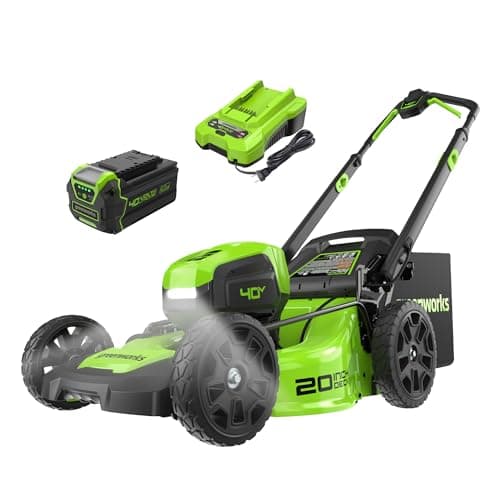
#ad Price as of October 21, 2026. Prices change; we check daily. How we're funded.
40 minutes on a 160Wh pack and 57.5 lb to push -- the honest answer for a third of an acre and nothing more.
Published specs
| Model / SKU | LM2054 / 2549902 |
|---|---|
| Deck | 20 in |
| Max blade speed | 3200 RPM |
| Battery included | 40V 4.0Ah |
| Cut height | 1.2-3.6 in, 7 positions |
| Runtime claim | Up to 40 min |
| Weight | 57.5 lb |
| Rated for | Up to 1/3 acre |
| Warranty | 3-yr tool / 3-yr battery |
Source: 40V 20" 4-in-1 Push Lawn Mower (LM2054), greenworkstools.com
40V x 4.0Ah = 160Wh. Note it claims 40 minutes on 160Wh where the 80V flagship claims 33 minutes on 320Wh -- a 20 in deck and no self-propel drive motor is why.
What the numbers favor
- Lightest published weight on this page at 57.5 lb, and the only sub-60 lb mower here
- Claims 40 minutes from 160Wh -- the best published minutes-per-watt-hour of any mower on this page
- Same 3200 RPM blade speed as the 80V flagship
- 4-in-1 deck at the entry price
What they don't
- Push only -- no drive assist on any slope
- 1.2 in minimum cut height is lower than most cool-season lawns should ever be cut
- 120-minute recharge, three times the 80V model's 40 minutes
your lawn is over a third of an acre or has any real slope. Greenworks rates it to 1/3 acre and you will be pushing all 57.5 lb of it up the hill yourself.
How it scores
Scores are our editorial weighting of the published specs above, not a test result. They are deliberately kept out of this page's structured data.
EGO Power+ 21" Select Cut LM2135SP
EGO · EGO 56V ARC Lithium · Our score 9.1/10
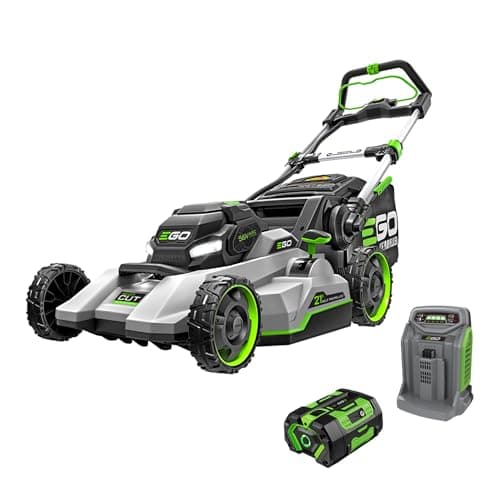
#ad Price as of October 21, 2026. Prices change; we check daily. How we're funded.
The most watt-hours in the box of any flagship walk-behind here, on the platform with the widest tool range to grow into.
Published specs
| Deck | 21 in |
|---|---|
| Cutting torque | Up to 7.0 ft-lbs |
| Battery included | 56V 7.5Ah |
| Cut height | 1-4 in, 8 positions |
| Self-propel speed | 0.9-3.1 MPH |
| Runtime claim | Up to 60 min |
| Warranty | 5-yr tool / 3-yr battery |
Source: EGO POWER+ 21" Select Cut System (LM2135SP), egopowerplus.com
56V x 7.5Ah = 420Wh, using EGO's advertised pack voltage.
What the numbers favor
- 420Wh in the box -- the largest included pack of any flagship walk-behind on this page
- Eight cut-height positions from 1 to 4 in, the widest published range here
- Three interchangeable lower blades (mulching, high-lift bagging, extended runtime)
- 5-year tool warranty, the longest published on this page
What they don't
- EGO publishes torque (7.0 ft-lbs), not motor wattage, so it cannot be compared directly against Greenworks' 1500W figure
- The 7.5Ah pack that earns the runtime claim is also the expensive one to replace
your yard is under a quarter acre. You would be paying for 420Wh of headroom you will never discharge, and a 20 in push mower cuts the same grass.
How it scores
Scores are our editorial weighting of the published specs above, not a test result. They are deliberately kept out of this page's structured data.
Where to buy the tools on this page
Amazon affiliate links, except where a product has no Amazon listing — those go direct to the maker and earn us nothing, and the button says so. We show no price we have not verified today, so where there is no live figure the link says "check price" and takes you to the listing to read it there.
Best overall
Scotts Elite Spreader
Scotts · Manual (push)
Best for small yards
Greenworks 40V 20" Push LM2054
Greenworks · Greenworks 40V
Best overall
EGO Power+ 21" Select Cut LM2135SP
EGO · EGO 56V ARC Lithium
#ad As an Amazon Associate we earn from qualifying purchases, at no extra cost to you. How we're funded.
Common questions
How do I measure my lawn's square footage?
How many square feet are in an acre?
Why does lawn size matter for fertilizer?
How do I measure an irregular lawn?
Should I include beds and paths in the measurement?
How accurate does this need to be?
Sources
- Fertilizing lawns, University of Minnesota Extension
- Scotts Elite Spreader (75902), scotts.com
- Greenworks 40V 20" 4-in-1 Push Lawn Mower (LM2054), greenworkstools.com
- Greenworks 80V 21" Self-Propelled Lawn Mower (LM2108S), greenworkstools.com
- Mowing practices for healthy lawns, University of Minnesota Extension
Read next
- Lawn Care
Cutting the grass is a third of the job. This is the other two thirds.
- What size mower do I need for my yard?
Deck width and watt-hours by lawn size, with the mowing-time arithmetic for each.
- What the three numbers on a fertilizer bag mean
N-P-K decoded, UMN's published nitrogen rates, and the maths that turns a bag into pounds.
- Spreader settings: how to calibrate instead of guessing
Calibrate a spreader by weight in twenty minutes, with the passes and rate arithmetic.
- How long does it take to mow an acre?
Deck width x ground speed = square feet per minute. Worked out for 20, 21 and 42 inch decks.
- Best lawn spreader for fertilizer and seed
Spread width decides how long the job takes. The passes-per-lawn math, worked out.