Yard Tools
Best splitting axes, ranked on the specs makers will admit to
A splitting axe is head weight, edge width and handle length. The category leader publishes none of them, because it has no product page at all.
Affiliate disclosure: we earn a commission if you buy through our links, at no extra cost to you. It never changes which product we rank first — here is how we're funded.
We have not tested these units. Every spec on this page comes from the manufacturer's own documentation and is linked to it. Every computed figure is arithmetic you can redo. Prices are checked daily — last verified October 19, 2026. Here is exactly how we pick.
Quick picks
Ranked on the published specs and the arithmetic below. Tap any row to jump to the full write-up. We have not tested these units -- here is exactly how we pick.
| # | Product | Best for | Score | Price |
|---|---|---|---|---|
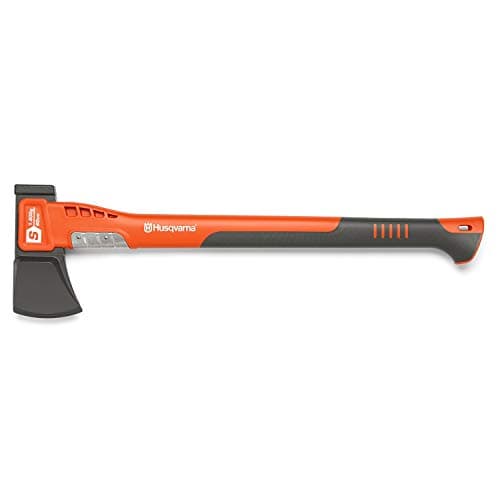
| 1 | Husqvarna Splitting Axe S2800 The only full-length splitting axe in this category whose maker publishes a head weight separately from a total weight, which is the figure that decides how it splits. | Best overall | 8.6 | |
| 2 | 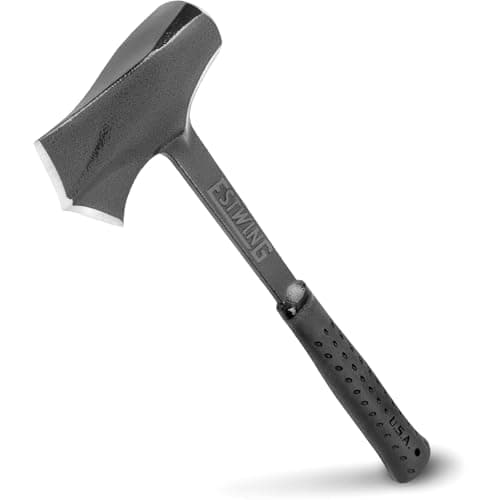 Estwing Timber Titan 16 in Splitting Tool (EB-TT4) Head and handle forged from one piece of American steel, with the widest published cutting edge here -- and no published weight anywhere. | Best one-piece forged tool | 8.0 | |
| 3 | 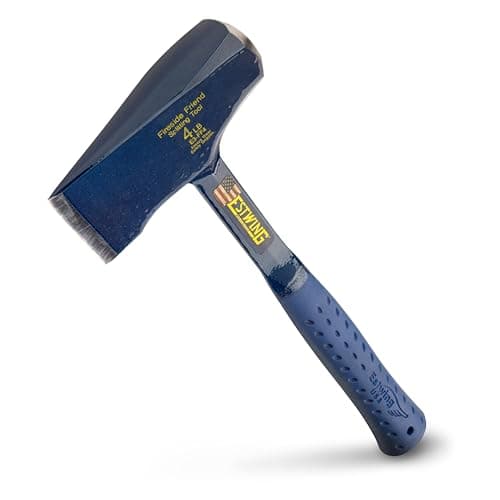 Estwing Fireside Friend Splitting Tool (E3-FF4) Fourteen inches and a 2-3/8 in edge: the narrowest wedge here, which is exactly what you want for splitting kindling off a dry billet one-handed. | Best for kindling | 7.8 | |
| 4 | 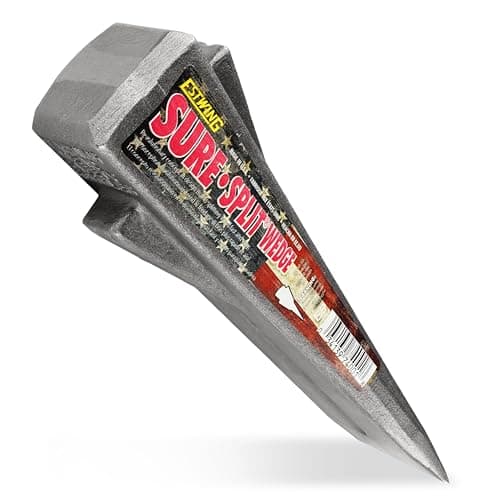 Estwing Sure Split Wedge, 5 lb (E-5) Not an axe at all. It is the thing you drive with the Husqvarna's milled back when a round refuses to open, and the cheapest item on this page. | Best for knotty rounds | 8.0 |
#ad Buy links are affiliate links. Prices come from a live daily check; where we have no verified price we say "check price" rather than print a stale one.
A splitting axe is three numbers: head weight, edge width and handle length. Head weight sets the energy that arrives at the wood, edge width sets how far the split opens per strike, and handle length sets the head speed you can generate. Four tools on this page publish enough of those three to be ranked. The best-known splitting axe in America is not among them, because its maker has no product page for it anywhere on its US site — which is the single most surprising thing we found researching this category.
The short answer
Why the obvious pick is missing
If you have shopped this category you expect a Fiskars X27 at the top. We expected to put one there. It is not here because Fiskars publishes no product page for its splitting axes on fiskars.com US. The axes-and-wood-preparation collection returns no products, the site's own product sitemap contains no product URLs at all, and the X27 URLs that search results surface return 404. There is no manufacturer page to transcribe a head weight, an edge width or a handle length from.
This site ranks products on figures their makers publish, and we do not fill gaps with retailer data or remembered numbers. So the X27 and X25 are absent for the same reason the Bully Tools snow pusher was absent from our snow shovels page: no reachable manufacturer source. If Fiskars puts its US product pages back up, this page gets revisited.
What actually decides a splitting axe
- Head weight, not total weight. Energy at the wood is head mass times head speed. Handle mass contributes almost nothing useful and costs you effort. Published by Husqvarna; published by nobody else here.
- Edge width. The wedge angle, effectively. Narrow enters easily and opens little; wide needs force and opens far. Published by Estwing on both axes.
- Handle length. Head speed, and therefore energy, scales with it. 14 in is a one-hand kindling tool; 27.5 in is a one-and-a-half-hand splitting swing; a 36 in maul is two hands.
- Overstrike protection. The spot just behind the head is what gets destroyed when you miss. Husqvarna publishes stainless shaft protection; Estwing solves it by forging head and handle as one piece.
- Wedge compatibility. Whether the back of the head is rated for hammering. Husqvarna says yes for the S2800. Never hammer with an axe poll that is not rated for it.
The four tools, side by side
| Husqvarna S2800 | Estwing Timber Titan | Estwing Fireside Friend | Estwing Sure Split | |
|---|---|---|---|---|
| Type | Splitting axe | Splitting tool | Splitting tool | Splitting wedge |
| Overall length | 27.5 in | 16.25 in | 14 in | 9 in |
| Total weight | 6.17 lb | Not published | Not published | 5 lb |
| Head weight | 5.07 lb | Not published | Not published | n/a |
| Cutting edge | Not published | 3.5 in | 2-3/8 in | Not published |
| Handle | Fiber-reinforced PA | One-piece forged steel | One-piece forged steel | n/a |
| Wedge-driving back | Yes, milled | No | No | n/a |
| Origin | Not stated on this page | Forged in USA | Forged in USA | Made in USA |
Figures from husqvarna.com (art. no. 580 76 14-01) and estwing.com, cited below. Note that no single maker here publishes both a weight and an edge width, so the two columns of this table cannot be compared against each other — only within a brand.
The arithmetic: why a composite handle splits harder
The one genuinely useful number in this category is the share of total weight that sits in the head, and Husqvarna is the only maker on this page who publishes both halves of it.
Published head weight: 5.07 lb
Published total weight: 6.17 lb
5.07 / 6.17 = 0.82, so 82% of the axe is head
Handle and shaft account for 1.10 lb
Energy delivered to the wood scales with head mass. Energy you spend swinging scales with total mass. A ratio of 82% means almost everything you lift arrives at the split. A hickory handle on a 27 in axe typically weighs 1.5 to 2 lb, so an equivalent wooden-handled axe at the same 6.17 lb total would carry a head of roughly 4.2 to 4.7 lb — about 8 to 17% less head for the same effort. That is the entire argument for composite, published rather than asserted.
Fireside Friend: 2.375 in edge on a 14 in handle
Timber Titan: 3.5 in edge on a 16.25 in handle
3.5 / 2.375 = 1.47, so 47% more edge
A wider edge is a blunter wedge: it needs more force to enter and opens the split further once in. Estwing pairs the 47% wider edge with 16% more handle, so the extra head speed pays for the extra entry force. That is a coherent design pair, and it is why the Fireside Friend is a kindling tool and the Timber Titan is not.
1. Husqvarna S2800 — best overall
The only full-size splitting axe on this page, and the only tool in the category whose maker publishes head weight and total weight as separate fields: 5.07 lb and 6.17 lb, on a 27.5 in fiber-reinforced PA shaft. Everything else follows from that ratio, worked out above. Husqvarna also publishes a non-stick head coating as the answer to the axe sticking in green wood, stainless steel shaft protection behind the head where overstrikes land, a head geometry it says is set for large logs, and a milled back rated for hammering a splitting wedge. That last one matters: it means the axe and the $24 wedge further down this page are designed as a pair, so there is a path through a knotty round that does not involve buying a log splitter.
Three honest limits. At 27.5 in this is a short full-size axe — a one-and-a-half-hand swing, not a two-hand maul stroke. Husqvarna publishes no edge width, so you cannot compare its wedge angle against Estwing's figures. And a PA shaft cannot be re-hung: when it fails, the axe is finished, where a hickory handle is a twenty-dollar repair. Note also that these figures come from Husqvarna's Canadian and UK pages — its US site has no product page for this axe either.
#ad Check the Husqvarna Splitting Axe S2800 price on Amazon — how we're funded.
2. Estwing Timber Titan (EB-TT4) — best one-piece tool
Head and handle forged from a single piece of American steel. There is no joint, which removes the failure mode that ends most axes — a loose or broken haft. Estwing publishes a 3.5 in cutting edge and a 16.25 in overall length, the widest edge on this page, with a contoured blade it says is shaped to stop the tool sticking and bouncing back, a rust-preventative powder coat, the patented Shock Reduction Grip and a ballistic nylon sheath in the box.
And no published weight. On a splitting tool, weight is the specification — it is the thing head geometry is in service of — and Estwing publishes exactly two fields for this product: Cutting Edge and Overall Length. The 4-plus-pound figures you will see quoted come from retailers. Beyond that: 16.25 in is a kindling and small-round length rather than a replacement for a full axe, and an all-steel handle transmits more shock to your hands than composite does, which is precisely why the grip exists. Note the same tool ships as EB-TT4 in black and E6-TT4 in blue.
#ad Check the Estwing Timber Titan 16 in Splitting Tool (EB-TT4) price on Amazon — how we're funded.
3. Estwing Fireside Friend (E3-FF4) — best for kindling
Fourteen inches and a 2-3/8 in edge: the narrowest wedge here, which is exactly right for taking kindling off a dry billet one-handed beside the stove. Same one-piece forging as the Timber Titan, same hand-sharpened tempered edge, same sheath, and Estwing publishes its vibration claim as an actual number — 70% reduction through the Shock Reduction Grip — rather than as an adjective. It is also the cheapest axe on this page by a clear margin.
Same missing weight as the Timber Titan. And this is unambiguously a one-hand tool: it will not open a 12 in round, and Estwing does not suggest it will. If you only ever split kindling, this is the whole purchase; if you split rounds, it is the second tool, not the first.
#ad Check the Estwing Fireside Friend Splitting Tool (E3-FF4) price on Amazon — how we're funded.
4. Estwing Sure Split Wedge (E-5) — the one everybody skips
Not an axe. Five pounds and nine inches of solid American steel with a fast-tapered head and fins that let it keep working below the surface instead of stalling at the wood line, and the only published weight on this page. It costs less than a quarter of the Husqvarna and it is the difference between a knotty round going on the fire and a knotty round going back on the pile.
It needs something to drive it, which is the whole reason the Husqvarna's milled back exists — a sledge works too. Do not strike it with an axe poll that is not rated for hammering. On a badly knotted round, one wedge frequently is not enough and two is the usual answer. Estwing publishes no edge width or taper angle. And it does nothing at all on its own: this is a complement to an axe, never a substitute.
#ad Check the Estwing Sure Split Wedge, 5 lb (E-5) price on Amazon — how we're funded.
Which one, by situation
| Your situation | Buy | Why |
|---|---|---|
| Splitting rounds for a wood stove | Husqvarna S2800 | The only published head weight, and the only milled back for a wedge |
| Kindling beside the stove | Estwing Fireside Friend | Narrowest published edge, 14 in, cheapest here |
| One tool for both, mostly small stuff | Estwing Timber Titan | 3.5 in edge on 16.25 in; one-piece forging, nothing to work loose |
| Knotty rounds and crotches | Sure Split Wedge + the S2800 | Designed as a pair; the axe's back is rated to drive the wedge |
| Over about half a cord a year | An electric log splitter | Published tonnage beats effort; see our log splitters page |
| You want a re-hangable handle | None of these | The S2800 is composite and the Estwings are one-piece steel -- all four are replace, not repair |
Verdict
The Husqvarna S2800 wins because it is the only axe here that tells you what matters: 5.07 lb of head in 6.17 lb of tool, with a back rated to drive a wedge. The two Estwings are better-built in one specific respect — no joint to fail — and worse documented in the one that decides a splitter, because neither publishes a weight. The Sure Split Wedge is the cheapest useful thing on this page and the item most people leave out. And the most useful finding on the page is a negative one: the market-leading splitting axe in the US cannot be ranked on specifications, because its maker does not publish any.
The picks in full
Specs are the manufacturer's own and linked to the page they came from. Prices come from a live daily check; where we have no verified price we say so rather than print a stale one.
Husqvarna Splitting Axe S2800
Husqvarna · Manual · Our score 8.6/10
#ad Price as of October 19, 2026. Prices change; we check daily. How we're funded.
The only full-length splitting axe in this category whose maker publishes a head weight separately from a total weight, which is the figure that decides how it splits.
Published specs
| Overall length | 27.5 in |
|---|---|
| Total weight | 6.17 lb |
| Axe head weight | 5.07 lb |
| Shaft | Fiber-reinforced PA with stainless steel shaft protection |
| Head | Non-stick coated, geometry set for large logs |
| Back of head | Milled for hammering a splitting wedge |
| Edge cover | Included |
| Article number | 580 76 14-01 |
Source: Husqvarna Splitting axe S2800, art. no. 580 76 14-01, husqvarna.com
5.07 lb of head in a 6.17 lb axe = 82%. That ratio is the whole argument for a composite shaft: the energy you put into the swing arrives at the wood instead of being spent accelerating the handle. A hickory-handled axe of the same total weight carries a lighter head.
What the numbers favor
- Publishes head weight AND total weight, so you can work out the balance -- almost nobody in this category publishes either
- Milled back rated by Husqvarna for driving a splitting wedge, so one tool covers the rounds a single axe will not open
- Stainless shaft protection behind the head: the spot where a wooden handle gets destroyed by overstrikes
- Non-stick coated head, which is the published answer to the axe sticking in green wood
- Edge cover included
What they don't
- 27.5 in is a short full-size axe. At 6.17 lb that is a one-and-a-half-hand swing, not a two-hand maul stroke
- No published edge width, so you cannot compare the wedge angle against an Estwing figure
- Husqvarna publishes these figures on its Canadian and UK pages; the US site has no product page for this axe at all
- A PA shaft cannot be re-hung. When it goes, the axe goes
your rounds are over about 16 in across and knotty. At that size you want a maul driving a wedge, and this axe's own milled back tells you Husqvarna agrees.
How it scores
Scores are our editorial weighting of the published specs above, not a test result. They are deliberately kept out of this page's structured data.
Estwing Timber Titan 16 in Splitting Tool (EB-TT4)
Estwing · Manual · Our score 8.0/10
#ad Price as of October 19, 2026. Prices change; we check daily. How we're funded.
Head and handle forged from one piece of American steel, with the widest published cutting edge here -- and no published weight anywhere.
Published specs
| Cutting edge | 3.5 in / 88.9 mm |
|---|---|
| Overall length | 16.25 in / 412.75 mm |
| Construction | One-piece forged head and handle, solid American steel |
| Grip | Patented Shock Reduction Grip |
| Blade | Contoured, rust-preventative powder coating |
| Sheath | Ballistic nylon, included |
| Item number | EB-TT4 (black) / E6-TT4 (blue) |
| Origin | Forged in the USA |
Source: Timber Titan Splitting Tool, item EB-TT4 / E6-TT4, estwing.com
3.5 in against 2.375 in = 1.47x. A wider edge is a blunter wedge: it opens a split further per strike but needs more force to enter. That is why Estwing pairs the wider edge with the longer handle and not with the short one.
What the numbers favor
- One-piece forging means there is no handle-to-head joint, which is the failure point on every hafted axe
- Publishes both a cutting edge width and an overall length, in a category where most makers publish neither
- 3.5 in contoured blade: Estwing's stated purpose is stopping the tool sticking and bouncing back
- Powder-coated blade and a ballistic nylon sheath, both included
- Made in the USA from American steel
What they don't
- Estwing publishes no weight for this tool, and on a splitting tool weight is the spec
- 16.25 in is a kindling and small-round length, not a replacement for a full axe
- An all-steel handle transmits more shock than composite, which is exactly why the grip exists
- The blue E6-TT4 and black EB-TT4 are the same tool under two item numbers, which makes listings hard to match
your job is rounds rather than kindling. Sixteen inches of handle cannot generate the head speed a 27.5 in axe can, no matter how good the steel is.
How it scores
Scores are our editorial weighting of the published specs above, not a test result. They are deliberately kept out of this page's structured data.
Estwing Fireside Friend Splitting Tool (E3-FF4)
Estwing · Manual · Our score 7.8/10
#ad Price as of October 19, 2026. Prices change; we check daily. How we're funded.
Fourteen inches and a 2-3/8 in edge: the narrowest wedge here, which is exactly what you want for splitting kindling off a dry billet one-handed.
Published specs
| Cutting edge | 2-3/8 in / 60 mm |
|---|---|
| Overall length | 14 in / 356 mm |
| Construction | One-piece forged head and handle, solid American steel |
| Edge finish | Hand-sharpened, tempered |
| Grip | Shock Reduction Grip, 70% vibration reduction claimed |
| Sheath | Ballistic nylon, included |
| Item number | E3-FF4 |
| Origin | Forged in the USA |
Source: Fireside Friend Splitting Tool, item E3-FF4, estwing.com
$39.99 over a 2.375 in edge = $16.84 per inch, against $14.85 per inch for the Timber Titan's 3.5 in edge at $51.99. The bigger tool is the better value per inch of edge; this one is the better value if the job is kindling.
What the numbers favor
- The narrowest published edge here, which is the right geometry for kindling: a narrow wedge enters with less force
- One-piece forging, same as the Timber Titan -- no joint to fail
- Cheapest tool on this page by a clear margin
- Estwing publishes the vibration-reduction claim as a number (70%) rather than as an adjective
- Short enough to keep by the stove, with its sheath on
What they don't
- No published weight, same gap as the Timber Titan. The 4.4 lb figure you will see quoted comes from retailers, not Estwing
- 14 in is a one-hand tool. It will not open a 12 in round and is not meant to
- The 70% vibration claim is Estwing's own and we have not tested it
- All-steel handle, so cold hands feel every strike the grip does not absorb
you are splitting anything bigger than a billet. For rounds this is the wrong tool and the Timber Titan is barely the right one.
How it scores
Scores are our editorial weighting of the published specs above, not a test result. They are deliberately kept out of this page's structured data.
Estwing Sure Split Wedge, 5 lb (E-5)
Estwing · Manual · Our score 8.0/10
#ad Price as of October 19, 2026. Prices change; we check daily. How we're funded.
Not an axe at all. It is the thing you drive with the Husqvarna's milled back when a round refuses to open, and the cheapest item on this page.
Published specs
| Weight | 5 lb |
|---|---|
| Overall length | 9 in / 229 mm |
| Material | Solid American steel |
| Edge | Hand-sharpened, fast-tapered head |
| Design | Sure Split fins for extra wedge action below the wood line |
| Item number | E-5 |
| Origin | Made in the USA |
Source: Sure Split Wedge, item E-5, estwing.com
$23.98 against $99.99 = 24%. A wedge plus the S2800's milled back covers rounds no single axe on this page opens, for less than a quarter of the axe's price again.
What the numbers favor
- The only published weight on this page: 5 lb, stated by Estwing
- Fins let the wedge keep working below the surface instead of stalling at the wood line
- Solid steel with nothing to break, nothing to re-hang, nothing to rust through
- Turns a stuck round into a solvable problem rather than a reason to buy a log splitter
- Cheapest item on this page
What they don't
- Needs something to drive it -- a sledge, or an axe with a milled back rated for it. Do not strike it with a normal axe poll
- No published edge width or taper angle
- One wedge often is not enough on a badly knotted round; two is the usual answer
- Does nothing on its own, so it is a complement to an axe and never a replacement
your wood is straight-grained and seasoned. A wedge is the answer to knots and crotches, and clean rounds do not need one.
How it scores
Scores are our editorial weighting of the published specs above, not a test result. They are deliberately kept out of this page's structured data.
Where to buy the tools on this page
Amazon affiliate links, except where a product has no Amazon listing — those go direct to the maker and earn us nothing, and the button says so. We show no price we have not verified today, so where there is no live figure the link says "check price" and takes you to the listing to read it there.
Best overall
Husqvarna Splitting Axe S2800
Husqvarna · Manual
Best one-piece forged tool
Estwing Timber Titan 16 in Splitting Tool (EB-TT4)
Estwing · Manual
Best for kindling
Estwing Fireside Friend Splitting Tool (E3-FF4)
Estwing · Manual
Best for knotty rounds
Estwing Sure Split Wedge, 5 lb (E-5)
Estwing · Manual
#ad As an Amazon Associate we earn from qualifying purchases, at no extra cost to you. How we're funded.
Common questions
What is the best splitting axe?
Why is the Fiskars X27 not on this list?
How heavy should a splitting axe be?
What is the difference between a splitting axe and a maul?
Do I need a splitting wedge as well?
How wide should the cutting edge be?
Is a manual axe or an electric log splitter better?
Sources
Read next
- Yard Tools
The tools you buy third and fourth. This is where a platform choice pays off or bites.
- Best log splitter for home use
Force, log capacity and cycle time for an electric splitter and a manual one.
- Best firewood racks, and what a half-cord claim really assumes
Three racks on published gauge, dimensions and warranty, with the cubic-foot arithmetic behind every half-cord claim worked out in full.
- Best cordless saw setup for cutting firewood
About 0.93 watt-hours per 4x4 cut, published. How to size a firewood setup from that.
- Best gifts for someone who cuts their own firewood
Published protection standards, splitter tonnage and cut capacities for four firewood picks, led by the safety purchase people rarely make themselves.
- Best chainsaw safety gear
Protective layers, shell denier and the four named standards behind two sets of chainsaw chaps.
- Best cordless chainsaw for homeowners
Cuts per charge beats minutes on a chainsaw. The published figures and the energy-per-cut math.