Battery Platforms
What a battery platform really costs over ten years
Four line items, one of which nobody includes. It is the one that decides the answer.
Affiliate disclosure: we earn a commission if you buy through our links, at no extra cost to you. It never changes which product we rank first — here is how we're funded.
We have not tested these units. Every spec on this page comes from the manufacturer's own documentation and is linked to it. Every computed figure is arithmetic you can redo. Prices are checked daily — last verified October 19, 2026. Here is exactly how we pick.
Not one of the ten competitor pages we read while building this site works out what a battery platform costs over its life — despite most of them describing the choice as a long-term commitment. This page is the arithmetic they skipped.
We are not going to print prices. Prices move daily, a number typed here in September is wrong by October, and a stale figure is worse than no figure. What follows is the model. Fill it in with today's prices from the buy links on our roundups and it takes about four minutes.
The formula
That last line is the whole argument. Manufacturers warrant these packs for three to four years (the warranty table is here). Assuming one replacement per pack across a decade is conservative rather than pessimistic — and it is the line item every other comparison omits.
A worked example, in ratios
Since we will not print dollar figures, here is the same model expressed in multiples of one thing you can look up in ten seconds: the price of a single large battery pack. Call that 1 P.
| Line item | Typical size | Why |
|---|---|---|
| Mower kit (entry) | About 3-4 P | A flagship mower kit is roughly the price of three or four bare packs. Most of what you pay for is the pack and charger inside it. |
| Trimmer, blower, hedge trimmer (bare) | About 3-5 P total | Bare tools cost far less than kits. Buying these three as kits instead would add roughly 3 P of packs and chargers you already own. |
| One spare pack | 1 P | Sized to the mower, not the trimmer. |
| Replacements (2 packs x 1 each) | 2 P | The line nobody counts. On a 3-4 year warranty, one replacement per pack over ten years is conservative. |
| TEN-YEAR TOTAL | About 9-12 P | Of which roughly a third is batteries -- bought, spared and replaced. |
Ratios, not prices. Look up one large pack's current price and multiply. The structure holds across brands; the value of P is what differs.
Roughly a third of a decade of cordless yard tools is batteries. That single conclusion reframes the whole platform decision: you are not choosing a mower brand, you are choosing whose packs you will buy four or five times.
Cost per watt-hour: the comparable number
Because pack price dominates, the useful cross-brand metric is cost per watt-hour rather than cost per pack.
Two packs at the same price are not equivalent purchases if one holds 240Wh and the other 420Wh. Cost per watt-hour is how you see that instantly, and it is the number to check before every pack purchase for the next ten years, not just the first one.
The four expensive mistakes
- Buying kits repeatedly. Four kits means four chargers. After the first tool, buy bare. This is the single largest avoidable cost in the whole model.
- Sizing packs to the cheapest tool. A 2.0Ah pack is fine on a trimmer and is about twenty minutes of mowing. Buying it first means buying again.
- Splitting across voltage lines within one brand. Greenworks runs four incompatible platforms; Ryobi runs two. Ending up with tools on both is paying the entry cost twice — see the compatibility guide.
- Ignoring the warranty term on the battery. A one-year difference in battery warranty across five packs is a meaningful fraction of the total. It is also the clearest signal a manufacturer gives about how long it expects its own packs to survive.
What would change our answer
We publish this so you can disagree with us on the inputs rather than the conclusion:
- If packs turn out to last ten years, the Replacements line goes to zero and higher-voltage platforms with pricier packs look better. Nobody publishes the retention data that would settle this.
- If you only ever own two tools, platform economics barely matter and you should just buy the better mower.
- If a riding mower is in your ten-year plan, that single purchase dominates everything above, and only some platforms offer one — see electric riding mowers.
- If pack prices fall sharply, as cell prices have elsewhere, the Replacements line shrinks for everyone and the comparison tightens.
Run the model with your own tool list and today's prices. If it disagrees with our platform ranking, trust your version — you know which tools you will actually buy, and that input matters more than anything we can tell you.
The products discussed
Specs are the manufacturer's own and linked to the page they came from. Prices come from a live daily check; where we have no verified price we say so rather than print a stale one.
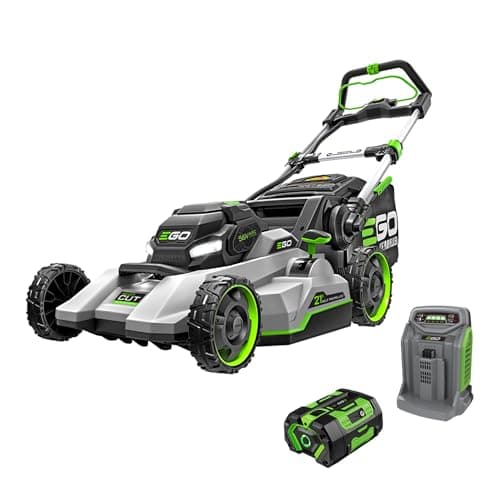
EGO Power+ 21" Select Cut LM2135SP
EGO · EGO 56V ARC Lithium · Our score 9.1/10
#ad Price as of October 19, 2026. Prices change; we check daily. How we're funded.
The most watt-hours in the box of any flagship walk-behind here, on the platform with the widest tool range to grow into.
Published specs
| Deck | 21 in |
|---|---|
| Cutting torque | Up to 7.0 ft-lbs |
| Battery included | 56V 7.5Ah |
| Cut height | 1-4 in, 8 positions |
| Self-propel speed | 0.9-3.1 MPH |
| Runtime claim | Up to 60 min |
| Warranty | 5-yr tool / 3-yr battery |
Source: EGO POWER+ 21" Select Cut System (LM2135SP), egopowerplus.com
56V x 7.5Ah = 420Wh, using EGO's advertised pack voltage.
What the numbers favor
- 420Wh in the box -- the largest included pack of any flagship walk-behind on this page
- Eight cut-height positions from 1 to 4 in, the widest published range here
- Three interchangeable lower blades (mulching, high-lift bagging, extended runtime)
- 5-year tool warranty, the longest published on this page
What they don't
- EGO publishes torque (7.0 ft-lbs), not motor wattage, so it cannot be compared directly against Greenworks' 1500W figure
- The 7.5Ah pack that earns the runtime claim is also the expensive one to replace
your yard is under a quarter acre. You would be paying for 420Wh of headroom you will never discharge, and a 20 in push mower cuts the same grass.
How it scores
Scores are our editorial weighting of the published specs above, not a test result. They are deliberately kept out of this page's structured data.
Ryobi 40V HP Brushless 21" Self-Propelled
Ryobi · Ryobi 40V · Our score 8.6/10
#ad No verified live price right now, so we show none rather than a stale one. How we're funded.
Two 6Ah packs and the longest published runtime claim on this page, on the platform with the cheapest route to a fourth and fifth tool.
Published specs
| Model | RY40HPLM01B |
|---|---|
| Deck | 21 in |
| Motor | Brushless, 40V HP |
| Batteries included (kit) | 2 x 40V 6.0Ah |
| Drive | Variable-speed rear-wheel self-propel |
| Runtime claim | Up to 80 min on 2 x 6Ah |
Source: 40V HP Brushless 21" Self-Propelled Mower, ryobitools.com
40V x 6.0Ah = 240Wh per pack; the kit ships two, so 480Wh total -- but only 240Wh is available at any moment, because the mower draws one pack at a time.
What the numbers favor
- 480Wh across two packs, the most total energy in any kit here
- Two packs means you swap and keep mowing instead of waiting on a charger
- Ryobi's 40V range is the broadest consumer battery line of the three platforms
What they don't
- Only one 240Wh pack is live at a time -- the 480Wh is sequential, not simultaneous
- Ryobi does not publish a cut-height range or weight on the product page, so both are unknown to us
you own nothing on Ryobi yet and expect to buy heavy tools later. 40V is the lowest voltage of the three platforms, and the ceiling shows on chainsaws and riding gear.
How it scores
Scores are our editorial weighting of the published specs above, not a test result. They are deliberately kept out of this page's structured data.
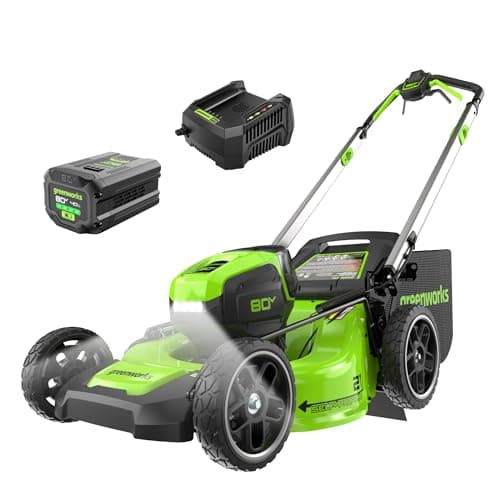
Greenworks 80V 21" 4-in-1 LM2108S
Greenworks · Greenworks 80V · Our score 8.4/10
#ad Price as of October 19, 2026. Prices change; we check daily. How we're funded.
The only mower here that publishes motor wattage, blade RPM, weight and an acreage rating -- and the only one whose battery warranty matches its tool warranty.
Published specs
| Model / SKU | LM2108S / 2550402 |
|---|---|
| Deck | 21 in |
| Max blade speed | 3200 RPM |
| Battery included | 80V 4.0Ah |
| Cut height | 1.38-4.0 in, 7 positions |
| Runtime claim | Up to 33 min |
| Weight | 75 lb |
| Rated for | Up to 1/2 acre |
| Warranty | 4-yr tool / 4-yr battery |
Source: 80V 21" 4-in-1 Self-Propelled Lawn Mower (LM2108S), greenworkstools.com
80V x 4.0Ah = 320Wh, using Greenworks' advertised pack voltage.
What the numbers favor
- 4-year battery warranty -- a year longer than EGO's 3-year, on the component that fails first
- Publishes blade RPM, weight and acreage rating; the other two brands publish none of the three
- 40-minute recharge on the included charger, the fastest published here
- 4-in-1 deck adds turbo leaf pickup on top of mulch, bag and side discharge
What they don't
- 320Wh included, the least of the three flagships -- and the 33-minute runtime claim reflects that
- 75 lb is the only published weight here, and it is not light
you want one battery to finish a half-acre without a swap. Greenworks rates the mower for 1/2 acre but claims only 33 minutes on the included pack; those two numbers only reconcile if you buy a second battery.
How it scores
Scores are our editorial weighting of the published specs above, not a test result. They are deliberately kept out of this page's structured data.
Where to buy the tools on this page
Amazon affiliate links, except where a product has no Amazon listing — those go direct to the maker and earn us nothing, and the button says so. We show no price we have not verified today, so where there is no live figure the link says "check price" and takes you to the listing to read it there.
Best overall
EGO Power+ 21" Select Cut LM2135SP
EGO · EGO 56V ARC Lithium
Best for a household already on Ryobi
Ryobi 40V HP Brushless 21" Self-Propelled
Ryobi · Ryobi 40V
Best published spec sheet
Greenworks 80V 21" 4-in-1 LM2108S
Greenworks · Greenworks 80V
#ad As an Amazon Associate we earn from qualifying purchases, at no extra cost to you. How we're funded.
Common questions
Why can't you just show me the prices?
What is the biggest hidden cost of going cordless?
Is it cheaper to buy tool kits or bare tools?
How many batteries do I actually need?
Does gas work out cheaper over ten years?
Sources
Read next
- Battery Platforms
Pick the system once and the next four tools are decided for you. Start here.
- How long do electric lawn mower batteries last?
Runtime per charge is arithmetic. Lifespan in years is mostly warranty terms and honest uncertainty.
- EGO 56V vs Ryobi 40V: which platform should you start on?
420Wh in one pack against 480Wh in two, with the warranty and build-out cost worked out.
- How much should I spend on a lawn mower?
Why we keep prices out of the page text, and the cost-per-watt-hour math to run instead.
- Are battery lawn mowers worth it?
Yes under about an hour of mowing, no above it without a second pack. The conditional answer.