Guides
Are battery lawn mowers worth it?
Yes, conditionally. The condition is one number, and it is not the one the marketing leads with.
Affiliate disclosure: we earn a commission if you buy through our links, at no extra cost to you. It never changes which product we rank first — here is how we're funded.
We have not tested these units. Every spec on this page comes from the manufacturer's own documentation and is linked to it. Every computed figure is arithmetic you can redo. Prices are checked daily — last verified October 19, 2026. Here is exactly how we pick.
The condition, quantified
That is the whole conditional. Under an hour, essentially every flagship battery mower on the market will finish your lawn on the pack it ships with. Over an hour, you are into a second battery — and a second battery is a meaningful fraction of the mower's price where a gas can is not.
Do not guess at your number. Time one mow. It is the single most useful input to this decision and it costs you nothing — the sizing guide converts it into a spec.
What you actually gain
| Battery | Gas | |
|---|---|---|
| Starting | Push button | Pull cord or electric start |
| Oil changes | None | Annually or by hours |
| Spark plug | None | Annually |
| Air filter | None | Annually |
| Winterizing / stabilizer | None | Every fall |
| Carburetor issues | None | The most common failure on a stored gas mower |
| Fuel storage | None | A can in the garage |
| Noise | Quieter (no figure published) | Louder |
| Blade sharpening | Yes | Yes |
| Battery replacement | Every 3-8 years | None |
Five maintenance categories removed, one added. Whether that trade favors you is a question about how you feel in year five versus how you feel every spring.
Note the noise row honestly: no manufacturer publishes a decibel figure for a battery walk-behind mower. We are confident of the direction and we cannot give you the magnitude — we went looking and wrote up what we found.
The power question is settled
This was a real objection five years ago and largely is not now. Ryobi publishes a claim of more power than a 170cc gas mower, and EGO publishes 7.0 ft-lbs of cutting torque with a brushless motor delivering it instantly rather than after revving.
Where battery mowers do struggle is sustained heavy load — a fortnight of growth after rain — and the symptom is a shorter runtime, not a stalled deck. Which brings the argument back to watt-hours, where it always ends up.
The honest case against
- Runtime is a hard ceiling. A gas can adds unlimited runtime for a few dollars. A second pack adds 30 to 80 minutes for a substantial fraction of the mower's price. That asymmetry is the strongest argument against battery and it is usually skipped.
- Battery replacement is a real future cost. Packs are warranted 3 to 4 years and roughly a third of a decade of cordless tools is batteries — the model is here.
- Longevity beyond the warranty is genuinely unknown. Nobody in this category publishes capacity retention. A maintained small engine commonly runs past a decade; whether a 2026 lithium pack will is not something anyone can tell you honestly, and we say so plainly.
- Cold, unheated storage is unkind to packs. If the mower lives in an outbuilding through a hard winter, that is a real factor.
The verdict, by situation
| If this is you | Answer |
|---|---|
| Under 1/2 acre, flat, near a garage | Yes, clearly. This is the case battery mowers were built for. |
| 1/2 to 1 acre, willing to buy two packs | Yes, with a dual-battery machine. |
| 1/2 to 1 acre, unwilling to buy two packs | Gas, or accept splitting the lawn across two sessions. |
| Over an acre, no riding mower planned | Gas. An acre is ~110 minutes of walking. |
| Over an acre, open to a rider | Yes -- an electric zero turn carries ~1,120Wh per acre. |
| Already own cordless yard tools | Yes. You have already paid the platform cost. |
| Attached garage, no fuel storage | Yes, and this often matters more than the arithmetic. |
Riding mower figures from the electric rider page.
The products discussed
Specs are the manufacturer's own and linked to the page they came from. Prices come from a live daily check; where we have no verified price we say so rather than print a stale one.
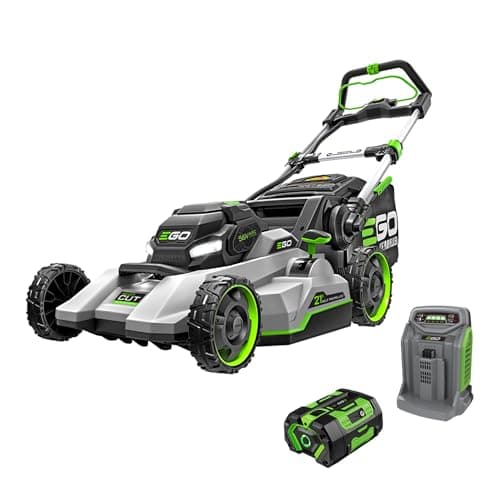
EGO Power+ 21" Select Cut LM2135SP
EGO · EGO 56V ARC Lithium · Our score 9.1/10
#ad Price as of October 19, 2026. Prices change; we check daily. How we're funded.
The most watt-hours in the box of any flagship walk-behind here, on the platform with the widest tool range to grow into.
Published specs
| Deck | 21 in |
|---|---|
| Cutting torque | Up to 7.0 ft-lbs |
| Battery included | 56V 7.5Ah |
| Cut height | 1-4 in, 8 positions |
| Self-propel speed | 0.9-3.1 MPH |
| Runtime claim | Up to 60 min |
| Warranty | 5-yr tool / 3-yr battery |
Source: EGO POWER+ 21" Select Cut System (LM2135SP), egopowerplus.com
56V x 7.5Ah = 420Wh, using EGO's advertised pack voltage.
What the numbers favor
- 420Wh in the box -- the largest included pack of any flagship walk-behind on this page
- Eight cut-height positions from 1 to 4 in, the widest published range here
- Three interchangeable lower blades (mulching, high-lift bagging, extended runtime)
- 5-year tool warranty, the longest published on this page
What they don't
- EGO publishes torque (7.0 ft-lbs), not motor wattage, so it cannot be compared directly against Greenworks' 1500W figure
- The 7.5Ah pack that earns the runtime claim is also the expensive one to replace
your yard is under a quarter acre. You would be paying for 420Wh of headroom you will never discharge, and a 20 in push mower cuts the same grass.
How it scores
Scores are our editorial weighting of the published specs above, not a test result. They are deliberately kept out of this page's structured data.
Ryobi 40V HP Brushless 21" Self-Propelled
Ryobi · Ryobi 40V · Our score 8.6/10
#ad No verified live price right now, so we show none rather than a stale one. How we're funded.
Two 6Ah packs and the longest published runtime claim on this page, on the platform with the cheapest route to a fourth and fifth tool.
Published specs
| Model | RY40HPLM01B |
|---|---|
| Deck | 21 in |
| Motor | Brushless, 40V HP |
| Batteries included (kit) | 2 x 40V 6.0Ah |
| Drive | Variable-speed rear-wheel self-propel |
| Runtime claim | Up to 80 min on 2 x 6Ah |
Source: 40V HP Brushless 21" Self-Propelled Mower, ryobitools.com
40V x 6.0Ah = 240Wh per pack; the kit ships two, so 480Wh total -- but only 240Wh is available at any moment, because the mower draws one pack at a time.
What the numbers favor
- 480Wh across two packs, the most total energy in any kit here
- Two packs means you swap and keep mowing instead of waiting on a charger
- Ryobi's 40V range is the broadest consumer battery line of the three platforms
What they don't
- Only one 240Wh pack is live at a time -- the 480Wh is sequential, not simultaneous
- Ryobi does not publish a cut-height range or weight on the product page, so both are unknown to us
you own nothing on Ryobi yet and expect to buy heavy tools later. 40V is the lowest voltage of the three platforms, and the ceiling shows on chainsaws and riding gear.
How it scores
Scores are our editorial weighting of the published specs above, not a test result. They are deliberately kept out of this page's structured data.
Greenworks 40V 20" Push LM2054
Greenworks · Greenworks 40V · Our score 8.0/10
#ad Price as of October 19, 2026. Prices change; we check daily. How we're funded.
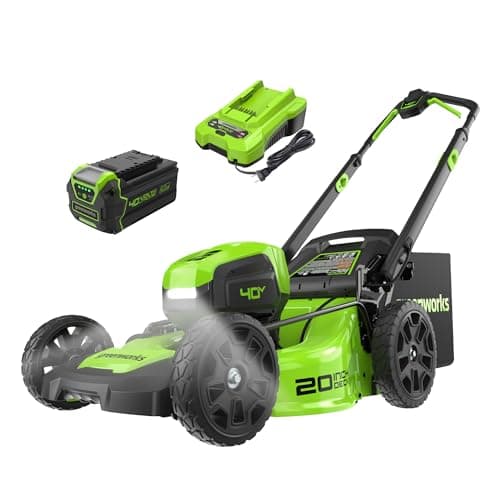
40 minutes on a 160Wh pack and 57.5 lb to push -- the honest answer for a third of an acre and nothing more.
Published specs
| Model / SKU | LM2054 / 2549902 |
|---|---|
| Deck | 20 in |
| Max blade speed | 3200 RPM |
| Battery included | 40V 4.0Ah |
| Cut height | 1.2-3.6 in, 7 positions |
| Runtime claim | Up to 40 min |
| Weight | 57.5 lb |
| Rated for | Up to 1/3 acre |
| Warranty | 3-yr tool / 3-yr battery |
Source: 40V 20" 4-in-1 Push Lawn Mower (LM2054), greenworkstools.com
40V x 4.0Ah = 160Wh. Note it claims 40 minutes on 160Wh where the 80V flagship claims 33 minutes on 320Wh -- a 20 in deck and no self-propel drive motor is why.
What the numbers favor
- Lightest published weight on this page at 57.5 lb, and the only sub-60 lb mower here
- Claims 40 minutes from 160Wh -- the best published minutes-per-watt-hour of any mower on this page
- Same 3200 RPM blade speed as the 80V flagship
- 4-in-1 deck at the entry price
What they don't
- Push only -- no drive assist on any slope
- 1.2 in minimum cut height is lower than most cool-season lawns should ever be cut
- 120-minute recharge, three times the 80V model's 40 minutes
your lawn is over a third of an acre or has any real slope. Greenworks rates it to 1/3 acre and you will be pushing all 57.5 lb of it up the hill yourself.
How it scores
Scores are our editorial weighting of the published specs above, not a test result. They are deliberately kept out of this page's structured data.
Where to buy the tools on this page
Amazon affiliate links, except where a product has no Amazon listing — those go direct to the maker and earn us nothing, and the button says so. We show no price we have not verified today, so where there is no live figure the link says "check price" and takes you to the listing to read it there.
Best overall
EGO Power+ 21" Select Cut LM2135SP
EGO · EGO 56V ARC Lithium
Best for a household already on Ryobi
Ryobi 40V HP Brushless 21" Self-Propelled
Ryobi · Ryobi 40V
Best for small yards
Greenworks 40V 20" Push LM2054
Greenworks · Greenworks 40V
#ad As an Amazon Associate we earn from qualifying purchases, at no extra cost to you. How we're funded.
Common questions
Are battery lawn mowers worth it?
Are battery lawn mowers powerful enough?
How long do battery lawn mowers last?
Do battery mowers save money?
What do battery mowers do better than gas?
Sources
- EGO POWER+ 21" Select Cut System (LM2135SP), egopowerplus.com
- RYOBI 40V HP Brushless 21" Self-Propelled Mower, ryobitools.com
- Greenworks 40V 20" 4-in-1 Push Lawn Mower (LM2054), greenworkstools.com
- Greenworks 80V 21" Self-Propelled Mower (LM2108S), greenworkstools.com
- Toro 60V Max 21 in. Recycler Self-Propel Lawn Mower (21356T), toro.com
Read next
- Guides
The questions that come before the shopping. Answered in the first paragraph, then explained.
- Battery vs gas lawn mower: which should you actually buy?
Runtime, running cost, maintenance and noise compared, including where gas still wins.
- How much should I spend on a lawn mower?
Why we keep prices out of the page text, and the cost-per-watt-hour math to run instead.
- How long do electric lawn mower batteries last?
Runtime per charge is arithmetic. Lifespan in years is mostly warranty terms and honest uncertainty.
- Best battery lawn mowers of 2026
Six flagship battery mowers ranked on watt-hours in the box and energy spent per minute.