Mowers
Best mower blade sharpeners, ranked on the one spec that is the whole job
Sharpening a mower blade means grinding a bevel at an angle and taking the same amount off both ends. Almost nobody selling you a sharpener will tell you what angle it grinds.
Affiliate disclosure: we earn a commission if you buy through our links, at no extra cost to you. It never changes which product we rank first — here is how we're funded.
We have not tested these units. Every spec on this page comes from the manufacturer's own documentation and is linked to it. Every computed figure is arithmetic you can redo. Prices are checked daily — last verified November 4, 2026. Here is exactly how we pick.
Quick picks
Ranked on the published specs and the arithmetic below. Tap any row to jump to the full write-up. We have not tested these units -- here is exactly how we pick.
| # | Product | Best for | Score | Price |
|---|---|---|---|---|
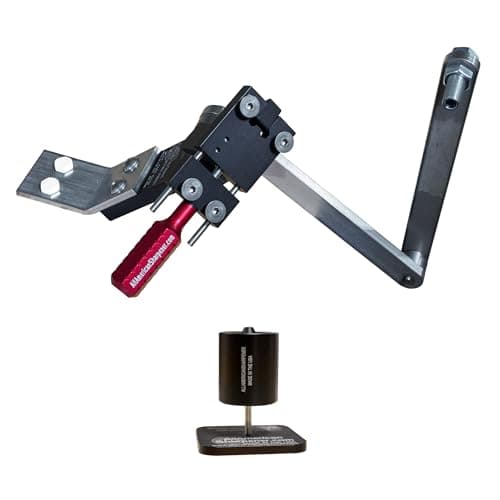
| 1 | All American Sharpener 5005 Gen 2 with Blade Balancer The only mower blade sharpener whose maker publishes the bevel angle as a number -- 15 to 45 degrees in 5 degree increments -- and then explains what both ends of that range are for. | Best overall | 9.0 | |
| 2 | 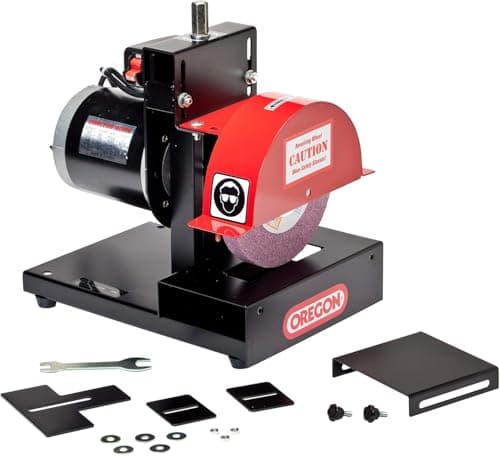 Oregon 88-025 Blade Grinder Economy, 1/3 HP A dedicated 1750 RPM bench grinder that will sharpen any length cutting edge -- Oregon publishes the motor, the speed and the weight, and no angle figure whatsoever. | Best for volume | 7.4 | |
| 3 | 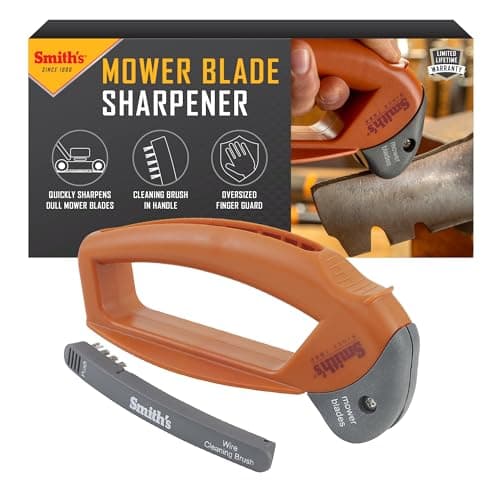 Smith's 50603 Handheld Lawn Mower Blade Sharpener A $16 preset carbide pull-through that Smith's does describe for mower blades specifically -- and it publishes no angle, no weight and no warranty. | Best for the money | 6.8 |
#ad Buy links are affiliate links. Prices come from a live daily check; where we have no verified price we say "check price" rather than print a stale one.
Sharpening a mower blade is two jobs. You grind a bevel at an angle, and you take the same amount off both ends so the blade still spins true. That is the entire task — and across the four sharpeners we sourced for this page, exactly one maker publishes the angle and exactly one addresses the balance. They happen to be the same maker. Everyone else sells you horsepower, carbide, or the word "preset".
The short answer
The bevel angle is the product, and three of four makers hide it
A mower blade has a factory bevel. Sharpening it means restoring that bevel, which means holding the abrasive at a repeatable angle. So the first question to ask a sharpener is what angle it grinds. Here is what the four makers answer:
- All American Sharpener 5005 — "will adjust and lock at angles from 15 to 45 degrees, in 5 degree increments", and then explains both ends: 15° is "the lowest angle needed to sharpen the mulching section of a bi-level mulching blade", 45° is "the maximum angle needed for edge retention in the toughest of mowing situations (sticks and leaves)".
- Oregon 88-025 — publishes 1/3 HP, 1750 RPM, a 42.1 lb packaged weight, a volume figure and the exact part numbers of its consumable stones. On angle: "easy height adjustment". No degrees.
- Smith's 50603 — "uses a preset carbide blade". No degrees.
- SHARPAL 103N — "3 sharpening slots of preset optimal sharpening angle". No degrees. More on this one below, because its listing and its maker disagree about what it is for.
And the gap is wider than it looks, because the other half of the reference is missing too: no mower manufacturer in our registry publishes a blade bevel angle. The mower maker will not tell you what angle the blade left the factory at, and three of four sharpener makers will not tell you what angle their tool grinds. A tool that at least lets you set and lock a number is worth more than one that asks you to trust a geometry you cannot inspect.
15 to 45 degrees in 5 degree increments = (45 − 15) / 5 + 1 = 7 lockable positions
The evidence is All American's own account of why the 5005 exists. It says the model "was developed, by request, for customers that have specific needs for specific blade angles".
Its cheaper sibling, the 5002, is described only as "designed for faster mower blade sharpening times and precise sharp edges", with anodized aluminum and stainless steel components, machined in the United States — and publishes no angle range at all.
So the same manufacturer, asked to solve angle control, built a second model and put the number on it. When a company splits its own line on a specification, that specification is the product.
What each maker publishes
| All American 5005 Gen 2 | Oregon 88-025 | Smith's 50603 | |
|---|---|---|---|
| What it is | Jig for an angle grinder | 1/3 HP bench grinder | Handheld carbide pull-through |
| Bevel angle | 15-45 deg, 5 deg increments | Not published | Not published ("preset") |
| Both ends of the range explained | Yes | n/a | n/a |
| Blade balance addressed | Balancer included with this listing | Not published | Not published |
| Max blade length | 30 in; ~15 in reach beyond clamp | Any length cutting edge | Not published |
| Max blade width | 3.31 in in the clamp | Not published | Not published |
| Power source | Your own 4 / 4.5 / 5 in angle grinder | 1/3 HP, 1750 RPM motor | Your arm |
| Consumable | 36-40 grit flap discs | 8 in stone, 88-047 or 88-048 | Replaceable carbide blades |
| Consumable part number published | Grit spec only | Yes, both stones | No |
| Weight | Not published | 42.1 lb with packaging | Not published |
| Dimensions | Not published | 5,876.61 cu in volume | 7 in x 2.75 in |
| Warranty | Lifetime, material and workmanship | Not published | Not published |
| Origin stated | Made in the USA | Not published on the page | Not published |
| Maker's own price | Not published | Not published | $16.99 |
Transcribed from allamericansharpener.com (product page and FAQ), oregonproducts.com and smithsproducts.com on 2026-11-04. 'Not published' means the maker does not state the figure -- it is not an omission on our part.
Read the angle row and the balance row together and the page decides itself. The two jobs that make up sharpening a mower blade are addressed, in published figures, by one of these three tools.
What each one costs to actually use
None of these three prices is the price. Every one of them has a consumable or a prerequisite, and the cheapest tool is the only one that works out of the packet.
- All American 5005 — needs a grinder you may not own. All American is explicit in its FAQ: "This is designed to be used with a 4", 4 1/2" or 5" angle grinder." The jig does not spin. It also recommends a 36 or 40 grit flap disc or a hard disc, noting the finer flap disc "will take less material, leave a smoother grind and may be desirable for subsequent re-sharpening". So the running cost is discs, and the entry cost is a grinder on top of the jig.
- Oregon 88-025 — needs stones, and has no light. It "uses 8" Oregon 88-047 or 88-048 grinding stone", sold separately, and Oregon states plainly that it "does not include light" — on a machine where you are grinding to a line. Credit where it is due though: Oregon is the only maker here that publishes the part numbers for its own consumable, which makes re-stocking unambiguous.
- Smith's 50603 — works immediately, and wears out quietly. Smith's states the carbide blades are replaceable, which is the right design, but publishes no part number for a replacement. You also get a wire-bristle cleaning brush that stores in the handle.
Oregon 88-025 $383.10 ÷ Smith's 50603 $15.89 = 24.1x
All American 5005 $245.00 ÷ Smith's 50603 $15.89 = 15.4x
Oregon ÷ All American = 1.56x
So the most expensive tool here costs 24 times the cheapest, and it is not the one that controls the angle. The angle-adjustable option is the middle price. Spending more does not buy you the decisive specification in this category — it buys throughput, which is a different thing and only worth paying for if you have the volume.
The balance problem, which our own pages already named
This site has been telling readers about this failure mode for months without offering a tool for it. Our mower blades guide puts it in a blade routine: balance after sharpening, because an unbalanced blade vibrates and the vibration goes straight into the motor bearings on a machine with no engine mass to absorb it. Our riding mower maintenance page says the same thing and adds the multi-blade version: blades sharpened to different profiles on a wide deck produce a stepped cut.
Balance goes wrong in one specific way — you remove more material from one end of the blade than the other. That is easy to do by hand, hard to see by eye, and the reason it matters is that the correction is not "sharpen it again". So it is worth saying plainly which of these tools helps: only the All American listing includes a blade balancer. Oregon and Smith's publish nothing about balance whatsoever. If you buy either of those, the second half of the job is still yours to solve.
And getting at the blade in the first place is its own problem on a rider, which is what our riding mower lifts page covers — you cannot tip a zero-turn on its side.
The picks
1. All American Sharpener 5005 Gen 2 — best overall
All American Sharpener is a small Ohio manufacturer — Dean James LLC, in Haskins, with a published phone number and staffed weekday hours — and it describes itself as the original designer and manufacturer of this tool, made in the USA. The 5005 is a clamp and a guide rail that holds your angle grinder at a locked angle while you pass it along the blade.
It wins this page on the specification nobody else prints. Seven lockable positions from 15° to 45°, with the purpose of each end of the range stated. It also publishes the most useful fit limits in the category: about 15 in of reach beyond the clamping area, enough that it "will easily accommodate a 30 inch mower blade", and a maximum blade width in the clamp of 3.31 in. Behind that sits a lifetime warranty on material and workmanship, and this listing bundles the blade balancer that addresses the other half of the job.
The honest marks against it. It is a jig, not a sharpener — $245.00 buys you nothing that spins, and if you do not own a 4, 4.5 or 5 in angle grinder that is another purchase before you can use it. Flap discs are a consumable on top. It publishes no weight and no assembled dimensions, so bench or shelf space is a guess. The 3.31 in clamp width is a real limit worth measuring your blades against first. And All American itself notes the tool may rust if left outdoors unattended and suggests a rust preventative — this is bare metal, not a weatherproof thing to leave on a trailer.
#ad Check the All American Sharpener 5005 Gen 2 with Blade Balancer price on Amazon — how we're funded.
2. Oregon 88-025 Blade Grinder Economy — best for volume
This is the dedicated machine: a 1/3 HP, 1750 RPM, single-direction non-reversing bench grinder with a safety switch and height adjustment, which Oregon says "will sharpen any length cutting edge". If you service blades for more than one machine — two mowers, a rider and a walk-behind, a few neighbors — this is the throughput answer, and it is the same volume argument our chainsaw sharpeners page makes about bench units versus files.
Oregon is also the best documented maker here in every respect except the one that matters most. It publishes horsepower, speed, motor direction, a 42.1 lb packaged weight, a volume figure, and the exact part numbers of the 8 in stones it consumes (88-047 or 88-048) — which is more consumable clarity than either rival offers.
The honest marks against it. No bevel-angle figure anywhere, only "easy height adjustment", which in a category defined by angle is the omission that costs it the top spot. At $383.10 it is the most expensive option by 1.56x and 24.1x the handheld. The grinding stone is sold separately, so the purchase price is not the running cost. Oregon states it does not include a light. It is single-direction and non-reversing, where Oregon's own costlier models in this family offer more. No warranty term is published on the product page. And it publishes nothing at all about blade balance.
#ad Check the Oregon 88-025 Blade Grinder Economy, 1/3 HP price on Amazon — how we're funded.
3. Smith's 50603 — best for the money
About $16, 7 in by 2.75 in, no bench, no motor, no grinder. You draw it along the blade and it puts an edge back. Smith's uses a preset carbide blade, states that the carbide is replaceable, and gives it an oversized handle and a large finger guard — sensible on a tool you drag along a sharpened edge. A wire-bristle cleaning brush is included and stores in the handle.
It also earns a point one rival loses: Smith's does describe this for mower blades specifically, in the product name, in a feature bullet and in the description. That sounds like a low bar until you read the next section.
The honest marks against it. No angle figure, only "preset", so you are trusting a fixed geometry against a factory bevel you cannot check. A pull-through carbide removes material by scraping rather than grinding to a line, which means it restores an edge but will not rebuild a bevel ground back over several seasons. No published weight, no handle material, no warranty. Only two dimensions published. Nothing about balance — and a hand-pulled edge is the easiest way of all to take more off one end than the other. Replacement carbide is stated to exist but Smith's publishes no part number for it, where Oregon names both of its stones.
One pricing note, and it is the pleasant direction for once. Smith's sells this at $16.99 on its own site, and the street price of $15.89 is 6.5% below buying direct. That is the exception in our registry rather than the rule — the Extreme Max mower lift and the Flame King weed torch both cost more on the convenient listing than from the maker. Here the retail listing is genuinely cheaper, so there is no reason to go direct.
#ad Check the Smith's 50603 Handheld Lawn Mower Blade Sharpener price on Amazon — how we're funded.
The fourth sharpener, and why its own maker contradicts its listing
The SHARPAL 103N comes up constantly when you search for a mower blade sharpener, because its retail listing title leads with exactly that phrase. It is cleanly in stock at about $24, SHARPAL publishes a proper product page, and the tool itself looks well made: three sharpening slots at a preset angle, one carbide bar, one ceramic bar, a large handle sized for gloves, an oversized safety guard and a rubber over-molded grip.
We are not ranking it, for one specific reason. SHARPAL's own product page never mentions mower blades — not in the product name, not anywhere in the description. What SHARPAL lists it for is pocket knives, scissors, poultry shears, axes, pruners, hedge shears, loppers, hoes, spades, scythes, machetes, chisels and scrapers. The mower-blade claim appears on the retail listing, not on the manufacturer's page.
That may well be a conservative manufacturer rather than a bad tool, and SHARPAL does publish a separate model whose own name includes lawn mower blades. But this site ranks on what manufacturers publish, and a sharpener we would be recommending for a job its maker does not claim it does is not a pick — it is a guess. Same principle that keeps Fiskars off our bypass pruners page and MoJack off the riding mower lifts page.
What nobody in this category publishes
- A bevel angle, from three makers out of four. The defining specification of the task.
- A blade bevel angle, from any mower manufacturer. The other half of the reference, missing industry-wide, which is what makes the sharpener makers' silence expensive rather than merely annoying.
- Anything about balance, from two of the three. Despite it being the failure mode that damages the machine rather than just the cut.
- A warranty term, from two of the three. All American publishes a lifetime warranty; Oregon and Smith's publish nothing on their product pages.
- How many sharpenings a blade has in it. Nobody will say, and it is the question that decides whether you buy a sharpener or a blade.
Which sharpener, by the job
| Your situation | Buy | Why |
|---|---|---|
| A mulching blade you want ground right | All American 5005 | 15 deg setting exists specifically for the mulching section of a bi-level blade |
| You already own an angle grinder | All American 5005 | The jig is the only missing piece, and it is the one that controls the angle |
| Blades for several machines | Oregon 88-025 | 1/3 HP, 1750 RPM, any length cutting edge -- throughput is what it sells |
| Touching up a dull edge twice a year | Smith's 50603 | About $16, works out of the packet, no grinder and no bench |
| You own no power tools at all | Smith's 50603 | The only one of the three that needs nothing but your arm |
| A 30 in zero-turn blade | All American 5005 | Published to accommodate it; measure against the 3.31 in clamp width first |
| A blade that is worn, not dull | All American 5005 or Oregon 88-025 | A pull-through carbide restores an edge; it cannot rebuild a bevel |
| A cracked or bent blade | None of these | That is a replacement, not a sharpening -- see our blade replacement page |
Verdict
The All American Sharpener 5005 Gen 2 wins because it is the only tool here that answers both halves of the actual job. Seven lockable positions from 15° to 45° with the purpose of each end stated, published blade-size limits, a lifetime warranty, and a balancer in the box. The price is honest about itself only if you read the FAQ: it is a jig, and the grinder is yours to supply. The Oregon 88-025 is the volume answer and the best-documented machine on the page in every respect but the decisive one. The Smith's 50603 is the proportionate buy for a homeowner with one mower and a dull edge, and it is cheaper on the shelf than from Smith's itself.
The finding worth carrying away: in a category whose entire purpose is grinding a bevel at an angle, three of the four makers we sourced publish no angle at all, and no mower manufacturer publishes the angle their blades arrived with either. The most expensive tool on this page does not control the angle. The middle-priced one does, and it is the only one that admits the second half of the job exists.
The picks in full
Specs are the manufacturer's own and linked to the page they came from. Prices come from a live daily check; where we have no verified price we say so rather than print a stale one.
All American Sharpener 5005 Gen 2 with Blade Balancer
All American Sharpener · Angle-grinder jig · Our score 9.0/10
#ad Price as of November 4, 2026. Prices change; we check daily. How we're funded.
The only mower blade sharpener whose maker publishes the bevel angle as a number -- 15 to 45 degrees in 5 degree increments -- and then explains what both ends of that range are for.
Published specs
| Bevel angle | Adjusts and locks 15-45 deg in 5 deg increments (7 positions) |
|---|---|
| What the ends are for | 15 deg is the lowest angle for the mulching section of a bi-level mulching blade; 45 deg is the maximum for edge retention in sticks and leaves |
| Max blade length | Accommodates a 30 in mower blade |
| Reach beyond the clamp | About 15 in, standard setup |
| Max blade width in clamp | 3.31 in |
| Grinder required | A 4 in, 4-1/2 in or 5 in angle grinder -- NOT included |
| Disc recommended | 36 or 40 grit flap disc or a hard disc; type 27 or 29, straight or beveled |
| Blade balancer | Included with this listing |
| Warranty | Lifetime, material and workmanship |
| Origin | Made in the USA (Dean James LLC, Haskins, Ohio) |
| Model | 5005 Gen 2 |
| Weight and assembled dimensions | Not published |
Source: Authentic Model 5005 Gen 2, allamericansharpener.com
15 to 45 degrees in 5 degree increments is (45 - 15) / 5 + 1 = 7 lockable positions. The reason to trust that this is the feature you are paying for is All American's own description of why the 5005 exists: it 'was developed, by request, for customers that have specific needs for specific blade angles'. Its cheaper sibling, the 5002, is described only as 'designed for faster mower blade sharpening times and precise sharp edges' with anodized aluminum and stainless steel components -- and publishes no angle range at all. The same manufacturer, asked to solve angle control, built a second model and put the number on it. That is the clearest signal in this category that the angle is the product.
What the numbers favor
- The only maker on this page that publishes a bevel-angle figure at all, let alone a range with both ends explained
- 15 deg setting exists specifically for the mulching section of a bi-level mulching blade -- a spec that matches what our mower blades guide says about mulching profiles
- Lifetime warranty on material and workmanship, where one rival publishes no warranty and the other publishes none either
- This listing bundles the blade balancer, which addresses the failure mode our own maintenance pages name: an unbalanced blade vibrates
- Accommodates a 30 in blade with about 15 in of reach beyond the clamp, so it covers riding mower and zero-turn blades, not just walk-behinds
- Made in the USA by the original designer, with a published phone number and staffed weekday hours
- Free US shipping when bought directly from All American, and the maker sells it direct
What they don't
- You must already own a 4 in, 4-1/2 in or 5 in angle grinder -- it is a jig, not a sharpener, and the grinder is not included at any price
- Flap discs are a consumable on top of that; All American recommends 36 or 40 grit, which is a recurring cost the price does not show
- At $245.00 it is 15.4x the price of the handheld option and it still needs a power tool to work
- No published weight and no assembled dimensions, so bench or shelf space is an unknown
- Maximum blade width in the clamp is 3.31 in, which is a real fit limit worth measuring before you buy
- All American states it may rust if left outdoors unattended and suggests a rust preventative -- this is bare metal, not a weatherproof tool
Skip it if you do not own an angle grinder and do not want to buy one, because the $245.00 buys a jig and nothing that spins. Skip it too if you sharpen two blades twice a year -- the angle precision it exists to deliver is wasted at that volume, and a $16 carbide pull-through will keep a homeowner blade cutting.
How it scores
Scores are our editorial weighting of the published specs above, not a test result. They are deliberately kept out of this page's structured data.
Oregon 88-025 Blade Grinder Economy, 1/3 HP
Oregon · Bench grinder · Our score 7.4/10
#ad Price as of November 4, 2026. Prices change; we check daily. How we're funded.
A dedicated 1750 RPM bench grinder that will sharpen any length cutting edge -- Oregon publishes the motor, the speed and the weight, and no angle figure whatsoever.
Published specs
| Motor | 1/3 HP, standard-duty |
|---|---|
| Speed | 1750 RPM |
| Direction | Single direction, non-reversing |
| Blade length | Will sharpen any length cutting edge |
| Adjustment | Safety switch and easy height adjustment |
| Grinding stone | Uses 8 in Oregon 88-047 or 88-048 -- a consumable, sold separately |
| Light | Does not include light |
| Weight (with packaging) | 42.1 lb |
| Volume | 5,876.61 cu in |
| Part number | 88-025 |
| Bevel angle | No figure published by Oregon |
| Warranty | Not published on the product page |
Source: Blade Grinder Economy, 1/3 HP (88-025), oregonproducts.com
$383.10 against $15.89 is 24.1x. What the money demonstrably buys is a 1/3 HP 1750 RPM motor, a safety switch, height adjustment and the ability to sharpen any length of cutting edge -- a real throughput advantage if you are servicing blades for more than one machine. What it does NOT buy, on Oregon's own published specification, is any control over the bevel angle: Oregon publishes horsepower, RPM, volume and a 42.1 lb packaged weight, and describes the adjustment only as 'easy height adjustment' with no degree figure anywhere. Two of the three tools on this page cost under $250 and one of those is the only one that tells you what angle it grinds.
What the numbers favor
- A dedicated machine rather than an attachment: 1/3 HP and 1750 RPM, published
- Oregon states it will sharpen any length cutting edge, so blade length is never the constraint
- Safety switch and height adjustment both published as features
- Oregon publishes the exact consumable part numbers (8 in 88-047 or 88-048), so re-stocking is unambiguous -- which is more than the handheld does for its carbide
- The right tool if you sharpen for several machines or a small round, which is the same volume argument our chainsaw sharpener page makes
- Oregon is a long-established equipment manufacturer with a published spec table, a product catalog and documented accessories
What they don't
- No bevel-angle figure published anywhere -- only 'easy height adjustment', which is the one spec this category should lead with
- $383.10 makes it the most expensive option here by 1.56x and 24.1x the handheld
- The 8 in grinding stone is a consumable sold separately, so the purchase price is not the running cost
- Oregon states plainly that it does not include a light, and you are grinding to a line
- Single direction and non-reversing, where Oregon's own costlier models in this family offer more
- 42.1 lb with packaging, and no warranty term published on the product page
- Nothing published about blade balance, which is the failure mode that actually damages a mower
Skip it unless volume genuinely justifies a dedicated machine. For one mower's blades this is a 42 lb appliance that will sit unused for eleven months, and it still will not tell you what angle you ground. If precision on a mulching blade is what you want, the angle-adjustable jig costs less.
How it scores
Scores are our editorial weighting of the published specs above, not a test result. They are deliberately kept out of this page's structured data.
Smith's 50603 Handheld Lawn Mower Blade Sharpener
Smith's · Handheld carbide · Our score 6.8/10
#ad Price as of November 4, 2026. Prices change; we check daily. How we're funded.
A $16 preset carbide pull-through that Smith's does describe for mower blades specifically -- and it publishes no angle, no weight and no warranty.
Published specs
| Abrasive | Preset carbide blade; Smith's states the carbide blades are replaceable |
|---|---|
| Bevel angle | No figure published -- described only as "preset" |
| Dimensions | 7 in x 2.75 in (Smith's gives two dimensions only) |
| Head material | Durable plastic |
| Safety | Oversized handle and a large safety guard; described as a large finger guard |
| Included | Wire-bristle cleaning brush, stores in the handle |
| Maker's own price | $16.99 at smithsproducts.com |
| SKU / UPC | SP-50603 / 27925506035 |
| Weight | Not published |
| Handle material | Not published |
| Warranty | Not published |
Source: Lawn Mower Blade Sharpener (SP-50603), smithsproducts.com
Smith's sells this at $16.99 on its own site. The street price is $15.89, which is $1.10 or 6.5% BELOW buying direct from the manufacturer. Worth stating because it is the exception in this registry rather than the rule: the Extreme Max mower lift and the Flame King weed torch both cost MORE on the convenient listing than from the maker. Here the retail listing is genuinely the cheaper option, so there is no reason to go direct.
What the numbers favor
- $15.89, which is 1/15th the angle-adjustable jig and 1/24th the bench grinder
- Smith's describes it for mower blades specifically -- in the product name, a feature bullet and the description -- which is more than one rival marketed to us for the same job manages
- Carbide blades are stated to be replaceable, so the wear surface is not terminal
- An oversized handle and a large finger guard, both published, on a tool you drag along a sharpened edge
- A wire-bristle cleaning brush is included and stores in the handle, which is the kind of small sense that survives being put in a drawer for a year
- 7 in x 2.75 in and no bench, no motor and no grinder required -- it works where the mower is
What they don't
- No angle figure published at all, only "preset", so you are trusting a fixed geometry you cannot verify against your blade's factory bevel
- A pull-through carbide removes material by scraping rather than grinding to a line; it restores an edge, it does not re-establish a worn-away bevel
- No published weight, no handle material and no warranty term of any kind
- Smith's publishes only two dimensions (7 in x 2.75 in) with no thickness, and no unit on the figures beyond inches
- Nothing published about blade balance -- and a hand-pulled edge is the easiest way to take more off one end than the other
- Replacement carbide blades are stated to exist but Smith's publishes no part number for them, unlike Oregon's named stones
Skip it if your blades are genuinely worn rather than dull. A preset carbide pull-through touches up an edge; it will not rebuild a bevel that has been ground back over several seasons, and it gives you no way to check that you took the same amount off both ends. At that point you want the angle-adjustable jig or the grinder.
How it scores
Scores are our editorial weighting of the published specs above, not a test result. They are deliberately kept out of this page's structured data.
Where to buy the tools on this page
Amazon affiliate links, except where a product has no Amazon listing — those go direct to the maker and earn us nothing, and the button says so. We show no price we have not verified today, so where there is no live figure the link says "check price" and takes you to the listing to read it there.
Best overall
All American Sharpener 5005 Gen 2 with Blade Balancer
All American Sharpener · Angle-grinder jig
Best for volume
Oregon 88-025 Blade Grinder Economy, 1/3 HP
Oregon · Bench grinder
Best for the money
Smith's 50603 Handheld Lawn Mower Blade Sharpener
Smith's · Handheld carbide
#ad As an Amazon Associate we earn from qualifying purchases, at no extra cost to you. How we're funded.
Common questions
What is the best mower blade sharpener?
What angle should a lawn mower blade be sharpened at?
Do I need to balance a mower blade after sharpening?
Is a handheld mower blade sharpener any good?
Is a bench blade grinder worth it for one mower?
Can I sharpen a mower blade with an angle grinder?
How big a blade will these sharpeners handle?
When should I sharpen rather than replace a mower blade?
Sources
Read next
- Mowers
Deck width sets how fast you finish. Watt-hours set whether you finish at all.
- Mower blades: mulching, high-lift, and when to change them
Mulching against high-lift, what a dull blade costs the lawn, and the multi-blade systems.
- When to sharpen and replace mower blades
The four published sharpening intervals, converted into mows for your own lawn, and when a blade is past sharpening.
- Storing a battery mower when the garage is already full
Vertical storage, folding handles and published weights, and how to handle the pack over winter.
- Electric riding mower maintenance: what is left to do
Deck, blades, tires, packs and storage -- the five things a gas schedule leaves behind.
- Best riding mower lifts, ranked on what the capacity rating actually carries
Two riding mower lifts compared on the one thing that makes a capacity rating usable -- whether the maker says what share of the machine it carries -- plus the fit figures only one publishes, and why the cheaper tool's bigger number proves nothing.
- Best chainsaw sharpeners, and which one your volume justifies
Bench grinder, bar-mounted jig and pocket file kit compared on what each actually controls, with the break-even against paying a shop worked out.