Leaf Blowers
Leaf blower nozzles: what the tube on the end actually does
A nozzle cannot create air. It can only decide whether the air you have arrives fast and narrow or slow and wide.
Affiliate disclosure: we earn a commission if you buy through our links, at no extra cost to you. It never changes which product we rank first — here is how we're funded.

We have not tested these units. Every spec on this page comes from the manufacturer's own documentation and is linked to it. Every computed figure is arithmetic you can redo. Prices are checked daily — last verified October 23, 2026. Here is exactly how we pick.
The tube on the end of a blower is the least discussed part of the tool and one of the few things you can change about it. It is worth understanding, because it does exactly one thing and it is not the thing most people assume.
The trade, in one line
That is why the two headline figures on a blower box — peak CFM and peak MPH — are usually measured with different tips fitted and are not delivered at the same instant. The tool cannot do both at once, and the nozzle is where you choose.
The clearest published example
Ryobi publishes three speed tips for the RY404100 with a stated air speed for each, which is the only place in our registry where the trade is quantified on one tool.
| Tip | Published air speed | What it is for |
|---|---|---|
| Widest | 160 MPH | Broad sweeping on hard surfaces and dry loose debris |
| Middle | 175 MPH | General lawn clearing |
| Narrowest | 190 MPH | Wet leaves, matted material, needles in turf |
From the Ryobi RY404100 product page, checked 3 September 2026. The tool's 730 CFM figure is published separately.
#ad Check the Ryobi 40V HP Whisper Series 730 CFM RY404100 price on Amazon — how we're funded.
The nozzle types and what each is for
| Type | Shape | Effect | Use it for |
|---|---|---|---|
| Round concentrator | Narrow circular opening | Highest air speed, smallest footprint | Stuck material: wet leaves, needles in turf, debris in a corner |
| Flat / fan | Wide, shallow slot | Broad low sheet of air close to the ground | Driveways, patios, sweeping a wide line of loose debris |
| Standard round | Medium circular | The compromise the tool ships with | General lawn work; leave it fitted if you only own one |
| Extended tube | Longer, same opening | No airflow change, better reach and posture | Anyone tall, or working down into gullies and gutters from the ground |
Shapes and effects follow directly from the airflow trade described above. Only Ryobi publishes speed figures per tip among the tools we hold specs for.
Nozzles versus the variable dial
Two different controls, often confused. The dial changes how much air the fan makes; the nozzle changes how that air is delivered. Using both well is what keeps you off turbo.
The published variable ranges are the other half of this. EGO publishes 225 to 470 CFM on the LB6504 and 260 to 580 on the LB7650; Greenworks and Ryobi publish that their tools are variable without stating a minimum. Mode arithmetic in full is in the blower runtime guide.
#ad Check the EGO Power+ 765 CFM Blower LB7650 price on Amazon — how we're funded.
Tube length, which is about your back
Tube length does not change airflow. It changes the angle at which you can hold the nozzle near the ground without bending, and on a job that lasts an hour that is the difference between comfortable and not.
EGO publishes an adjustable tube length on the LB6000 backpack, which is the model where it matters most because the harness fixes your torso position. On handhelds, check that the assembled tube reaches within a few inches of the ground with your arm relaxed at your side.
#ad Check the EGO Power+ 650 CFM Blower LB6504 price on Amazon — how we're funded.
Choosing a tip in practice
- Start wide and low. Most yard debris is loose and moves on very little.
- Narrow the tip before you raise the power. A concentrator at a mid setting often beats a wide tip on turbo, and costs a fraction of the energy.
- Match the tip to the bond, not the volume. Loose material is a volume problem; stuck material is a speed problem.
- Keep the nozzle low and angled forward. Whatever the tip, pointing down scatters and pointing forward sweeps.
- Keep the tips you do not use. They are the cheapest capability upgrade the tool has, and they are easy to lose in a shed.
What we cannot tell you
Only one manufacturer in our registry publishes an air speed per tip, so we cannot tell you what any other tool's nozzles deliver. Nobody publishes airflow at each dial position, and nobody publishes a newton force rating, which is the measurement that would combine speed and volume properly.
What is solid: a nozzle trades volume for speed and adds nothing, Ryobi's three published tips show the trade at 160, 175 and 190 MPH, and a narrower tip is usually a cheaper way to finish a job than more power.
The products discussed
Specs are the manufacturer's own and linked to the page they came from. Prices come from a live daily check; where we have no verified price we say so rather than print a stale one.
Ryobi 40V HP Whisper Series 730 CFM RY404100
Ryobi · Ryobi 40V · Our score 8.8/10
#ad No verified live price right now, so we show none rather than a stale one. How we're funded.
57 dB published at 730 CFM. That is the lowest published noise figure on this page and it is not close.
Published specs
| Max air volume | 730 CFM |
|---|---|
| Max air speed | 190 MPH |
| Speed tips | 160 / 175 / 190 MPH |
| Noise | 57 dB |
| Batteries (kit) | 2 x 40V 4.0Ah |
| Runtime | 30 min high / 120 min low |
| Weight | 9.4 lb |
Source: 40V HP Brushless Whisper Series 730 CFM Blower (RY404100), ryobitools.com
Decibels are logarithmic: a 7 dB drop is roughly a 5x reduction in sound intensity, and is perceived as roughly half as loud. Both figures are manufacturer-published under their own test conditions, so treat the gap as directional, not lab-comparable.
What the numbers favor
- 57 dB published -- the quietest figure any manufacturer on this page publishes
- 730 CFM while doing it, second only to the 765 CFM EGO
- Ships with two 4Ah packs (320Wh total) in the kit
- Publishes high AND low runtimes rather than an average
What they don't
- 9.4 lb is the heaviest published handheld weight here, roughly double the EGO LB7650 bare
- Manufacturer noise figures are measured under each brand's own conditions -- not a like-for-like lab comparison
you need to move soaked leaves off a large property fast. Quiet costs air speed, and 190 MPH is the lowest peak here.
How it scores
Scores are our editorial weighting of the published specs above, not a test result. They are deliberately kept out of this page's structured data.
EGO Power+ 765 CFM Blower LB7650
EGO · EGO 56V ARC Lithium · Our score 8.9/10
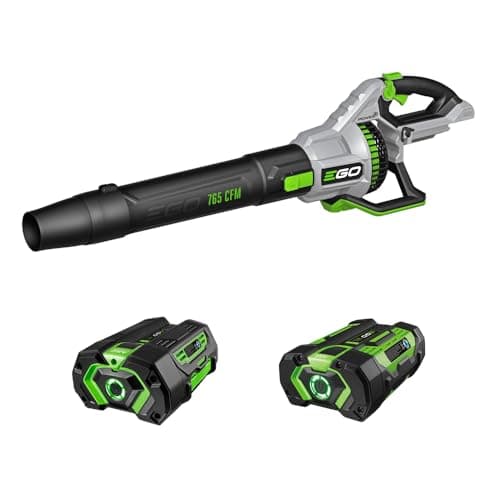
#ad Price as of October 23, 2026. Prices change; we check daily. How we're funded.
765 CFM and 200 MPH, with the turbo/low split published honestly: 15 minutes flat out, 150 minutes on low.
Published specs
| Max air volume | 765 CFM |
|---|---|
| Variable range | 260-580 CFM |
| Max air speed | Up to 200 MPH |
| Runtime (turbo) | 15 min on 5.0Ah |
| Runtime (low) | 150 min on 5.0Ah |
| Weight | 4.6 lb without battery |
| Noise | 64 dB |
Source: POWER+ 765 CFM Blower (LB7650), egopowerplus.com
280Wh (56V x 5.0Ah) over the published 15-minute turbo runtime = about 18.7Wh per minute. On low, 280Wh over 150 minutes is about 1.9Wh/min -- turbo costs roughly 10x the energy per minute.
What the numbers favor
- Highest published CFM and MPH of any handheld here
- Publishes BOTH turbo and low runtimes, so the trade-off is visible instead of averaged away
- 4.6 lb bare -- the lightest published weight of the handhelds on this page
What they don't
- 15 minutes of turbo on a 5.0Ah pack is the real constraint, whatever the 90-minute average says
- Sold bare in most configurations; budget for a battery and charger
you are clearing a small lawn. You will run it at 260 CFM forever and never touch what you paid for.
How it scores
Scores are our editorial weighting of the published specs above, not a test result. They are deliberately kept out of this page's structured data.
EGO Power+ 650 CFM Blower LB6504
EGO · EGO 56V ARC Lithium · Our score 9.0/10
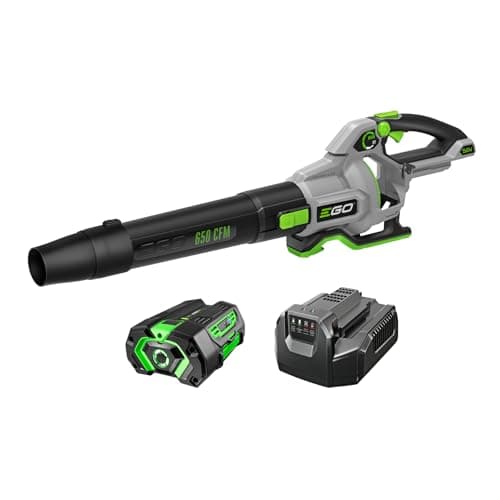
#ad Price as of October 23, 2026. Prices change; we check daily. How we're funded.
650 CFM in turbo with a genuine variable dial down to 225 CFM, and 64 dB published -- the useful range is the whole point.
Published specs
| Max air volume | 650 CFM (turbo) |
|---|---|
| Variable range | 225-470 CFM |
| Max air speed | Up to 180 MPH |
| Battery (kit) | 56V 5.0Ah |
| Runtime claim | Up to 90 min average |
| Noise | 64 dB |
| Warranty | 5-yr tool / 3-yr battery |
Source: POWER+ 650 CFM Blower, egopowerplus.com
56V x 5.0Ah = 280Wh, using EGO's advertised pack voltage.
What the numbers favor
- A real variable dial (225-470 CFM) plus turbo, not a three-position switch
- 64 dB published -- quieter than the 730 CFM Greenworks, which does not publish a figure at all
- IPX4 weather-resistant rating, published
- 5-year tool warranty
What they don't
- The 650 CFM headline is turbo-only; sustained work happens at 470 CFM or below
- EGO does not publish a weight for this model
your yard is a small courtyard or a deck. 650 CFM will move your mulch, your gravel and your neighbor's patience.
How it scores
Scores are our editorial weighting of the published specs above, not a test result. They are deliberately kept out of this page's structured data.
Where to buy the tools on this page
Amazon affiliate links, except where a product has no Amazon listing — those go direct to the maker and earn us nothing, and the button says so. We show no price we have not verified today, so where there is no live figure the link says "check price" and takes you to the listing to read it there.
Best quiet blower
Ryobi 40V HP Whisper Series 730 CFM RY404100
Ryobi · Ryobi 40V
Best for large yards
EGO Power+ 765 CFM Blower LB7650
EGO · EGO 56V ARC Lithium
Best overall
EGO Power+ 650 CFM Blower LB6504
EGO · EGO 56V ARC Lithium
#ad As an Amazon Associate we earn from qualifying purchases, at no extra cost to you. How we're funded.
Common questions
What does a leaf blower nozzle do?
What are speed tips?
Which nozzle should I use for wet leaves?
Which nozzle is best for a driveway?
Does a longer tube help?
Do nozzles affect runtime?
Sources
- Ryobi 40V HP Brushless Whisper Series 730 CFM Blower (RY404100), ryobitools.com
- EGO POWER+ 765 CFM Blower (LB7650), egopowerplus.com
- EGO POWER+ 650 CFM Blower (LB6504), egopowerplus.com
- EGO POWER+ 600 CFM Cordless Backpack Leaf Blower (LB6000), egopowerplus.com
- Greenworks 80V 730 CFM Cordless Battery Leaf Blower, greenworkstools.com
Read next
- Leaf Blowers
CFM moves the pile. MPH lifts what's stuck. Almost nobody explains which you need.
- Leaf blower CFM vs MPH: which is better?
CFM moves volume, MPH dislodges. Which spec predicts clearing power for which job.
- Best cordless blower for driveways, patios and paths
The bottom of the variable range is the spec that matters on hard surfaces.
- Best cordless blower for pine needles
Needles interlock into turf, so air speed clears them where volume does not.
- How long will a cordless leaf blower actually run?
Turbo costs about ten times low, per minute. Every published blower runtime converted.
- Yard tool glossary: what every specification means
Watt-hours, CFM, MPH, PSI, GPM, pitch, gauge, kerf, swath and duty cycle, defined.