Leaf Blowers
Leaf blower CFM vs MPH: which is better?
They do two different jobs, and the marketing on the box tells you about the wrong one.
Affiliate disclosure: we earn a commission if you buy through our links, at no extra cost to you. It never changes which product we rank first — here is how we're funded.
We have not tested these units. Every spec on this page comes from the manufacturer's own documentation and is linked to it. Every computed figure is arithmetic you can redo. Prices are checked daily — last verified October 19, 2026. Here is exactly how we pick.
What each number actually does
CFM — cubic feet per minute
The volume of air leaving the tube each minute. Think of it as the width of the broom. High CFM lets you sweep a wide swathe and keep a large pile moving without it spilling around the edges of the airstream.
Where it matters: open lawns, large leaf falls, driveways, moving material a long distance in one push.
MPH — miles per hour
The speed of that air at the nozzle. Think of it as how hard the broom presses. High air speed is what breaks the surface bond holding a wet leaf to a paving slab or a pine needle into turf.
Where it matters: wet leaves, matted debris, pine needles, anything pressed into grass, caked-on grass clippings.
Why you rarely get both at once
The same fan drives both numbers, and the nozzle decides how the energy is split. A narrow nozzle accelerates the air — higher MPH, lower CFM. A wide one does the opposite. That is why blowers ship with several nozzles, and why the two peak figures on the box are often measured with different ones fitted.
The real numbers, and what they imply
| Blower | Peak CFM | Peak MPH | Better at |
|---|---|---|---|
| EGO LB7650 | 765 | 200 | Both -- highest peak on each axis here |
| Ryobi RY404100 | 730 | 190 | Volume, with selectable air speed tips |
| Greenworks 80V axial | 730 | 170 | Volume. Lowest air speed here. |
| EGO LB6504 | 650 | 180 | Balanced, with the widest published variable range |
| EGO LB6000 backpack | 600 | 145 | Sustained volume. Weakest on stuck debris. |
Manufacturer-published peaks, checked 3 September 2026. Peaks on the two axes are often measured with different nozzles fitted and may not be simultaneous.
The backpack is the clearest illustration. It moves 600 CFM — plenty of volume — at 145 MPH, the lowest air speed here. It is built to push large quantities of loose material for a long time, and it is the wrong tool for scraping wet leaves off a patio. That is a design decision, not a defect, and reading the two numbers together is how you see it.
Matching the spec to your debris
| Your job | Prioritize | Roughly |
|---|---|---|
| Dry leaves, open lawn | CFM | 400+ CFM sustained is comfortable |
| Dry leaves, driveway or patio | CFM | Low-to-mid range; too much just scatters |
| Wet leaves in grass | MPH | The top of the published range you can afford |
| Pine needles in turf | MPH | Air speed does all the work here |
| Grass clippings off concrete | MPH | A narrow nozzle and moderate volume |
| Gravel drive or mulch beds | Low CFM | Use the bottom of a variable range or you will redistribute it |
That last row is why we rate a published variable range so highly in the main blower roundup. The LB6504 dials down to 225 CFM, which is the difference between clearing a flowerbed and rearranging it.
Both numbers cost battery, and turbo costs the most
So the peak CFM on the box describes a setting you can hold for a quarter of an hour. Whatever you conclude about CFM versus MPH, the practical answer is usually "buy the blower with the best variable range", because that is the setting you will live in. The buying framework is in how to choose a cordless leaf blower.
The measurement nobody publishes
There is a spec that genuinely combines the two: blowing force, measured in newtons. It captures mass flow and velocity together, which is what actually moves debris, and professional gas blower manufacturers sometimes publish it.
Not one of the cordless blowers we compared for this site publishes a newton rating. So the honest answer to "which number should I look at" is: both, together, matched to your debris — because the number that would settle it does not exist on these product pages.
The products discussed
Specs are the manufacturer's own and linked to the page they came from. Prices come from a live daily check; where we have no verified price we say so rather than print a stale one.
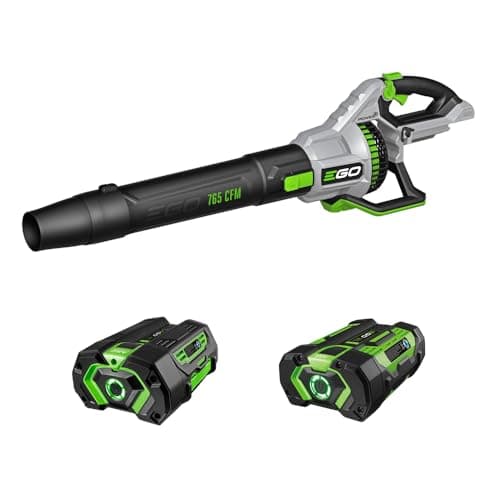
EGO Power+ 765 CFM Blower LB7650
EGO · EGO 56V ARC Lithium · Our score 8.9/10
#ad Price as of October 19, 2026. Prices change; we check daily. How we're funded.
765 CFM and 200 MPH, with the turbo/low split published honestly: 15 minutes flat out, 150 minutes on low.
Published specs
| Max air volume | 765 CFM |
|---|---|
| Variable range | 260-580 CFM |
| Max air speed | Up to 200 MPH |
| Runtime (turbo) | 15 min on 5.0Ah |
| Runtime (low) | 150 min on 5.0Ah |
| Weight | 4.6 lb without battery |
| Noise | 64 dB |
Source: POWER+ 765 CFM Blower (LB7650), egopowerplus.com
280Wh (56V x 5.0Ah) over the published 15-minute turbo runtime = about 18.7Wh per minute. On low, 280Wh over 150 minutes is about 1.9Wh/min -- turbo costs roughly 10x the energy per minute.
What the numbers favor
- Highest published CFM and MPH of any handheld here
- Publishes BOTH turbo and low runtimes, so the trade-off is visible instead of averaged away
- 4.6 lb bare -- the lightest published weight of the handhelds on this page
What they don't
- 15 minutes of turbo on a 5.0Ah pack is the real constraint, whatever the 90-minute average says
- Sold bare in most configurations; budget for a battery and charger
you are clearing a small lawn. You will run it at 260 CFM forever and never touch what you paid for.
How it scores
Scores are our editorial weighting of the published specs above, not a test result. They are deliberately kept out of this page's structured data.
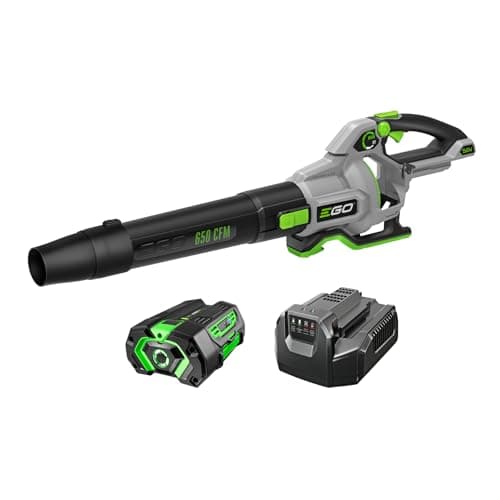
EGO Power+ 650 CFM Blower LB6504
EGO · EGO 56V ARC Lithium · Our score 9.0/10
#ad Price as of October 19, 2026. Prices change; we check daily. How we're funded.
650 CFM in turbo with a genuine variable dial down to 225 CFM, and 64 dB published -- the useful range is the whole point.
Published specs
| Max air volume | 650 CFM (turbo) |
|---|---|
| Variable range | 225-470 CFM |
| Max air speed | Up to 180 MPH |
| Battery (kit) | 56V 5.0Ah |
| Runtime claim | Up to 90 min average |
| Noise | 64 dB |
| Warranty | 5-yr tool / 3-yr battery |
Source: POWER+ 650 CFM Blower, egopowerplus.com
56V x 5.0Ah = 280Wh, using EGO's advertised pack voltage.
What the numbers favor
- A real variable dial (225-470 CFM) plus turbo, not a three-position switch
- 64 dB published -- quieter than the 730 CFM Greenworks, which does not publish a figure at all
- IPX4 weather-resistant rating, published
- 5-year tool warranty
What they don't
- The 650 CFM headline is turbo-only; sustained work happens at 470 CFM or below
- EGO does not publish a weight for this model
your yard is a small courtyard or a deck. 650 CFM will move your mulch, your gravel and your neighbor's patience.
How it scores
Scores are our editorial weighting of the published specs above, not a test result. They are deliberately kept out of this page's structured data.
Ryobi 40V HP Whisper Series 730 CFM RY404100
Ryobi · Ryobi 40V · Our score 8.8/10
#ad No verified live price right now, so we show none rather than a stale one. How we're funded.
57 dB published at 730 CFM. That is the lowest published noise figure on this page and it is not close.
Published specs
| Max air volume | 730 CFM |
|---|---|
| Max air speed | 190 MPH |
| Speed tips | 160 / 175 / 190 MPH |
| Noise | 57 dB |
| Batteries (kit) | 2 x 40V 4.0Ah |
| Runtime | 30 min high / 120 min low |
| Weight | 9.4 lb |
Source: 40V HP Brushless Whisper Series 730 CFM Blower (RY404100), ryobitools.com
Decibels are logarithmic: a 7 dB drop is roughly a 5x reduction in sound intensity, and is perceived as roughly half as loud. Both figures are manufacturer-published under their own test conditions, so treat the gap as directional, not lab-comparable.
What the numbers favor
- 57 dB published -- the quietest figure any manufacturer on this page publishes
- 730 CFM while doing it, second only to the 765 CFM EGO
- Ships with two 4Ah packs (320Wh total) in the kit
- Publishes high AND low runtimes rather than an average
What they don't
- 9.4 lb is the heaviest published handheld weight here, roughly double the EGO LB7650 bare
- Manufacturer noise figures are measured under each brand's own conditions -- not a like-for-like lab comparison
you need to move soaked leaves off a large property fast. Quiet costs air speed, and 190 MPH is the lowest peak here.
How it scores
Scores are our editorial weighting of the published specs above, not a test result. They are deliberately kept out of this page's structured data.
Greenworks 80V 730 CFM Axial Blower
Greenworks · Greenworks 80V · Our score 7.4/10
No Amazon listing for this one right now, so the link goes direct to Greenworks and we earn nothing on it. We show no price because we only publish figures from our own daily check. How we're funded.
730 CFM and a 4-year warranty from a tool Greenworks still sells direct -- but it has no Amazon listing right now, so this link earns us nothing.
Published specs
| Max air volume | 730 CFM |
|---|---|
| Max air speed | 170 MPH |
| Weight | 8.82 lb (Greenworks' own summary figure; its spec table says 15 lb, which reads as shipping weight) |
| Battery (kit) | 80V 2.5Ah |
| Runtime | Up to 60 min on low |
| Recharge | 40 min |
| Warranty | 4-yr |
| Availability | Sold direct by Greenworks; no Amazon listing as of 2026-10-13 |
Source: 80V 730 CFM Cordless Battery Leaf Blower, greenworkstools.com
730 CFM / 8.82 lb = 82.8 CFM per pound. We previously published 133 CFM per pound from a 5.5 lb weight that matches neither figure on Greenworks' current page -- that was wrong and is corrected here. On the real figure the EGO LB7650 leads the category at 765 / 4.6 = 166 CFM per pound, and this tool is second, ahead of the RYOBI RY404100's 730 / 9.4 = 78. The pack arithmetic is unchanged: 80V x 2.5Ah = 200Wh nameplate.
What the numbers favor
- 730 CFM at 8.82 lb is about 83 CFM per pound -- second only to the EGO LB7650 in our registry, and ahead of the RYOBI that matches its airflow
- 4-year warranty on tool and battery
- 40-minute recharge
- Cruise control and turbo button, so it is not a dead-man trigger for long sessions
What they don't
- 170 MPH is the lowest peak air speed here -- airflow moves volume, speed dislodges wet debris
- Greenworks publishes no noise figure for this tool at all
- 200Wh included is the smallest pack of the blowers here
- No Amazon listing right now, so buying means going direct to Greenworks
you own nothing else on Greenworks 80V. A 200Wh pack bought for one blower is an expensive way to start a platform.
How it scores
Scores are our editorial weighting of the published specs above, not a test result. They are deliberately kept out of this page's structured data.
Where to buy the tools on this page
Amazon affiliate links, except where a product has no Amazon listing — those go direct to the maker and earn us nothing, and the button says so. We show no price we have not verified today, so where there is no live figure the link says "check price" and takes you to the listing to read it there.
Best for large yards
EGO Power+ 765 CFM Blower LB7650
EGO · EGO 56V ARC Lithium
Best overall
EGO Power+ 650 CFM Blower LB6504
EGO · EGO 56V ARC Lithium
Best quiet blower
Ryobi 40V HP Whisper Series 730 CFM RY404100
Ryobi · Ryobi 40V
Best budget high-CFM
Greenworks 80V 730 CFM Axial Blower
Greenworks · Greenworks 80V
#ad As an Amazon Associate we earn from qualifying purchases, at no extra cost to you. How we're funded.
Common questions
What is better in a leaf blower, CFM or MPH?
Is 500 CFM enough for a leaf blower?
How many MPH do I need to move wet leaves?
Why do blowers list both numbers?
Is there a single number that combines them?
Sources
Read next
- Leaf Blowers
CFM moves the pile. MPH lifts what's stuck. Almost nobody explains which you need.
- Best cordless leaf blowers of 2026
Five cordless blowers ranked on usable airflow range, published noise and real turbo runtime.
- What to look for in a cordless leaf blower
Six blower specs in priority order, with published figures. Peak CFM is not first.
- Best cordless leaf blower for a large yard
On a big property the constraint is watt-hours, not airflow. Ranked on sustained runtime.
- Quietest cordless leaf blower: the published decibel figures
57 dB vs 64 dB, what the gap means, and which brands publish no figure at all.
- Most powerful cordless leaf blower
Highest published CFM and MPH in our registry, and why multiplying the two overstates every machine.
- Jet fan vs axial leaf blowers
Fan geometry against published CFM, MPH and noise, and which shape of output suits which debris.