Leaf Blowers
Leaf cleanup, in the order that actually works
Most of the leaves on your lawn should never be collected at all. Here is the research, and the sequence.
Affiliate disclosure: we earn a commission if you buy through our links, at no extra cost to you. It never changes which product we rank first — here is how we're funded.
We have not tested these units. Every spec on this page comes from the manufacturer's own documentation and is linked to it. Every computed figure is arithmetic you can redo. Prices are checked daily — last verified October 19, 2026. Here is exactly how we pick.
The standard autumn routine — blow everything into a pile, bag it, put it on the curb — throws away the best free input your lawn gets all year, and takes the longest. The research-backed version is faster and it starts with the mower rather than the blower.
What the research says about leaves on grass
Penn State Extension is specific: a layer up to about one-half inch in depth is beneficial to the lawn. Mow slowly so the blades have time to chop, and make a second pass at right angles to the first if the shred is still coarse. Start while the layer is thin and the leaves are dry, rather than waiting for everything to come down at once.
The reason to bother is Michigan State University research cited in the same article: mulching leaf litter into turf improved grass quality, increased soil organic matter and reduced broadleaf weeds, with no negative pH effect from either oak or maple leaves. That is a rare thing in lawn care — a job that is less work and produces a better result.
The sequence
- Check the depth before you do anything. Under about half an inch on the lawn: mow it in. Deeper: move some off first, then mow the rest in.
- Mulch-mow the lawn first, not last. Mowing before you blow means you are not blowing leaves you were going to shred anyway. Set the deck high and go slowly.
- Blow the hard surfaces on the lowest setting that works. Driveway, path, patio, deck. This is the stage where the variable dial earns its place.
- Clear beds and corners with air speed, not volume. Leaves packed into a border need a narrow, fast stream to lift them, not a wide one to push them.
- Stockpile what you collected. Penn State suggests keeping surplus leaves as compost browns, or making leaf mold over roughly two years.
What each stage costs you in battery
Turbo is not the setting you work in, it is the setting you reach for when something is stuck. Every blower here that publishes both figures shows the same roughly tenfold gap, and it is the single biggest lever you have over how long the job takes. The LB7650 publishes both its turbo and low runtimes, which is why it appears in this arithmetic rather than a tool that publishes one averaged number.
Dry leaves need CFM, wet leaves need MPH
| Job | What moves it | Published figures that matter |
|---|---|---|
| Dry leaves on a lawn | Volume of air (CFM) | 600-765 CFM across the blowers here |
| Wet leaves stuck to concrete | Air speed (MPH) | 145-200 MPH; EGO LB7650 is the highest published |
| Leaves packed into a border | Air speed, narrow nozzle | Ryobi publishes three speed tips: 160 / 175 / 190 MPH |
| Grass clippings off a path | Low volume, low speed | EGO's 225-260 CFM published minimums |
| A large lawn of dry leaves | Sustained volume, not peak | EGO LB6000 backpack: 180 published minutes on low |
Airflow and air speed figures are each manufacturer's own published maxima. The job-to-spec mapping is our reasoning, and the full explanation is on the CFM vs MPH page.
The full version of that argument, including why the two numbers are not interchangeable and which brands publish only one of them, is on the CFM vs MPH page.
Which blower suits which cleanup
Long sessions: the backpack
The EGO LB6000 publishes 180 minutes on low from a 7.5Ah pack and carries its 12.5 lb on a harness rather than your wrist. For a property where leaf cleanup is a two-hour job rather than a ten-minute one, that is the difference between finishing and stopping.
#ad Check the EGO LB6000 backpack price on Amazon — how we're funded.
Close neighbors: the quiet one
Ryobi's RY404100 publishes 57 dB while moving 730 CFM, the lowest published figure of any blower here. Autumn cleanup happens on weekend mornings, which is exactly when 7 dB matters.
#ad Check the Ryobi RY404100 price on Amazon — how we're funded.
Light work, light tool
The Greenworks 80V moves 730 CFM from 8.82 lb with cruise control, so you are not holding a trigger for an hour. It publishes no noise figure and its 170 MPH is the lowest peak air speed here — fine for dry leaves, less so for wet ones welded to a driveway.
Check the Greenworks 80V blower price on Amazon — no Amazon listing right now, so this link earns us nothing. How we're funded.
The mower does most of this job
If your deck has a mulching mode, it is the leaf tool you already own. Greenworks publishes a turbo leaf-collection mode as one of four deck configurations; EGO ships a high-lift blade for bagging; Toro's Recycler deck is built around recutting material. The decision between shredding leaves into the lawn and collecting them is the same decision as mulching versus bagging clippings, and the research points the same way.
What we cannot tell you
- How many leaves your lawn can take. The half-inch figure is Penn State Extension's guidance for a typical lawn, not a universal limit. Species, canopy density and how wet the autumn is all move it.
- Runtime for a real cleanup. Published turbo and low figures are endpoints; your session is a mix, and no manufacturer publishes a mixed-use figure.
- Whether a blower clears wet leaves. That depends on the leaf, the surface and the water, and nobody publishes a test for it.
The products discussed
Specs are the manufacturer's own and linked to the page they came from. Prices come from a live daily check; where we have no verified price we say so rather than print a stale one.
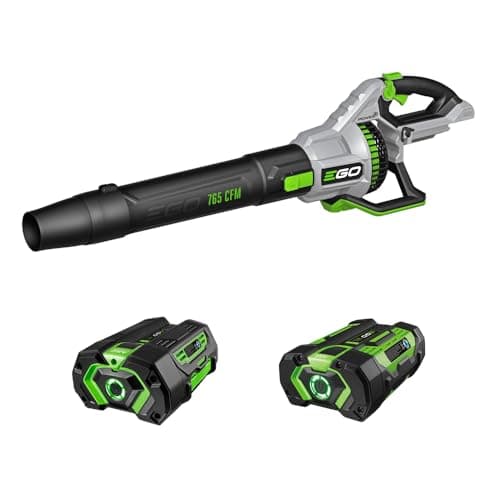
EGO Power+ 765 CFM Blower LB7650
EGO · EGO 56V ARC Lithium · Our score 8.9/10
#ad Price as of October 19, 2026. Prices change; we check daily. How we're funded.
765 CFM and 200 MPH, with the turbo/low split published honestly: 15 minutes flat out, 150 minutes on low.
Published specs
| Max air volume | 765 CFM |
|---|---|
| Variable range | 260-580 CFM |
| Max air speed | Up to 200 MPH |
| Runtime (turbo) | 15 min on 5.0Ah |
| Runtime (low) | 150 min on 5.0Ah |
| Weight | 4.6 lb without battery |
| Noise | 64 dB |
Source: POWER+ 765 CFM Blower (LB7650), egopowerplus.com
280Wh (56V x 5.0Ah) over the published 15-minute turbo runtime = about 18.7Wh per minute. On low, 280Wh over 150 minutes is about 1.9Wh/min -- turbo costs roughly 10x the energy per minute.
What the numbers favor
- Highest published CFM and MPH of any handheld here
- Publishes BOTH turbo and low runtimes, so the trade-off is visible instead of averaged away
- 4.6 lb bare -- the lightest published weight of the handhelds on this page
What they don't
- 15 minutes of turbo on a 5.0Ah pack is the real constraint, whatever the 90-minute average says
- Sold bare in most configurations; budget for a battery and charger
you are clearing a small lawn. You will run it at 260 CFM forever and never touch what you paid for.
How it scores
Scores are our editorial weighting of the published specs above, not a test result. They are deliberately kept out of this page's structured data.
Ryobi 40V HP Whisper Series 730 CFM RY404100
Ryobi · Ryobi 40V · Our score 8.8/10
#ad No verified live price right now, so we show none rather than a stale one. How we're funded.
57 dB published at 730 CFM. That is the lowest published noise figure on this page and it is not close.
Published specs
| Max air volume | 730 CFM |
|---|---|
| Max air speed | 190 MPH |
| Speed tips | 160 / 175 / 190 MPH |
| Noise | 57 dB |
| Batteries (kit) | 2 x 40V 4.0Ah |
| Runtime | 30 min high / 120 min low |
| Weight | 9.4 lb |
Source: 40V HP Brushless Whisper Series 730 CFM Blower (RY404100), ryobitools.com
Decibels are logarithmic: a 7 dB drop is roughly a 5x reduction in sound intensity, and is perceived as roughly half as loud. Both figures are manufacturer-published under their own test conditions, so treat the gap as directional, not lab-comparable.
What the numbers favor
- 57 dB published -- the quietest figure any manufacturer on this page publishes
- 730 CFM while doing it, second only to the 765 CFM EGO
- Ships with two 4Ah packs (320Wh total) in the kit
- Publishes high AND low runtimes rather than an average
What they don't
- 9.4 lb is the heaviest published handheld weight here, roughly double the EGO LB7650 bare
- Manufacturer noise figures are measured under each brand's own conditions -- not a like-for-like lab comparison
you need to move soaked leaves off a large property fast. Quiet costs air speed, and 190 MPH is the lowest peak here.
How it scores
Scores are our editorial weighting of the published specs above, not a test result. They are deliberately kept out of this page's structured data.
EGO Power+ 600 CFM Backpack Blower LB6000
EGO · EGO 56V ARC Lithium · Our score 8.7/10
#ad No verified live price right now, so we show none rather than a stale one. How we're funded.
The weight goes on your back instead of your wrist, and EGO publishes all three runtimes so you can see what the harness actually buys you.
Published specs
| Max air volume | 600 CFM |
|---|---|
| Variable range | 260-600 CFM |
| Max air speed | 145 MPH |
| Runtime (low) | Up to 180 min on 7.5Ah |
| Runtime (high) | Up to 33 min |
| Runtime (turbo) | Up to 23 min |
| Weight | 12.5 lb |
Source: 600 CFM Cordless Backpack Leaf Blower (LB6000), egopowerplus.com
420Wh (56V x 7.5Ah) over the published 23-minute turbo runtime = about 18.3Wh per minute, almost exactly the LB7650 handheld's 18.7Wh/min. Turbo costs the same energy whichever way you carry it -- the backpack buys comfort, not efficiency.
What the numbers favor
- Publishes low, high AND turbo runtimes -- three numbers where most brands give one average
- 12.5 lb carried on a harness with a waist belt, not held out at arm's length
- Variable 260-600 CFM across the whole range
- Adjustable tube length, published
What they don't
- 145 MPH is the lowest air speed of any blower on this page
- 12.5 lb is genuine weight even on a harness
- Sold bare in most configurations
your clearing sessions are under twenty minutes. A harness you spend a minute putting on for a fifteen-minute job is a worse tool than a 4.6 lb handheld.
How it scores
Scores are our editorial weighting of the published specs above, not a test result. They are deliberately kept out of this page's structured data.
Greenworks 80V 730 CFM Axial Blower
Greenworks · Greenworks 80V · Our score 7.4/10
No Amazon listing for this one right now, so the link goes direct to Greenworks and we earn nothing on it. We show no price because we only publish figures from our own daily check. How we're funded.
730 CFM and a 4-year warranty from a tool Greenworks still sells direct -- but it has no Amazon listing right now, so this link earns us nothing.
Published specs
| Max air volume | 730 CFM |
|---|---|
| Max air speed | 170 MPH |
| Weight | 8.82 lb (Greenworks' own summary figure; its spec table says 15 lb, which reads as shipping weight) |
| Battery (kit) | 80V 2.5Ah |
| Runtime | Up to 60 min on low |
| Recharge | 40 min |
| Warranty | 4-yr |
| Availability | Sold direct by Greenworks; no Amazon listing as of 2026-10-13 |
Source: 80V 730 CFM Cordless Battery Leaf Blower, greenworkstools.com
730 CFM / 8.82 lb = 82.8 CFM per pound. We previously published 133 CFM per pound from a 5.5 lb weight that matches neither figure on Greenworks' current page -- that was wrong and is corrected here. On the real figure the EGO LB7650 leads the category at 765 / 4.6 = 166 CFM per pound, and this tool is second, ahead of the RYOBI RY404100's 730 / 9.4 = 78. The pack arithmetic is unchanged: 80V x 2.5Ah = 200Wh nameplate.
What the numbers favor
- 730 CFM at 8.82 lb is about 83 CFM per pound -- second only to the EGO LB7650 in our registry, and ahead of the RYOBI that matches its airflow
- 4-year warranty on tool and battery
- 40-minute recharge
- Cruise control and turbo button, so it is not a dead-man trigger for long sessions
What they don't
- 170 MPH is the lowest peak air speed here -- airflow moves volume, speed dislodges wet debris
- Greenworks publishes no noise figure for this tool at all
- 200Wh included is the smallest pack of the blowers here
- No Amazon listing right now, so buying means going direct to Greenworks
you own nothing else on Greenworks 80V. A 200Wh pack bought for one blower is an expensive way to start a platform.
How it scores
Scores are our editorial weighting of the published specs above, not a test result. They are deliberately kept out of this page's structured data.
Where to buy the tools on this page
Amazon affiliate links, except where a product has no Amazon listing — those go direct to the maker and earn us nothing, and the button says so. We show no price we have not verified today, so where there is no live figure the link says "check price" and takes you to the listing to read it there.
Best for large yards
EGO Power+ 765 CFM Blower LB7650
EGO · EGO 56V ARC Lithium
Best quiet blower
Ryobi 40V HP Whisper Series 730 CFM RY404100
Ryobi · Ryobi 40V
Best backpack
EGO Power+ 600 CFM Backpack Blower LB6000
EGO · EGO 56V ARC Lithium
Best budget high-CFM
Greenworks 80V 730 CFM Axial Blower
Greenworks · Greenworks 80V
#ad As an Amazon Associate we earn from qualifying purchases, at no extra cost to you. How we're funded.
Common questions
Should I rake leaves or mulch them into the lawn?
How deep a layer of leaves can a mower handle?
When should I start clearing leaves?
Do I need high CFM or high MPH for leaves?
How much battery does a leaf cleanup use?
What should I do with leaves I do collect?
Sources
- Leaves Are Treasure, Not Trash, Penn State Extension
- Mowing practices for healthy lawns, University of Minnesota Extension
- EGO POWER+ 765 CFM Blower (LB7650), egopowerplus.com
- RYOBI 40V HP Whisper Series 730 CFM Blower (RY404100), ryobitools.com
- EGO POWER+ 600 CFM Backpack Blower (LB6000), egopowerplus.com
Read next
- Leaf Blowers
CFM moves the pile. MPH lifts what's stuck. Almost nobody explains which you need.
- Best cordless leaf blowers of 2026
Five cordless blowers ranked on usable airflow range, published noise and real turbo runtime.
- Leaf blower CFM vs MPH: which is better?
CFM moves volume, MPH dislodges. Which spec predicts clearing power for which job.
- Best cordless leaf blower for a large yard
On a big property the constraint is watt-hours, not airflow. Ranked on sustained runtime.
- Best leaf rakes, and the spec problem in this whole category
Two maker-published rakes, the raking arithmetic that says when to stop, and the retailer tine counts that disagree by a factor of three.
- Mulching vs bagging: which should you actually do?
The extension research on returning clippings, and what each deck mode costs you in runtime.
- Doing your own lawn care: what to do, and when
Four jobs, the right order, the right season. The sequence matters more than the equipment.
- Leaf blower vs lawn sweeper
Collection versus movement, on published CFM, hopper capacity and watt-hours per minute.