Lawn Care
Best propane weed torches, ranked on the regulator
Every torch in this category is sold on BTU. BTU per hour is a rate of fuel consumption -- so the biggest number on the box is a description of your propane bill, not of the weeds.
Affiliate disclosure: we earn a commission if you buy through our links, at no extra cost to you. It never changes which product we rank first — here is how we're funded.
We have not tested these units. Every spec on this page comes from the manufacturer's own documentation and is linked to it. Every computed figure is arithmetic you can redo. Prices are checked daily — last verified November 4, 2026. Here is exactly how we pick.
Quick picks
Ranked on the published specs and the arithmetic below. Tap any row to jump to the full write-up. We have not tested these units -- here is exactly how we pick.
| # | Product | Best for | Score | Price |
|---|---|---|---|---|
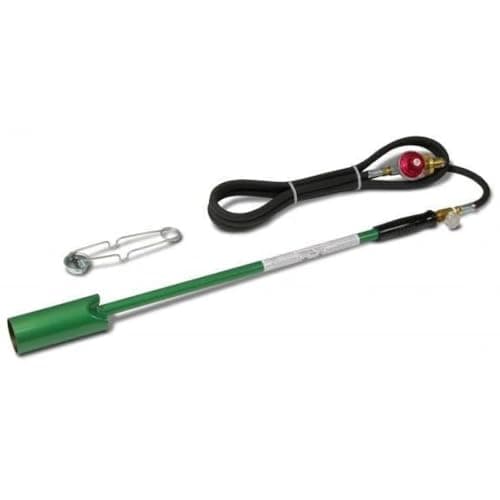
| 1 | Red Dragon VT 2-23 C Weed Dragon Propane Vapor Torch Kit The only torch here that ships a regulator -- which is why it is also the only one that can publish an operating pressure, a fuel consumption and a flame temperature. You buy a known burn rate, not a bigger number. | Best overall | 9.0 | |
| 2 | 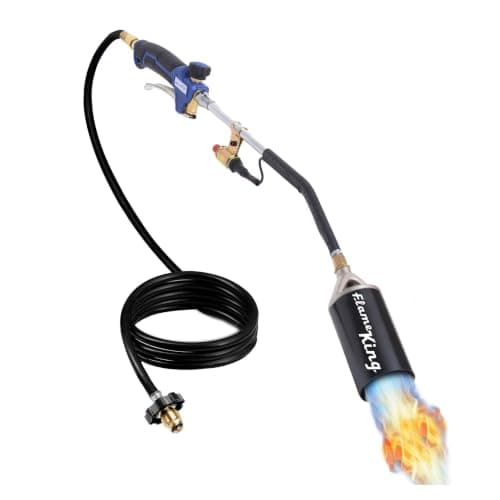 Flame King YSN340K Propane Torch Weed Burner 340,000 BTU, a published 28 in flame and a built-in piezo igniter for $25 less -- but no regulator, and therefore no published pressure, burn rate or flame temperature to go with the big number. | Best for reach and flame size | 7.6 |
#ad Buy links are affiliate links. Prices come from a live daily check; where we have no verified price we say "check price" rather than print a stale one.
Every propane weed torch sold is sold on one number, and the number is measured in the wrong units for the job. BTU per hour is a rate of fuel consumption. A 340,000 BTU torch is not a torch that kills weeds 3.4 times deader than a 100,000 BTU torch; it is a torch that burns 3.4 times the propane. Weeds die from heat, and the one maker here that publishes a flame temperature puts it at about 2050 °F — already vastly more than enough, at the lower BTU rating. So the interesting question is not how big the number is. It is what the torch does with the fuel, and that comes down to one component.
The short answer
BTU per hour is a fuel-burn rate
This is not an interpretation, it is arithmetic, and Flame Engineering supplies the numbers to prove it. The company publishes a maximum capacity of 100,000 BTU/hr for the Weed Dragon and a maximum fuel consumption of 4.6 lbs/hr. Divide one by the other and you get the energy content of a pound of propane — about 21,739 BTU. That figure is not editorial; it falls straight out of the maker's own two published specs, and it means the BTU rating and the fuel-burn rating are the same fact written twice.
Which lets us check the maker against the federal government. The U.S. Department of Energy publishes propane's energy content as 91,420 BTU per gallon on a higher-heating-value basis. At 21,739 BTU/lb that implies 4.21 lb per gallon — which is the propane density the trade uses. Flame Engineering's two numbers are internally consistent and consistent with DOE. Good.
So when Flame King rates the YSN340K at 340,000 BTU, it is telling you — whether it means to or not — that the torch consumes roughly 15.6 lbs of propane an hour held wide open. That is the whole finding of this page, and here is what it costs you.
A standard barbecue cylinder holds 20 lb of propane. Flame Engineering says outright that barbecue cylinders work great with the Weed Dragon.
Weed Dragon at its published normal operating pressure, 18 P.S.I. and 2.25 lbs/hr: 20 / 2.25 = 8.9 hours
Weed Dragon at its published maximum, 4.6 lbs/hr: 20 / 4.6 = 4.3 hours
Flame King at 340,000 BTU, derived at 15.6 lbs/hr: 20 / 15.6 = 1.28 hours, or about 77 minutes
Compared maximum to maximum, that is 4.3 hours against 1.28 — a ratio of 3.4, which is exactly the BTU ratio, because it has to be. The extra 4.6 hours the Weed Dragon gets on top of that is what the regulator buys: it holds the torch at a fixed 18 P.S.I. instead of handing it raw tank pressure, and 2.25 lbs/hr works out to about 48,900 BTU/hr. Its own headline figure of 100,000 BTU is a maximum it does not normally run at.
The honest caveat. The Flame King's blast lever returns to idle the moment you let go, nobody holds it wide open continuously, and Flame King publishes no idle consumption figure. So 77 minutes is the floor, not the expectation — and there is no published number anywhere that would let you calculate the real one. That is itself the problem with buying on BTU.
The regulator is the real split in this category
Once you notice which specs each maker publishes, the category stops looking like a BTU ladder and starts looking like two different machines.
The Red Dragon kit contains a U.L. Listed R-700 C regulator and a separate V-334 flame-adjusting needle valve. Because the pressure is held at a known value, everything downstream becomes a publishable number: an operating pressure of 18 P.S.I., a usable range of 5–25 P.S.I., a consumption figure at that pressure, a maximum consumption figure, and a flame temperature.
The Flame King publishes no regulator at all. It runs on whatever pressure the cylinder is making, which is why Flame King cannot print an operating pressure, a consumption figure or a flame temperature — there is no fixed value to print. Instead it publishes the things that stay true regardless: a flame length of up to 28 in, a 32 in torch, a 10 ft hose, 3.49 lb, CSA testing and a one-year warranty.
Neither design is unsafe and neither maker is hiding anything. But it explains the one piece of advice Flame King gives that reads oddly until you understand the architecture: its own documentation warns that cold weather lowers tank pressure and tells you to use a 20 lb tank or bigger. An unregulated torch gets weaker as the cylinder cools. And Flame King markets this torch for melting ice and snow on steps and walkways — which is to say, for use in precisely the conditions that undermine it. If that is your job, our ice melt page covers the chemical route and is a great deal less exciting.
What each maker publishes
| Red Dragon VT 2-23 C | Flame King YSN340K | |
|---|---|---|
| Rated output | 100,000 BTU/hr maximum | 340,000 BTU |
| Regulator in kit | Yes -- U.L. Listed R-700 C | None published |
| Normal operating pressure | 18 P.S.I. | Not published |
| Operating pressure range | 5-25 P.S.I. | Not published |
| Fuel consumption, normal | 2.25 lbs/hr at 18 P.S.I. | Not published |
| Fuel consumption, maximum | 4.6 lbs/hr | Not published |
| Flame temperature | About 2050 deg F | Not published |
| Flame length | Not published | Up to 28 in |
| Torch length | 27 1/2 in | 32 in |
| Handle length | 23 in | Not published |
| Bell diameter | 2 in | Not published |
| Hose | 10 ft, U.L. Listed | 10 ft |
| Weight | 5 lb | 3.49 lb |
| Ignition | Separate spark lighter (L2002) | Built-in piezo, push-button |
| Flame control | Needle valve V-334 | Blast lever, returns to idle |
| Cylinder range | Any refillable; barbecue cylinders stated | 5-100 lb; not 1 lb |
| Certification | U.L. Listed components | CSA-tested |
| Warranty | Not published on the product page | 1 year, defects |
| Maker's list price | $134.00 | $57.95 (direct $46.36) |
Transcribed from flameengineering.com and flamekingproducts.com on 2026-10-28. 'Not published' means the maker does not state the figure anywhere on its product page -- it is not an omission on our part.
Read the "not published" cells as a block and the asymmetry is almost comic. BTU is the only specification both makers print, and it is the one that misleads. Everything that would let you compare these two torches properly is published by exactly one of them.
What flame weeding actually does
It helps to know the mechanism, because it explains why the BTU arms race is beside the point. Flame weeding does not incinerate a plant. Passing a flame over foliage for a fraction of a second heats the water inside the cells until the cell walls rupture; the plant loses its ability to hold water and collapses over the following day or two. The visible leaf often still looks green when you walk away. You are not burning the weed down, you are killing it and letting it wilt.
Two consequences follow, and both matter more than BTU:
- It is a top-kill, not a root-kill. Annual weeds caught small frequently die outright because they have almost nothing stored below ground. Established perennials — dandelion, bindweed, Bermuda grass — regrow from the root and need a repeat pass every couple of weeks. If root removal is the actual goal, our weed pullers page covers the mechanical answer and weed control basics covers why timing beats force in all of this.
- More heat does not mean more dead. Once you are past the temperature that ruptures a cell wall, extra temperature is wasted, and the Red Dragon's published 2050 °F clears that bar by a margin no plant notices. What a bigger flame genuinely buys is area — a 28 in flame clears a wider strip per pass than a 2 in bell, so you walk faster. That is a real advantage on a gravel driveway and an irrelevance in a paver joint.
It also cannot be used on a lawn. A torch does not discriminate between a weed and the turf around it, so flame weeding belongs on hard surfaces, gravel, bare beds before planting and fence lines. For weeds standing in grass you want a sprayer, a puller, or a pre-emergent — see lawn sprayers and crabgrass preventers. For weeds taller than the tool, string trimmers get there first.
The picks
1. Red Dragon VT 2-23 C Weed Dragon — best overall
Flame Engineering is an American manufacturer in LaCrosse, Kansas that has been building flame equipment since the tool was a single farm torch, and the Weed Dragon is its homeowner kit — the company says explicitly that it regulated the flame and BTU down for homeowners who do not need the power of a farm torch, and that it assembled the kit for you. That sentence is the product.
What arrives is a complete, closed system: the VT2-23 torch, a 10 ft U.L. Listed hose, the U.L. Listed R-700 C regulator, the V-334 flame-adjusting needle valve, a hand-tighten excess-flow P.O.L. fitting that Flame Engineering says needs no wrench, and an L2002 spark lighter. Because the regulator fixes the pressure, you get the only genuinely predictable torch on this page: 18 P.S.I., 2.25 lbs/hr, roughly 2050 °F, and by our arithmetic 8.9 hours of work out of a cylinder you can refill at any hardware store.
The honest marks against it. It costs the most here at $74.99 despite being rated for under a third of the BTU. Flame Engineering publishes no flame length, which is the figure that would tell you how fast you can walk. Ignition is a separate spark lighter held in your other hand — a genuine step backwards from a push-button piezo when you are crouched over a path. At 5 lb it is the heavier of the two by 43%. There is a California Prop 65 lead warning on the product page. And no warranty term is published anywhere on it, which is a strange gap next to Flame King's clearly stated year.
One thing worth knowing before you compare prices anywhere else: Flame Engineering's own list price is $134.00. The street price is 44% below the maker's list, so the gap between this torch and the Flame King is far narrower in the shops than the two companies' own pricing suggests.
#ad Check the Red Dragon VT 2-23 C Weed Dragon Propane Vapor Torch Kit price on Amazon — how we're funded.
2. Flame King YSN340K — best for reach and flame size
Flame King's main business is propane cylinders, and the YSN340K is the torch that sells on the number: 340,000 BTU, a published flame up to 28 in long, a 32 in torch on a 10 ft hose, 3.49 lb, a built-in piezo igniter and a blast lever that snaps back to idle when you release it. CSA-tested, one-year warranty against defects, fully assembled in the box, and it will run off anything from a 5 lb to a 100 lb cylinder. At $49.99 it is $25.00 less than the Red Dragon.
For open, rough work this is the better tool, and the reason is the published flame length rather than the BTU. A 28 in flame clears a wide strip of gravel drive or fence line per pass; a 2 in bell does not. Flame King also lists the jobs beyond weeds that the extra output genuinely serves — brush, fire starting, torch-down roofing, charring wood, ice and snow on steps.
The honest marks against it are all downstream of the missing regulator. There is no published operating pressure, no fuel consumption and no flame temperature, so there is no way to know what it will cost to run except by deriving it as we did above: roughly 15.6 lbs/hr wide open, about 77 minutes per barbecue cylinder. Flame King's own guidance that cold weather lowers tank pressure, and that you should therefore use a bigger tank, is an admission that the output is not fixed. It will not take a 1 lb camping cylinder, ruling out the cheapest fuel most people already own. And a 28 in flame is a great deal of flame to point into a 2 in crack.
A buying note we will not pretend away: at the time of writing the YSN340K is out of stock on flamekingproducts.com, and the $49.99 street price is $3.63 above Flame King's own direct price of $46.36. That is the opposite of the Red Dragon's situation and worth knowing before you assume the retail price is the deal.
#ad Check the Flame King YSN340K Propane Torch Weed Burner price on Amazon — how we're funded.
The safety section most torch roundups leave out
A propane weed torch is an open flame — around 2050 °F where the one maker who publishes the figure does — that you walk around your property pointing at dry vegetation. Both makers say outdoor use only and both tell you to wear eye protection and heavy gloves. Beyond that, three things deserve more prominence than they usually get.
- Never torch poison ivy, poison oak or poison sumac. CDC / NIOSH is unambiguous: "Do not burn plants" that may be any of the three. These plants release urushiol when damaged or burned, and CDC warns that inhaling the smoke can cause "severe allergic respiratory problems". CDC also records that urushiol stays active on surfaces for up to five years and that less than a grain of salt's worth triggers a rash in 80–90% of adults. That guidance is written for outdoor workers rather than homeowners, but the chemistry is the same. Identify the plant before you light the torch.
- Check your local burn rules, and the day. Many jurisdictions restrict open flame outdoors seasonally or during fire weather, and Flame King tells you to check local burn rules on the product page itself. Dry grass, mulch beds, bark chips and anything resinous will take light from a passing flame and keep burning after you have moved on. Carry water or an extinguisher, and walk the area again twenty minutes later — a smoldering mulch bed is the classic way this goes wrong.
- Open the cylinder valve slowly. Flame King specifically warns that opening it fast can trip the built-in excess-flow valve, which leaves you with a feeble flame and no obvious cause. Both torches use a reverse-thread P.O.L. connection — turn left to tighten, hand-tight only, no wrench.
What nobody in this category publishes
Worth stating plainly, because every one of these is a figure a buyer would reasonably expect and neither maker provides:
- Coverage rate. No square feet per hour, and no flame width at a stated height, from either maker. The nearest thing available is Flame King's flame length.
- Idle fuel consumption. The Flame King has a lever that returns to idle, and no published figure for what idle costs — which makes its real running cost uncomputable from published data.
- Flame temperature, from Flame King. The one specification that explains why flame weeding works at all is published by one maker out of two.
- How many passes a perennial takes. Neither maker will put a number on it, which is fair — it depends on the species — but it leaves the central question of the method unanswered in the marketing.
- A warranty term, from Flame Engineering. Flame King publishes one year. The Weed Dragon product page publishes nothing.
We also could not transcribe specifications for Flame Engineering's heavier VT 3-30 kits, which sit above the Weed Dragon in its own catalog and would be the logical step up for brush and burn piles: flameengineering.com served one product record and then returned HTTP 429 to five backed-off retries. They are named here unranked rather than quietly omitted, on the same principle that keeps Fiskars off our bypass pruners page.
Which torch, by the job
| Your job | Buy | Why |
|---|---|---|
| Paver joints, sidewalk cracks, patio edges | Red Dragon VT 2-23 C | A 2 in bell aims where you want it; a 28 in flame does not |
| Gravel drive, long fence line, open ground | Flame King YSN340K | Published 28 in flame clears a wider strip per pass |
| You want to know what it costs to run | Red Dragon VT 2-23 C | The only one publishing pressure and two fuel-consumption figures |
| Working in the cold, or melting ice | Red Dragon VT 2-23 C | Regulated to 18 P.S.I.; Flame King warns cold lowers tank pressure |
| Brush, burn piles, torch-down roofing | Flame King YSN340K | The output is genuinely useful here -- though a VT 3-30 is the real answer |
| Longest run time per cylinder | Red Dragon VT 2-23 C | 8.9 hr at normal pressure against about 77 min wide open |
| Lightest, and one-handed ignition | Flame King YSN340K | 3.49 lb and a built-in piezo against 5 lb and a separate spark lighter |
| Weeds standing in your lawn | Neither | A torch cannot tell turf from weed -- that is a sprayer or puller job |
| Poison ivy, oak or sumac | Neither | CDC says do not burn these plants; the smoke carries urushiol |
Verdict
The Red Dragon VT 2-23 C Weed Dragon wins because it is the only torch here that can tell you what it will do. That is not a coincidence of better marketing — it is the regulator. Fix the pressure and every other figure becomes publishable, which is why Flame Engineering prints an operating pressure, a range, a flame temperature and two fuel-consumption figures while Flame King prints none of the four. The Flame King YSN340K is the right buy for open ground, reach and one-handed ignition, and its published 28 in flame is a more useful number than its BTU rating; it is also cheaper, lighter and the only one here with a published warranty.
But the finding worth carrying away from this page is the arithmetic, because it inverts the way the whole category is sold. BTU per hour is a rate of fuel consumption — Flame Engineering's own two published figures prove it, and the Department of Energy's propane data confirms their internal consistency to within a percent. So the 340,000 BTU on the box is not a promise about weeds. It is a promise about propane: 3.4 times the fuel for 3.4 times the number, while the weed, which dies the moment a cell wall ruptures somewhere north of boiling, cannot tell the two torches apart.
The picks in full
Specs are the manufacturer's own and linked to the page they came from. Prices come from a live daily check; where we have no verified price we say so rather than print a stale one.
Red Dragon VT 2-23 C Weed Dragon Propane Vapor Torch Kit
Red Dragon (Flame Engineering) · Propane, regulated · Our score 9.0/10
#ad Price as of November 4, 2026. Prices change; we check daily. How we're funded.
The only torch here that ships a regulator -- which is why it is also the only one that can publish an operating pressure, a fuel consumption and a flame temperature. You buy a known burn rate, not a bigger number.
Published specs
| Maximum capacity | 100,000 BTU/hr |
|---|---|
| Normal operating pressure | 18 P.S.I. |
| Operating pressure range | 5-25 P.S.I. |
| Approximate flame temperature | 2050 deg F |
| Fuel consumption at 18 P.S.I. | 2.25 lbs/hr |
| Maximum fuel consumption | 4.6 lbs/hr |
| Torch bell diameter | 2 in |
| Handle length | 23 in |
| Overall torch length | 27 1/2 in |
| Fuel inlet | 1/4 in NPT |
| Hose | 10 ft, U.L. Listed (HP10) |
| Kit contents | Torch VT2-23, HP10 hose, U.L. Listed regulator R-700 C, flame adjusting needle valve V-334, hand-tighten excess-flow P.O.L. P-W795, spark lighter L2002 |
| Shipping weight | 5 lb |
| Flame length | Not published by Flame Engineering |
| Model | VT 2-23 C |
Source: #VT2-23C Weed Dragon Vapor Torch Kit Weed Flamer, flameengineering.com
Flame Engineering publishes fuel consumption directly, so this needs no assumption about propane. At its stated normal operating pressure of 18 P.S.I. the torch burns 2.25 lbs/hr, and a standard 20 lb barbecue cylinder holds 20 lb of propane -- the cylinder Flame Engineering itself says works great. 20 / 2.25 = 8.9 hours. At the published maximum of 4.6 lbs/hr, 20 / 4.6 = 4.3 hours. The second figure is the one to compare against an unregulated torch; the first is the one you will actually get, because the regulator holds the torch at a fixed pressure instead of handing it raw tank pressure.
What the numbers favor
- The only torch on this page whose kit includes a U.L. Listed regulator (R-700 C) and a separate flame-adjusting needle valve -- the reason it has a published, repeatable burn rate at all
- Flame Engineering publishes a full spec table: maximum BTU, normal operating pressure, pressure range, flame temperature and two fuel-consumption figures
- 2050 deg F published flame temperature, far above what killing a weed requires, so the heat is never the limiting factor
- 8.9 hours of run time on one 20 lb barbecue cylinder at the published normal pressure, by our arithmetic from the maker's own figures
- Regulated to 18 P.S.I. from a 5-25 P.S.I. range, so a cold tank losing pressure matters far less than it does to an unregulated torch
- Hand-tighten P.O.L. tank fitting -- Flame Engineering states you do not need a wrench
- Ships assembled, and the maker publishes downloadable manuals in English, French and Spanish
- Street price is 44% below Flame Engineering's own $134.00 list
What they don't
- Highest price here at $74.99, and $25.00 more than the Flame King even though it is rated for less than a third of the BTU
- Flame Engineering publishes no flame length for it, which is the figure that actually predicts how fast you can walk
- Ignition is a separate spark lighter (L2002) you hold in your other hand -- there is no built-in igniter, unlike the Flame King
- Carries a California Prop 65 warning for lead, published by Flame Engineering on the product page
- At 5 lb it is the heavier of the two, 43% heavier than the Flame King
- No warranty term is published anywhere on the product page we fetched
- The 100,000 BTU headline is its maximum, not its normal operating point -- at 2.25 lbs/hr it is running at about 48,900 BTU/hr
Skip it if your job is big, open and rough -- brush, burn piles, torch-down roofing, a long gravel drive. The regulator that makes this torch predictable also caps it at 100,000 BTU, and Flame Engineering's own catalog puts heavier VT 3-30 kits above it for exactly that work.
How it scores
Scores are our editorial weighting of the published specs above, not a test result. They are deliberately kept out of this page's structured data.
Flame King YSN340K Propane Torch Weed Burner
Flame King · Propane, unregulated · Our score 7.6/10
#ad Price as of November 4, 2026. Prices change; we check daily. How we're funded.
340,000 BTU, a published 28 in flame and a built-in piezo igniter for $25 less -- but no regulator, and therefore no published pressure, burn rate or flame temperature to go with the big number.
Published specs
| Rated output | 340,000 BTU |
|---|---|
| Flame length | Up to 28 in (2.33 ft) |
| Torch length | 32 in |
| Hose length | 10 ft |
| Weight | 3.49 lb |
| Dimensions | 108 x 3 x 2.77 in |
| Ignition | Built-in push-button piezo igniter |
| Flame control | Blast/boost lever -- press for maximum, release to idle |
| Cylinder compatibility | Vapor-withdrawal cylinders 5-100 lb; 20 lb or bigger recommended; not for 1 lb cylinders |
| Tank connection | P.O.L., reverse thread, hand-tight only |
| Certification | CSA-tested |
| Warranty | 1 year, manufacturer's defects |
| Assembly | Arrives fully assembled |
| Regulator | None published or included |
| Operating pressure / fuel consumption / flame temperature | None published by Flame King |
| Model | YSN340K |
Flame King publishes a BTU rating but no fuel-consumption figure, so this one is derived and we show the chain. Flame Engineering publishes BOTH for its torch -- 100,000 BTU/hr maximum against 4.6 lbs/hr maximum -- which implies 21,739 BTU per pound of propane. Cross-checking that against the U.S. Department of Energy's published propane energy content of 91,420 BTU/gal (higher heating value) gives a density of 4.21 lb/gal, the figure the propane trade uses, so the maker's two numbers are internally consistent and consistent with federal data. Applying 21,739 BTU/lb to 340,000 BTU gives about 15.6 lbs/hr held wide open, and 20 / 15.6 = 1.28 hours, or about 77 minutes, on a 20 lb barbecue cylinder. Max-to-max against the Weed Dragon's 4.3 hours that is 3.4x the fuel for 3.4x the BTU -- exactly as it must be, because BTU per hour IS a fuel-burn rate. The honest caveat: the blast lever returns to idle when you let go, nobody holds it open continuously, and Flame King publishes no idle figure, so 77 minutes is the floor rather than the expectation.
What the numbers favor
- 340,000 BTU rated output, 3.4x the Weed Dragon, for $25.00 less
- Flame length is published -- up to 28 in -- which is the figure that decides how wide a strip you clear per pass, and the Red Dragon does not publish it
- Built-in push-button piezo igniter, so both hands stay on the torch
- 3.49 lb against 5 lb, the lighter of the two by 43%
- 32 in torch plus a 10 ft hose, the longer reach here, and Flame King markets it for ice and snow on steps and walkways as well as weeds
- CSA-tested with a published 1-year defect warranty, where Flame Engineering publishes no warranty term at all
- Explicitly rated for 5 lb to 100 lb cylinders, so it scales to a 40 lb tank on a cart for long jobs
- Arrives fully assembled
What they don't
- No regulator published or included, so the torch runs on raw tank pressure -- which is why Flame King can publish no operating pressure, no fuel consumption and no flame temperature
- Flame King's own documentation warns that cold weather lowers tank pressure and tells you to use a 20 lb tank or bigger, the exact condition you would buy it for ice melting in
- Burns a 20 lb cylinder in roughly 77 minutes held wide open by our arithmetic, against 8.9 hours for the regulated torch at its normal pressure
- Out of stock on flamekingproducts.com at the time of writing, and the Amazon price of $49.99 is $3.63 ABOVE Flame King's own direct price of $46.36
- Not usable with 1 lb camping cylinders, which rules out the cheapest fuel most people already own
- No flame temperature published, so the one specification that actually explains why flame weeding works is absent
Skip it if you want a predictable burn rate or you are working in the cold. With no regulator the output tracks whatever pressure the tank happens to be making, and Flame King says so itself. Skip it too if your job is sidewalk cracks and bed edges rather than open ground -- a 28 in flame is a lot of flame to aim at a 2 in gap.
How it scores
Scores are our editorial weighting of the published specs above, not a test result. They are deliberately kept out of this page's structured data.
Where to buy the tools on this page
Amazon affiliate links, except where a product has no Amazon listing — those go direct to the maker and earn us nothing, and the button says so. We show no price we have not verified today, so where there is no live figure the link says "check price" and takes you to the listing to read it there.
Best overall
Red Dragon VT 2-23 C Weed Dragon Propane Vapor Torch Kit
Red Dragon (Flame Engineering) · Propane, regulated
Best for reach and flame size
Flame King YSN340K Propane Torch Weed Burner
Flame King · Propane, unregulated
#ad As an Amazon Associate we earn from qualifying purchases, at no extra cost to you. How we're funded.
Common questions
What is the best propane weed torch?
How many BTU do I need for a weed torch?
Does a propane weed torch kill the roots?
Is it safe to burn poison ivy with a weed torch?
Why does my propane torch get weaker as I use it?
Can I use a 1 lb camping propane cylinder with a weed torch?
Is a weed torch cheaper than weed killer?
Do I need a regulator for a propane weed torch?
Sources
- #VT2-23C Weed Dragon Vapor Torch Kit Weed Flamer, flameengineering.com
- Flame King Auto Ignition Heavy Duty Propane Torch Weed Burner 340,000 BTU with Blast Trigger (YSN340K), flamekingproducts.com
- Fuel Properties Comparison -- propane energy content, U.S. Department of Energy Alternative Fuels Data Center
- Poisonous Plants and Work, CDC / NIOSH (updated 1 October 2026)
Read next
- Lawn Care
Cutting the grass is a third of the job. This is the other two thirds.
- Lawn weed control starts with the lawn
Weeds signal a condition. The cultural fixes, and the published timing windows.
- Best weed puller
Stand-up weeders on published height, weight and ejection, with the Extension case for pulling.
- Best lawn sprayers, ranked on the seal compound
Three sprayers compared on the one spec every maker publishes -- seal compound -- plus the warranty correlation, the filtration that decides clogging, and the figures none of them print.
- Best crabgrass preventer, by what it actually asks of you
Published application rates, active ingredients and the one product with a post-emergence window -- plus why most lawns should not buy any of them.
- Best ice melt, ranked on the one number that decides it
Three de-icers compared on published lowest working temperature, chemistry and cost per pound -- plus the one whose maker publishes no temperature at all.
- Best cordless string trimmer for tall weeds and rough growth
Line gauge decides weed work. 0.095 in against 0.080 in, and the runtimes for long sessions.