Lawn Care
Lawn weed control starts with the lawn
Weeds are a symptom. Extension guidance is unusually blunt about what happens if you treat the symptom and leave the cause alone.
Affiliate disclosure: we earn a commission if you buy through our links, at no extra cost to you. It never changes which product we rank first — here is how we're funded.
We have not tested these units. Every spec on this page comes from the manufacturer's own documentation and is linked to it. Every computed figure is arithmetic you can redo. Prices are checked daily — last verified October 23, 2026. Here is exactly how we pick.
Weed advice usually starts with a product. Extension guidance starts somewhere else entirely, and the sentence it opens with is worth reading before you buy anything.
The order of operations
The five cultural levers
Extension guidance lists the practices that shift the balance toward grass and away from weeds. Notice that four of the five are things you already do — the change is doing them differently.
| Lever | What extension guidance says | What that looks like in practice |
|---|---|---|
| Mowing height | Raising or lowering mowing height | UMN separately recommends 3 in or higher for a typical residential lawn; taller turf shades the soil |
| Mowing frequency | Changing how often you mow | Mow before the grass reaches 4.5 in and remove no more than one third of the leaf tissue |
| Watering interval | Lengthening or shortening time between watering | Irrigate one time or less per week, wetting soil to a depth of six inches |
| Fertility | Increasing or decreasing how much and how often you apply fertilizer | 1 to 4 lb of nitrogen per 1,000 sq ft a year by maintenance level, capped at 1 lb per application |
| Aeration | Aerating the soil by allowing air, water and nutrients to reach the grass roots | Core aeration pulls plugs 2 to 3 in deep; a dethatcher at 0.4 in cannot do this |
Lever list from UMN Extension, lawn weeds; the supporting figures from UMN mowing, watering and fertilizing guidance cited across this site.
#ad Check the EGO Power+ 21" Select Cut LM2135SP price on Amazon — how we're funded.
Reading weeds as a diagnosis
Because weeds occupy conditions grass is not thriving in, what has moved in is information about the site. This is the reasoning extension guidance is pointing at when it says to find the reasons first.
- Is it thin because of shade? Bluegrass does not tolerate heavy shade. A species change may be the actual fix — see moss and shady lawns.
- Is it thin because of traffic? Repeated wear and compacted tracks are gaps waiting to be filled. Vary mowing direction and consider aeration.
- Is water pooling or running off? That is compaction, and core aeration is the published answer.
- Is the lawn cut short? Short turf lets light reach the soil surface, which is what weed seed needs.
- Is fertility wrong in either direction? A soil test answers this with a number rather than a guess — see soil testing for lawns.
Annuals and perennials need different timing
| Type | Lifecycle | Examples | Timing that matters |
|---|---|---|---|
| Summer annual | Completes its cycle in under a year; germinates in spring | Crabgrass | Pre-emergent window: May 1 to May 15, or 50-55 F soil temperature in the top inch |
| Winter annual | Completes its cycle in under a year; germinates in fall | Not named in the guidance we cite | Autumn establishment is when they arrive |
| Perennial | Persists more than two years, flowering and seeding each year | Dandelion, quackgrass | Mid-September through mid-October, when plants are storing energy for winter |
Lifecycle definitions, examples and timing windows from UMN Extension, lawn weeds, fetched 7 September 2026. These are Minnesota-region dates.
Soil temperature beats the calendar
The crabgrass window is the one lawn job where timing is genuinely tight, and extension guidance gives you a better trigger than a date: soil temperatures in the top inch or so consistently in the 50 to 55 degrees Fahrenheit range.
A date is a proxy for that temperature in one region. A soil thermometer costs very little and works everywhere, and it removes the guesswork from a job where being two weeks late means the application does nothing at all.
Filling the gaps you created
Removing weeds leaves bare soil, and bare soil is where the next generation establishes. The complete job includes putting grass into the space.
Extension guidance places the optimum seeding window in late summer, typically late August into early September, so seedlings get two cool growing seasons before their first summer — which overlaps the perennial weed window neatly. The method is in how to overseed a lawn, and the spreader calibration in spreader settings.
#ad Check the Scotts Elite Spreader price on Amazon — how we're funded.
#ad Check the Agri-Fab 48" Tow-Behind Plug Aerator (45-0299) price on Amazon — how we're funded.
What we cannot tell you
We do not recommend herbicides, name products or give application rates. Those are regulated, regionally specific and often restricted, and the label plus your own state extension service are the only correct authorities. Some jurisdictions restrict particular actives on lawns entirely.
What is published and general: fix the cause before the symptom, five cultural levers, a mid-September to mid-October window for perennial weeds, and a crabgrass window triggered by 50 to 55 degree soil temperature.
The products discussed
Specs are the manufacturer's own and linked to the page they came from. Prices come from a live daily check; where we have no verified price we say so rather than print a stale one.
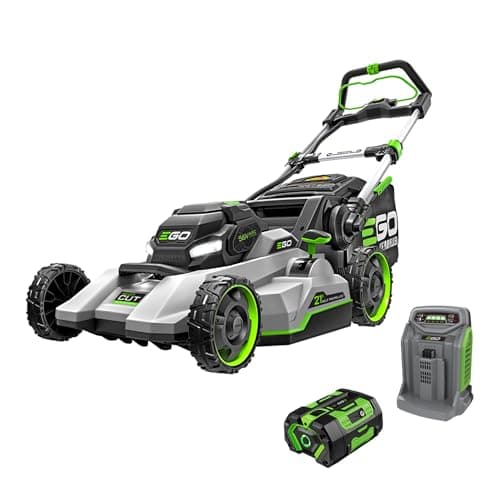
EGO Power+ 21" Select Cut LM2135SP
EGO · EGO 56V ARC Lithium · Our score 9.1/10
#ad Price as of October 23, 2026. Prices change; we check daily. How we're funded.
The most watt-hours in the box of any flagship walk-behind here, on the platform with the widest tool range to grow into.
Published specs
| Deck | 21 in |
|---|---|
| Cutting torque | Up to 7.0 ft-lbs |
| Battery included | 56V 7.5Ah |
| Cut height | 1-4 in, 8 positions |
| Self-propel speed | 0.9-3.1 MPH |
| Runtime claim | Up to 60 min |
| Warranty | 5-yr tool / 3-yr battery |
Source: EGO POWER+ 21" Select Cut System (LM2135SP), egopowerplus.com
56V x 7.5Ah = 420Wh, using EGO's advertised pack voltage.
What the numbers favor
- 420Wh in the box -- the largest included pack of any flagship walk-behind on this page
- Eight cut-height positions from 1 to 4 in, the widest published range here
- Three interchangeable lower blades (mulching, high-lift bagging, extended runtime)
- 5-year tool warranty, the longest published on this page
What they don't
- EGO publishes torque (7.0 ft-lbs), not motor wattage, so it cannot be compared directly against Greenworks' 1500W figure
- The 7.5Ah pack that earns the runtime claim is also the expensive one to replace
your yard is under a quarter acre. You would be paying for 420Wh of headroom you will never discharge, and a 20 in push mower cuts the same grass.
How it scores
Scores are our editorial weighting of the published specs above, not a test result. They are deliberately kept out of this page's structured data.
Scotts Elite Spreader
Scotts · Manual (push) · Our score 8.5/10
#ad No verified live price right now, so we show none rather than a stale one. How we're funded.
A 6 ft dual-rotor pattern over 20,000 sq ft, with EdgeGuard to keep product off the sidewalk.
Published specs
| Type | Broadcast (rotary), dual rotor |
|---|---|
| Spread width | 6 ft |
| Coverage per fill | Up to 20,000 sq ft |
| Hopper capacity | 80 lb |
| Edge control | EdgeGuard (blocks right side) |
| Tires | 10 in, foam filled |
Source: Scotts Elite Spreader (75902), scotts.com
5,000 sq ft at a 6 ft spread width needs about 833 linear feet of walking. On a 60 ft run that is roughly 14 passes -- versus 17 passes at a standard 5 ft width. That is the whole practical difference the dual rotor buys.
What the numbers favor
- 6 ft pattern against the 5 ft standard -- about 20% fewer passes
- 80 lb hopper covers 20,000 sq ft without a refill
- EdgeGuard keeps fertilizer off hard surfaces, which is where runoff starts
- Foam-filled tires cannot go flat in the shed over winter
What they don't
- 80 lb loaded is heavy to push on soft or sloped ground
- Broadcast spreaders are harder to control near beds than a drop spreader
your lawn is under about 2,000 sq ft or heavily bordered by beds. A drop spreader puts product exactly where you steer it and nowhere else.
How it scores
Scores are our editorial weighting of the published specs above, not a test result. They are deliberately kept out of this page's structured data.
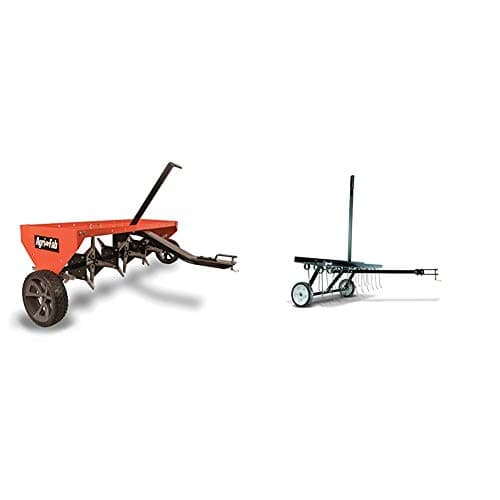
Agri-Fab 48" Tow-Behind Plug Aerator (45-0299)
Agri-Fab · Tow-behind (needs a tractor) · Our score 8.0/10
#ad Price as of October 23, 2026. Prices change; we check daily. How we're funded.
32 galvanized knives pulling 3 in plugs across 48 in -- the only tool here that actually relieves compaction.
Published specs
| Working width | 48 in |
|---|---|
| Knives | 32, galvanized |
| Plug depth | Up to 3 in |
| Weight tray capacity | 175 lb |
| Unit weight | 94 lb |
| Tires | 10 in flat-proof |
Source: 48" Tow Behind Plug Aerator (45-0299), agri-fab.com
10,000 sq ft at a 48 in (4 ft) working width needs 2,500 linear feet. On a 48 ft run that is about 52 passes -- an hour or so behind a tractor, against a full day with a walk-behind core aerator.
What the numbers favor
- Pulls genuine 3 in cores, which is what aeration means
- 48 in width covers ground fast
- 175 lb weight tray lets you force depth in hard soil
- Flat-proof tires
What they don't
- Needs a lawn tractor or riding mower to tow it -- useless on its own
- 94 lb empty is awkward to move and store by hand
you have no tow vehicle. Without a tractor this is a 94 lb ornament; rent a walk-behind core aerator for the weekend instead.
How it scores
Scores are our editorial weighting of the published specs above, not a test result. They are deliberately kept out of this page's structured data.
Where to buy the tools on this page
Amazon affiliate links, except where a product has no Amazon listing — those go direct to the maker and earn us nothing, and the button says so. We show no price we have not verified today, so where there is no live figure the link says "check price" and takes you to the listing to read it there.
Best overall
EGO Power+ 21" Select Cut LM2135SP
EGO · EGO 56V ARC Lithium
Best overall
Scotts Elite Spreader
Scotts · Manual (push)
Best real aeration
Agri-Fab 48" Tow-Behind Plug Aerator (45-0299)
Agri-Fab · Tow-behind (needs a tractor)
#ad As an Amazon Associate we earn from qualifying purchases, at no extra cost to you. How we're funded.
Common questions
How do I get rid of lawn weeds?
What cultural practices reduce weeds?
When is the best time to control broadleaf weeds?
When should crabgrass preventer go down?
What is the difference between annual and perennial weeds?
Does mowing height affect weeds?
Sources
Read next
- Best lawn sprayers, ranked on the seal compound
Three sprayers compared on the one spec every maker publishes -- seal compound -- plus the warranty correlation, the filtration that decides clogging, and the figures none of them print.
- Lawn Care
Cutting the grass is a third of the job. This is the other two thirds.
- Doing your own lawn care: what to do, and when
Four jobs, the right order, the right season. The sequence matters more than the equipment.
- What height should you mow your lawn?
The one-third rule, the 3-inch recommendation, and every published cut-height range checked against them.
- How to overseed a lawn
Published extension seeding rates, the late-summer window, and the passes-per-lawn arithmetic.
- Soil testing for lawns, step by step
4 inches deep, 8 to 10 locations, every three to five years. What the report tells you.
- Fall lawn care, in the order the guidance puts it
Aeration, seeding, weeds and most feeding all land between late August and mid-October.
- Best weed puller
Stand-up weeders on published height, weight and ejection, with the Extension case for pulling.