Lawn Care
Best fertilizer spreader for the money
A spreader has no motor and nothing to wear out but the gearbox. What you are actually buying is passes saved.
Affiliate disclosure: we earn a commission if you buy through our links, at no extra cost to you. It never changes which product we rank first — here is how we're funded.
We have not tested these units. Every spec on this page comes from the manufacturer's own documentation and is linked to it. Every computed figure is arithmetic you can redo. Prices are checked daily — last verified September 24, 2026. Here is exactly how we pick.
Quick picks
Ranked on the published specs and the arithmetic below. Tap any row to jump to the full write-up. We have not tested these units -- here is exactly how we pick.
| # | Product | Best for | Score | Price |
|---|---|---|---|---|
| 1 | No photo Scotts Elite Spreader A 6 ft dual-rotor pattern over 20,000 sq ft, with EdgeGuard to keep product off the sidewalk. | Best overall | 8.5 | |
| 2 | 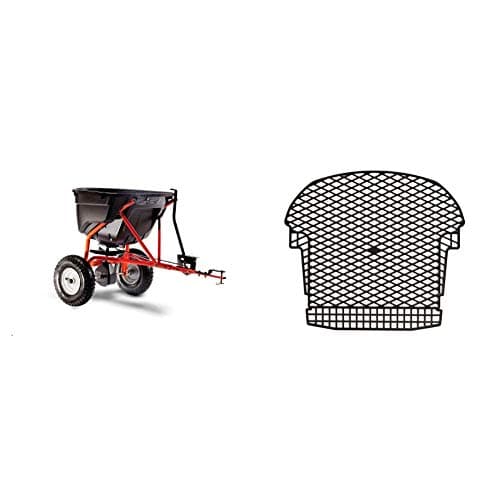 Agri-Fab 130 lb Tow Spreader (45-0463) A 130 lb hopper on pneumatic tires that turns a two-hour push into one lap of the yard. | Best for big lawns | 8.0 |
#ad Buy links are affiliate links. Prices come from a live daily check; where we have no verified price we say "check price" rather than print a stale one.
A spreader is the simplest thing in the shed: a hopper, a gearbox and a spinning plate. There is no battery to age and no motor to burn out, which means value here is not about durability specs. It is about how many times you have to walk the lawn.
The short answer
Value is passes, and passes are arithmetic
That is the whole value case for a wider pattern, and it repeats every application, several times a year, for as long as you own the spreader. It is also why we rank on published spread width rather than on build quality claims that nobody quantifies.
Hopper capacity is the second number
The two, on published figures
| Spec | Scotts Elite (75902) | Agri-Fab 45-0463 |
|---|---|---|
| Type | Broadcast, dual rotor, walk-behind | Broadcast, tow-behind |
| Spread width | 6 ft | Not published |
| Hopper capacity | 80 lb | 130 lb |
| Coverage per fill | Up to 20,000 sq ft | Not published (about 43,000 sq ft at 3 lb/1,000) |
| Edge control | EdgeGuard, blocks the right side | Not published |
| Tires | 10 in, foam filled | Pneumatic |
| Gearbox | Not published | Enclosed |
| Unit weight | Not published | 37 lb |
| Needs a tow vehicle | No | Yes |
Transcribed from the Scotts Elite and Agri-Fab 45-0463 product pages. Passes and coverage arithmetic are ours.
1. Scotts Elite — the widest published walk-behind pattern
Six feet is the widest published spread width in our registry and the reason this is the value pick: it is the specification that reduces the work every single time you use it. The dual rotor is what produces that width, and the 80 lb hopper means the pattern rather than the capacity is the constraint.
EdgeGuard is the feature that stops product landing on a drive or washing into a drain, which matters both for the lawn and for the watershed. Ten inch foam-filled tires will not go flat in a shed over winter.
Against it: a 6 ft pattern is imprecise near beds — that is the trade a broadcast spreader makes — and Scotts publishes no unit weight and no gearbox detail. An 80 lb hopper full of fertilizer is a lot to push on a slope.
#ad Check the Scotts Elite Spreader price on Amazon — how we're funded.
2. Agri-Fab 45-0463 — if a tractor does the walking
One hundred and thirty pounds in a rustproof poly hopper on an enclosed gearbox and pneumatic tires, at 37 lb empty. At a typical rate that is roughly an acre per fill, and the walking arithmetic above stops applying entirely because you are sitting down.
Against it: it needs a tow vehicle, and Agri-Fab publishes no spread width, no coverage figure and no edge control. For a lawn under half an acre it is the wrong tool — see spreaders for small lawns.
#ad Check the Agri-Fab 130 lb Tow Spreader (45-0463) price on Amazon — how we're funded.
Broadcast, drop and handheld
Three mechanisms exist and they are not graded versions of one another. Each is the right answer somewhere.
| Type | How it works | Pattern width | Where it wins |
|---|---|---|---|
| Broadcast (rotary) | Spinning disc throws product outward | Wide -- 6 ft on the Scotts Elite | Open lawn; fewest passes |
| Drop | Product falls between the wheels | Exactly the hopper width | Next to beds, drives and water |
| Handheld crank | Small hopper, hand-cranked disc | Narrow and uneven | Patches and very small lawns |
| Tow-behind broadcast | As broadcast, pulled by a tractor | Not published by Agri-Fab | Half an acre and up |
Pattern widths are published figures where a maker states one. Agri-Fab publishes no spread width for the 45-0463.
The value argument favors broadcast for almost every home lawn, because pattern width is the variable that reduces work. Where broadcast loses is precision: a 6 ft pattern centered on a path throws three feet of product onto the path. That is what EdgeGuard exists to stop, and it is why a drop spreader still has a job next to a pond or a border.
The overlap question, which decides evenness
This is also the reason the half-rate, two-directions method works so well: two passes at right angles cancel each other's seams, so overlap error stops mattering.
What actually breaks on a spreader
- The gearbox, which is why Agri-Fab publishing an enclosed one is worth noting and Scotts publishing nothing about its own is worth noting too.
- The hopper, from fertilizer itself. Most lawn fertilizers are salts and they are corrosive to metal. Agri-Fab publishes a rustproof poly hopper; Scotts does not state a hopper material.
- The shut-off linkage, which is the part you operate every few seconds. Neither maker publishes anything about it.
- Tires, on a stored machine. Scotts' 10 in foam-filled tires cannot go flat over winter, which is a small but genuine durability advantage over pneumatic.
The maintenance that prevents most of it is rinsing the hopper and disc after use and letting it dry. Nobody publishes an interval for that either, which puts it in the same category as most of the jobs on our maintenance schedule.
The free upgrade: calibrate it
A spreader is only as accurate as its setting, and the setting is the difference between an even lawn and a striped one. Our spreader settings page covers how to find the right number, and how to measure your lawn gives you the area to apply it to.
- Half the rate, twice the passes, at right angles. It doubles the walking and eliminates stripes, and it is free.
- Close the hopper before you stop walking, not after.
- Sweep hard surfaces back onto the lawn. Fertilizer on a driveway is money in a storm drain.
What to check before buying
- Is a spread width published? It is the figure that decides how much walking you do, and one of the two spreaders here does not state it.
- Does the hopper outlast your lawn? Divide the capacity by your application rate; if it does not cover the lawn in one fill you will be carrying a bag around with you.
- Is there edge control? Only if your lawn borders hard surfaces or water — and if it does, it matters a lot.
- Do the settings map to the products you buy? Spreader settings covers finding the right number when the bag and the spreader disagree.
- Do you have a tow vehicle? It is the single question that decides between the two machines on this page.
For lawns under about 5,000 sq ft, neither of these is the obvious answer — a smaller hopper is easier to store and quicker to fill. See spreaders for small lawns.
What we cannot tell you
We have not used either spreader. Agri-Fab publishes no spread width, which makes the passes arithmetic impossible for it; Scotts publishes no unit weight or gearbox detail. The 3 lb per 1,000 sq ft rate used above is a typical figure drawn from the bags in our registry, not a universal one — your product's label sets the real rate. Nobody publishes a pattern-uniformity figure, which is the specification that would actually separate a good spreader from a bad one.
The picks in full
Specs are the manufacturer's own and linked to the page they came from. Prices come from a live daily check; where we have no verified price we say so rather than print a stale one.
Scotts Elite Spreader
Scotts · Manual (push) · Our score 8.5/10
#ad No verified live price right now, so we show none rather than a stale one. How we're funded.
A 6 ft dual-rotor pattern over 20,000 sq ft, with EdgeGuard to keep product off the sidewalk.
Published specs
| Type | Broadcast (rotary), dual rotor |
|---|---|
| Spread width | 6 ft |
| Coverage per fill | Up to 20,000 sq ft |
| Hopper capacity | 80 lb |
| Edge control | EdgeGuard (blocks right side) |
| Tires | 10 in, foam filled |
Source: Scotts Elite Spreader (75902), scotts.com
5,000 sq ft at a 6 ft spread width needs about 833 linear feet of walking. On a 60 ft run that is roughly 14 passes -- versus 17 passes at a standard 5 ft width. That is the whole practical difference the dual rotor buys.
What the numbers favor
- 6 ft pattern against the 5 ft standard -- about 20% fewer passes
- 80 lb hopper covers 20,000 sq ft without a refill
- EdgeGuard keeps fertilizer off hard surfaces, which is where runoff starts
- Foam-filled tires cannot go flat in the shed over winter
What they don't
- 80 lb loaded is heavy to push on soft or sloped ground
- Broadcast spreaders are harder to control near beds than a drop spreader
your lawn is under about 2,000 sq ft or heavily bordered by beds. A drop spreader puts product exactly where you steer it and nowhere else.
How it scores
Scores are our editorial weighting of the published specs above, not a test result. They are deliberately kept out of this page's structured data.
Agri-Fab 130 lb Tow Spreader (45-0463)
Agri-Fab · Tow-behind (needs a tractor) · Our score 8.0/10
#ad Price as of September 24, 2026. Prices change; we check daily. How we're funded.
A 130 lb hopper on pneumatic tires that turns a two-hour push into one lap of the yard.
Published specs
| Type | Tow-behind broadcast spreader |
|---|---|
| Hopper capacity | 130 lb |
| Hopper material | Rustproof poly |
| Gearbox | Enclosed |
| Wheels | Pneumatic |
| Unit weight | 37 lb |
| Assembled size | 46.0 x 27.1 x 31.5 in |
| Spread width | Not published on the product page |
Source: 130 lb. Tow Spreader - 45-0463, agri-fab.com
A 130 lb hopper at a 3 lb per 1,000 sq ft application rate covers 130 / 3 = 43.3 thousand square feet, or about an acre. A typical 80 lb push hopper covers 26,700 sq ft at the same rate. Whether you ever hit that depends on the rate your product calls for, which is printed on the bag and not on the spreader.
What the numbers favor
- 130 lb hopper, 62% more than the largest push spreader we hold specs for
- Poly hopper cannot rust where fertilizer sits
- Enclosed gearbox keeps grit out of the drive
- 37 lb empty, so it is manageable to hitch and store
What they don't
- Spread width is not published on the product page, which is the one number you need to plan passes
- No published operating speed on the product page either
- Useless without a tractor or riding mower to tow it
you have no tow vehicle or a lawn under about 10,000 sq ft. A push spreader costs less and steers better around beds.
How it scores
Scores are our editorial weighting of the published specs above, not a test result. They are deliberately kept out of this page's structured data.
Where to buy the tools on this page
Every link below is an Amazon affiliate link. We show no price we have not verified today, so where there is no live figure the link says "check price" and takes you to the listing to read it there.
Best overall
Scotts Elite Spreader
Scotts · Manual (push)
Best for big lawns
Agri-Fab 130 lb Tow Spreader (45-0463)
Agri-Fab · Tow-behind (needs a tractor)
#ad As an Amazon Associate we earn from qualifying purchases, at no extra cost to you. How we're funded.
Common questions
What is the best fertilizer spreader for the money?
Does a wider spreader save much time?
Is a broadcast or drop spreader better value?
How big a hopper do you need?
Do you need edge control on a spreader?
Sources
Read next
- Lawn Care
Cutting the grass is a third of the job. This is the other two thirds.
- Best lawn spreader for fertilizer and seed
Spread width decides how long the job takes. The passes-per-lawn math, worked out.
- Best fertilizer spreader for a small lawn
Broadcast against drop on a small bordered lot, and why hopper size can be a liability.
- Best tow-behind spreader
130 lb tow hopper against an 80 lb push hopper, converted to area covered per fill.
- Spreader settings: how to calibrate instead of guessing
Calibrate a spreader by weight in twenty minutes, with the passes and rate arithmetic.
- What the three numbers on a fertilizer bag mean
N-P-K decoded, UMN's published nitrogen rates, and the maths that turns a bag into pounds.
- How to measure your lawn (and why every other decision needs it)
Three methods for an irregular lawn, plus the sq ft to acres conversions everything else needs.