Lawn Care
Best tow-behind spreader
A hopper is only worth its size if you know your application rate. Here is what 130 lb covers, and what the makers refuse to publish.
Affiliate disclosure: we earn a commission if you buy through our links, at no extra cost to you. It never changes which product we rank first — here is how we're funded.
We have not tested these units. Every spec on this page comes from the manufacturer's own documentation and is linked to it. Every computed figure is arithmetic you can redo. Prices are checked daily — last verified October 25, 2026. Here is exactly how we pick.
Quick picks
Ranked on the published specs and the arithmetic below. Tap any row to jump to the full write-up. We have not tested these units -- here is exactly how we pick.
| # | Product | Best for | Score | Price |
|---|---|---|---|---|
| 1 | Agri-Fab 130 lb Tow Spreader (45-0463) A 130 lb hopper on pneumatic tires that turns a two-hour push into one lap of the yard. | Best for big lawns | 8.0 | |
| 2 | No photo Scotts Elite Spreader A 6 ft dual-rotor pattern over 20,000 sq ft, with EdgeGuard to keep product off the sidewalk. | Best overall | 8.5 |
#ad Buy links are affiliate links. Prices come from a live daily check; where we have no verified price we say "check price" rather than print a stale one.
Spreaders are sold on hopper size, which is the least useful way to compare them. A hopper is a number of pounds; what you want is a number of square feet, and getting from one to the other needs the application rate off the bag. Here is that conversion for the largest tow hopper and the largest push hopper we hold specifications for.
The short answer
Pounds converted to square feet
Application rates live on the product bag, not on the spreader. Pick a rate and the hopper size turns into an area.
Tow against push, on published figures
| Spec | Agri-Fab 45-0463 (tow) | Scotts Elite (push) |
|---|---|---|
| Hopper capacity | 130 lb | 80 lb |
| Coverage per fill (maker) | Not published | Up to 20,000 sq ft |
| Spread width | Not published on the product page | 6 ft, dual rotor |
| Hopper material | Rustproof poly | Not published |
| Gearbox | Enclosed | Dual rotor |
| Wheels | Pneumatic | 10 in, foam filled |
| Edge control | Not published | EdgeGuard (blocks right side) |
| Unit weight | 37 lb | Not published |
| Assembled size | 46.0 x 27.1 x 31.5 in | Not published |
| Needs a tow vehicle | Yes | No |
Transcribed from the Agri-Fab 45-0463 and Scotts Elite Spreader product pages, fetched 9 September 2026. Area-per-fill figures are our arithmetic at a stated rate.
1. Agri-Fab 45-0463 — best for big lawns
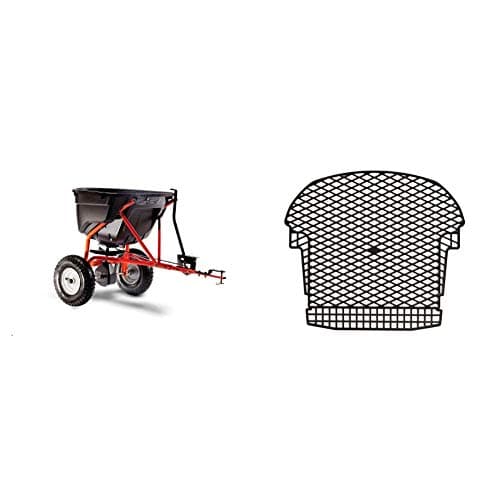
A 130 lb poly hopper, an enclosed gearbox and pneumatic tires, at 37 lb empty and 46 inches long assembled. Poly matters here: fertilizer is hygroscopic and corrosive, and a steel hopper that sits with residue in it does not last.
The enclosed gearbox is the second point. A tow spreader's impeller is driven off the wheels, so the gearbox lives directly in the fall of grit and product. Enclosing it is the difference between a spreader that works in year five and one that grinds.
The honest failure: the product page publishes no spread width and no operating speed. Those are the two numbers that let you plan pass spacing, and without them the only route is calibration — run a known weight over a measured area and see what happens.
#ad Check the Agri-Fab 130 lb Tow Spreader (45-0463) price on Amazon — how we're funded.
2. Scotts Elite — when a push spreader is still right
Eighty pounds, a published 6 ft dual-rotor spread width, up to 20,000 sq ft per fill, EdgeGuard to keep product off the sidewalk, and foam-filled tires that cannot go flat over winter.
It publishes what Agri-Fab does not: a spread width. Six feet against a five-foot standard is about 20% fewer passes, and knowing the number is what lets you space them.
It is here because a tow spreader is the wrong answer for most lawns. Under about 10,000 sq ft, or on a lawn cut up by beds and paths, walking behind a hopper you can steer beats towing one you cannot. EdgeGuard also does something no tow spreader here offers: it stops product landing on hard surfaces, which is where runoff starts.
#ad Check the Scotts Elite Spreader price on Amazon — how we're funded.
Calibrating a spreader with no published width
- Weigh out a known quantity — 10 lb is convenient — and put it in an empty hopper.
- Run it over a measured strip at your normal towing speed until the hopper is empty, keeping the passes at a fixed spacing.
- Divide the weight by the area you actually covered. That is your real rate in pounds per 1,000 sq ft, at that setting and that speed.
- Adjust the gate setting and repeat until the measured rate matches the rate on the bag. Faster towing broadens the pattern, so calibrate at the speed you will use.
Who should skip both
- Small lawns. Under about 5,000 sq ft, a small-lawn spreader or a drop spreader puts product exactly where you steer it.
- Anyone without a tow vehicle. The Agri-Fab has no drive of its own — the wheels turn the impeller, and something has to turn the wheels.
- Lawns bordered by water. Broadcast spreaders throw product sideways. Near a pond, stream or storm drain, a drop spreader is the responsible choice.
What we cannot tell you
Agri-Fab publishes no spread width, no operating speed, no tire size and no warranty term on the 45-0463 product page. Scotts publishes no unit weight or assembled dimensions for the Elite. Neither publishes a calibration table for any specific product, which is why the procedure above measures instead of assuming. And we have not run either spreader across a season to compare pattern consistency as the hopper empties.
The picks in full
Specs are the manufacturer's own and linked to the page they came from. Prices come from a live daily check; where we have no verified price we say so rather than print a stale one.
Agri-Fab 130 lb Tow Spreader (45-0463)
Agri-Fab · Tow-behind (needs a tractor) · Our score 8.0/10
#ad Price as of October 25, 2026. Prices change; we check daily. How we're funded.
A 130 lb hopper on pneumatic tires that turns a two-hour push into one lap of the yard.
Published specs
| Type | Tow-behind broadcast spreader |
|---|---|
| Hopper capacity | 130 lb |
| Hopper material | Rustproof poly |
| Gearbox | Enclosed |
| Wheels | Pneumatic |
| Unit weight | 37 lb |
| Assembled size | 46.0 x 27.1 x 31.5 in |
| Spread width | Not published on the product page |
Source: 130 lb. Tow Spreader - 45-0463, agri-fab.com
A 130 lb hopper at a 3 lb per 1,000 sq ft application rate covers 130 / 3 = 43.3 thousand square feet, or about an acre. A typical 80 lb push hopper covers 26,700 sq ft at the same rate. Whether you ever hit that depends on the rate your product calls for, which is printed on the bag and not on the spreader.
What the numbers favor
- 130 lb hopper, 62% more than the largest push spreader we hold specs for
- Poly hopper cannot rust where fertilizer sits
- Enclosed gearbox keeps grit out of the drive
- 37 lb empty, so it is manageable to hitch and store
What they don't
- Spread width is not published on the product page, which is the one number you need to plan passes
- No published operating speed on the product page either
- Useless without a tractor or riding mower to tow it
you have no tow vehicle or a lawn under about 10,000 sq ft. A push spreader costs less and steers better around beds.
How it scores
Scores are our editorial weighting of the published specs above, not a test result. They are deliberately kept out of this page's structured data.
Scotts Elite Spreader
Scotts · Manual (push) · Our score 8.5/10
#ad No verified live price right now, so we show none rather than a stale one. How we're funded.
A 6 ft dual-rotor pattern over 20,000 sq ft, with EdgeGuard to keep product off the sidewalk.
Published specs
| Type | Broadcast (rotary), dual rotor |
|---|---|
| Spread width | 6 ft |
| Coverage per fill | Up to 20,000 sq ft |
| Hopper capacity | 80 lb |
| Edge control | EdgeGuard (blocks right side) |
| Tires | 10 in, foam filled |
Source: Scotts Elite Spreader (75902), scotts.com
5,000 sq ft at a 6 ft spread width needs about 833 linear feet of walking. On a 60 ft run that is roughly 14 passes -- versus 17 passes at a standard 5 ft width. That is the whole practical difference the dual rotor buys.
What the numbers favor
- 6 ft pattern against the 5 ft standard -- about 20% fewer passes
- 80 lb hopper covers 20,000 sq ft without a refill
- EdgeGuard keeps fertilizer off hard surfaces, which is where runoff starts
- Foam-filled tires cannot go flat in the shed over winter
What they don't
- 80 lb loaded is heavy to push on soft or sloped ground
- Broadcast spreaders are harder to control near beds than a drop spreader
your lawn is under about 2,000 sq ft or heavily bordered by beds. A drop spreader puts product exactly where you steer it and nowhere else.
How it scores
Scores are our editorial weighting of the published specs above, not a test result. They are deliberately kept out of this page's structured data.
Where to buy the tools on this page
Amazon affiliate links, except where a product has no Amazon listing — those go direct to the maker and earn us nothing, and the button says so. We show no price we have not verified today, so where there is no live figure the link says "check price" and takes you to the listing to read it there.
Best for big lawns
Agri-Fab 130 lb Tow Spreader (45-0463)
Agri-Fab · Tow-behind (needs a tractor)
Best overall
Scotts Elite Spreader
Scotts · Manual (push)
#ad As an Amazon Associate we earn from qualifying purchases, at no extra cost to you. How we're funded.
Common questions
What is the best tow-behind spreader?
How much does a 130 lb spreader cover?
Is a tow-behind spreader better than a push spreader?
What spread width does a tow spreader have?
Do I need a tractor for a tow-behind spreader?
Sources
Read next
- Lawn Care
Cutting the grass is a third of the job. This is the other two thirds.
- Best lawn spreader for fertilizer and seed
Spread width decides how long the job takes. The passes-per-lawn math, worked out.
- Best fertilizer spreader for a small lawn
Broadcast against drop on a small bordered lot, and why hopper size can be a liability.
- Spreader settings: how to calibrate instead of guessing
Calibrate a spreader by weight in twenty minutes, with the passes and rate arithmetic.
- What the three numbers on a fertilizer bag mean
N-P-K decoded, UMN's published nitrogen rates, and the maths that turns a bag into pounds.
- How to measure your lawn (and why every other decision needs it)
Three methods for an irregular lawn, plus the sq ft to acres conversions everything else needs.
- Best lawn sweeper
Hopper capacity, brush-to-wheel ratio and storage volume for two tow-behind sweepers.
- Best lawn roller
Filled and empty weights, drum sizes and load per inch for two tow-behind lawn rollers.