Lawn Care
How to overseed a lawn
Late summer, the right rate, and seed touching soil. Everything else is detail.
Affiliate disclosure: we earn a commission if you buy through our links, at no extra cost to you. It never changes which product we rank first — here is how we're funded.
We have not tested these units. Every spec on this page comes from the manufacturer's own documentation and is linked to it. Every computed figure is arithmetic you can redo. Prices are checked daily — last verified October 19, 2026. Here is exactly how we pick.
Overseeding is the highest-return job in the lawn calendar and the one most often done at the wrong time of year. Get the window right and the rate right and a thin lawn thickens up over one autumn; get them wrong and you have fed the birds.
Why late summer beats spring
Penn State Extension is direct about it: late summer is the optimum time to seed, and seedlings from a late-summer planting will have two cool growing seasons (fall and spring) to become established. Spring-sown grass gets one cool season and then meets July as a seedling.
The other half of the argument is competition. Crabgrass and most summer annual weeds are germinating in spring and finishing in late summer; seeding into September puts your grass in the ground when its competition is on the way out.
Published seeding rates
| Species | New establishment (lb / 1,000 sq ft) | Notes |
|---|---|---|
| Turf-type tall fescue | 6-8 | Sunny areas; the heaviest rate published |
| Perennial ryegrass | 4-5 | 4-6 for overseeding and renovation |
| Kentucky bluegrass | 2-3 | Fine seed, so a low rate goes a long way |
| Fine fescues | 4-5 | Shaded areas |
| Rough bluegrass | 2-3 | Shaded areas |
Rates as published by Penn State Extension for Pennsylvania conditions. Your county extension service is the authority for your own region and species mix -- these are the numbers we can cite, not a universal prescription.
The method, in order
- Mow low, once. Take the lawn down before you seed so the new seed reaches soil rather than sitting in a canopy. This is the one time of year to ignore the 3-inch maintenance height, and go straight back up afterwards.
- Deal with thatch and compaction first. Minnesota Extension treats thatch over half an inch as a problem, and recommends core aeration from late August through early October — the same window as seeding. The difference between dethatching and aerating matters here, and it is covered on the dethatching page.
- Spread at the published rate, in two passes at half rate, walking at right angles on the second. Half-rate cross-hatching is how you avoid stripes.
- Get seed touching soil. Penn State suggests dragging with a leaf rake without pressure, to cover most of the seed with about a quarter inch of soil, then rolling with a lightweight roller.
- Keep it damp until it germinates. Not soaked. New seed dries out faster than established turf because it has no root system yet.
The spreader arithmetic
A spread width turns a rate into a route. The Scotts Elite publishes a 6 ft dual-rotor pattern and up to 20,000 sq ft of coverage from an 80 lb hopper, which on most suburban lawns means you fill it once and never stop.
Broadcast spreaders throw product in an arc, which is fast and imprecise near beds. The Scotts Elite publishes EdgeGuard, which blocks the right side of the pattern so seed and fertilizer stay off the sidewalk — that is where runoff starts. Check the Scotts Elite on Amazon, or read the spreader roundup for the drop-spreader alternative.
Aerating or dethatching first
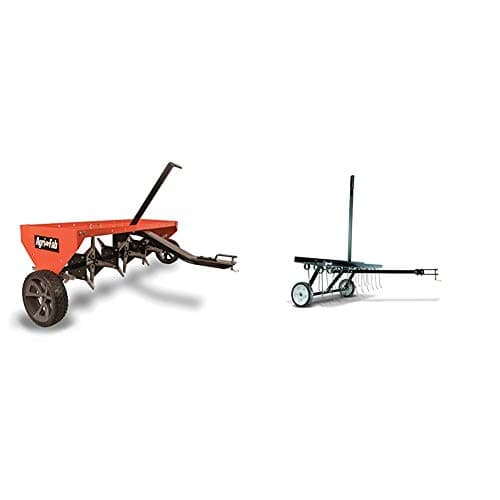
Both are September jobs and they do different things. Core aeration pulls plugs and relieves compaction; the Agri-Fab tow-behind publishes 32 knives across 48 inches pulling up to 3-inch plugs. Dethatching removes the fibrous layer at the surface; the Sun Joe AJ801E publishes a working depth of 0 to 0.4 inches, which is a dethatcher rather than an aerator.
For overseeding specifically, aeration is the more useful of the two: it opens holes that seed falls into and makes contact with soil. If your lawn also has a thatch layer over half an inch, dethatch first and seed into the cleared surface.
#ad Check the Agri-Fab 48-inch plug aerator price on Amazon — how we're funded.
#ad Check the Sun Joe AJ801E dethatcher price on Amazon — how we're funded.
The first six weeks after seeding
Seed germinates into a lawn that is still being used, and the two things most likely to undo the work are mowing it too soon and walking on it too much. Both are free to avoid.
- Keep the surface from drying out. New seed has no root system, so it dries faster than established turf. The Penn State page we cite does not publish germination watering rates, so we are not going to invent one — the principle is little and often rather than deep and infrequent.
- Wait to mow, then obey the one-third rule. Minnesota Extension guidance applies to new grass as much as old: let it reach mowing height, then take no more than a third. Details on the mowing height guide.
- Use a sharp blade for the first cut. A dull blade tears young plants out of loose soil rather than cutting them.
- Keep traffic light. Seedlings on a path line are the ones that do not make it, and that is where you will see the failure next spring.
- Leave the clippings. Returned clippings are worth roughly one fertilizer application a year on an established lawn, and a new one has nothing to spare.
Why overseeding fails
In our reading of the extension guidance, the failures cluster into four causes, and three of them are decisions rather than accidents.
- Seeding in spring. One cool season instead of two, and summer arrives while the plants are still seedlings.
- Seed sitting on thatch. If the seed never reaches soil it never establishes. That is what the rake-drag and the roller are for, and it is why the thatch layer matters — see dethatching versus aerating.
- Guessing the rate. Too little is a thin result; too much is seedlings competing with each other. Calibrate the spreader instead: here is the method.
- Letting it dry out at day four. The one genuine accident on the list, and the reason to seed when the weather is on your side rather than when the weekend is free.
What we cannot tell you
- The right species for your yard. That is a climate and soil question your county extension service answers better than any comparison site.
- Watering volumes. The Penn State page we cite does not publish germination watering rates, so we do not state one.
- Regional timing. The late-August-to-early-September window is Penn State's guidance for Pennsylvania. Further south and further north it moves.
The products discussed
Specs are the manufacturer's own and linked to the page they came from. Prices come from a live daily check; where we have no verified price we say so rather than print a stale one.
Scotts Elite Spreader
Scotts · Manual (push) · Our score 8.5/10
#ad No verified live price right now, so we show none rather than a stale one. How we're funded.
A 6 ft dual-rotor pattern over 20,000 sq ft, with EdgeGuard to keep product off the sidewalk.
Published specs
| Type | Broadcast (rotary), dual rotor |
|---|---|
| Spread width | 6 ft |
| Coverage per fill | Up to 20,000 sq ft |
| Hopper capacity | 80 lb |
| Edge control | EdgeGuard (blocks right side) |
| Tires | 10 in, foam filled |
Source: Scotts Elite Spreader (75902), scotts.com
5,000 sq ft at a 6 ft spread width needs about 833 linear feet of walking. On a 60 ft run that is roughly 14 passes -- versus 17 passes at a standard 5 ft width. That is the whole practical difference the dual rotor buys.
What the numbers favor
- 6 ft pattern against the 5 ft standard -- about 20% fewer passes
- 80 lb hopper covers 20,000 sq ft without a refill
- EdgeGuard keeps fertilizer off hard surfaces, which is where runoff starts
- Foam-filled tires cannot go flat in the shed over winter
What they don't
- 80 lb loaded is heavy to push on soft or sloped ground
- Broadcast spreaders are harder to control near beds than a drop spreader
your lawn is under about 2,000 sq ft or heavily bordered by beds. A drop spreader puts product exactly where you steer it and nowhere else.
How it scores
Scores are our editorial weighting of the published specs above, not a test result. They are deliberately kept out of this page's structured data.
Sun Joe AJ801E Dethatcher + Scarifier
Sun Joe · Corded 120V · Our score 7.6/10
#ad No verified live price right now, so we show none rather than a stale one. How we're funded.
Two swappable cylinders and five depth settings -- but read the depth numbers before you assume this aerates.
Published specs
| Motor | 12 A |
|---|---|
| Working width | 12.6 in |
| Depth settings | 5 |
| Raking depth | 0 to 0.4 in |
| Scarifying depth | -0.4 to 0 in |
| Speed | 2,990 RPM |
| Collection bag | 8 gal |
| Tines | 27-tine dethatching cylinder |
Source: Sun Joe AJ801E Electric Lawn Dethatcher + Scarifier, shopjoe.com
What the numbers favor
- Two cylinders in one machine -- dethatch and scarify without buying twice
- Five published depth settings with actual inch figures for each mode
- 8 gallon bag means fewer stops to rake up
- Corded, so no pack to size and no runtime limit
What they don't
- This is NOT an aerator. Maximum working depth is 0.4 in; core aeration needs 2-3 in
- 12.6 in working width makes a large lawn a long afternoon
- Corded, with the working-radius limit that implies
your problem is compacted soil rather than thatch. A 0.4 in scarifier cannot relieve compaction; you need a core aerator that pulls plugs.
How it scores
Scores are our editorial weighting of the published specs above, not a test result. They are deliberately kept out of this page's structured data.
Agri-Fab 48" Tow-Behind Plug Aerator (45-0299)
Agri-Fab · Tow-behind (needs a tractor) · Our score 8.0/10
#ad Price as of October 19, 2026. Prices change; we check daily. How we're funded.
32 galvanized knives pulling 3 in plugs across 48 in -- the only tool here that actually relieves compaction.
Published specs
| Working width | 48 in |
|---|---|
| Knives | 32, galvanized |
| Plug depth | Up to 3 in |
| Weight tray capacity | 175 lb |
| Unit weight | 94 lb |
| Tires | 10 in flat-proof |
Source: 48" Tow Behind Plug Aerator (45-0299), agri-fab.com
10,000 sq ft at a 48 in (4 ft) working width needs 2,500 linear feet. On a 48 ft run that is about 52 passes -- an hour or so behind a tractor, against a full day with a walk-behind core aerator.
What the numbers favor
- Pulls genuine 3 in cores, which is what aeration means
- 48 in width covers ground fast
- 175 lb weight tray lets you force depth in hard soil
- Flat-proof tires
What they don't
- Needs a lawn tractor or riding mower to tow it -- useless on its own
- 94 lb empty is awkward to move and store by hand
you have no tow vehicle. Without a tractor this is a 94 lb ornament; rent a walk-behind core aerator for the weekend instead.
How it scores
Scores are our editorial weighting of the published specs above, not a test result. They are deliberately kept out of this page's structured data.
Where to buy the tools on this page
Amazon affiliate links, except where a product has no Amazon listing — those go direct to the maker and earn us nothing, and the button says so. We show no price we have not verified today, so where there is no live figure the link says "check price" and takes you to the listing to read it there.
Best overall
Scotts Elite Spreader
Scotts · Manual (push)
Best for thatch, not compaction
Sun Joe AJ801E Dethatcher + Scarifier
Sun Joe · Corded 120V
Best real aeration
Agri-Fab 48" Tow-Behind Plug Aerator (45-0299)
Agri-Fab · Tow-behind (needs a tractor)
#ad As an Amazon Associate we earn from qualifying purchases, at no extra cost to you. How we're funded.
Common questions
When is the best time to overseed a lawn?
How much seed do I need to overseed?
Do I need to rake seed in?
Should I aerate before overseeding?
Can I overseed in spring instead?
How do I know how many passes to make with the spreader?
Sources
Read next
- Lawn Care
Cutting the grass is a third of the job. This is the other two thirds.
- Best lawn spreader for fertilizer and seed
Spread width decides how long the job takes. The passes-per-lawn math, worked out.
- Spreader settings: how to calibrate instead of guessing
Calibrate a spreader by weight in twenty minutes, with the passes and rate arithmetic.
- Dethatching vs aerating: they solve different problems
Thatch or compaction, how to tell which you have, and the published depths that decide the tool.
- Doing your own lawn care: what to do, and when
Four jobs, the right order, the right season. The sequence matters more than the equipment.
- What height should you mow your lawn?
The one-third rule, the 3-inch recommendation, and every published cut-height range checked against them.
- Best grass seed
Coverage claims converted to pounds per 1,000 sq ft, checked against Extension seeding rates.
- Best fertilizer for new grass
Starter versus lawn food on published analyses, with the nitrogen and phosphate arithmetic per 1,000 sq ft.
- Best grass seed for full sun
Sunlight hours, germination speed, soil temperature and seeding rates for three open-lawn mixes.
- Best mower for a new lawn
Top-end cut height, weight and blade condition for the first mow on newly established grass.
- Watering a new lawn
Germination windows from three seed makers, and the watering pattern that has to change once they close.