Mowers
How often should you mow your lawn?
The answer is not a number of days. It is a height, and the grass tells you when it has reached it.
Affiliate disclosure: we earn a commission if you buy through our links, at no extra cost to you. It never changes which product we rank first — here is how we're funded.
We have not tested these units. Every spec on this page comes from the manufacturer's own documentation and is linked to it. Every computed figure is arithmetic you can redo. Prices are checked daily — last verified October 23, 2026. Here is exactly how we pick.
Almost every answer to this question is a number of days, and almost every one of them is wrong for most of the season. Grass does not grow on a calendar. The extension guidance is better because it is expressed in the only unit the plant responds to: height.
The rule
The arithmetic works at any height. If you cut at 2.5 inches your trigger is about 3.75. If you cut at 3.5 inches your trigger is about 5.25. Pick your height, divide by two thirds, and that is when you mow.
What that means through the season
Growth rate is the variable, and it swings enormously. The interval that follows from the rule swings with it.
| Conditions | What the grass does | What the rule implies |
|---|---|---|
| Cool, wet spring | Fastest growth of the year | Possibly twice a week |
| Warm early summer | Steady growth | Roughly weekly |
| Hot, dry midsummer | Growth slows; cool-season turf may go dormant | Every two or three weeks, or not at all |
| Cool, wet early autumn | A second growth flush | Back to roughly weekly |
| Late autumn | Growth tails off | Stretching out to nothing |
Growth descriptions follow the seasonal pattern set out in extension guidance; the intervals are the direct consequence of the one-third rule rather than a published schedule.
#ad Check the EGO Power+ 21" Select Cut LM2135SP price on Amazon — how we're funded.
When the lawn has already got away from you
It happens — a fortnight of rain, a holiday, a broken charger. The wrong response is to drop the deck and take it all off in one pass, because that breaks the one-third rule by a long way and stresses the plant exactly when it is least able to cope.
- Raise the deck to its highest setting and cut. You will remove far less than you want to, and that is the point.
- Wait two or three days. Let the plant recover before you ask again.
- Drop one setting and cut again. Repeat until you are back at your normal height.
- Deal with the clippings. Extension guidance is that clippings of an inch or less filter down and decompose quickly, but that if the lawn is wet or the grass has become too tall, clippings can mat together and smother the grass. On an overgrown cut, bag or rake.
There is an equipment consequence here worth knowing about. A deck whose maximum height is low leaves you no room to execute step one. The Greenworks LM2054 tops out at 3.6 inches; the EGO LM2135SP and Greenworks LM2108S reach 4.0.
Why frequent mowing is less work, not more
- No bagging. Clippings of an inch or less filter down to the soil surface and decompose quickly, per extension guidance. That is one fewer job and no trips to empty a bag.
- Free fertilizer. Decomposed clippings add the equivalent of one fertilizer application to the lawn each year. Bagging throws that away.
- Less battery per cut. Short growth is a lighter load, so the pack goes further and the mower spends less time near its draw ceiling.
- A better cut. A sharp blade on short growth cuts cleanly; the same blade in a hayfield tears.
- Fewer weeds over time. Extension weed guidance treats mowing height and frequency as cultural controls, because dense turf at a good height leaves less room for anything else.
#ad Check the Greenworks 40V 20" Push LM2054 price on Amazon — how we're funded.
Pick the height before the frequency
Everything above depends on choosing a cutting height first, and higher is generally better on a cool-season lawn: it shades the soil, roots more deeply and needs less irrigation. Extension guidance for shaded areas goes further and recommends cutting approximately one inch higher than in sun.
Check your deck can do it. Published cut-height ranges vary: EGO publishes 1 to 4 inches over eight positions, Greenworks 1.38 to 4.0 on the 80V and 1.2 to 3.6 on the 40V, and Toro and Kobalt publish no range at all for the mowers we hold specs for.
What we cannot tell you
We cannot tell you how many days your lawn takes to grow an inch and a half. That depends on your grass species, your soil, your fertility program, your rainfall and your latitude, and any interval we printed would be wrong for most readers.
What the extension guidance gives you is better than an interval anyway: a height to maintain, a height to mow at, and a ceiling on how much to take. Measure the grass rather than the calendar.
The products discussed
Specs are the manufacturer's own and linked to the page they came from. Prices come from a live daily check; where we have no verified price we say so rather than print a stale one.
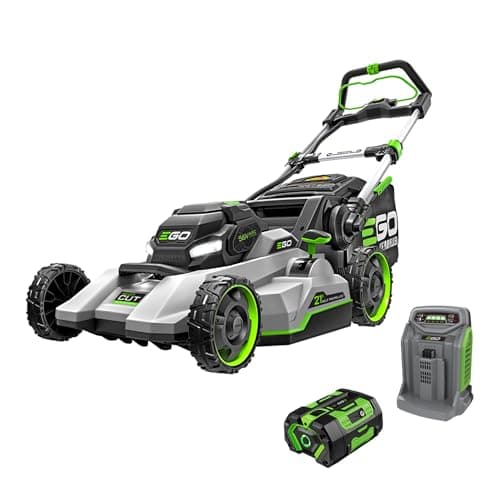
EGO Power+ 21" Select Cut LM2135SP
EGO · EGO 56V ARC Lithium · Our score 9.1/10
#ad Price as of October 23, 2026. Prices change; we check daily. How we're funded.
The most watt-hours in the box of any flagship walk-behind here, on the platform with the widest tool range to grow into.
Published specs
| Deck | 21 in |
|---|---|
| Cutting torque | Up to 7.0 ft-lbs |
| Battery included | 56V 7.5Ah |
| Cut height | 1-4 in, 8 positions |
| Self-propel speed | 0.9-3.1 MPH |
| Runtime claim | Up to 60 min |
| Warranty | 5-yr tool / 3-yr battery |
Source: EGO POWER+ 21" Select Cut System (LM2135SP), egopowerplus.com
56V x 7.5Ah = 420Wh, using EGO's advertised pack voltage.
What the numbers favor
- 420Wh in the box -- the largest included pack of any flagship walk-behind on this page
- Eight cut-height positions from 1 to 4 in, the widest published range here
- Three interchangeable lower blades (mulching, high-lift bagging, extended runtime)
- 5-year tool warranty, the longest published on this page
What they don't
- EGO publishes torque (7.0 ft-lbs), not motor wattage, so it cannot be compared directly against Greenworks' 1500W figure
- The 7.5Ah pack that earns the runtime claim is also the expensive one to replace
your yard is under a quarter acre. You would be paying for 420Wh of headroom you will never discharge, and a 20 in push mower cuts the same grass.
How it scores
Scores are our editorial weighting of the published specs above, not a test result. They are deliberately kept out of this page's structured data.
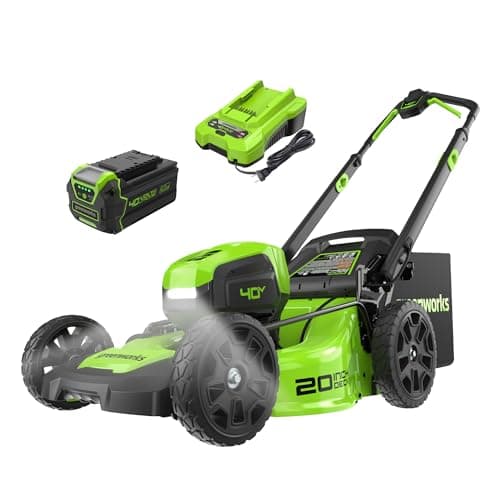
Greenworks 40V 20" Push LM2054
Greenworks · Greenworks 40V · Our score 8.0/10
#ad Price as of October 23, 2026. Prices change; we check daily. How we're funded.
40 minutes on a 160Wh pack and 57.5 lb to push -- the honest answer for a third of an acre and nothing more.
Published specs
| Model / SKU | LM2054 / 2549902 |
|---|---|
| Deck | 20 in |
| Max blade speed | 3200 RPM |
| Battery included | 40V 4.0Ah |
| Cut height | 1.2-3.6 in, 7 positions |
| Runtime claim | Up to 40 min |
| Weight | 57.5 lb |
| Rated for | Up to 1/3 acre |
| Warranty | 3-yr tool / 3-yr battery |
Source: 40V 20" 4-in-1 Push Lawn Mower (LM2054), greenworkstools.com
40V x 4.0Ah = 160Wh. Note it claims 40 minutes on 160Wh where the 80V flagship claims 33 minutes on 320Wh -- a 20 in deck and no self-propel drive motor is why.
What the numbers favor
- Lightest published weight on this page at 57.5 lb, and the only sub-60 lb mower here
- Claims 40 minutes from 160Wh -- the best published minutes-per-watt-hour of any mower on this page
- Same 3200 RPM blade speed as the 80V flagship
- 4-in-1 deck at the entry price
What they don't
- Push only -- no drive assist on any slope
- 1.2 in minimum cut height is lower than most cool-season lawns should ever be cut
- 120-minute recharge, three times the 80V model's 40 minutes
your lawn is over a third of an acre or has any real slope. Greenworks rates it to 1/3 acre and you will be pushing all 57.5 lb of it up the hill yourself.
How it scores
Scores are our editorial weighting of the published specs above, not a test result. They are deliberately kept out of this page's structured data.
Where to buy the tools on this page
Amazon affiliate links, except where a product has no Amazon listing — those go direct to the maker and earn us nothing, and the button says so. We show no price we have not verified today, so where there is no live figure the link says "check price" and takes you to the listing to read it there.
Best overall
EGO Power+ 21" Select Cut LM2135SP
EGO · EGO 56V ARC Lithium
Best for small yards
Greenworks 40V 20" Push LM2054
Greenworks · Greenworks 40V
#ad As an Amazon Associate we earn from qualifying purchases, at no extra cost to you. How we're funded.
Common questions
How often should I mow my lawn?
What is the one-third rule?
Should I mow once a week?
What happens if I let the lawn get too long?
Does mowing more often mean more work?
Do I need to mow in a drought?
Sources
Read next
- Mowers
Deck width sets how fast you finish. Watt-hours set whether you finish at all.
- What height should you mow your lawn?
The one-third rule, the 3-inch recommendation, and every published cut-height range checked against them.
- Should you mow wet grass?
Delay if you can: footing, clumping and disease spread are the published reasons.
- Doing your own lawn care: what to do, and when
Four jobs, the right order, the right season. The sequence matters more than the equipment.
- What to do with grass clippings
Worth one fertilizer application a year, and no cause of thatch. Return, mulch or compost.
- Mulching vs bagging: which should you actually do?
The extension research on returning clippings, and what each deck mode costs you in runtime.