Lawn Care
What to do with grass clippings
The most valuable thing your lawn produces is the thing most people put in a bag. Extension guidance is clear on all three options.
Affiliate disclosure: we earn a commission if you buy through our links, at no extra cost to you. It never changes which product we rank first — here is how we're funded.
We have not tested these units. Every spec on this page comes from the manufacturer's own documentation and is linked to it. Every computed figure is arithmetic you can redo. Prices are checked daily — last verified October 23, 2026. Here is exactly how we pick.
Grass clippings are the only free input a lawn produces, and the standard household response is to collect them, bag them and drive them somewhere. Extension guidance disagrees with almost every part of that, and it disagrees with numbers attached.
The case for leaving them
The conversion from a rate to an amount of product is in fertilizer numbers explained. The short version: on a 4,000 sq ft lawn, one pound of nitrogen per 1,000 sq ft from a 24% bag is about 17 lb of product you did not have to buy or spread.
The thatch myth, settled
The most persistent reason people bag is a belief that clippings cause thatch. Extension guidance addresses it directly: leaving clippings on the lawn does not contribute to increased thatch, and clippings break down rapidly and do not accumulate.
Thatch has its own causes and its own threshold. Minnesota Extension treats thatch over half an inch as a problem, and attributes it to vigorous varieties, excessive nitrogen especially in spring, compacted soil, acidic soil, poor drainage and pesticides that suppress the microbial and earthworm activity that breaks thatch down. Clippings are on none of those lists.
#ad Check the EGO Power+ 21" Select Cut LM2135SP price on Amazon — how we're funded.
The three cases for removing them
| Situation | Extension guidance | What to do |
|---|---|---|
| Lawn heavily infested with disease | Remove clippings if the lawn is heavily infested with diseases such as leaf spot, rust or dollar spot, to help reduce disease severity | Bag, and do not compost the diseased material into a pile you will spread |
| Grass has become too tall | If the grass has become too tall when you mow, clippings can mat together and smother the grass | Mulch by mowing several times, or rake them off |
| Lawn is wet | If the lawn is wet, clippings can mat together and smother the grass; clumping is common with mulching mowers when the turf is wet | Delay mowing if you can; otherwise bag or rake |
From UMN Extension, what to do with lawn clippings, fetched 7 September 2026.
Two of those three are avoidable by mowing more often. Extension guidance is that clippings of an inch or less filter down and decompose quickly, and you only produce longer clippings by letting the lawn get away from you. The interval logic is in how often to mow.
Using clippings as mulch elsewhere
If you have collected clippings anyway, they are a usable mulch in beds and around vegetables — with two published constraints.
- Depth. Do not apply more than 1 or 2 inches of grass clippings at one time.
- Moisture. Avoid wet grass clippings, which can mat down, reducing oxygen and moisture.
- Source. Do not use clippings from a lawn that has been treated with anything you would not want on a vegetable bed, and do not use diseased material.
Dry, thin layers, topped up regularly, is the pattern that works. A single thick wet layer is the one that goes slimy and smells.
#ad Check the Greenworks 40V 20" Push LM2054 price on Amazon — how we're funded.
Composting them properly
Grass clippings are the classic compost failure, and extension guidance identifies the reason precisely: a thick layer of grass clippings in a compost pile will lead to bad odors from anaerobic decomposition.
- Mix them with dry materials rather than adding them as a layer. Leaves, straw and shredded card all work.
- Add in thin amounts, more often, instead of a full bag at once.
- Turn the pile after adding a quantity of clippings, to get air into the material.
- Keep diseased material out of a pile you intend to spread back on the lawn.
Autumn leaves are the ideal dry partner, and the same season produces both. Penn State Extension separately supports mulching a leaf layer of up to about half an inch straight into the lawn — the mower method is in best mower for mulching leaves.
#ad Check the Sun Joe AJ801E Dethatcher + Scarifier price on Amazon — how we're funded.
The decision, in one place
| Clipping condition | Best destination |
|---|---|
| Dry, under an inch long, healthy lawn | Leave them. This is the default. |
| Dry, longer than an inch | Mow again to shorten them, then leave |
| Wet and clumping | Rake or bag; compost mixed with dry material |
| From a diseased lawn | Remove; keep out of compost destined for the lawn |
| Collected and dry, and you have beds | Mulch at 1 to 2 inches maximum |
| Collected and wet | Compost, mixed thoroughly with dry material |
What we cannot tell you
Extension guidance quantifies the fertilizer value as the equivalent of one application per year and does not give a nutrient percentage for clippings, so neither do we. We also cannot tell you how quickly clippings break down in your conditions — that depends on moisture, temperature and soil biology.
What is published: clippings are a nutrient source, they do not cause thatch, an inch or less filters down and decomposes quickly, remove them only when diseased, too long or wet, mulch at no more than 1 to 2 inches, and mix with dry material to compost.
The products discussed
Specs are the manufacturer's own and linked to the page they came from. Prices come from a live daily check; where we have no verified price we say so rather than print a stale one.
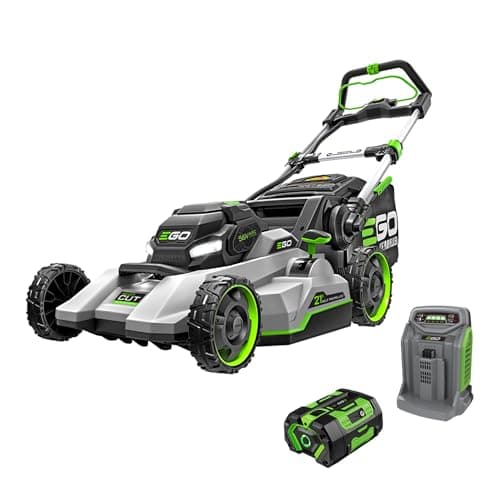
EGO Power+ 21" Select Cut LM2135SP
EGO · EGO 56V ARC Lithium · Our score 9.1/10
#ad Price as of October 23, 2026. Prices change; we check daily. How we're funded.
The most watt-hours in the box of any flagship walk-behind here, on the platform with the widest tool range to grow into.
Published specs
| Deck | 21 in |
|---|---|
| Cutting torque | Up to 7.0 ft-lbs |
| Battery included | 56V 7.5Ah |
| Cut height | 1-4 in, 8 positions |
| Self-propel speed | 0.9-3.1 MPH |
| Runtime claim | Up to 60 min |
| Warranty | 5-yr tool / 3-yr battery |
Source: EGO POWER+ 21" Select Cut System (LM2135SP), egopowerplus.com
56V x 7.5Ah = 420Wh, using EGO's advertised pack voltage.
What the numbers favor
- 420Wh in the box -- the largest included pack of any flagship walk-behind on this page
- Eight cut-height positions from 1 to 4 in, the widest published range here
- Three interchangeable lower blades (mulching, high-lift bagging, extended runtime)
- 5-year tool warranty, the longest published on this page
What they don't
- EGO publishes torque (7.0 ft-lbs), not motor wattage, so it cannot be compared directly against Greenworks' 1500W figure
- The 7.5Ah pack that earns the runtime claim is also the expensive one to replace
your yard is under a quarter acre. You would be paying for 420Wh of headroom you will never discharge, and a 20 in push mower cuts the same grass.
How it scores
Scores are our editorial weighting of the published specs above, not a test result. They are deliberately kept out of this page's structured data.
Greenworks 40V 20" Push LM2054
Greenworks · Greenworks 40V · Our score 8.0/10
#ad Price as of October 23, 2026. Prices change; we check daily. How we're funded.
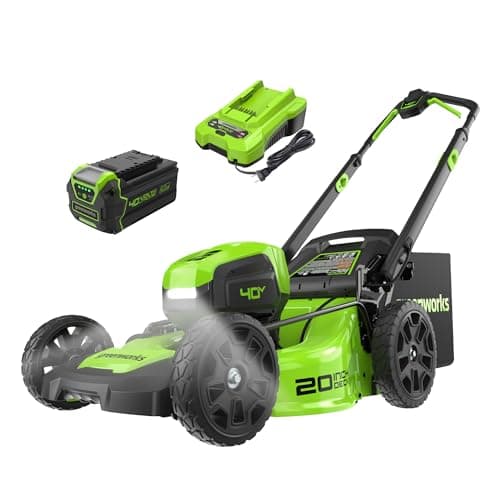
40 minutes on a 160Wh pack and 57.5 lb to push -- the honest answer for a third of an acre and nothing more.
Published specs
| Model / SKU | LM2054 / 2549902 |
|---|---|
| Deck | 20 in |
| Max blade speed | 3200 RPM |
| Battery included | 40V 4.0Ah |
| Cut height | 1.2-3.6 in, 7 positions |
| Runtime claim | Up to 40 min |
| Weight | 57.5 lb |
| Rated for | Up to 1/3 acre |
| Warranty | 3-yr tool / 3-yr battery |
Source: 40V 20" 4-in-1 Push Lawn Mower (LM2054), greenworkstools.com
40V x 4.0Ah = 160Wh. Note it claims 40 minutes on 160Wh where the 80V flagship claims 33 minutes on 320Wh -- a 20 in deck and no self-propel drive motor is why.
What the numbers favor
- Lightest published weight on this page at 57.5 lb, and the only sub-60 lb mower here
- Claims 40 minutes from 160Wh -- the best published minutes-per-watt-hour of any mower on this page
- Same 3200 RPM blade speed as the 80V flagship
- 4-in-1 deck at the entry price
What they don't
- Push only -- no drive assist on any slope
- 1.2 in minimum cut height is lower than most cool-season lawns should ever be cut
- 120-minute recharge, three times the 80V model's 40 minutes
your lawn is over a third of an acre or has any real slope. Greenworks rates it to 1/3 acre and you will be pushing all 57.5 lb of it up the hill yourself.
How it scores
Scores are our editorial weighting of the published specs above, not a test result. They are deliberately kept out of this page's structured data.
Sun Joe AJ801E Dethatcher + Scarifier
Sun Joe · Corded 120V · Our score 7.6/10
#ad No verified live price right now, so we show none rather than a stale one. How we're funded.
Two swappable cylinders and five depth settings -- but read the depth numbers before you assume this aerates.
Published specs
| Motor | 12 A |
|---|---|
| Working width | 12.6 in |
| Depth settings | 5 |
| Raking depth | 0 to 0.4 in |
| Scarifying depth | -0.4 to 0 in |
| Speed | 2,990 RPM |
| Collection bag | 8 gal |
| Tines | 27-tine dethatching cylinder |
Source: Sun Joe AJ801E Electric Lawn Dethatcher + Scarifier, shopjoe.com
What the numbers favor
- Two cylinders in one machine -- dethatch and scarify without buying twice
- Five published depth settings with actual inch figures for each mode
- 8 gallon bag means fewer stops to rake up
- Corded, so no pack to size and no runtime limit
What they don't
- This is NOT an aerator. Maximum working depth is 0.4 in; core aeration needs 2-3 in
- 12.6 in working width makes a large lawn a long afternoon
- Corded, with the working-radius limit that implies
your problem is compacted soil rather than thatch. A 0.4 in scarifier cannot relieve compaction; you need a core aerator that pulls plugs.
How it scores
Scores are our editorial weighting of the published specs above, not a test result. They are deliberately kept out of this page's structured data.
Where to buy the tools on this page
Amazon affiliate links, except where a product has no Amazon listing — those go direct to the maker and earn us nothing, and the button says so. We show no price we have not verified today, so where there is no live figure the link says "check price" and takes you to the listing to read it there.
Best overall
EGO Power+ 21" Select Cut LM2135SP
EGO · EGO 56V ARC Lithium
Best for small yards
Greenworks 40V 20" Push LM2054
Greenworks · Greenworks 40V
Best for thatch, not compaction
Sun Joe AJ801E Dethatcher + Scarifier
Sun Joe · Corded 120V
#ad As an Amazon Associate we earn from qualifying purchases, at no extra cost to you. How we're funded.
Common questions
Should I leave grass clippings on the lawn?
Do grass clippings cause thatch?
When should I remove clippings?
How long can clippings be to leave them?
Can I use grass clippings as mulch?
How do I compost grass clippings?
Sources
- What to do with lawn clippings, University of Minnesota Extension
- Mowing practices for healthy lawns, University of Minnesota Extension
- Fertilizing lawns, University of Minnesota Extension
- How to control thatch in your lawn, University of Minnesota Extension
- EGO POWER+ 21" Select Cut System (LM2135SP), egopowerplus.com
Read next
- Lawn Care
Cutting the grass is a third of the job. This is the other two thirds.
- Mulching vs bagging: which should you actually do?
The extension research on returning clippings, and what each deck mode costs you in runtime.
- What the three numbers on a fertilizer bag mean
N-P-K decoded, UMN's published nitrogen rates, and the maths that turns a bag into pounds.
- How often should you mow your lawn?
Mow by height, not by calendar: cut at 3 in, mow before 4.5 in, never take more than a third.
- Should you mow wet grass?
Delay if you can: footing, clumping and disease spread are the published reasons.
- Dethatching vs aerating: they solve different problems
Thatch or compaction, how to tell which you have, and the published depths that decide the tool.