Mowers
Mowing patterns: stripes, ruts and the fastest route round a lawn
Changing direction each cut is not an aesthetic choice. It is the cheapest way to stop wearing tracks into a lawn, and it costs nothing.
Affiliate disclosure: we earn a commission if you buy through our links, at no extra cost to you. It never changes which product we rank first — here is how we're funded.
We have not tested these units. Every spec on this page comes from the manufacturer's own documentation and is linked to it. Every computed figure is arithmetic you can redo. Prices are checked daily — last verified October 23, 2026. Here is exactly how we pick.
Pattern is treated as a vanity topic, which is a shame, because two of the three reasons to think about it are practical. One is soil, one is time, and only the third is about how the lawn looks from the kitchen window.
The short answer
Reason one: ruts and wear
A mower puts its whole weight on two narrow wheel tracks. Published weights for the machines we hold specs for run from 57.5 lb to 75 lb, and on a self-propelled model the drive wheels are also applying torque to the same strip of turf.
Do that along identical lines every week and two things happen: the soil under those tracks compacts, and the grass in them wears. Compacted soil is the problem that core aeration exists to fix — and unlike thatch, it is not something a dethatcher can touch. We separate the two in dethatching vs aerating.
Reason two: how stripes actually work
Stripes are an optical effect, not a cutting effect. Grass blades pushed away from the viewer reflect more light and read as pale; blades leaning towards the viewer read as dark. The mower is not cutting the two rows differently at all.
That has two consequences worth knowing. A striped lawn looks striped from one end and plain from the side, and any mower will produce a mild version of the effect while a machine with a rear roller produces a strong one. None of the mowers in our registry publishes a roller as a feature.
| Pattern | How to run it | Best for |
|---|---|---|
| Straight rows | Perimeter lap, then parallel runs along the long axis | Speed. The fewest turns of any pattern. |
| Alternating rows | As above, rotated 90 degrees from last week | Avoiding ruts. This is the default we recommend. |
| Diagonals | Runs at 45 degrees to the lawn's long axis | Breaking up a rectangular lawn; more turns, more time |
| Checkerboard | One pass in rows, a second at 90 degrees | Appearance only. Doubles the mowing time. |
| Spiral, outside in | Perimeter, then work inward | Small enclosed lawns; leaves you finishing in the middle |
Reason three: turns are pure overhead
Cutting time is swath times speed. Turning time is neither — it is time spent covering ground you have already cut, and it scales with how many turns you make.
Deck width is still the bigger lever on total time — a 42 inch deck cuts an acre in roughly a third of the time of a 21 inch one — but run orientation is free, and the full arithmetic is in how long it takes to mow an acre.
#ad Check the EGO Power+ 21" Select Cut LM2135SP price on Amazon — how we're funded.
Overlap: the setting nobody sets
Nobody mows with perfectly abutting passes, because a missed strip is far more visible than a double-cut one. But overlap is a cost, and most people overlap far more than they need to.
The fix is not concentration, it is a reference. Run the drive wheel along the edge of the previous cut rather than eyeballing the deck edge, and the overlap becomes consistent without any effort.
A pattern that works on almost any lawn
- Mow the perimeter first, one or two laps wide. That is your turning strip for everything that follows.
- Identify the longest axis and run your passes along it.
- Reference the previous cut with a wheel, not with the deck edge.
- Turn in the perimeter strip, not on uncut lawn and not on a bed edge.
- Rotate 90 degrees next time. Alternate weekly and you will never wear a track.
- Finish by tidying the perimeter if the turns marked it up.
#ad Check the Greenworks 80V 21" 4-in-1 LM2108S price on Amazon — how we're funded.
#ad Check the EGO Power+ Z6 42" Zero Turn ZT4204L price on Amazon — how we're funded.
What we cannot tell you
We have not timed any pattern on any lawn, and no manufacturer publishes a figure for turning time, overlap or the runtime cost of either. The pass arithmetic above uses our stated 10% overlap assumption, and you should substitute your own.
What is well supported is the direction advice. Weight on repeated tracks compacts soil, extension guidance is to reduce machinery traffic on stressed turf, and rotating your lines costs nothing at all.
The products discussed
Specs are the manufacturer's own and linked to the page they came from. Prices come from a live daily check; where we have no verified price we say so rather than print a stale one.
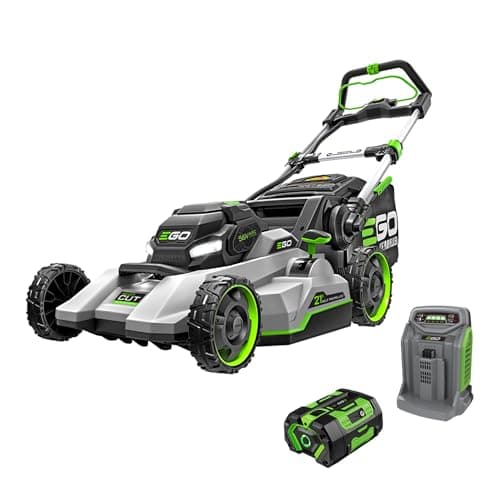
EGO Power+ 21" Select Cut LM2135SP
EGO · EGO 56V ARC Lithium · Our score 9.1/10
#ad Price as of October 23, 2026. Prices change; we check daily. How we're funded.
The most watt-hours in the box of any flagship walk-behind here, on the platform with the widest tool range to grow into.
Published specs
| Deck | 21 in |
|---|---|
| Cutting torque | Up to 7.0 ft-lbs |
| Battery included | 56V 7.5Ah |
| Cut height | 1-4 in, 8 positions |
| Self-propel speed | 0.9-3.1 MPH |
| Runtime claim | Up to 60 min |
| Warranty | 5-yr tool / 3-yr battery |
Source: EGO POWER+ 21" Select Cut System (LM2135SP), egopowerplus.com
56V x 7.5Ah = 420Wh, using EGO's advertised pack voltage.
What the numbers favor
- 420Wh in the box -- the largest included pack of any flagship walk-behind on this page
- Eight cut-height positions from 1 to 4 in, the widest published range here
- Three interchangeable lower blades (mulching, high-lift bagging, extended runtime)
- 5-year tool warranty, the longest published on this page
What they don't
- EGO publishes torque (7.0 ft-lbs), not motor wattage, so it cannot be compared directly against Greenworks' 1500W figure
- The 7.5Ah pack that earns the runtime claim is also the expensive one to replace
your yard is under a quarter acre. You would be paying for 420Wh of headroom you will never discharge, and a 20 in push mower cuts the same grass.
How it scores
Scores are our editorial weighting of the published specs above, not a test result. They are deliberately kept out of this page's structured data.
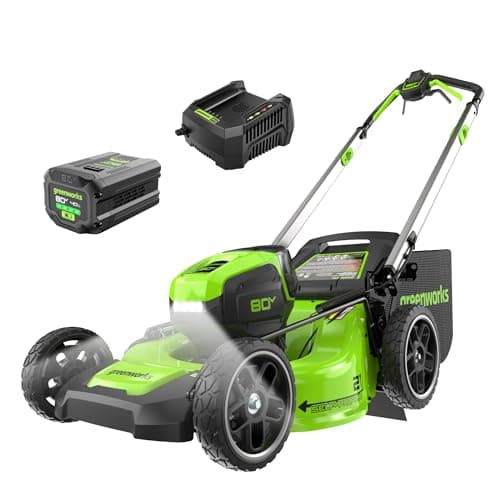
Greenworks 80V 21" 4-in-1 LM2108S
Greenworks · Greenworks 80V · Our score 8.4/10
#ad Price as of October 23, 2026. Prices change; we check daily. How we're funded.
The only mower here that publishes motor wattage, blade RPM, weight and an acreage rating -- and the only one whose battery warranty matches its tool warranty.
Published specs
| Model / SKU | LM2108S / 2550402 |
|---|---|
| Deck | 21 in |
| Max blade speed | 3200 RPM |
| Battery included | 80V 4.0Ah |
| Cut height | 1.38-4.0 in, 7 positions |
| Runtime claim | Up to 33 min |
| Weight | 75 lb |
| Rated for | Up to 1/2 acre |
| Warranty | 4-yr tool / 4-yr battery |
Source: 80V 21" 4-in-1 Self-Propelled Lawn Mower (LM2108S), greenworkstools.com
80V x 4.0Ah = 320Wh, using Greenworks' advertised pack voltage.
What the numbers favor
- 4-year battery warranty -- a year longer than EGO's 3-year, on the component that fails first
- Publishes blade RPM, weight and acreage rating; the other two brands publish none of the three
- 40-minute recharge on the included charger, the fastest published here
- 4-in-1 deck adds turbo leaf pickup on top of mulch, bag and side discharge
What they don't
- 320Wh included, the least of the three flagships -- and the 33-minute runtime claim reflects that
- 75 lb is the only published weight here, and it is not light
you want one battery to finish a half-acre without a swap. Greenworks rates the mower for 1/2 acre but claims only 33 minutes on the included pack; those two numbers only reconcile if you buy a second battery.
How it scores
Scores are our editorial weighting of the published specs above, not a test result. They are deliberately kept out of this page's structured data.
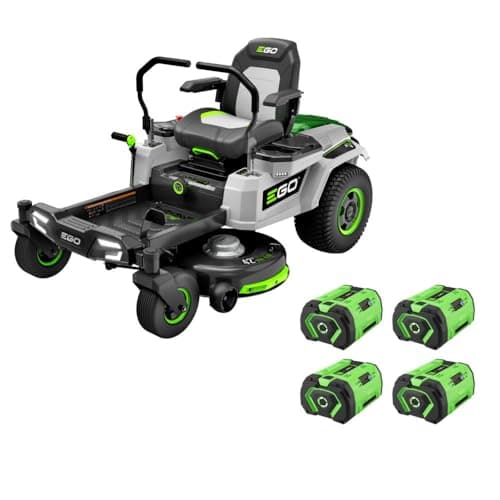
EGO Power+ Z6 42" Zero Turn ZT4204L
EGO · EGO 56V ARC Lithium · Our score 8.8/10
#ad Price as of October 23, 2026. Prices change; we check daily. How we're funded.
2,240Wh of the same 56V packs that run the rest of your yard, and a published two acres on a charge.
Published specs
| Deck | 42 in |
|---|---|
| Power claim | 22 HP gas equivalent |
| Top speed | 8 MPH |
| Batteries included | 4 x 56V 10.0Ah |
| Bay capacity | Up to 6 packs |
| Coverage | Up to 2 acres per charge |
| Warranty | 5-yr tool, battery and charger |
Source: POWER+ 42" Z6 Zero Turn Riding Mower (ZT4204L), egopowerplus.com
56V x 10.0Ah = 560Wh per pack. Four packs = 2,240Wh; six bays filled = 3,360Wh. Against the published 2 acres on four packs, that is roughly 1,120Wh per acre -- the number to size any electric riding mower against.
What the numbers favor
- Uses the identical 56V ARC Lithium packs as EGO's handheld tools -- the batteries are not stranded
- Six battery bays, so range is a purchase decision rather than a fixed limit
- 5-year warranty covering tool, battery AND charger
- 32 published LED lights, which matters more than it sounds for dusk mowing
What they don't
- Four 10.0Ah packs is a substantial share of the purchase price on its own
- EGO's published watt-hour figure for this configuration does not reconcile with 56V x 10.0Ah x 4; we publish our own arithmetic (2,240Wh) and show the working rather than repeat a number we cannot verify
your lot is under an acre. A 21 in walk-behind finishes a half acre in the time it takes to get a zero turn out of the shed, and costs a fifth as much.
How it scores
Scores are our editorial weighting of the published specs above, not a test result. They are deliberately kept out of this page's structured data.
Where to buy the tools on this page
Amazon affiliate links, except where a product has no Amazon listing — those go direct to the maker and earn us nothing, and the button says so. We show no price we have not verified today, so where there is no live figure the link says "check price" and takes you to the listing to read it there.
Best overall
EGO Power+ 21" Select Cut LM2135SP
EGO · EGO 56V ARC Lithium
Best published spec sheet
Greenworks 80V 21" 4-in-1 LM2108S
Greenworks · Greenworks 80V
Best overall
EGO Power+ Z6 42" Zero Turn ZT4204L
EGO · EGO 56V ARC Lithium
#ad As an Amazon Associate we earn from qualifying purchases, at no extra cost to you. How we're funded.
Common questions
Should I change mowing direction every time?
How are lawn stripes made?
What is the fastest mowing pattern?
Should I mow the edges first or last?
Does mowing pattern affect battery life?
How do you avoid ruts in a lawn?
Sources
Read next
- Mowers
Deck width sets how fast you finish. Watt-hours set whether you finish at all.
- How often should you mow your lawn?
Mow by height, not by calendar: cut at 3 in, mow before 4.5 in, never take more than a third.
- How long does it take to mow an acre?
Deck width x ground speed = square feet per minute. Worked out for 20, 21 and 42 inch decks.
- What height should you mow your lawn?
The one-third rule, the 3-inch recommendation, and every published cut-height range checked against them.
- How to measure your lawn (and why every other decision needs it)
Three methods for an irregular lawn, plus the sq ft to acres conversions everything else needs.
- Best self-propelled battery lawn mower
Four self-propelled machines on installed watt-hours, drive speed and acreage rating.