Mowers
Poly vs steel mower decks
One rusts and dents, the other cracks and warps. The awkward part is how few makers tell you which one you are buying.
Affiliate disclosure: we earn a commission if you buy through our links, at no extra cost to you. It never changes which product we rank first — here is how we're funded.

We have not tested these units. Every spec on this page comes from the manufacturer's own documentation and is linked to it. Every computed figure is arithmetic you can redo. Prices are checked daily — last verified September 24, 2026. Here is exactly how we pick.
Deck material is one of the few mower specifications with a genuine engineering trade behind it, and one of the few that most product pages simply omit. Before comparing the two materials it is worth saying plainly how little is published about either.
The short answer
Who actually publishes a deck material
| Mower | Deck material published | Deck size |
|---|---|---|
| Toro 21356 | 14-gauge steel | 21 in |
| Sun Joe MJ401E | Rust-resistant steel | 14 in |
| Greenworks CRZ4262 (zero turn) | Reinforced 12-gauge steel | 42 in |
| RYOBI ZR3 (zero turn) | 12-gauge fabricated steel | 42 in |
| EGO LM2135SP | Not published | 21 in |
| Greenworks LM2108S | Not published | 21 in |
| RYOBI RY40HPLM01B | Not published | 21 in |
| Greenworks LM2054 | Not published | 20 in |
| Kobalt 80V self-propelled | Steel (no gauge published) | 21 in |
Transcribed from each maker's product page, including Toro 21356T, Greenworks LM2108S and EGO LM2135SP.
Steel: stiffness, and a corrosion clock
Gauge is the number to want, and it runs backwards: a smaller gauge is thicker steel. Toro publishes 14-gauge on a walk-behind; Greenworks and RYOBI publish 12-gauge on their 42 inch zero turns, which is thicker again for a much larger unsupported span.
- For it: takes an impact and keeps its shape, which matters because deck shape is what generates the airflow that lifts grass before the blade reaches it.
- Against it: it corrodes. The underside is permanently damp under packed clippings, and no maker in our registry publishes a coating spec or a rust warranty.
- What to do: clear the underside at end of season. Our storage guide covers the five-minute routine, and mowing wet grass covers why the clippings pack in the first place.
Poly: no rust, and a temperature question
- For it: it cannot corrode, so the wet underside that slowly eats a steel deck does nothing to it. It is also lighter for the same shape, which on a mower you lift over a step is real.
- Against it: polymers stiffen and become more brittle as temperature falls, so a hard impact on a cold morning is the failure people describe. Heat can warp a large unsupported panel.
- The honest gap: no maker in our registry publishes a service temperature range, an impact rating or a polymer grade for a deck. We can describe the mechanism; we cannot give you the threshold, and neither can anyone else from published data.
Gauge, and why the number runs backwards
Steel thickness is quoted as a gauge, and the scale is inverted: a lower gauge number is a thicker sheet. Twelve gauge is thicker than fourteen. That trips people up constantly, and it matters because it is the only steel-deck specification any maker in our registry publishes.
| Machine | Published gauge | Deck width | What the span asks of it |
|---|---|---|---|
| Greenworks CRZ4262 | 12 gauge, reinforced | 42 in | Large unsupported span, riding loads |
| RYOBI ZR3 42 | 12 gauge, fabricated | 42 in | Large unsupported span, riding loads |
| Toro 21356 | 14 gauge | 21 in | Half the span, walk-behind loads |
Transcribed from each product page. A thicker gauge on the wider decks is what you would expect; it is noted here because these are the only three machines that publish one at all.
The pattern is sensible engineering: the 42 inch decks that carry a rider and span twice the width use thicker steel than the 21 inch walk-behind. What is less sensible is that four walk-behind mowers in our registry publish no material at all, so there is nothing to compare them on.
How each one actually fails
- Steel fails slowly, from the inside of the deck outward. Wet clippings pack against the underside and hold moisture against bare metal wherever the coating has been scoured by grit. It takes years and it is entirely preventable with five minutes at end of season.
- Poly fails suddenly, at an impact. The mechanism people describe is a cold-weather strike — a buried root, a sprinkler head, a rock — on a panel that is stiffer and less forgiving at low temperature than it was in July.
- Both fail invisibly first. A rust perforation and a hairline crack both start where you cannot see them, which is the argument for turning the mower over once a year whichever deck you have.
The thing deck material does not change
Cut quality comes from deck shape, not deck material. The curved underside of a mower deck is an airflow surface: it lifts grass upright before the blade arrives and then carries the clipping either back under the blade to be recut, or out to a bag. That geometry can be moulded in polymer or pressed in steel with the same result.
So a material argument is a durability argument and nothing else. If someone tells you a steel deck cuts better, ask which published figure says so — there is not one. What does change cut quality is blade condition, deck height and ground speed, all of which you control: see mowing height and blade sharpening.
How much should this decide your purchase?
- Less than cut height, energy or weight. All three are published by most makers and all three change how the mower performs this season.
- More than it is usually given credit for if you store outdoors, where a steel deck's corrosion clock runs faster and a poly deck's cold-brittleness matters more.
- Use it as a tie-breaker. Between two mowers that are otherwise close, a published 14-gauge steel deck is more information than a blank line, and information is the thing worth rewarding.
The three mowers below are the ones in our registry that publish a deck material at all. That is the only reason they appear here, and it is a better reason than most.
#ad Check the Toro 60V Max 21" Recycler Self-Propel (21356) price on Amazon — how we're funded.
#ad Check the Greenworks 80V 21" 4-in-1 LM2108S price on Amazon — how we're funded.
#ad Check the Sun Joe MJ401E 14" 12-Amp Corded Electric Lawn Mower price on Amazon — how we're funded.
What to do with this when buying
Treat a published deck material as a small positive and an unpublished one as a small unknown, and let cut height, energy and weight decide the purchase. Then treat the deck as a maintenance item rather than a purchase criterion: whichever material you end up with, the five minutes spent clearing the underside at end of season does more for its life than the material choice ever will.
What we cannot tell you
We have not cut open a mower deck or run a corrosion test. Nobody in our registry publishes a polymer grade, a service temperature range, an impact rating, a steel coating specification or a corrosion warranty, so the comparison above describes materials in general rather than these decks in particular. Four of the nine mowers in the table publish no deck material at all, and we have not guessed at theirs.
The products discussed
Specs are the manufacturer's own and linked to the page they came from. Prices come from a live daily check; where we have no verified price we say so rather than print a stale one.
Toro 60V Max 21" Recycler Self-Propel (21356)
Toro · Toro 60V Max Flex-Force · Our score 8.3/10
#ad No verified live price right now, so we show none rather than a stale one. How we're funded.
The only manufacturer here that publishes the actual watt-hour figure for its pack -- and the number tells you something the others hide.
Published specs
| Model | 21356 |
|---|---|
| Deck | 21 in, 14-gauge steel |
| Battery | 60V Max L324, 6.0Ah, 324Wh |
| Charge time | 150 min |
| Runtime claim | Up to 45 min on the 6.0Ah |
| Drive | Personal Pace variable-speed RWD |
| Weight | 66 lb |
| Storage | SmartStow vertical |
Source: 60V Max 21 in. Recycler Self-Propel Lawn Mower (21356T), toro.com
Toro labels the pack 60V Max 6.0Ah and publishes 324Wh. 324 / 6.0 = 54V -- the nominal voltage, not the 60V max-charge figure on the sticker. Every brand's 'max volts' is roughly 11% above nominal, so a nameplate watt-hour number is always about 11% optimistic. This is the single most useful spec on this page.
What the numbers favor
- Publishes a real watt-hour figure (324Wh) instead of leaving you to multiply the marketing voltage
- 45 minutes from 324Wh, against Greenworks' 33 minutes from a nameplate 320Wh
- 14-gauge steel deck, the only steel deck spec published on this page
- SmartStow vertical storage -- a genuine constraint solver in a one-car garage
What they don't
- 150-minute recharge is the slowest here by a wide margin
- Toro's 60V line is narrower than EGO's or Ryobi's, so the platform grows less far
you are buying into a platform rather than a mower. Toro builds excellent mowers; the 60V Flex-Force tool range is not the one to bet a decade of yard tools on.
How it scores
Scores are our editorial weighting of the published specs above, not a test result. They are deliberately kept out of this page's structured data.
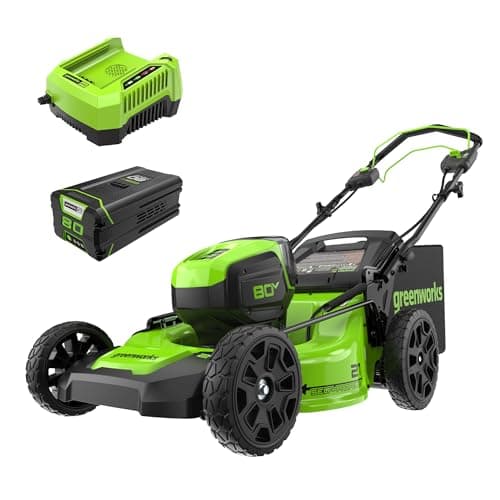
Greenworks 80V 21" 4-in-1 LM2108S
Greenworks · Greenworks 80V · Our score 8.4/10
#ad Price as of September 24, 2026. Prices change; we check daily. How we're funded.
The only mower here that publishes motor wattage, blade RPM, weight and an acreage rating -- and the only one whose battery warranty matches its tool warranty.
Published specs
| Model / SKU | LM2108S / 2550402 |
|---|---|
| Deck | 21 in |
| Max blade speed | 3200 RPM |
| Battery included | 80V 4.0Ah |
| Cut height | 1.38-4.0 in, 7 positions |
| Runtime claim | Up to 33 min |
| Weight | 75 lb |
| Rated for | Up to 1/2 acre |
| Warranty | 4-yr tool / 4-yr battery |
Source: 80V 21" 4-in-1 Self-Propelled Lawn Mower (LM2108S), greenworkstools.com
80V x 4.0Ah = 320Wh, using Greenworks' advertised pack voltage.
What the numbers favor
- 4-year battery warranty -- a year longer than EGO's 3-year, on the component that fails first
- Publishes blade RPM, weight and acreage rating; the other two brands publish none of the three
- 40-minute recharge on the included charger, the fastest published here
- 4-in-1 deck adds turbo leaf pickup on top of mulch, bag and side discharge
What they don't
- 320Wh included, the least of the three flagships -- and the 33-minute runtime claim reflects that
- 75 lb is the only published weight here, and it is not light
you want one battery to finish a half-acre without a swap. Greenworks rates the mower for 1/2 acre but claims only 33 minutes on the included pack; those two numbers only reconcile if you buy a second battery.
How it scores
Scores are our editorial weighting of the published specs above, not a test result. They are deliberately kept out of this page's structured data.
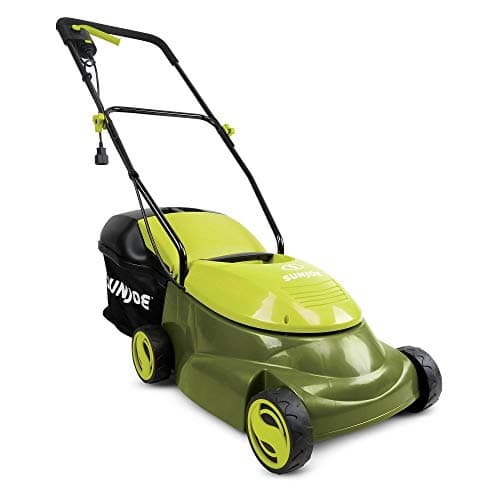
Sun Joe MJ401E 14" 12-Amp Corded Electric Lawn Mower
Sun Joe · Corded 120V · Our score 8.2/10
#ad No verified live price right now, so we show none rather than a stale one. How we're funded.
Twenty-three pounds, a 14 in steel deck and no battery to run out -- the mower that answers the small-lawn case without any energy arithmetic at all.
Published specs
| Motor | 12 A, up to 3,500 RPM |
|---|---|
| Deck / blade | 14 in steel |
| Deck material | Rust-resistant steel |
| Cut height | 1.18-2.52 in, 3 positions |
| Grass bag | 10.6 gal hard-top rear bag |
| Rear wheels | 5.5 in |
| Weight | 23.1 lb net / 34 lb gross |
| Dimensions | 50 in L x 16.3 in W x 41.7 in H |
| Warranty | 2 years |
| Runtime | Unlimited (corded) |
Source: Sun Joe 14-Inch 12-Amp Electric Lawn Mower, shopjoe.com
23.1 lb over a 14 in deck is 23.1 / 14 = 1.65 lb per inch of cut. The Greenworks LM2054, which carries the lightest published weight of any cordless mower in our registry, is 57.5 lb over 20 in = 2.88 lb per inch. The corded mower is 43% lighter for every inch it cuts, because it carries no battery. That is the trade in one number: you gain the weight back as a cord you have to manage.
What the numbers favor
- 23.1 lb -- lighter than any cordless mower in our registry by more than half
- No runtime limit and no charge wait
- Steel deck at this weight, not plastic
- 14 in width turns inside obstacles a 21 in deck has to go round
- 2-year warranty published
What they don't
- Cord range is whatever your extension lead reaches, and you have to mow around it
- 2.52 in maximum cut height is too low for St. Augustine or a heat-stressed cool-season lawn
- Three height positions against seven or eight on a cordless deck
- 10.6 gal bag on a 14 in deck means frequent emptying on long grass
- No mulching or side-discharge mode published
you mow more than about 2,500 sq ft, or your lawn is more than one extension lead from an outlet.
How it scores
Scores are our editorial weighting of the published specs above, not a test result. They are deliberately kept out of this page's structured data.
Where to buy the tools on this page
Every link below is an Amazon affiliate link. We show no price we have not verified today, so where there is no live figure the link says "check price" and takes you to the listing to read it there.
Best published watt-hour honesty
Toro 60V Max 21" Recycler Self-Propel (21356)
Toro · Toro 60V Max Flex-Force
Best published spec sheet
Greenworks 80V 21" 4-in-1 LM2108S
Greenworks · Greenworks 80V
Best corded mower
Sun Joe MJ401E 14" 12-Amp Corded Electric Lawn Mower
Sun Joe · Corded 120V
#ad As an Amazon Associate we earn from qualifying purchases, at no extra cost to you. How we're funded.
Common questions
Is a steel or poly mower deck better?
Do poly mower decks crack?
Do steel mower decks rust?
Which mowers publish their deck material?
Does deck material affect mowing quality?
Sources
Read next
- Mowers
Deck width sets how fast you finish. Watt-hours set whether you finish at all.
- Push, self-propelled, riding or robot: which class of mower fits your lot
Published acreage ratings and slope limits for all four mower classes, and where each one stops.
- Storing a battery mower when the garage is already full
Vertical storage, folding handles and published weights, and how to handle the pack over winter.
- Mower blades: mulching, high-lift, and when to change them
Mulching against high-lift, what a dull blade costs the lawn, and the multi-blade systems.
- Best battery lawn mowers of 2026
Six flagship battery mowers ranked on watt-hours in the box and energy spent per minute.
- Should you mow wet grass?
Delay if you can: footing, clumping and disease spread are the published reasons.