Riding & Robot Mowers
Is a robot mower worth it?
You are not buying a mower, you are buying back roughly nine hours a year. Whether that is a good trade depends on four numbers.
Affiliate disclosure: we earn a commission if you buy through our links, at no extra cost to you. It never changes which product we rank first — here is how we're funded.
We have not tested these units. Every spec on this page comes from the manufacturer's own documentation and is linked to it. Every computed figure is arithmetic you can redo. Prices are checked daily — last verified October 19, 2026. Here is exactly how we pick.
Every robot mower review answers this question with a feeling. There is a better way to do it: work out how many hours of mowing the machine actually removes from your year, then decide whether that is worth what it costs. The published specs give you everything you need for the first half.
What you are actually buying, in hours
Nine hours is the honest scale of the prize on a small lawn. It is not nothing — it is a full working day of Saturdays — but it is a long way from the "never mow again" framing, because the robot does not edge, trim or clear leaves. You are removing the mowing, not the yard work.
The three limits that decide it before cost does
| Limit | Published figure | What it rules out |
|---|---|---|
| Coverage | Up to 1/8 acre (~5,445 sq ft) | Anything approaching a quarter acre |
| Max slope | 16 degrees | Banks, terraces, anything you would call a hill |
| Cut height | 2 to 3.6 in | Lawns kept at 4 inches, which extension guidance permits |
| Duty cycle | 60 min run / 90 min charge | Fast spring growth on a short daily window |
| Cutting width | 7.1 in | Nothing, but it means a great many passes |
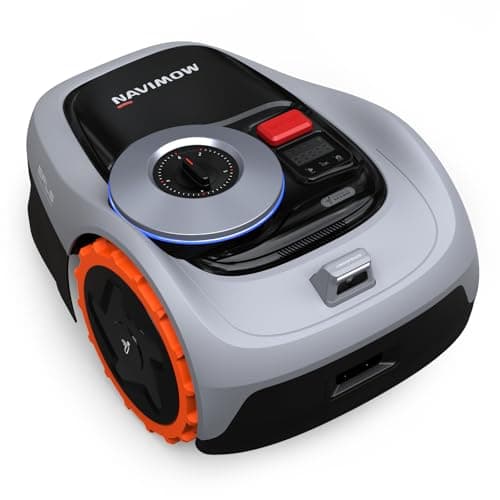
Segway's published specifications for the Navimow i105N. Two of these are hard limits rather than guidance, and both are easy to check before you spend anything.
Check yours properly before you get as far as comparing prices — the measurements take ten minutes and are set out step by step on the robot mower checklist.
The argument nobody makes: it mows better
Minnesota Extension guidance is to remove no more than one third of the leaf blade in a single cut. A weekly mow in peak growth routinely breaks that rule; a machine that takes a fraction of an inch every day cannot break it. The clippings are also small enough to fall straight into the canopy, which is the mulching argument taken to its logical end.
That is a real agronomic benefit, and it is the one thing a robot does that a better walk-behind cannot. Whether it shows up in your lawn depends on everything else you do — the seasonal schedule is where the rest of it lives.
#ad Check the Segway Navimow i105N price on Amazon — how we're funded.
When it is not worth it
- Your lawn is over an eighth of an acre. The rating is the rating. A machine working beyond it either falls behind or never finishes.
- You have a bank. 16 degrees is published as a maximum, and wet grass on a slope is where traction goes.
- You enjoy mowing. Genuinely — some people do, and the entire value proposition here is the removal of a task.
- Your lawn is full of obstacles. Every bed, tree ring and trampoline is boundary to define and an area the machine will not cut.
- You still have to do the edges. Which you do. Budget for a string trimmer on top.
The two honest alternatives
Under a third of an acre: a light push mower
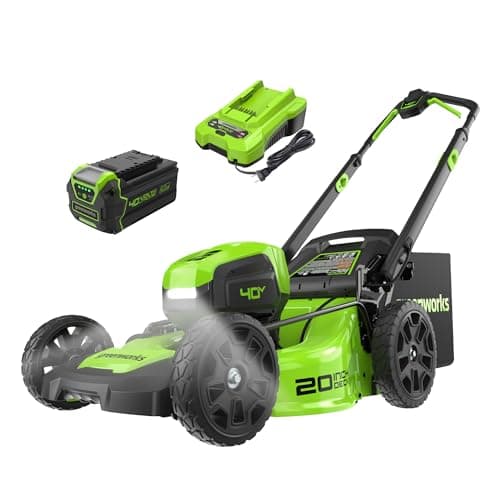
A 20-inch push mower at a published 57.5 lb, rated to a third of an acre, does the same job in 20 minutes a week with no boundary mapping, no slope limit and nothing to store indoors over winter. On a small flat lawn it is the unglamorous right answer.
#ad Check the Greenworks LM2054 price on Amazon — how we're funded.
Over an acre: a rider, not a robot
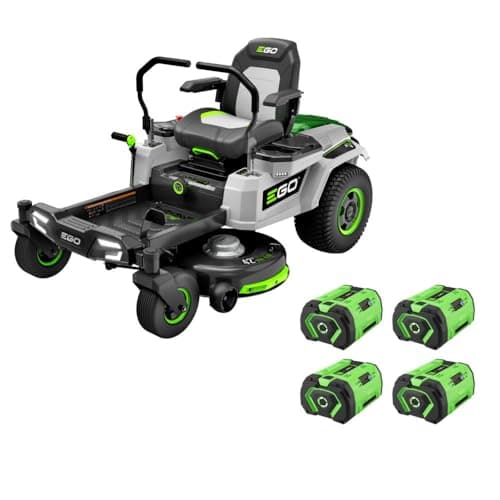
Above an acre the arithmetic changes completely, and the machine that saves hours is a 42-inch electric zero turn covering a published two acres per charge at 8 MPH. That is a different purchase with different maths, worked through on the electric rider page and in the acres-per-charge guide.
#ad Check the EGO Z6 ZT4204L price on Amazon — how we're funded.
The jobs it does not remove
The hours arithmetic above only counts mowing. Every other yard job stays exactly where it was, and it is worth listing them plainly, because "never mow again" marketing quietly implies otherwise.
| Job | Does the robot do it? | What you still need |
|---|---|---|
| Cutting the open lawn | Yes, within its rated area | Nothing |
| Edges along paths and drives | No | A blade edger or a string trimmer |
| Around posts, trees and furniture | Partly; it leaves an uncut margin | A string trimmer |
| Autumn leaves | No | A blower, or a mulching mower |
| Slopes over 16 degrees | No -- published hard limit | A walk-behind |
| Lawn over 1/8 acre | No -- published rating | A walk-behind or a rider |
Capability rows follow directly from Segway's published specifications for the i105N. The equipment column is our reading of what is left over.
Which means the realistic setup is a robot mower plus a string trimmer plus a small blower, not a robot mower instead of a shed. That is not an argument against buying one — the mowing really is the recurring hour — but it changes what "worth it" has to clear.
What to settle before you spend
- Measure, do not estimate. An eighth of an acre is 5,445 square feet and gardens are consistently bigger than they look from the kitchen window.
- Check the steepest bank, not the average slope. One 20 degree bank makes part of the lawn unreachable regardless of the rest.
- Decide where the base goes. It needs a position, power and enough clear ground for the machine to dock reliably.
- Work out your running window. At a 40% duty cycle, a six-hour permitted window is 2.4 hours of actual cutting a day.
What we cannot tell you
- Whether it is worth the money. We do not publish prices we have not verified today, and the value of nine hours is yours to set.
- How many mows your season needs. The 26 figure is our stated assumption. Growth rate, region and rainfall move it a long way.
- Reliability over years. These machines are too new for anyone, including us, to have that answer.
- How it copes with your specific garden. Obstacles, gradients and ground conditions vary more than any spec sheet captures.
The products discussed
Specs are the manufacturer's own and linked to the page they came from. Prices come from a live daily check; where we have no verified price we say so rather than print a stale one.
Segway Navimow i105N Robot Mower
Segway · Navimow (self-contained) · Our score 8.0/10
#ad Price as of October 19, 2026. Prices change; we check daily. How we're funded.
No perimeter wire, 58 dB published, and an eighth of an acre it will cut while you are at work.
Published specs
| Coverage | Up to 1/8 acre |
|---|---|
| Cutting width | 7.1 in |
| Cut height | 2-3.6 in |
| Runtime / charge | 60 min run / 90 min charge |
| Navigation | RTK + Vision, wire-free |
| Max slope | 16 degrees |
| Noise | 58 dB(A) |
| Weight | 24 lb |
Source: Navimow i105N, navimow.com
60 minutes of run against 90 minutes of charge is a 60/150 duty cycle -- about 40%. Over a 12-hour window that is roughly 4.8 hours of actual cutting, which is the number that decides whether 1/8 acre is realistic for your grass growth rate.
What the numbers favor
- No perimeter wire to bury, cut or repair -- boundaries are set in the app
- 58 dB published, quiet enough to run while people are outside
- Publishes both runtime and charge time, so the duty cycle is computable
- 24 lb, light enough to carry to storage single-handed
What they don't
- 1/8 acre is a genuinely small lawn; Segway's own 0.15 acre figure is layout-dependent
- 7.1 in cutting width means many passes
- 16 degree maximum slope rules out a lot of real gardens
your lawn has slopes over 16 degrees or is over an eighth of an acre. Both are hard published limits, not soft ones.
How it scores
Scores are our editorial weighting of the published specs above, not a test result. They are deliberately kept out of this page's structured data.
Greenworks 40V 20" Push LM2054
Greenworks · Greenworks 40V · Our score 8.0/10
#ad Price as of October 19, 2026. Prices change; we check daily. How we're funded.
40 minutes on a 160Wh pack and 57.5 lb to push -- the honest answer for a third of an acre and nothing more.
Published specs
| Model / SKU | LM2054 / 2549902 |
|---|---|
| Deck | 20 in |
| Max blade speed | 3200 RPM |
| Battery included | 40V 4.0Ah |
| Cut height | 1.2-3.6 in, 7 positions |
| Runtime claim | Up to 40 min |
| Weight | 57.5 lb |
| Rated for | Up to 1/3 acre |
| Warranty | 3-yr tool / 3-yr battery |
Source: 40V 20" 4-in-1 Push Lawn Mower (LM2054), greenworkstools.com
40V x 4.0Ah = 160Wh. Note it claims 40 minutes on 160Wh where the 80V flagship claims 33 minutes on 320Wh -- a 20 in deck and no self-propel drive motor is why.
What the numbers favor
- Lightest published weight on this page at 57.5 lb, and the only sub-60 lb mower here
- Claims 40 minutes from 160Wh -- the best published minutes-per-watt-hour of any mower on this page
- Same 3200 RPM blade speed as the 80V flagship
- 4-in-1 deck at the entry price
What they don't
- Push only -- no drive assist on any slope
- 1.2 in minimum cut height is lower than most cool-season lawns should ever be cut
- 120-minute recharge, three times the 80V model's 40 minutes
your lawn is over a third of an acre or has any real slope. Greenworks rates it to 1/3 acre and you will be pushing all 57.5 lb of it up the hill yourself.
How it scores
Scores are our editorial weighting of the published specs above, not a test result. They are deliberately kept out of this page's structured data.
EGO Power+ Z6 42" Zero Turn ZT4204L
EGO · EGO 56V ARC Lithium · Our score 8.8/10
#ad Price as of October 19, 2026. Prices change; we check daily. How we're funded.
2,240Wh of the same 56V packs that run the rest of your yard, and a published two acres on a charge.
Published specs
| Deck | 42 in |
|---|---|
| Power claim | 22 HP gas equivalent |
| Top speed | 8 MPH |
| Batteries included | 4 x 56V 10.0Ah |
| Bay capacity | Up to 6 packs |
| Coverage | Up to 2 acres per charge |
| Warranty | 5-yr tool, battery and charger |
Source: POWER+ 42" Z6 Zero Turn Riding Mower (ZT4204L), egopowerplus.com
56V x 10.0Ah = 560Wh per pack. Four packs = 2,240Wh; six bays filled = 3,360Wh. Against the published 2 acres on four packs, that is roughly 1,120Wh per acre -- the number to size any electric riding mower against.
What the numbers favor
- Uses the identical 56V ARC Lithium packs as EGO's handheld tools -- the batteries are not stranded
- Six battery bays, so range is a purchase decision rather than a fixed limit
- 5-year warranty covering tool, battery AND charger
- 32 published LED lights, which matters more than it sounds for dusk mowing
What they don't
- Four 10.0Ah packs is a substantial share of the purchase price on its own
- EGO's published watt-hour figure for this configuration does not reconcile with 56V x 10.0Ah x 4; we publish our own arithmetic (2,240Wh) and show the working rather than repeat a number we cannot verify
your lot is under an acre. A 21 in walk-behind finishes a half acre in the time it takes to get a zero turn out of the shed, and costs a fifth as much.
How it scores
Scores are our editorial weighting of the published specs above, not a test result. They are deliberately kept out of this page's structured data.
Where to buy the tools on this page
Amazon affiliate links, except where a product has no Amazon listing — those go direct to the maker and earn us nothing, and the button says so. We show no price we have not verified today, so where there is no live figure the link says "check price" and takes you to the listing to read it there.
Best wire-free robot for a small lawn
Segway Navimow i105N Robot Mower
Segway · Navimow (self-contained)
Best for small yards
Greenworks 40V 20" Push LM2054
Greenworks · Greenworks 40V
Best overall
EGO Power+ Z6 42" Zero Turn ZT4204L
EGO · EGO 56V ARC Lithium
#ad As an Amazon Associate we earn from qualifying purchases, at no extra cost to you. How we're funded.
Common questions
Is a robot mower worth the money?
Does a robot mower do a better job than a normal mower?
What can't a robot mower do?
Are robot mowers good for big lawns?
Do robot mowers work on slopes?
How long does a robot mower run each day?
Sources
Read next
- Riding & Robot Mowers
Above an acre the question stops being which mower and starts being how many watt-hours.
- Best robot lawn mower (and the limits nobody puts on the box)
Coverage, slope limit and duty cycle -- the three published numbers that decide if a robot mower fits.
- Seven things to measure before you buy a robot mower
Area, slope, passage width, cut height and duty cycle -- the checks that decide before you spend.
- Best battery lawn mower for a small yard
Under a third of an acre, weight and storage beat watt-hours. The numbers that actually matter, ranked.
- What height should you mow your lawn?
The one-third rule, the 3-inch recommendation, and every published cut-height range checked against them.
- What size mower do I need for my yard?
Deck width and watt-hours by lawn size, with the mowing-time arithmetic for each.
- What does a robot mower cost to run?
Why robot electricity costs cannot be computed from published specs, and what bounds them.