Trimmers & Edgers
How to trim a hedge properly
The single most common mistake is cutting the sides vertical. Everything else about a thin, bare-bottomed hedge follows from it.
Affiliate disclosure: we earn a commission if you buy through our links, at no extra cost to you. It never changes which product we rank first — here is how we're funded.

We have not tested these units. Every spec on this page comes from the manufacturer's own documentation and is linked to it. Every computed figure is arithmetic you can redo. Prices are checked daily — last verified October 23, 2026. Here is exactly how we pick.
Hedge trimming looks like the simplest job in the garden and produces more slowly accumulating damage than almost anything else. Most of it comes from one geometric mistake that takes years to become obvious and years to fix.
The one thing that matters: taper
The taper does not need to be dramatic. A few degrees is enough for most hedges, and the effect compounds over seasons. What is not recoverable quickly is the opposite: once a hedge is bare at the base, growth there has to be regenerated, and that is a renewal-pruning project rather than a trimming one.
How much to take off
Extension pruning guidance gives two different answers depending on which job you are doing, and confusing them is the second most common mistake.
| Job | Extension guidance | What it means in practice |
|---|---|---|
| Routine hedge maintenance | Once the hedge reaches the desired height, prune new growth back whenever it grows another 6 to 8 inches | You are cutting this season's soft growth, not old wood |
| Maintaining an established hedge | Prune twice a year, in spring and again in mid-summer | Two sessions, not a single heavy one |
| Renewing an overgrown shrub | Every year remove up to one third of the oldest, thickest stems | A saw job at the base, spread over about three years |
From University of Minnesota Extension, pruning trees and shrubs, fetched 7 September 2026.
The sequence
- Check the tool and the hedge. Look for wire, ties, netting and nesting birds. A hedge trimmer meeting a wire fence damages both.
- Set a string line at your target height along the length of the hedge. This is the difference between a hedge that follows the horizon and one that follows the ground.
- Cut the first side, bottom to top, with the blade angled slightly in as you rise. Sweeping upward means the cut material falls away from the face you are working on.
- Cut the second side the same way, matching the taper by eye against the first.
- Cut the top last, working to the string line, with the blade flat and level rather than tipped.
- Step back at each stage. Hedge shape is only visible from ten feet away, and it is far easier to take a little more than to put any back.
- Clear the clippings out of the hedge base as well as off the ground. Material left sitting in the crown holds moisture against stems.
See the EGO Power+ 24" Hedge Trimmer HT2410 on EGO's own site — no Amazon listing right now, so this link earns us nothing. How we're funded.
Handling a 24 inch blade well
- Sweep, do not stab. A long smooth arc lets the full blade work; short jabbing motions cut with the tip and leave a ragged face.
- Let the blade speed do it. The HT2410 publishes 3,000 strokes per minute. Pushing harder does not cut faster; it wedges thicker stems into a gap that cannot take them.
- Keep both hands on the tool. At 6.17 lb bare plus a pack, one handed above shoulder height is how control gets lost.
- Work at waist to shoulder height. If the top of the hedge is above comfortable reach, that is a pole tool or a platform, not a stretch.
- Pull the battery before you clear a jam. On a cordless tool the pack is the entire safety interlock.
When the tool is the wrong one
The published cut capacity is a hard limit, not a target. On the HT2410 that is 1 inch. Above it the stem wedges rather than shears and repeated attempts bend teeth.
Renewal cuts — the up to one third of the oldest, thickest stems that extension guidance describes — are almost always above that. Those are saw cuts made low in the shrub, and the EGO PSA1000 publishes a 10 inch bar and a 10 inch maximum cut diameter on a 38 inch pole, which handles most of them without a ladder.
#ad Check the EGO Power+ 10" Pole Saw Attachment PSA1000 price on Amazon — how we're funded.
The five mistakes worth naming
- Vertical or top-heavy sides. The cause of nearly every bare-bottomed hedge.
- One heavy annual cut instead of the two lighter ones extension guidance describes.
- Cutting into old wood on species that will not reshoot from it. Take new growth in routine trims.
- Forcing stems past the published cut capacity. That is a saw job.
- Trimming without checking for nesting birds. Look before the blade goes in, every time.
What we cannot tell you
We are not going to give species-specific advice on which hedges regenerate from old wood, because that varies and getting it wrong is expensive. Your own state extension service is the right authority for the plants you actually have.
What is published and general: taper the sides, trim new growth back when it reaches 6 to 8 inches, prune established hedges twice a year, and on renewal take up to a third of the oldest stems annually. The tool limits — 1 inch of cut capacity, 24 inches of blade — do the rest of the deciding.
The products discussed
Specs are the manufacturer's own and linked to the page they came from. Prices come from a live daily check; where we have no verified price we say so rather than print a stale one.
EGO Power+ 24" Hedge Trimmer HT2410
EGO · EGO 56V ARC Lithium · Our score 8.3/10
No Amazon listing for this one right now, so the link goes direct to EGO and we earn nothing on it. We show no price because we only publish figures from our own daily check. How we're funded.
A published 1 in cut capacity on 24 in of hardened steel, at 6.17 lb bare -- the numbers that decide whether a hedge trimmer is a hedge trimmer.
Published specs
| Blade length | 24 in, hardened steel |
|---|---|
| Cut capacity | 1 in |
| Blade speed | 3,000 strokes per minute |
| Blade type | Dual-action, fully serviceable |
| Weight | 6.17 lb (bare tool) |
| Battery | Any EGO 56V ARC Lithium |
Source: 24" Cordless Brushless Hedge Trimmer (HT2410), egopowerplus.com
What the numbers favor
- 1 in published cut capacity -- most cordless hedge trimmers publish 3/4 in or stay silent
- 6.17 lb bare, light enough to hold above shoulder height
- Blades described as fully serviceable rather than sealed
- Runs on any EGO 56V pack you already own
What they don't
- EGO publishes no runtime figure for this tool at any pack size, so we cannot compute one honestly
- EGO's product page no longer publishes a weight for this tool. Our 6.17 lb bare figure is a prior transcription from that page and is no longer verifiable at the source
- Sold bare in most configurations
your hedges are soft new growth on a small boundary. 24 in of blade is awkward on a low hedge and a 20 in tool is easier to control.
How it scores
Scores are our editorial weighting of the published specs above, not a test result. They are deliberately kept out of this page's structured data.
EGO Power+ 10" Pole Saw Attachment PSA1000
EGO · EGO 56V ARC Lithium · Our score 8.1/10
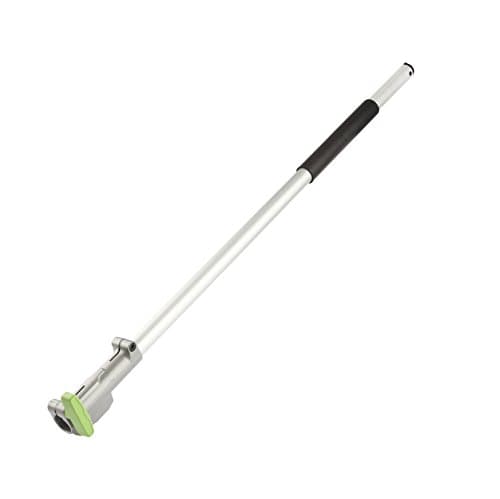
#ad Price as of October 23, 2026. Prices change; we check daily. How we're funded.
70 published cuts from a 140Wh pack at 4.17 lb -- the honest answer for limbs you should not be on a ladder for.
Published specs
| Bar length | 10 in |
|---|---|
| Max cut diameter | 10 in |
| Chain | 3/8 in pitch, 0.043 in gauge |
| Pole length | 38 in (plus power head) |
| Cuts per charge | Up to 70 (2.5Ah) |
| Weight | 4.17 lb |
| Lubrication | Automatic |
Source: 10" Pole Saw Attachment for Multi-Head System (PSA1000), egopowerplus.com
140Wh (56V x 2.5Ah) over 70 published cuts = about 2.0Wh per cut, roughly double the CS1804's 0.93Wh -- a narrow-kerf chain on a long pole works harder per cut than a saw you can lean on.
What the numbers favor
- 70 cuts per 2.5Ah pack, published
- 4.17 lb attachment weight, published
- Automatic bar lubrication rather than a manual oiler
- Takes EGO's EP7500 extension pole for more reach
What they don't
- Attachment only -- needs an EGO PH1400 or PH1420 power head
- 0.043 in narrow-kerf gauge chain, less common than the 0.050 in on the CS1804
you have one overhanging branch. Renting or hiring is cheaper than a power head plus an attachment for a single afternoon.
How it scores
Scores are our editorial weighting of the published specs above, not a test result. They are deliberately kept out of this page's structured data.
Where to buy the tools on this page
Amazon affiliate links, except where a product has no Amazon listing — those go direct to the maker and earn us nothing, and the button says so. We show no price we have not verified today, so where there is no live figure the link says "check price" and takes you to the listing to read it there.
Best cut capacity
EGO Power+ 24" Hedge Trimmer HT2410
EGO · EGO 56V ARC Lithium
Best pole saw on-platform
EGO Power+ 10" Pole Saw Attachment PSA1000
EGO · EGO 56V ARC Lithium
#ad As an Amazon Associate we earn from qualifying purchases, at no extra cost to you. How we're funded.
Common questions
How do you trim a hedge properly?
How much can I cut off a hedge?
Why is my hedge bare at the bottom?
Should I cut the top or the sides first?
How do I get a straight hedge line?
What thickness can a hedge trimmer cut?
Sources
Read next
- Trimmers & Edgers
The line gauge and the head design decide whether you enjoy this job or dread it.
- When should you trim hedges and shrubs?
Late dormant season for most pruning, spring bloomers right after flowering, hedges twice a year.
- Best cordless hedge trimmer for thick growth
Cut capacity decides it: 1 in published, and a different tool above that.
- How to choose a cordless hedge trimmer
The four specs that decide a hedge trimmer, and the one most makers do not publish.
- Best cordless hedge trimmer
Cut capacity decides whether a trimmer suits your hedge. The published figures and the runtime gap.
- Yard tool safety, from the published guidance
CDC, CPSC and extension guidance for saws, washers and mowers, in one place.