Trimmers & Edgers
When should you trim hedges and shrubs?
Timing is the difference between a hedge that thickens and a shrub that does not flower next year. Extension guidance answers it in three rules.
Affiliate disclosure: we earn a commission if you buy through our links, at no extra cost to you. It never changes which product we rank first — here is how we're funded.
We have not tested these units. Every spec on this page comes from the manufacturer's own documentation and is linked to it. Every computed figure is arithmetic you can redo. Prices are checked daily — last verified October 23, 2026. Here is exactly how we pick.
Almost everyone trims their hedge when it looks untidy, which is a reasonable heuristic and occasionally the wrong month entirely. Extension guidance reduces the timing question to three rules, and the exceptions are worth knowing before you cut.
The three rules
Rule one: late dormant season for structure
Extension guidance is that the late dormant season — late winter to early spring — is best for most pruning. Three things make it the right window: the plant is not spending energy on growth, the branch structure is visible without leaves in the way, and cuts are followed almost immediately by the season's growth flush.
This is the window for shape and for renewal, not for tidying. If a hedge or shrub has got out of hand, this is when to do something about it.
Note the tool implication. Old stems are almost always thicker than a hedge trimmer's published cut capacity — 1 inch on the EGO HT2410 — so renewal work belongs to loppers, a pruning saw or a pole saw.
#ad Check the EGO Power+ 10" Pole Saw Attachment PSA1000 price on Amazon — how we're funded.
Rule two: flowering shrubs go by their bloom
This is the rule that costs people a year of flowers when they get it wrong, and it splits cleanly in two.
| Type | Extension guidance | Examples given | Why |
|---|---|---|---|
| Spring-flowering | Prune immediately after they finish blooming | Lilac, forsythia, flowering cherry, azalea | They flower on growth made the previous year, so later pruning removes next year's buds |
| Summer-flowering, blooming on new growth | May be pruned in spring before growth begins | Not named individually in the guidance we cite | This year's flowers come from this year's growth, so a spring cut costs nothing |
| Tender summer-flowering | Cut back to live wood | - | Winter damage is removed as part of the spring cut |
| Hardier summer-flowering | Prune to the first pair of buds above the ground | - | A hard renewal cut the plant regrows from |
From UMN Extension, pruning trees and shrubs, fetched 7 September 2026.
Rule three: hedges are trimmed on growth, twice a year
A formal hedge is a different job from a specimen shrub, and extension guidance treats it separately. Once the hedge has reached the height you want, prune new growth back whenever it grows another 6 to 8 inches, and maintain it by pruning twice a year, in spring and again in mid-summer.
Two lighter cuts beat one heavy one for the same reason frequent mowing beats occasional mowing: you are always removing soft new growth rather than cutting into older wood, and the plant thickens rather than being repeatedly set back.
| Season | Hedge job | Notes |
|---|---|---|
| Late winter to early spring | Structural pruning, renewal cuts, reshaping | The main pruning window; saw work happens here |
| Spring | First maintenance trim | Check for nesting birds before the blade goes in |
| Mid-summer | Second maintenance trim | The one that sets how the hedge looks for the rest of the year |
| Late summer to autumn | Light tidying only | Not a window the guidance we cite names for pruning |
See the EGO Power+ 24" Hedge Trimmer HT2410 on EGO's own site — no Amazon listing right now, so this link earns us nothing. How we're funded.
The exceptions worth checking first
- Oaks and fruit trees. Extension guidance notes certain trees should be pruned at specific times to avoid disease issues, naming oak wilt and fireblight. Check locally before cutting either.
- Nesting birds. Look into the hedge before every cut in spring and early summer. A hedge trimmer does not stop for a nest.
- Evergreens that will not reshoot from old wood. Some conifers do not regenerate from bare wood at all, which makes a hard cut permanent. Species advice belongs with your state extension service.
- Newly planted hedges. Extension guidance describes an initial planting prune before the maintenance regime begins.
Where this sits in the year
Hedge timing interlocks with the rest of the yard calendar. The late dormant window lands before the first mow of the year, the spring maintenance trim falls in the same period as spring cleanup, and the mid-summer trim is usually the quietest moment in the lawn calendar.
The lawn side of the year is in the lawn care schedule, and the spring sequence is in spring yard cleanup.
What we cannot tell you
We are not going to give you dates. The extension guidance we cite is regional, and "late dormant season" falls in different months across the country. Nor will we give species-specific advice on which plants regenerate from old wood — that is exactly the sort of question your own state extension service exists to answer.
What travels: prune most things in the late dormant season, cut spring bloomers right after they flower, trim established hedges twice a year on a 6 to 8 inch growth trigger, and take no more than a third of the oldest stems in any renewal year.
The products discussed
Specs are the manufacturer's own and linked to the page they came from. Prices come from a live daily check; where we have no verified price we say so rather than print a stale one.
EGO Power+ 24" Hedge Trimmer HT2410
EGO · EGO 56V ARC Lithium · Our score 8.3/10
No Amazon listing for this one right now, so the link goes direct to EGO and we earn nothing on it. We show no price because we only publish figures from our own daily check. How we're funded.
A published 1 in cut capacity on 24 in of hardened steel, at 6.17 lb bare -- the numbers that decide whether a hedge trimmer is a hedge trimmer.
Published specs
| Blade length | 24 in, hardened steel |
|---|---|
| Cut capacity | 1 in |
| Blade speed | 3,000 strokes per minute |
| Blade type | Dual-action, fully serviceable |
| Weight | 6.17 lb (bare tool) |
| Battery | Any EGO 56V ARC Lithium |
Source: 24" Cordless Brushless Hedge Trimmer (HT2410), egopowerplus.com
What the numbers favor
- 1 in published cut capacity -- most cordless hedge trimmers publish 3/4 in or stay silent
- 6.17 lb bare, light enough to hold above shoulder height
- Blades described as fully serviceable rather than sealed
- Runs on any EGO 56V pack you already own
What they don't
- EGO publishes no runtime figure for this tool at any pack size, so we cannot compute one honestly
- EGO's product page no longer publishes a weight for this tool. Our 6.17 lb bare figure is a prior transcription from that page and is no longer verifiable at the source
- Sold bare in most configurations
your hedges are soft new growth on a small boundary. 24 in of blade is awkward on a low hedge and a 20 in tool is easier to control.
How it scores
Scores are our editorial weighting of the published specs above, not a test result. They are deliberately kept out of this page's structured data.
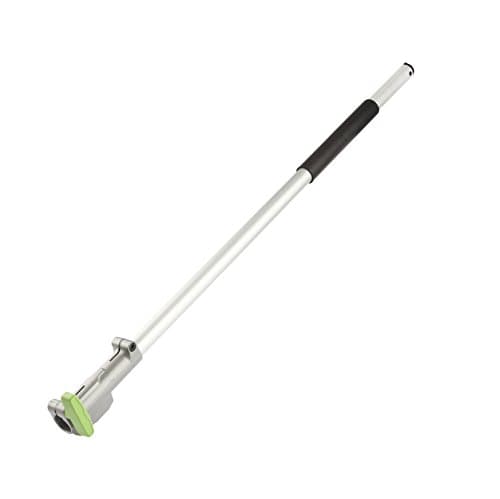
EGO Power+ 10" Pole Saw Attachment PSA1000
EGO · EGO 56V ARC Lithium · Our score 8.1/10
#ad Price as of October 23, 2026. Prices change; we check daily. How we're funded.
70 published cuts from a 140Wh pack at 4.17 lb -- the honest answer for limbs you should not be on a ladder for.
Published specs
| Bar length | 10 in |
|---|---|
| Max cut diameter | 10 in |
| Chain | 3/8 in pitch, 0.043 in gauge |
| Pole length | 38 in (plus power head) |
| Cuts per charge | Up to 70 (2.5Ah) |
| Weight | 4.17 lb |
| Lubrication | Automatic |
Source: 10" Pole Saw Attachment for Multi-Head System (PSA1000), egopowerplus.com
140Wh (56V x 2.5Ah) over 70 published cuts = about 2.0Wh per cut, roughly double the CS1804's 0.93Wh -- a narrow-kerf chain on a long pole works harder per cut than a saw you can lean on.
What the numbers favor
- 70 cuts per 2.5Ah pack, published
- 4.17 lb attachment weight, published
- Automatic bar lubrication rather than a manual oiler
- Takes EGO's EP7500 extension pole for more reach
What they don't
- Attachment only -- needs an EGO PH1400 or PH1420 power head
- 0.043 in narrow-kerf gauge chain, less common than the 0.050 in on the CS1804
you have one overhanging branch. Renting or hiring is cheaper than a power head plus an attachment for a single afternoon.
How it scores
Scores are our editorial weighting of the published specs above, not a test result. They are deliberately kept out of this page's structured data.
Where to buy the tools on this page
Amazon affiliate links, except where a product has no Amazon listing — those go direct to the maker and earn us nothing, and the button says so. We show no price we have not verified today, so where there is no live figure the link says "check price" and takes you to the listing to read it there.
Best cut capacity
EGO Power+ 24" Hedge Trimmer HT2410
EGO · EGO 56V ARC Lithium
Best pole saw on-platform
EGO Power+ 10" Pole Saw Attachment PSA1000
EGO · EGO 56V ARC Lithium
#ad As an Amazon Associate we earn from qualifying purchases, at no extra cost to you. How we're funded.
Common questions
When is the best time to prune shrubs?
When should I prune a spring-flowering shrub?
When should I prune summer-flowering shrubs?
How often should a hedge be trimmed?
Can I trim a hedge in autumn?
Are there plants with special timing?
Sources
Read next
- Trimmers & Edgers
The line gauge and the head design decide whether you enjoy this job or dread it.
- How to trim a hedge properly
Taper the sides, work bottom to top, and follow the extension limit on how much to remove.
- Best cordless hedge trimmer for thick growth
Cut capacity decides it: 1 in published, and a different tool above that.
- Doing your own lawn care: what to do, and when
Four jobs, the right order, the right season. The sequence matters more than the equipment.
- Spring yard cleanup, in the order that works
Debris first, then assess, then mow high. The spring sequence that avoids doing jobs twice.
- How to choose a cordless hedge trimmer
The four specs that decide a hedge trimmer, and the one most makers do not publish.