Yard Tools
Best pressure washer for patios and pavers
The sand between the pavers is the part that fails, and the specification that protects it is an angle rather than a pressure.
Affiliate disclosure: we earn a commission if you buy through our links, at no extra cost to you. It never changes which product we rank first — here is how we're funded.
We have not tested these units. Every spec on this page comes from the manufacturer's own documentation and is linked to it. Every computed figure is arithmetic you can redo. Prices are checked daily — last verified September 24, 2026. Here is exactly how we pick.
Quick picks
Ranked on the published specs and the arithmetic below. Tap any row to jump to the full write-up. We have not tested these units -- here is exactly how we pick.
| # | Product | Best for | Score | Price |
|---|---|---|---|---|
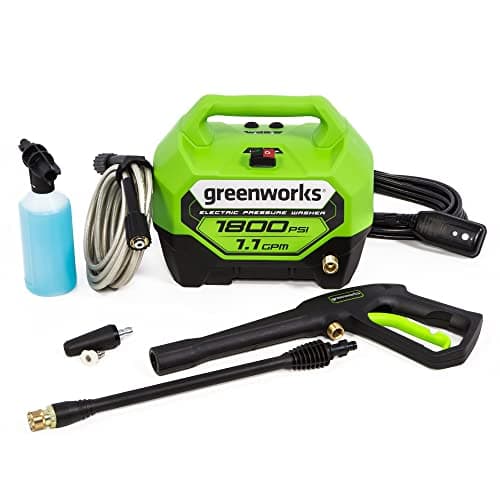
| 1 | Greenworks GPW1800 1800 PSI Corded Pressure Washer (PWMA Certified) The lowest published output of any pressure washer in our registry, and the only one carrying a PWMA certification -- which is what makes the low number trustworthy. | Gentlest certified output | 8.5 | |
| 2 | 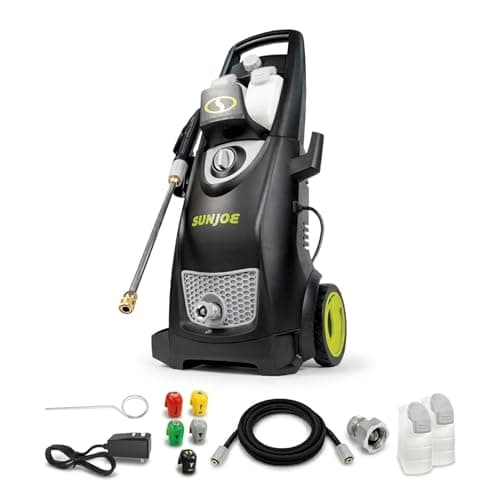 Sun Joe SPX3000 Electric Pressure Washer 2030 PSI rated with five nozzles and a 35 ft cord -- and no battery to size, because it does not have one. | Best corded value | 7.9 | |
| 3 | 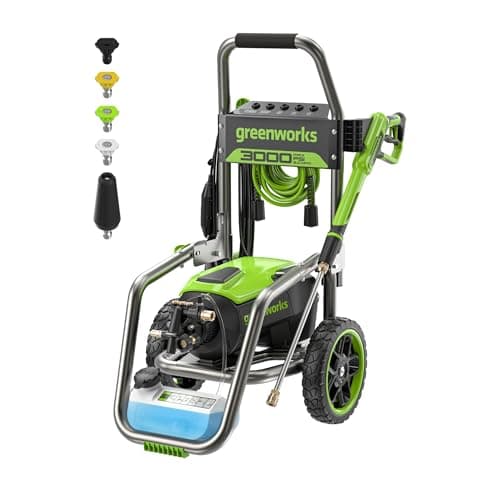 Greenworks 60V 3000 PSI Cordless Pressure Washer 3000 PSI and 2.0 GPM with no cord, and a published Eco mode that trades pressure for the runtime you actually need. | Best cordless | 8.2 |
#ad Buy links are affiliate links. Prices come from a live daily check; where we have no verified price we say "check price" rather than print a stale one.
A paver patio is not one surface. It is a few hundred separate stones held in place by the sand between them, and that sand is softer than anything a pressure washer is usually pointed at. The failure mode here is not a damaged paver, it is a joint that is no longer there.
The short answer
What the paver makers actually publish
We went looking for a safe PSI. Two major manufacturers publish cleaning guidance and neither states one.
- Unilock publishes an angle: "Spray water on the surface using a hose or power washer at an angle no greater than 30 degrees, to avoid washing out any joint material." It also warns that "improper pressure or nozzle settings can harm paver surfaces, causing cracks or erosion, or potentially blowing out joint sand from crevices of pavers", and its cleaning steps end with "inspect the joints and sweep in new joint material if necessary".
- Belgard publishes no figure and a caution: "Pavers are durable... But they can be damaged by the powerful jets that pressure washers can produce." It recommends "a stiff brush and some elbow grease" as preferable and directs readers to their original installation instructions.
The three, on published figures
| Spec | Greenworks GPW1800 | Sun Joe SPX3000 | Greenworks 60V |
|---|---|---|---|
| Pressure | 1800 PSI max | 2030 PSI certified rated | Up to 3000 PSI |
| Flow | 1.1 GPM max | 1.2 GPM certified rated | 2.0 GPM |
| Cleaning units | 1,980 | 2,436 | 6,000 (Eco: 2,200) |
| Certification | PWMA Certified | Certified rated figures | Not published |
| Widest nozzle | 40 degree | 40 degree | Not published |
| Turbo nozzle supplied | Yes -- leave it in the box | No | Not published |
| Hose / cord | 25 ft / 35 ft with GFCI | 20 ft / 35 ft | Cordless |
| Runtime | Unlimited (corded) | Unlimited (corded) | Up to 30 min |
| Warranty | 3-year limited tool | 2 years | Not published on this page |
Transcribed from the GPW1800, SPX3000 and Greenworks 60V product pages. Cleaning units are our arithmetic.
1. Greenworks GPW1800 — the least output, independently verified
One thousand nine hundred and eighty cleaning units is the gentlest published figure we hold, and the PWMA certification means it is a verified figure rather than a marketing peak. A 25 ft hose plus a 35 ft cord gives 60 ft of working radius, which on a patio usually means you never move the machine.
Against it: it ships a turbo nozzle, which is the single worst tip you could fit on a jointed surface — leave it in the box. Greenworks publishes no weight and no soap tank capacity, and 1.1 GPM is the lowest flow here, so rinsing a large patio takes longer.
#ad Check the Greenworks GPW1800 1800 PSI Corded Pressure Washer (PWMA Certified) price on Amazon — how we're funded.
2. Sun Joe SPX3000 — detergent capacity for the organic staining
Most patio dirt is biological — the green film on the shaded side is an organic growth, not grit — and that is a detergent problem. Two removable 0.9 liter tanks and a dedicated soap nozzle make this the machine for the part of the job that soap does.
At 2,436 cleaning units it is 23% above the GPW1800, so it asks for more discipline with the angle. No turbo nozzle in the box, which here counts in its favor.
Against it: the shortest hose of the three at 20 ft, and a two-year warranty.
#ad Check the Sun Joe SPX3000 Electric Pressure Washer price on Amazon — how we're funded.
3. Greenworks 60V — only in Eco, and only if you already own it
Six thousand cleaning units on a paver joint is the wrong tool held the wrong way. Its Eco mode — a published 2200 PSI and 1.0 GPM, so 2,200 units — brings it back into the range the corded machines occupy, and cordless genuinely helps on a patio away from the house.
Against it: you would run it detuned for the whole job, its 30 minute published runtime is short for a large patio, and Greenworks publishes no nozzle list for it, so you cannot confirm a 40 degree tip is included.
#ad Check the Greenworks 60V 3000 PSI Cordless Pressure Washer price on Amazon — how we're funded.
What the joint actually is, and why it matters
A paver patio is a structural sandwich, and the part a pressure washer threatens is not the part you can see. Under the pavers is a bedding layer, and between them is jointing sand whose job is to lock the stones against each other so the surface behaves as one plane instead of a few hundred loose tiles.
- Loose jointing sand is exactly what it sounds like and washes out most easily. It is also the cheapest to replace.
- Polymeric sand contains a binder that sets when wetted, so it resists washing far better — until it is old and cracked, at which point water gets under it and lifts it in sheets.
- Either way the failure is progressive. A joint that loses its top half inch this year holds less next year, and the stones begin to move under load.
Unilock's published warning names exactly this — improper pressure or nozzle settings "potentially blowing out joint sand from crevices of pavers" — and its cleaning routine ends by inspecting the joints and sweeping in new material.
Why the angle rule works
Most patio dirt is alive
The green or black film on the shaded side of a patio is biological growth, not embedded grit, and that changes the tool. Biological films come off with a cleaner and dwell time; they do not require force, and trying to remove them with force is how joints get destroyed.
- Apply a cleaner suitable for your paver and let it work. Check the paver maker's literature first — Unilock and Belgard both publish lists of what not to use, and PEPA publishes a comparable list for vinyl.
- Agitate with a stiff brush where it is worst. Belgard explicitly recommends "a stiff brush and some elbow grease" over a washer.
- Rinse at a shallow angle with the widest tip, which is the only stage a pressure washer is genuinely needed for.
- Let it dry, then re-sand. Sand will not settle into a wet joint.
Washing a patio without losing the joints
- Keep the angle at 30 degrees or shallower, which is Unilock's published instruction and the only numeric guidance either maker gives.
- Fit the widest tip that cleans. The 40 degree nozzle first; step down only if it fails, and never to turbo or 0 degree.
- Work across the joints, not along them, so the stream crosses a groove rather than running down it.
- Let detergent do the organic work and use the water to rinse rather than to scour.
- Re-sand afterwards. Unilock's own routine ends by inspecting the joints and sweeping in new material. Budget for sand as part of the job.
For unjointed concrete the calculus is completely different — see pressure washers for concrete and pressure washing a driveway.
If your pavers are sealed
A sealed patio is a different surface again, and it is worth checking before you start. A sealer is a surface film, and a pressure washer will damage a film long before it damages the stone underneath it — which turns a cleaning job into a stripping-and-resealing job you did not plan.
- Check first. Water beading rather than soaking in is the usual sign of a sealer still doing its job.
- Consult the sealer maker, not the paver maker. The film is theirs and their instructions govern.
- Expect to reseal after a wash if you do proceed, and budget the time.
Neither Unilock nor Belgard publishes a pressure figure for sealed surfaces either, which is consistent with everything else on this page: the published guidance is technique and product-specific literature, never a number.
What we cannot tell you
We have not washed a paver patio. Neither Unilock nor Belgard publishes a PSI ceiling, and we deliberately do not print one. We saw a 1,600 PSI figure attributed to porcelain pavers in search results but could not retrieve the source document, so it is not cited here. Greenworks publishes no nozzle list for its 60V machine and no soap tank capacity for either of its washers, and nobody publishes how much pressure a given jointing sand withstands — polymeric and loose sand behave differently and no maker quantifies it.
The picks in full
Specs are the manufacturer's own and linked to the page they came from. Prices come from a live daily check; where we have no verified price we say so rather than print a stale one.
Greenworks GPW1800 1800 PSI Corded Pressure Washer (PWMA Certified)
Greenworks · Corded 120V · Our score 8.5/10
#ad Price as of September 24, 2026. Prices change; we check daily. How we're funded.
The lowest published output of any pressure washer in our registry, and the only one carrying a PWMA certification -- which is what makes the low number trustworthy.
Published specs
| Model / SKU | GPW1800 / 5124102 |
|---|---|
| Max pressure | 1800 PSI |
| Max flow | 1.1 GPM |
| Certification | PWMA Certified |
| Motor | 13 A universal |
| Nozzles | Five: 0, 25, 40 degree, soap and turbo |
| Hose | 25 ft high-pressure |
| Power cord | 35 ft with inline GFCI |
| Wheels | 8 in |
| Max inlet water temperature | 104 F (40 C) |
| Dimensions | 33 in L x 15 in W x 15.75 in H |
| Warranty | 3-year limited tool warranty |
| Weight / soap tank capacity | Not published |
Source: 1800 PSI 1.2 GPM Pressure Washer (Open Frame) PWMA Certified, greenworkstools.com
1800 PSI x 1.1 GPM = 1,980 cleaning units. That is the lowest figure in our registry -- 19% under the Sun Joe SPX3000's 2,436 and a third of the Greenworks 60V's 6,000 at full output. On a driveway that is a shortcoming. On vinyl siding, where the Polymeric Exterior Products Association publishes no safe PSI at all and warns that water forced behind the panels rots the sheathing, the lowest certified output in the class is the one you want.
What the numbers favor
- PWMA Certified, so the 1800 PSI and 1.1 GPM are independently verified rather than marketing maximums
- 1,980 cleaning units -- the gentlest output we hold specs for
- 25 ft hose plus a 35 ft cord gives 60 ft of working radius, the longest here
- Inline GFCI on the cord, published rather than implied
- 8 in wheels roll over a lawn between elevations instead of digging in
- 3-year tool warranty, a year longer than the Sun Joe
- Publishes a maximum inlet water temperature, which most makers omit
What they don't
- 1.1 GPM is the lowest flow here, and rinsing a two-story wall is a flow job
- Ships a turbo nozzle and a 0 degree tip, neither of which belongs anywhere near vinyl
- No published weight, so you cannot judge how it carries around a house
- No published soap tank capacity, which is the specification that matters most on siding
- No published Total Stop System detail
your main job is a concrete driveway or a stripped-paint deck. At 1,980 cleaning units you will be there a long time.
How it scores
Scores are our editorial weighting of the published specs above, not a test result. They are deliberately kept out of this page's structured data.
Sun Joe SPX3000 Electric Pressure Washer
Sun Joe · Corded 120V · Our score 7.9/10
#ad Price as of September 24, 2026. Prices change; we check daily. How we're funded.
2030 PSI rated with five nozzles and a 35 ft cord -- and no battery to size, because it does not have one.
Published specs
| Rated pressure | 2030 PSI (max) |
|---|---|
| Rated flow | 1.2 GPM (certified rated) |
| Motor | 13 A |
| Nozzles | 5 quick-connect (0/15/25/40/soap) |
| Detergent tanks | 2 x 0.9 L, removable |
| Hose / cord | 20 ft hose, 35 ft cord |
| Safety | Total Stop System trigger |
| Weight | 24.3 lb |
Source: Sun Joe SPX3000 Electric Pressure Washer, shopjoe.com
What the numbers favor
- Runs indefinitely -- no pack to discharge, no runtime figure to reconcile
- Five nozzles included rather than sold separately
- Two removable detergent tanks
- Total Stop System shuts the pump off between trigger pulls
What they don't
- Corded: a 35 ft cord plus an extension is the real working radius
- Sun Joe lists this model at both 13 A and 14.5 A across variants -- confirm the amperage on the exact SKU before buying
- Not on any battery platform, so it shares nothing with the rest of your yard kit
your working area is beyond easy reach of an outdoor outlet. A cordless washer trades runtime for the ability to walk away from the house.
How it scores
Scores are our editorial weighting of the published specs above, not a test result. They are deliberately kept out of this page's structured data.
Greenworks 60V 3000 PSI Cordless Pressure Washer
Greenworks · Greenworks 60V · Our score 8.2/10
#ad Price as of September 24, 2026. Prices change; we check daily. How we're funded.
3000 PSI and 2.0 GPM with no cord, and a published Eco mode that trades pressure for the runtime you actually need.
Published specs
| Max pressure | Up to 3000 PSI |
|---|---|
| Max flow | 2.0 GPM |
| Eco mode | 2200 PSI / 1.0 GPM |
| Runtime | Up to 30 min |
| Power | 60V battery (dual-battery kits available) |
Source: 60V 3000-PSI 2.0 GPM Electric Pressure Washer, greenworkstools.com
What the numbers favor
- Highest published pressure of the two washers here, by nearly 1000 PSI
- No cord -- works anywhere on the property
- Eco mode is published with real numbers (2200 PSI / 1.0 GPM), not just a label
- Shares the Greenworks 60V pack with the rest of that platform
What they don't
- 30 minutes of published runtime against a corded washer's unlimited
- Greenworks publishes several 60V washers at different pressures; check the SKU matches the PSI you are paying for
you wash a driveway twice a year within reach of an outlet. You would be buying 60V packs to solve a problem an extension cord already solves.
How it scores
Scores are our editorial weighting of the published specs above, not a test result. They are deliberately kept out of this page's structured data.
Where to buy the tools on this page
Every link below is an Amazon affiliate link. We show no price we have not verified today, so where there is no live figure the link says "check price" and takes you to the listing to read it there.
Gentlest certified output
Greenworks GPW1800 1800 PSI Corded Pressure Washer (PWMA Certified)
Greenworks · Corded 120V
Best corded value
Sun Joe SPX3000 Electric Pressure Washer
Sun Joe · Corded 120V
Best cordless
Greenworks 60V 3000 PSI Cordless Pressure Washer
Greenworks · Greenworks 60V
#ad As an Amazon Associate we earn from qualifying purchases, at no extra cost to you. How we're funded.
Common questions
What is the best pressure washer for pavers?
What PSI is safe for pavers?
Will a pressure washer blow the sand out of paver joints?
Do you have to re-sand pavers after pressure washing?
Should you use a turbo nozzle on pavers?
Sources
Read next
- Yard Tools
The tools you buy third and fourth. This is where a platform choice pays off or bites.
- Best pressure washer for a home yard
PSI x GPM is the cleaning-power number. Corded and cordless compared on both.
- Best pressure washer for concrete
Cleaning units compared for flatwork, with the surface-cleaner case and the striping problem.
- Best pressure washer for siding
Cleaning units, detergent capacity and working radius for washing a house, and the PSI figure nobody publishes.
- Pressure washer nozzles explained
The tip number is a spray angle. Wider spreads the force; narrower concentrates it.
- How to pressure wash a driveway
Nozzle, overlap and runtime arithmetic, plus the CPSC electrical guidance.