Leaf Blowers
Best leaf blower for mulch beds
This is the one blowing job where the specification you need is the lowest number the tool can produce, not the highest.
Affiliate disclosure: we earn a commission if you buy through our links, at no extra cost to you. It never changes which product we rank first — here is how we're funded.
We have not tested these units. Every spec on this page comes from the manufacturer's own documentation and is linked to it. Every computed figure is arithmetic you can redo. Prices are checked daily — last verified September 24, 2026. Here is exactly how we pick.
Quick picks
Ranked on the published specs and the arithmetic below. Tap any row to jump to the full write-up. We have not tested these units -- here is exactly how we pick.
| # | Product | Best for | Score | Price |
|---|---|---|---|---|
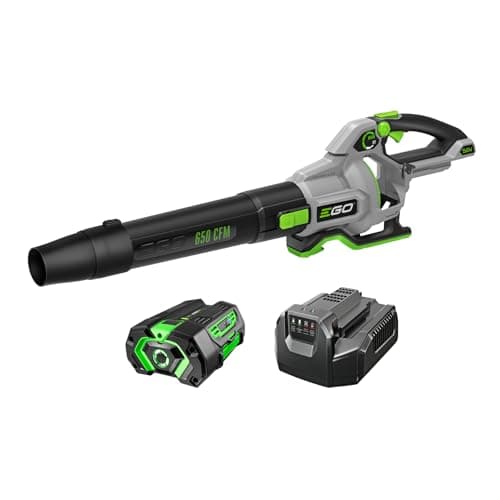
| 1 | EGO Power+ 650 CFM Blower LB6504 650 CFM in turbo with a genuine variable dial down to 225 CFM, and 64 dB published -- the useful range is the whole point. | Best overall | 9.0 | |
| 2 | 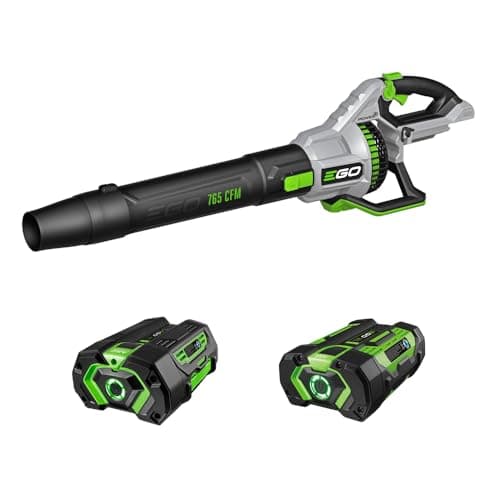 EGO Power+ 765 CFM Blower LB7650 765 CFM and 200 MPH, with the turbo/low split published honestly: 15 minutes flat out, 150 minutes on low. | Best for large yards | 8.9 | |
| 3 | No photo Ryobi 40V HP Whisper Series 730 CFM RY404100 57 dB published at 730 CFM. That is the lowest published noise figure on this page and it is not close. | Best quiet blower | 8.8 |
#ad Buy links are affiliate links. Prices come from a live daily check; where we have no verified price we say "check price" rather than print a stale one.
Every other page in this hub is about moving more air. This one is about moving less. Shredded bark mulch weighs so little that the setting which clears a driveway will redistribute your beds across the lawn, and the specification that prevents it is the one most makers do not publish.
The short answer
The floor is the specification
A bed is a surface where the debris you want gone and the material you want to keep have almost the same mass. The only control you have is how gently the tool can be asked to work, and that is a published number on some blowers and a blank on others.
| Blower | Published low setting | Peak CFM | Usable span |
|---|---|---|---|
| EGO LB6504 | 225 CFM | 650 CFM (turbo) | 225-470 CFM variable |
| EGO LB7650 | 260 CFM | 765 CFM (turbo) | 260-580 CFM variable |
| EGO LB6000 (backpack) | 260 CFM | 600 CFM | 260-600 CFM variable |
| RYOBI RY404100 | Not published as CFM | 730 CFM | Three speed tips: 160/175/190 MPH |
| Greenworks BL80L02 | Not published | 730 CFM | Not published |
Transcribed from the LB6504, LB7650, LB6000, RY404100 and BL80L02 product pages.
1. EGO LB6504 — the lowest published floor
Two hundred and twenty-five CFM is the gentlest published setting in our registry, and it comes with a 64 dB noise figure and an IPX4 weather rating — the only blower we hold specs for that publishes one, which is worth something on the damp autumn mornings this work actually happens on.
Against it: the lowest peak output of the three here at 650 CFM, so if the same tool also has to clear a long driveway you are giving something up. EGO publishes no weight for it at all.
#ad Check the EGO Power+ 650 CFM Blower LB6504 price on Amazon — how we're funded.
2. EGO LB7650 —35 CFM more at the floor, far more at the top
A 260 CFM floor is 16% above the LB6504's, which in a bed of fine bark is a real difference — but it is still a published floor, and the 260 to 580 CFM span is the widest band of control here. As one tool for beds and driveways both, it is the better compromise.
Against it: for this job specifically it starts higher than it needs to, and the 765 CFM headline is irrelevant in a bed.
#ad Check the EGO Power+ 765 CFM Blower LB7650 price on Amazon — how we're funded.
3. RYOBI RY404100 — speed tips instead of a dial
RYOBI takes a different approach: three interchangeable tips published at 160, 175 and 190 MPH rather than a variable CFM range. Fitting the 160 MPH tip is a genuine way to work more gently, and at 57 dB it is the quietest blower in our registry.
Against it: speed tips control the jet, not the volume, and RYOBI publishes no low-end CFM figure. In a bed you are managing airflow, so you are working without the number you most need.
#ad Check the Ryobi 40V HP Whisper Series 730 CFM RY404100 price on Amazon — how we're funded.
Technique matters more than the tool here
- Fit the wide nozzle, not the tapered one. Narrowing the opening raises speed, and speed is what excavates bark.
- Hold it high and angle across the bed, not down into it. You want the air to skim the top layer.
- Blow along the bed toward an open end, so leaves travel the short way out rather than across the whole planting.
- Start at the lowest setting that moves one leaf and step up only if it stops working.
- Leave the fines. The dust and small fragments at the bottom are the part of the mulch doing the work — see clippings and composting.
Why mulch moves and leaves do not stay
The problem is that the two materials are closer in weight than they look. A dry leaf and a fragment of shredded bark are both light, flat and easily lifted, and the bark has the disadvantage of sitting underneath — so any airflow strong enough to lift the leaf off the bark is usually strong enough to lift the bark too.
What separates them is not weight but interlock. Shredded bark mulch knits together as it settles, and a settled bed resists air far better than a freshly spread one. That is why the same blower that strips a new bed leaves an established one alone, and it is the single biggest variable on this job — bigger than the machine.
| Bed material | How it behaves under air | Practical approach |
|---|---|---|
| Settled shredded bark | Interlocked; resists moderate airflow | Low setting, wide nozzle, shallow angle |
| Fresh shredded bark | Not yet knitted; moves easily | Hand tool, or wait a few weeks |
| Pine fines / soil conditioner | Very light, no interlock | Do not blow it |
| Nugget bark | Heavier pieces, more stable | Tolerates more airflow |
| Pine straw | Interlocks strongly, sheds leaves poorly | Different job -- see our pine needle page |
Behavior described from material properties rather than from any published figure. No maker or extension service we could find publishes an airflow threshold for any mulch type.
The specification that should exist and does not
Every blower page on this site ends up at the same place, and this one arrives fastest: makers publish a peak and sometimes a range, and nothing about the bottom of the range except its number. What a bed owner wants is airflow at the nozzle at a given setting and distance, and that figure does not exist anywhere in consumer specifications.
Distance and angle are free, and they dominate
Air spreads and slows as it leaves the nozzle. Doubling your distance from the bed does more to protect the mulch than any setting change available on any of these machines, and it costs nothing.
- Stand further back than feels efficient. Three feet rather than one, and let the spread do the work.
- Keep the stream nearly parallel to the surface. Air aimed down excavates; air aimed across skims.
- Move continuously. A stationary nozzle digs a hole in anything.
- Work the perimeter inward toward an open end, so leaves exit the short way and you never cross the whole bed.
- Accept a partial result. A bed with a few leaves left in it is a bed that still has its mulch. This is not a surface that rewards perfectionism.
The tools that beat a blower here
- A leaf rake with flexible tines, used lightly. Slower, and it does not redistribute your mulch across the lawn.
- Your hands, for a small bed. Genuinely faster than fetching a blower and a battery for a ten-foot strip.
- A mower with a bag, on the lawn side only, so the leaves never reach the bed — see mowers for leaf mulching.
- Leaving them. A modest leaf layer in a bed breaks down into the same organic matter you paid for the mulch to provide — see clippings and composting.
When to put the blower down
Among close perennial plantings, in a freshly mulched bed, or anywhere the mulch is fine pine fines rather than shredded bark, a hand tool wins and no setting will fix it. The blower is for open beds along a drive, a fence or a foundation line. Pine straw is a different problem again and has its own page: best blowers for pine needles.
Timing the job to the bed, not the calendar
Two timing decisions make this job easier than any machine choice does.
- Wait for the mulch to settle. A bed spread in April resists air far better by October than it did in its first fortnight. If you mulch and then immediately face leaf fall, hand-clear that first season.
- Clear leaves while they are dry. A dry leaf lifts at a fraction of the airflow a wet one needs, and the wet-leaf setting is the setting that moves bark. Waiting for a dry afternoon does more for your mulch than any nozzle.
- Go more often, not harder. A thin layer of leaves clears on low. A three-week accumulation does not, and by then the bed is a compaction problem as well.
Both points argue for the blower you will actually pick up on a Tuesday evening rather than the one with the highest peak figure — which usually means the lightest one. Our lightweight blower page covers that side.
What we cannot tell you
We have not tested any of these blowers in a bed. Nobody publishes the airflow at which a given mulch starts to move — that depends on the material, its moisture and how long it has settled, and no maker or extension service we could find puts a figure on it. Two of the five blowers in the table publish no low-end setting at all, so their behavior here is genuinely unknown rather than merely worse.
The picks in full
Specs are the manufacturer's own and linked to the page they came from. Prices come from a live daily check; where we have no verified price we say so rather than print a stale one.
EGO Power+ 650 CFM Blower LB6504
EGO · EGO 56V ARC Lithium · Our score 9.0/10
#ad Price as of September 24, 2026. Prices change; we check daily. How we're funded.
650 CFM in turbo with a genuine variable dial down to 225 CFM, and 64 dB published -- the useful range is the whole point.
Published specs
| Max air volume | 650 CFM (turbo) |
|---|---|
| Variable range | 225-470 CFM |
| Max air speed | Up to 180 MPH |
| Battery (kit) | 56V 5.0Ah |
| Runtime claim | Up to 90 min average |
| Noise | 64 dB |
| Warranty | 5-yr tool / 3-yr battery |
Source: POWER+ 650 CFM Blower, egopowerplus.com
56V x 5.0Ah = 280Wh, using EGO's advertised pack voltage.
What the numbers favor
- A real variable dial (225-470 CFM) plus turbo, not a three-position switch
- 64 dB published -- quieter than the 730 CFM Greenworks, which does not publish a figure at all
- IPX4 weather-resistant rating, published
- 5-year tool warranty
What they don't
- The 650 CFM headline is turbo-only; sustained work happens at 470 CFM or below
- EGO does not publish a weight for this model
your yard is a small courtyard or a deck. 650 CFM will move your mulch, your gravel and your neighbor's patience.
How it scores
Scores are our editorial weighting of the published specs above, not a test result. They are deliberately kept out of this page's structured data.
EGO Power+ 765 CFM Blower LB7650
EGO · EGO 56V ARC Lithium · Our score 8.9/10
#ad Price as of September 24, 2026. Prices change; we check daily. How we're funded.
765 CFM and 200 MPH, with the turbo/low split published honestly: 15 minutes flat out, 150 minutes on low.
Published specs
| Max air volume | 765 CFM |
|---|---|
| Variable range | 260-580 CFM |
| Max air speed | Up to 200 MPH |
| Runtime (turbo) | 15 min on 5.0Ah |
| Runtime (low) | 150 min on 5.0Ah |
| Weight | 4.6 lb without battery |
| Noise | 64 dB |
Source: POWER+ 765 CFM Blower (LB7650), egopowerplus.com
280Wh (56V x 5.0Ah) over the published 15-minute turbo runtime = about 18.7Wh per minute. On low, 280Wh over 150 minutes is about 1.9Wh/min -- turbo costs roughly 10x the energy per minute.
What the numbers favor
- Highest published CFM and MPH of any handheld here
- Publishes BOTH turbo and low runtimes, so the trade-off is visible instead of averaged away
- 4.6 lb bare -- the lightest published weight of the handhelds on this page
What they don't
- 15 minutes of turbo on a 5.0Ah pack is the real constraint, whatever the 90-minute average says
- Sold bare in most configurations; budget for a battery and charger
you are clearing a small lawn. You will run it at 260 CFM forever and never touch what you paid for.
How it scores
Scores are our editorial weighting of the published specs above, not a test result. They are deliberately kept out of this page's structured data.
Ryobi 40V HP Whisper Series 730 CFM RY404100
Ryobi · Ryobi 40V · Our score 8.8/10
#ad No verified live price right now, so we show none rather than a stale one. How we're funded.
57 dB published at 730 CFM. That is the lowest published noise figure on this page and it is not close.
Published specs
| Max air volume | 730 CFM |
|---|---|
| Max air speed | 190 MPH |
| Speed tips | 160 / 175 / 190 MPH |
| Noise | 57 dB |
| Batteries (kit) | 2 x 40V 4.0Ah |
| Runtime | 30 min high / 120 min low |
| Weight | 9.4 lb |
Source: 40V HP Brushless Whisper Series 730 CFM Blower (RY404100), ryobitools.com
Decibels are logarithmic: a 7 dB drop is roughly a 5x reduction in sound intensity, and is perceived as roughly half as loud. Both figures are manufacturer-published under their own test conditions, so treat the gap as directional, not lab-comparable.
What the numbers favor
- 57 dB published -- the quietest figure any manufacturer on this page publishes
- 730 CFM while doing it, second only to the 765 CFM EGO
- Ships with two 4Ah packs (320Wh total) in the kit
- Publishes high AND low runtimes rather than an average
What they don't
- 9.4 lb is the heaviest published handheld weight here, roughly double the EGO LB7650 bare
- Manufacturer noise figures are measured under each brand's own conditions -- not a like-for-like lab comparison
you need to move soaked leaves off a large property fast. Quiet costs air speed, and 190 MPH is the lowest peak here.
How it scores
Scores are our editorial weighting of the published specs above, not a test result. They are deliberately kept out of this page's structured data.
Where to buy the tools on this page
Every link below is an Amazon affiliate link. We show no price we have not verified today, so where there is no live figure the link says "check price" and takes you to the listing to read it there.
Best overall
EGO Power+ 650 CFM Blower LB6504
EGO · EGO 56V ARC Lithium
Best for large yards
EGO Power+ 765 CFM Blower LB7650
EGO · EGO 56V ARC Lithium
Best quiet blower
Ryobi 40V HP Whisper Series 730 CFM RY404100
Ryobi · Ryobi 40V
#ad As an Amazon Associate we earn from qualifying purchases, at no extra cost to you. How we're funded.
Common questions
What is the best leaf blower for mulch beds?
How do you blow leaves out of mulch without moving the mulch?
Will a leaf blower ruin a mulched bed?
Should you use a leaf blower or a rake in beds?
What nozzle should you use in a bed?
Sources
Read next
- Leaf Blowers
CFM moves the pile. MPH lifts what's stuck. Almost nobody explains which you need.
- Best cordless blower for driveways, patios and paths
The bottom of the variable range is the spec that matters on hard surfaces.
- Best cordless blower for pine needles
Needles interlock into turf, so air speed clears them where volume does not.
- Leaf blower nozzles: what the tube on the end actually does
A nozzle trades volume for speed. What each tip does, and the published figures behind it.
- Best cordless leaf blowers of 2026
Five cordless blowers ranked on usable airflow range, published noise and real turbo runtime.
- What to do with grass clippings
Worth one fertilizer application a year, and no cause of thatch. Return, mulch or compost.