Leaf Blowers
Leaf blower, rake or leaf vacuum: which do you need?
They are not three ways of doing one job. They move, gather and collect, and most yards need two of the three at most.
Affiliate disclosure: we earn a commission if you buy through our links, at no extra cost to you. It never changes which product we rank first — here is how we're funded.
We have not tested these units. Every spec on this page comes from the manufacturer's own documentation and is linked to it. Every computed figure is arithmetic you can redo. Prices are checked daily — last verified October 23, 2026. Here is exactly how we pick.
These three get compared as if they are competing solutions to one problem. They are not. One moves material, one gathers it, one collects and shreds it, and knowing which part of the job you are actually stuck on is most of the decision.
The short answer
What each tool is actually good at
| Blower | Rake | Leaf vacuum | |
|---|---|---|---|
| Core job | Moves material across ground | Gathers material into a pile | Collects and shreds into a bag |
| Open lawn | Excellent | Slow | Very slow |
| Hard surfaces | Excellent | Fine | Good |
| Under shrubs and in beds | Blows mulch and gravel around | Excellent | Good, if it reaches |
| The final gather | Frustrating -- air spreads piles too | Excellent | Not needed; it collects |
| Wet, matted material | Needs high air speed | Heavy going but works | Clogs |
| Noise | 57 to 64 dB published across our registry | Silent | Comparable to a blower |
| Energy per minute | About 1.9 on low, 18.7 on turbo | None | Not published by anyone we cite |
Blower noise and runtime figures from the manufacturers' own product pages, checked 3 September 2026. We hold no cited spec sheet for a leaf vacuum, so its column describes the tool class rather than a specific product.
The blower: the moving tool
A blower is the only one of the three that covers ground quickly. It is also the only one with a meaningful running cost, and the published figures make that concrete.
The variable range is therefore the specification that matters most for this use. The LB6504 dials from 225 to 470 CFM before turbo, which is what lets you work near mulch beds and gravel without redistributing them. Full mode arithmetic is in the blower runtime guide.
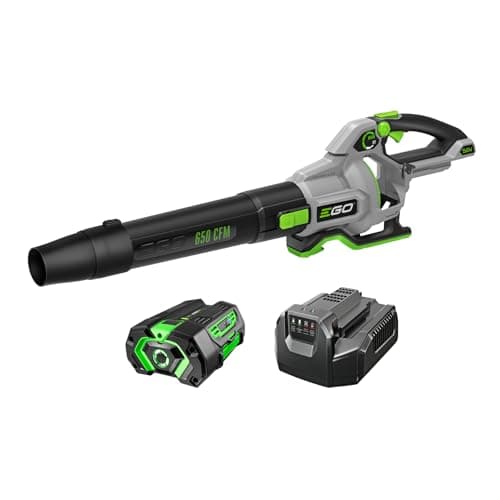
#ad Check the EGO Power+ 650 CFM Blower LB6504 price on Amazon — how we're funded.
The rake: still the best gathering tool
Air is bad at the last ten feet. A pile you have built with a blower is a pile a blower can scatter, and getting leaves off the ground and into a bag is a job with no airflow solution at all.
A rake also wins in the places a blower is actively unhelpful: under shrubs, in gravel, around bark mulch, and anywhere a 200 MPH jet would relocate your landscaping along with the leaves. Which rake is a harder question than it should be, because almost nobody in the category publishes a specification — our leaf rake roundup ranks the two that do and shows the walking distance raking actually costs. And it is silent, which on a Sunday morning is not nothing — the quietest blower we hold specs for still publishes 57 dB.
The leaf vacuum: the narrow case
A leaf vacuum earns its place when collection is genuinely required and shredding is useful — filling compost bins, clearing a lawn you cannot mulch onto, or collecting diseased material. Extension guidance is to remove clippings if the lawn is heavily infested with diseases such as leaf spot, rust or dollar spot, and the same logic applies to leaf litter you want off the lawn entirely.
It is slow over open ground, it clogs on wet material, and for most households the job it does is one a mower does faster.
The tool that beats all three
The efficient answer for most lawns is not on this page's title. Penn State Extension states that a leaf layer up to about one-half inch in depth is beneficial to the lawn when mulched in with a mower, and that you may need to go back over the leaves in a cross direction from the first cut to shred them more finely. Michigan State research it cites found no negative effects of mulching leaf litter into turf.
That is the sequence we set out in the leaf cleanup guide, and the mower side of it is in best mower for mulching leaves.
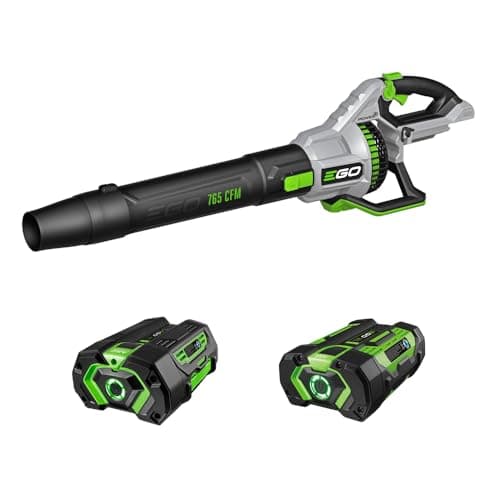
#ad Check the EGO Power+ 765 CFM Blower LB7650 price on Amazon — how we're funded.
Which to buy, by situation
- Open lawn with trees: blower plus your existing mower. Skip the vacuum entirely.
- Heavily bedded garden: blower for the hard surfaces, rake for the beds. A blower in a mulch bed makes work.
- Small courtyard or deck: a rake and a brush. 650 CFM in a courtyard moves your gravel.
- Large property, long sessions: a backpack blower. The LB6000 publishes 180 minutes on low and carries 12.5 lb on a harness rather than your wrist.
- You must collect, not move: this is the one clear leaf-vacuum case, and it is narrower than the marketing suggests.
#ad Check the EGO Power+ 600 CFM Backpack Blower LB6000 price on Amazon — how we're funded.
What we cannot tell you
We hold no published specifications for any leaf vacuum, so nothing here ranks one against a named blower on figures. We have also not used any of these tools, and nobody publishes a clearing-rate figure in square feet per minute for any of the three.
What is documented: the blower energy split between low and turbo, the published noise figures, and the extension guidance that makes a mower the fastest leaf tool most people already own.
The products discussed
Specs are the manufacturer's own and linked to the page they came from. Prices come from a live daily check; where we have no verified price we say so rather than print a stale one.
EGO Power+ 650 CFM Blower LB6504
EGO · EGO 56V ARC Lithium · Our score 9.0/10
#ad Price as of October 23, 2026. Prices change; we check daily. How we're funded.
650 CFM in turbo with a genuine variable dial down to 225 CFM, and 64 dB published -- the useful range is the whole point.
Published specs
| Max air volume | 650 CFM (turbo) |
|---|---|
| Variable range | 225-470 CFM |
| Max air speed | Up to 180 MPH |
| Battery (kit) | 56V 5.0Ah |
| Runtime claim | Up to 90 min average |
| Noise | 64 dB |
| Warranty | 5-yr tool / 3-yr battery |
Source: POWER+ 650 CFM Blower, egopowerplus.com
56V x 5.0Ah = 280Wh, using EGO's advertised pack voltage.
What the numbers favor
- A real variable dial (225-470 CFM) plus turbo, not a three-position switch
- 64 dB published -- quieter than the 730 CFM Greenworks, which does not publish a figure at all
- IPX4 weather-resistant rating, published
- 5-year tool warranty
What they don't
- The 650 CFM headline is turbo-only; sustained work happens at 470 CFM or below
- EGO does not publish a weight for this model
your yard is a small courtyard or a deck. 650 CFM will move your mulch, your gravel and your neighbor's patience.
How it scores
Scores are our editorial weighting of the published specs above, not a test result. They are deliberately kept out of this page's structured data.
EGO Power+ 765 CFM Blower LB7650
EGO · EGO 56V ARC Lithium · Our score 8.9/10
#ad Price as of October 23, 2026. Prices change; we check daily. How we're funded.
765 CFM and 200 MPH, with the turbo/low split published honestly: 15 minutes flat out, 150 minutes on low.
Published specs
| Max air volume | 765 CFM |
|---|---|
| Variable range | 260-580 CFM |
| Max air speed | Up to 200 MPH |
| Runtime (turbo) | 15 min on 5.0Ah |
| Runtime (low) | 150 min on 5.0Ah |
| Weight | 4.6 lb without battery |
| Noise | 64 dB |
Source: POWER+ 765 CFM Blower (LB7650), egopowerplus.com
280Wh (56V x 5.0Ah) over the published 15-minute turbo runtime = about 18.7Wh per minute. On low, 280Wh over 150 minutes is about 1.9Wh/min -- turbo costs roughly 10x the energy per minute.
What the numbers favor
- Highest published CFM and MPH of any handheld here
- Publishes BOTH turbo and low runtimes, so the trade-off is visible instead of averaged away
- 4.6 lb bare -- the lightest published weight of the handhelds on this page
What they don't
- 15 minutes of turbo on a 5.0Ah pack is the real constraint, whatever the 90-minute average says
- Sold bare in most configurations; budget for a battery and charger
you are clearing a small lawn. You will run it at 260 CFM forever and never touch what you paid for.
How it scores
Scores are our editorial weighting of the published specs above, not a test result. They are deliberately kept out of this page's structured data.
EGO Power+ 600 CFM Backpack Blower LB6000
EGO · EGO 56V ARC Lithium · Our score 8.7/10
#ad No verified live price right now, so we show none rather than a stale one. How we're funded.
The weight goes on your back instead of your wrist, and EGO publishes all three runtimes so you can see what the harness actually buys you.
Published specs
| Max air volume | 600 CFM |
|---|---|
| Variable range | 260-600 CFM |
| Max air speed | 145 MPH |
| Runtime (low) | Up to 180 min on 7.5Ah |
| Runtime (high) | Up to 33 min |
| Runtime (turbo) | Up to 23 min |
| Weight | 12.5 lb |
Source: 600 CFM Cordless Backpack Leaf Blower (LB6000), egopowerplus.com
420Wh (56V x 7.5Ah) over the published 23-minute turbo runtime = about 18.3Wh per minute, almost exactly the LB7650 handheld's 18.7Wh/min. Turbo costs the same energy whichever way you carry it -- the backpack buys comfort, not efficiency.
What the numbers favor
- Publishes low, high AND turbo runtimes -- three numbers where most brands give one average
- 12.5 lb carried on a harness with a waist belt, not held out at arm's length
- Variable 260-600 CFM across the whole range
- Adjustable tube length, published
What they don't
- 145 MPH is the lowest air speed of any blower on this page
- 12.5 lb is genuine weight even on a harness
- Sold bare in most configurations
your clearing sessions are under twenty minutes. A harness you spend a minute putting on for a fifteen-minute job is a worse tool than a 4.6 lb handheld.
How it scores
Scores are our editorial weighting of the published specs above, not a test result. They are deliberately kept out of this page's structured data.
Where to buy the tools on this page
Amazon affiliate links, except where a product has no Amazon listing — those go direct to the maker and earn us nothing, and the button says so. We show no price we have not verified today, so where there is no live figure the link says "check price" and takes you to the listing to read it there.
Best overall
EGO Power+ 650 CFM Blower LB6504
EGO · EGO 56V ARC Lithium
Best for large yards
EGO Power+ 765 CFM Blower LB7650
EGO · EGO 56V ARC Lithium
Best backpack
EGO Power+ 600 CFM Backpack Blower LB6000
EGO · EGO 56V ARC Lithium
#ad As an Amazon Associate we earn from qualifying purchases, at no extra cost to you. How we're funded.
Common questions
Is a leaf blower better than a rake?
Do I need a leaf vacuum?
What is the fastest way to clear leaves?
How much energy does a blower use?
Is a rake still worth owning?
Can a leaf blower do everything a rake does?
Sources
Read next
- Leaf Blowers
CFM moves the pile. MPH lifts what's stuck. Almost nobody explains which you need.
- Leaf cleanup, in the order that actually works
Mulch what the lawn can take, blow the rest, and the energy cost of each stage.
- Best leaf rakes, and the spec problem in this whole category
Two maker-published rakes, the raking arithmetic that says when to stop, and the retailer tine counts that disagree by a factor of three.
- Best battery mower for mulching leaves
Half an inch of leaves is the workable layer. Which decks shred it, and the cross pass that finishes the job.
- Best cordless leaf blowers of 2026
Five cordless blowers ranked on usable airflow range, published noise and real turbo runtime.
- How long will a cordless leaf blower actually run?
Turbo costs about ten times low, per minute. Every published blower runtime converted.
- Fall lawn care, in the order the guidance puts it
Aeration, seeding, weeds and most feeding all land between late August and mid-October.
- Best leaf vacuum mulcher
Mulch ratios converted to a common unit, plus airflow and weight for two corded vacuums.
- Best blower vacuum combo
Cordless against corded blower-vacs on mulch ratio, airflow and watt-hours per minute.
- Leaf blower vs lawn sweeper
Collection versus movement, on published CFM, hopper capacity and watt-hours per minute.