Lawn Care
Fall lawn care, in the order the guidance puts it
Almost every job that improves a cool-season lawn happens between late August and mid-October. Spring is for tidying; this is the season that counts.
Affiliate disclosure: we earn a commission if you buy through our links, at no extra cost to you. It never changes which product we rank first — here is how we're funded.
We have not tested these units. Every spec on this page comes from the manufacturer's own documentation and is linked to it. Every computed figure is arithmetic you can redo. Prices are checked daily — last verified October 23, 2026. Here is exactly how we pick.
Pull the published timing windows for every major lawn job into one place and something striking happens: almost all of them land in the same eight weeks. Autumn is not one season among four for a cool-season lawn. It is the season.
Every published window, in one table
| Job | Published window | Source |
|---|---|---|
| Core aeration and vertical mowing | Late August through early October | UMN Extension thatch guidance |
| Seeding and overseeding | Late summer, typically late August into early September | Extension seeding guidance |
| Perennial broadleaf weed control | Mid-September through mid-October | UMN Extension, lawn weeds |
| Fertilizer, high maintenance | Aug, Sept, early Oct (three of four applications) | UMN Extension, fertilizing lawns |
| Fertilizer, medium maintenance | Aug, Sept (two of three applications) | UMN Extension, fertilizing lawns |
| Fertilizer, low maintenance | Sept (the single annual application) | UMN Extension, fertilizing lawns |
| Leaf mulching | As leaves fall, at a layer up to about 1/2 inch | Penn State Extension |
These are Minnesota and Pennsylvania recommendations. Your own state extension service is the authority for local dates.
The order, and why it matters
These jobs interact. Done in the right sequence each one improves the conditions for the next; done in the wrong one, later jobs undo earlier ones.
- Measure and diagnose. Thatch over half an inch is a dethatching job; water pooling or soil you cannot push a screwdriver into is compaction and an aeration job. They are different tools and different depths — the distinction is in dethatching vs aerating.
- Dethatch or core aerate. Late August through early October. This opens the surface, which is exactly what the next job needs.
- Overseed into the opened surface. Seed-to-soil contact is the whole game, and an aerated or scarified lawn provides it for free. Method in how to overseed a lawn.
- Feed. Following the extension rates, capped at 1 lb of nitrogen per 1,000 sq ft per application.
- Handle perennial weeds in the mid-September to mid-October window, when the plants are storing energy for winter and actively growing.
- Keep mowing to the height trigger, and mulch leaves in as they fall.
#ad Check the Agri-Fab 48" Tow-Behind Plug Aerator (45-0299) price on Amazon — how we're funded.
Aeration: the depth that defines it
The most common autumn mistake is buying the wrong machine, because retail listings file dethatchers, scarifiers and spike rollers under "aerator". Working depth separates them, and the published figures are unambiguous.
Coverage arithmetic matters too, because these are slow machines. A 48 inch tow-behind aerator covers 10,000 sq ft in about 52 passes; a 12.6 inch dethatcher covers 5,000 sq ft in about 79 passes. The second one is an afternoon.
#ad Check the Sun Joe AJ801E Dethatcher + Scarifier price on Amazon — how we're funded.
Seeding: why late summer beats spring
Extension guidance puts the optimum window in late summer — typically late August into early September — so seedlings get two cool growing seasons before their first summer.
That is the whole argument. Spring-sown grass gets one short cool season and then meets July as a seedling, competing with summer annual weeds that germinate at the same time. Autumn-sown grass gets autumn, then spring, and meets its first summer established.
Species matters here too: perennial ryegrass germinates in 5 to 7 days where Kentucky bluegrass can take up to two weeks, which is why rye dominates overseeding mixes. The species detail is in the grass types guide.
#ad Check the Scotts Elite Spreader price on Amazon — how we're funded.
Leaves, which arrive in the middle of all this
Leaf fall overlaps the whole program, and the published guidance turns it from a chore into an input. Penn State Extension states that a layer up to about one-half inch in depth is beneficial to the lawn, that you may need to go back over the leaves in a cross direction from the first cut to shred them more finely, and that it works best when leaves are relatively dry and not piled too thickly.
It cites Michigan State University research finding no negative effects of mulching leaf litter into turf, with fewer broadleaf weeds, improved soil quality and no effect on soil pH from oak or maple leaves. The mower side is in best mower for mulching leaves.
#ad Check the EGO Power+ 21" Select Cut LM2135SP price on Amazon — how we're funded.
Keep mowing
Autumn produces a second growth flush, and the mowing rules do not change: maintain at 3 inches or higher, mow before the grass reaches 4.5 inches, remove no more than one third of the leaf tissue, and leave clippings of an inch or less on the lawn where they decompose quickly.
The last cut of the year happens when growth stops, not on a date. That is the same height-trigger logic as the rest of the season — see how often to mow.
What we cannot tell you
Every window on this page is a regional recommendation from Minnesota or Pennsylvania, and "late August through early October" means different calendar dates in different places. Warm-season lawns follow a different calendar entirely and are outside the sources we hold.
What is portable is the shape: open the surface, seed into it, feed, treat perennial weeds while they are moving resources downward, and mulch the leaves in as they fall. Get that order right and autumn does more for the lawn than the rest of the year combined.
The products discussed
Specs are the manufacturer's own and linked to the page they came from. Prices come from a live daily check; where we have no verified price we say so rather than print a stale one.
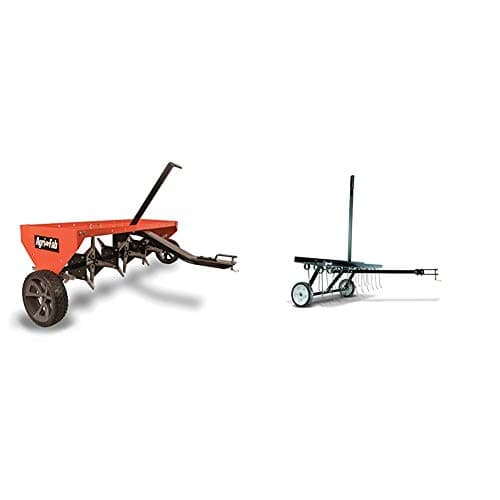
Agri-Fab 48" Tow-Behind Plug Aerator (45-0299)
Agri-Fab · Tow-behind (needs a tractor) · Our score 8.0/10
#ad Price as of October 23, 2026. Prices change; we check daily. How we're funded.
32 galvanized knives pulling 3 in plugs across 48 in -- the only tool here that actually relieves compaction.
Published specs
| Working width | 48 in |
|---|---|
| Knives | 32, galvanized |
| Plug depth | Up to 3 in |
| Weight tray capacity | 175 lb |
| Unit weight | 94 lb |
| Tires | 10 in flat-proof |
Source: 48" Tow Behind Plug Aerator (45-0299), agri-fab.com
10,000 sq ft at a 48 in (4 ft) working width needs 2,500 linear feet. On a 48 ft run that is about 52 passes -- an hour or so behind a tractor, against a full day with a walk-behind core aerator.
What the numbers favor
- Pulls genuine 3 in cores, which is what aeration means
- 48 in width covers ground fast
- 175 lb weight tray lets you force depth in hard soil
- Flat-proof tires
What they don't
- Needs a lawn tractor or riding mower to tow it -- useless on its own
- 94 lb empty is awkward to move and store by hand
you have no tow vehicle. Without a tractor this is a 94 lb ornament; rent a walk-behind core aerator for the weekend instead.
How it scores
Scores are our editorial weighting of the published specs above, not a test result. They are deliberately kept out of this page's structured data.
Scotts Elite Spreader
Scotts · Manual (push) · Our score 8.5/10
#ad No verified live price right now, so we show none rather than a stale one. How we're funded.
A 6 ft dual-rotor pattern over 20,000 sq ft, with EdgeGuard to keep product off the sidewalk.
Published specs
| Type | Broadcast (rotary), dual rotor |
|---|---|
| Spread width | 6 ft |
| Coverage per fill | Up to 20,000 sq ft |
| Hopper capacity | 80 lb |
| Edge control | EdgeGuard (blocks right side) |
| Tires | 10 in, foam filled |
Source: Scotts Elite Spreader (75902), scotts.com
5,000 sq ft at a 6 ft spread width needs about 833 linear feet of walking. On a 60 ft run that is roughly 14 passes -- versus 17 passes at a standard 5 ft width. That is the whole practical difference the dual rotor buys.
What the numbers favor
- 6 ft pattern against the 5 ft standard -- about 20% fewer passes
- 80 lb hopper covers 20,000 sq ft without a refill
- EdgeGuard keeps fertilizer off hard surfaces, which is where runoff starts
- Foam-filled tires cannot go flat in the shed over winter
What they don't
- 80 lb loaded is heavy to push on soft or sloped ground
- Broadcast spreaders are harder to control near beds than a drop spreader
your lawn is under about 2,000 sq ft or heavily bordered by beds. A drop spreader puts product exactly where you steer it and nowhere else.
How it scores
Scores are our editorial weighting of the published specs above, not a test result. They are deliberately kept out of this page's structured data.
Sun Joe AJ801E Dethatcher + Scarifier
Sun Joe · Corded 120V · Our score 7.6/10
#ad No verified live price right now, so we show none rather than a stale one. How we're funded.
Two swappable cylinders and five depth settings -- but read the depth numbers before you assume this aerates.
Published specs
| Motor | 12 A |
|---|---|
| Working width | 12.6 in |
| Depth settings | 5 |
| Raking depth | 0 to 0.4 in |
| Scarifying depth | -0.4 to 0 in |
| Speed | 2,990 RPM |
| Collection bag | 8 gal |
| Tines | 27-tine dethatching cylinder |
Source: Sun Joe AJ801E Electric Lawn Dethatcher + Scarifier, shopjoe.com
What the numbers favor
- Two cylinders in one machine -- dethatch and scarify without buying twice
- Five published depth settings with actual inch figures for each mode
- 8 gallon bag means fewer stops to rake up
- Corded, so no pack to size and no runtime limit
What they don't
- This is NOT an aerator. Maximum working depth is 0.4 in; core aeration needs 2-3 in
- 12.6 in working width makes a large lawn a long afternoon
- Corded, with the working-radius limit that implies
your problem is compacted soil rather than thatch. A 0.4 in scarifier cannot relieve compaction; you need a core aerator that pulls plugs.
How it scores
Scores are our editorial weighting of the published specs above, not a test result. They are deliberately kept out of this page's structured data.
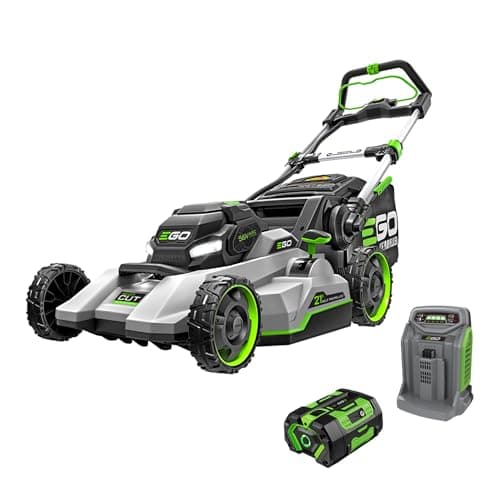
EGO Power+ 21" Select Cut LM2135SP
EGO · EGO 56V ARC Lithium · Our score 9.1/10
#ad Price as of October 23, 2026. Prices change; we check daily. How we're funded.
The most watt-hours in the box of any flagship walk-behind here, on the platform with the widest tool range to grow into.
Published specs
| Deck | 21 in |
|---|---|
| Cutting torque | Up to 7.0 ft-lbs |
| Battery included | 56V 7.5Ah |
| Cut height | 1-4 in, 8 positions |
| Self-propel speed | 0.9-3.1 MPH |
| Runtime claim | Up to 60 min |
| Warranty | 5-yr tool / 3-yr battery |
Source: EGO POWER+ 21" Select Cut System (LM2135SP), egopowerplus.com
56V x 7.5Ah = 420Wh, using EGO's advertised pack voltage.
What the numbers favor
- 420Wh in the box -- the largest included pack of any flagship walk-behind on this page
- Eight cut-height positions from 1 to 4 in, the widest published range here
- Three interchangeable lower blades (mulching, high-lift bagging, extended runtime)
- 5-year tool warranty, the longest published on this page
What they don't
- EGO publishes torque (7.0 ft-lbs), not motor wattage, so it cannot be compared directly against Greenworks' 1500W figure
- The 7.5Ah pack that earns the runtime claim is also the expensive one to replace
your yard is under a quarter acre. You would be paying for 420Wh of headroom you will never discharge, and a 20 in push mower cuts the same grass.
How it scores
Scores are our editorial weighting of the published specs above, not a test result. They are deliberately kept out of this page's structured data.
Where to buy the tools on this page
Amazon affiliate links, except where a product has no Amazon listing — those go direct to the maker and earn us nothing, and the button says so. We show no price we have not verified today, so where there is no live figure the link says "check price" and takes you to the listing to read it there.
Best real aeration
Agri-Fab 48" Tow-Behind Plug Aerator (45-0299)
Agri-Fab · Tow-behind (needs a tractor)
Best overall
Scotts Elite Spreader
Scotts · Manual (push)
Best for thatch, not compaction
Sun Joe AJ801E Dethatcher + Scarifier
Sun Joe · Corded 120V
Best overall
EGO Power+ 21" Select Cut LM2135SP
EGO · EGO 56V ARC Lithium
#ad As an Amazon Associate we earn from qualifying purchases, at no extra cost to you. How we're funded.
Common questions
Why is fall the most important lawn season?
In what order should I do fall lawn jobs?
When should I aerate my lawn?
When should I overseed?
How much should I fertilize in fall?
What do I do with fallen leaves?
Sources
- How to control thatch in your lawn, University of Minnesota Extension
- Fertilizing lawns, University of Minnesota Extension
- Lawn weeds, University of Minnesota Extension
- Leaves Are Treasure, Not Trash, Penn State Extension
- Lawn Management through the Seasons, Penn State Extension
- Agri-Fab 48" Tow Behind Plug Aerator (45-0299), agri-fab.com
- Scotts Elite Spreader (75902), scotts.com
Read next
- Lawn Care
Cutting the grass is a third of the job. This is the other two thirds.
- The winter yard tool handover, in order
Summer kit away, winter kit ready, and the last lawn jobs on their published timings.
- Doing your own lawn care: what to do, and when
Four jobs, the right order, the right season. The sequence matters more than the equipment.
- How to overseed a lawn
Published extension seeding rates, the late-summer window, and the passes-per-lawn arithmetic.
- Lawn weed control starts with the lawn
Weeds signal a condition. The cultural fixes, and the published timing windows.
- Dethatching vs aerating: they solve different problems
Thatch or compaction, how to tell which you have, and the published depths that decide the tool.
- Best battery mower for mulching leaves
Half an inch of leaves is the workable layer. Which decks shred it, and the cross pass that finishes the job.