Leaf Blowers
Jet fan vs axial leaf blowers
One design pushes air straight through, the other spins it out sideways. The published numbers show the trade clearly.
Affiliate disclosure: we earn a commission if you buy through our links, at no extra cost to you. It never changes which product we rank first — here is how we're funded.
We have not tested these units. Every spec on this page comes from the manufacturer's own documentation and is linked to it. Every computed figure is arithmetic you can redo. Prices are checked daily — last verified September 24, 2026. Here is exactly how we pick.
Blower marketing has settled on two words — jet fan and axial — without much explanation of either. The distinction is real and it is about where the air goes inside the housing, but the published specifications show it decides the shape of the output, not how much of it there is.
The short answer
What each design actually does
- Jet fan. The impeller sits in line with the outlet and moves air along the axis of the tool. The path from intake to nozzle is short and straight, which is the design argument for a compact housing and a concentrated stream.
- Axial and centrifugal layouts. Air is thrown outward by the impeller and collected before it leaves, which gives designers more freedom over the outlet shape at the cost of a longer path.
The three, on published figures
| Spec | RYOBI RY404100 (Jet Fan) | Greenworks BL80L02 | EGO LB7650 |
|---|---|---|---|
| Fan type published | Jet Fan (product naming) | Not published | Not published |
| Peak CFM | 730 | 730 | 765 |
| Peak MPH | 190 | 170 | 200 |
| Speed control | Three tips: 160 / 175 / 190 MPH | Not published | 260-580 CFM variable |
| Noise | 57 dB | Not published | 64 dB |
| Weight | 9.4 lb | 5.5 lb (tool only) | 4.6 lb without battery |
| Battery in the kit | 2 x 40V 4.0Ah = 320Wh | 80V 2.5Ah = 200Wh | 56V 5.0Ah = 280Wh |
| Runtime | 30 min high / 120 min low | Up to 60 min on low | 15 min turbo / 150 min low |
Transcribed from the RY404100, BL80L02 and LB7650 product pages.
Reading the table honestly
The one place the jet fan product genuinely stands apart is noise. RYOBI publishes 57 dB for the RY404100 against EGO's 64 dB — a 7 dB difference, which is a meaningful gap at the ear. Whether that is the fan or the housing or the motor, RYOBI does not say. Our quiet blower page works through what those figures do and do not cover.
Why the housing shape matters at all
A blower is a fan in a tube, and the only thing that distinguishes one from another at the same motor power is how efficiently it converts rotation into a directed stream. Air that has to change direction inside the housing loses energy doing it. That is the engineering argument for an in-line layout, and it is a real one.
It is also an argument that consumer specification sheets cannot settle, because the figure that would settle it — airflow per watt drawn, or airflow per watt-hour consumed — is not published by anyone. What we can do is compare the watt-hours each machine spends per minute against the air it claims, which is the nearest available proxy.
What to compare instead of fan type
- The variable range. A published span tells you what the tool does at settings you will actually use. Only EGO publishes one for both its blowers here.
- Watt-hours in the kit. RYOBI ships 320Wh across two packs, EGO 280Wh in one, Greenworks 200Wh — and the Greenworks listing we hold is tool-only.
- Weight, which nobody disputes. 5.5 lb against 9.4 lb is a fact you will feel in the first ten minutes, whatever is inside the housing.
- Published noise. 57 dB against 64 dB is the one difference in this comparison that a neighbor would notice.
- The platform. Whichever packs you already own outranks every row above — see switching platforms.
Which shape suits which debris
- Concentrated stream for wet mats, gravel edges and anything stuck: a narrow, fast column lifts what a wide one slides over.
- Wide, softer output for dry leaves across open lawn, where volume sweeps a broad path in one pass.
- Either, on a middle setting, for the great majority of work — which is the real lesson of the table.
The nozzle in your hand changes the output shape more than the fan behind it. See the blower nozzles guide.
#ad Check the Ryobi 40V HP Whisper Series 730 CFM RY404100 price on Amazon — how we're funded.
#ad Check the Greenworks 80V 730 CFM Axial Blower price on Amazon — how we're funded.
#ad Check the EGO Power+ 765 CFM Blower LB7650 price on Amazon — how we're funded.
The honest verdict on the label
"Jet fan" is a useful description of a real design choice and a poor basis for a purchase. The evidence on this page is that the published output of a blower tracks the motor, the battery and the nozzle rather than the housing, and that the one machine here beating the jet fan on both airflow and air speed publishes no fan type at all.
Where it does correlate with something worth having is noise: the jet fan product is the quietest blower in our registry at a published 57 dB. Whether the geometry causes that, RYOBI does not say, and one product is not a pattern. But if a neighbor is the reason you are reading this, that figure is the one to buy on.
Everything else on the spec sheet — the variable range, the watt-hours in the kit, the weight, the platform — will tell you more about how the tool behaves than the two words on the box. Our how to choose a blower guide runs through them in order.
What we cannot tell you
We have not tested these blowers and we cannot open them. No maker publishes impeller diameter, blade count, housing geometry or a fan-type specification, so "jet fan" here is a product name rather than a documented category. The 57 dB against 64 dB noise comparison is two brands' own figures measured under conditions neither states.
The products discussed
Specs are the manufacturer's own and linked to the page they came from. Prices come from a live daily check; where we have no verified price we say so rather than print a stale one.
Ryobi 40V HP Whisper Series 730 CFM RY404100
Ryobi · Ryobi 40V · Our score 8.8/10
#ad No verified live price right now, so we show none rather than a stale one. How we're funded.
57 dB published at 730 CFM. That is the lowest published noise figure on this page and it is not close.
Published specs
| Max air volume | 730 CFM |
|---|---|
| Max air speed | 190 MPH |
| Speed tips | 160 / 175 / 190 MPH |
| Noise | 57 dB |
| Batteries (kit) | 2 x 40V 4.0Ah |
| Runtime | 30 min high / 120 min low |
| Weight | 9.4 lb |
Source: 40V HP Brushless Whisper Series 730 CFM Blower (RY404100), ryobitools.com
Decibels are logarithmic: a 7 dB drop is roughly a 5x reduction in sound intensity, and is perceived as roughly half as loud. Both figures are manufacturer-published under their own test conditions, so treat the gap as directional, not lab-comparable.
What the numbers favor
- 57 dB published -- the quietest figure any manufacturer on this page publishes
- 730 CFM while doing it, second only to the 765 CFM EGO
- Ships with two 4Ah packs (320Wh total) in the kit
- Publishes high AND low runtimes rather than an average
What they don't
- 9.4 lb is the heaviest published handheld weight here, roughly double the EGO LB7650 bare
- Manufacturer noise figures are measured under each brand's own conditions -- not a like-for-like lab comparison
you need to move soaked leaves off a large property fast. Quiet costs air speed, and 190 MPH is the lowest peak here.
How it scores
Scores are our editorial weighting of the published specs above, not a test result. They are deliberately kept out of this page's structured data.
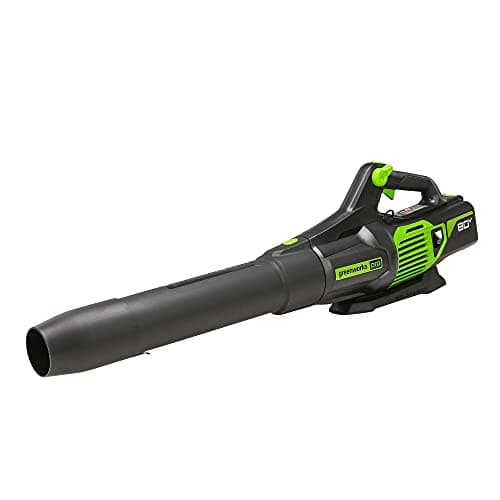
Greenworks 80V 730 CFM Axial Blower
Greenworks · Greenworks 80V · Our score 8.3/10
#ad Price as of September 24, 2026. Prices change; we check daily. How we're funded.
730 CFM from a 5.5 lb tool with a 4-year warranty -- the cheapest published route to real airflow.
Published specs
| Max air volume | 730 CFM |
|---|---|
| Max air speed | 170 MPH |
| Weight | 5.5 lb (tool only) |
| Battery (kit) | 80V 2.5Ah |
| Runtime | Up to 60 min on low |
| Recharge | 40 min |
| Warranty | 4-yr |
Source: 80V 730 CFM Cordless Battery Leaf Blower, greenworkstools.com
80V x 2.5Ah = 200Wh, using Greenworks' advertised pack voltage.
What the numbers favor
- 730 CFM from 5.5 lb -- the best published airflow-per-pound on this page
- 4-year warranty on tool and battery
- 40-minute recharge
- Cruise control and turbo button, so it is not a dead-man trigger for long sessions
What they don't
- 170 MPH is the lowest peak air speed here -- airflow moves volume, speed dislodges wet debris
- Greenworks publishes no noise figure for this tool at all
- 200Wh included is the smallest pack of the blowers here
you own nothing else on Greenworks 80V. A 200Wh pack bought for one blower is an expensive way to start a platform.
How it scores
Scores are our editorial weighting of the published specs above, not a test result. They are deliberately kept out of this page's structured data.
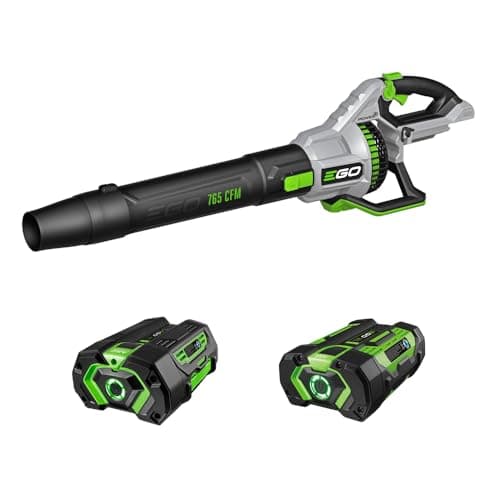
EGO Power+ 765 CFM Blower LB7650
EGO · EGO 56V ARC Lithium · Our score 8.9/10
#ad Price as of September 24, 2026. Prices change; we check daily. How we're funded.
765 CFM and 200 MPH, with the turbo/low split published honestly: 15 minutes flat out, 150 minutes on low.
Published specs
| Max air volume | 765 CFM |
|---|---|
| Variable range | 260-580 CFM |
| Max air speed | Up to 200 MPH |
| Runtime (turbo) | 15 min on 5.0Ah |
| Runtime (low) | 150 min on 5.0Ah |
| Weight | 4.6 lb without battery |
| Noise | 64 dB |
Source: POWER+ 765 CFM Blower (LB7650), egopowerplus.com
280Wh (56V x 5.0Ah) over the published 15-minute turbo runtime = about 18.7Wh per minute. On low, 280Wh over 150 minutes is about 1.9Wh/min -- turbo costs roughly 10x the energy per minute.
What the numbers favor
- Highest published CFM and MPH of any handheld here
- Publishes BOTH turbo and low runtimes, so the trade-off is visible instead of averaged away
- 4.6 lb bare -- the lightest published weight of the handhelds on this page
What they don't
- 15 minutes of turbo on a 5.0Ah pack is the real constraint, whatever the 90-minute average says
- Sold bare in most configurations; budget for a battery and charger
you are clearing a small lawn. You will run it at 260 CFM forever and never touch what you paid for.
How it scores
Scores are our editorial weighting of the published specs above, not a test result. They are deliberately kept out of this page's structured data.
Where to buy the tools on this page
Every link below is an Amazon affiliate link. We show no price we have not verified today, so where there is no live figure the link says "check price" and takes you to the listing to read it there.
Best quiet blower
Ryobi 40V HP Whisper Series 730 CFM RY404100
Ryobi · Ryobi 40V
Best budget high-CFM
Greenworks 80V 730 CFM Axial Blower
Greenworks · Greenworks 80V
Best for large yards
EGO Power+ 765 CFM Blower LB7650
EGO · EGO 56V ARC Lithium
#ad As an Amazon Associate we earn from qualifying purchases, at no extra cost to you. How we're funded.
Common questions
What is a jet fan leaf blower?
Is a jet fan blower better than an axial one?
Which is quieter, jet fan or axial?
Does fan type change battery drain?
Sources
Read next
- Leaf Blowers
CFM moves the pile. MPH lifts what's stuck. Almost nobody explains which you need.
- Leaf blower CFM vs MPH: which is better?
CFM moves volume, MPH dislodges. Which spec predicts clearing power for which job.
- Most powerful cordless leaf blower
Highest published CFM and MPH in our registry, and why multiplying the two overstates every machine.
- What to look for in a cordless leaf blower
Six blower specs in priority order, with published figures. Peak CFM is not first.
- Quietest cordless leaf blower: the published decibel figures
57 dB vs 64 dB, what the gap means, and which brands publish no figure at all.
- Leaf blower nozzles: what the tube on the end actually does
A nozzle trades volume for speed. What each tip does, and the published figures behind it.