Leaf Blowers
Most powerful cordless leaf blower
Nobody publishes blowing force, so there is no single power number -- only two, taken with different nozzles.
Affiliate disclosure: we earn a commission if you buy through our links, at no extra cost to you. It never changes which product we rank first — here is how we're funded.
We have not tested these units. Every spec on this page comes from the manufacturer's own documentation and is linked to it. Every computed figure is arithmetic you can redo. Prices are checked daily — last verified September 24, 2026. Here is exactly how we pick.
Quick picks
Ranked on the published specs and the arithmetic below. Tap any row to jump to the full write-up. We have not tested these units -- here is exactly how we pick.
| # | Product | Best for | Score | Price |
|---|---|---|---|---|
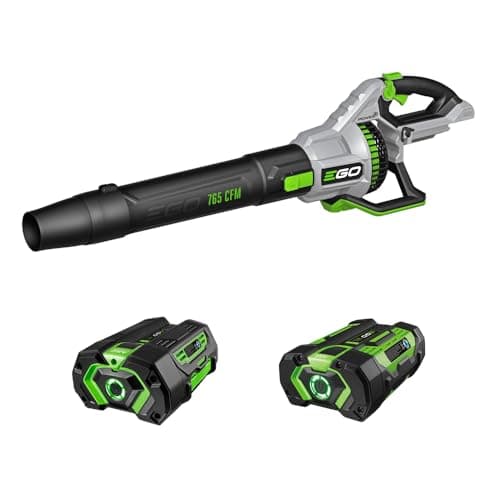
| 1 | EGO Power+ 765 CFM Blower LB7650 765 CFM and 200 MPH, with the turbo/low split published honestly: 15 minutes flat out, 150 minutes on low. | Best for large yards | 8.9 | |
| 2 | No photo Ryobi 40V HP Whisper Series 730 CFM RY404100 57 dB published at 730 CFM. That is the lowest published noise figure on this page and it is not close. | Best quiet blower | 8.8 | |
| 3 | 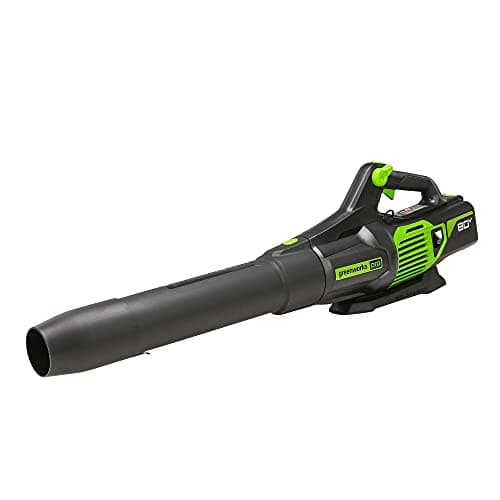 Greenworks 80V 730 CFM Axial Blower 730 CFM from a 5.5 lb tool with a 4-year warranty -- the cheapest published route to real airflow. | Best budget high-CFM | 8.3 | |
| 4 | 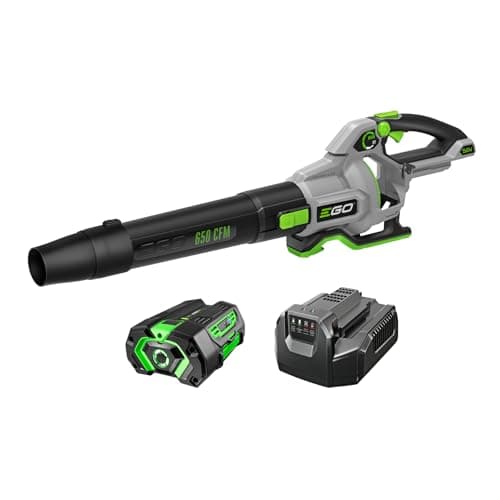 EGO Power+ 650 CFM Blower LB6504 650 CFM in turbo with a genuine variable dial down to 225 CFM, and 64 dB published -- the useful range is the whole point. | Best overall | 9.0 |
#ad Buy links are affiliate links. Prices come from a live daily check; where we have no verified price we say "check price" rather than print a stale one.
"Most powerful" sounds like it should be one number. It is two, they are measured differently, and the machine that tops both at the same time does not exist — because the peaks are taken with different nozzles fitted.
The short answer
Power is two numbers, taken separately
Air volume moves a wide, shallow path. Air speed concentrates into a narrow, hard jet. A blower that leads on one usually trails on the other, because the same motor and battery have to produce both.
Every published output figure in our registry
| Blower | Peak CFM | Peak MPH | Variable range | Our crude index (CFM x MPH) |
|---|---|---|---|---|
| EGO LB7650 | 765 | 200 | 260-580 CFM | 153,000 |
| RYOBI RY404100 | 730 | 190 | Three speed tips: 160/175/190 MPH | 138,700 |
| Greenworks BL80L02 | 730 | 170 | Not published | 124,100 |
| EGO LB6504 | 650 | 180 | 225-470 CFM | 117,000 |
| EGO LB6000 (backpack) | 600 | 145 | 260-600 CFM | 87,000 |
Transcribed from the LB7650, RY404100, BL80L02, LB6504 and LB6000 product pages. The index column is our arithmetic and is not an industry figure — see the warning below.
1. EGO LB7650 — highest on both published figures
Seven hundred and sixty-five CFM and up to 200 MPH are the top numbers in our registry, and the 260 to 580 CFM variable range underneath them is the widest usable dial here. At 4.6 lb without the battery it is also the lightest, which matters when peak output is the reason you are holding it out in front of you.
Against it: the peak is a turbo figure and turbo costs roughly ten times the battery per minute of low on EGO's own published runtimes (15 minutes against 150 from the same 5.0Ah pack). EGO publishes no ingress rating and no warranty term on this product page, and no recharge time.
#ad Check the EGO Power+ 765 CFM Blower LB7650 price on Amazon — how we're funded.
2. RYOBI RY404100 — nearly the same air, far less noise
Seven hundred and thirty CFM and 190 MPH put it within 5% of the EGO on both, and it is the only blower in our registry publishing a decibel figure as low as 57 dB — seven below EGO's 64.
The three speed tips (160, 175 and 190 MPH) are an unusual and honest way to publish a range: rather than one peak, you get the actual figure for each nozzle in the box.
Against it: 9.4 lb is more than twice the EGO's bare weight, and its 320Wh comes from two 40V packs rather than one, so both have to be charged and both have to be fitted.
#ad Check the Ryobi 40V HP Whisper Series 730 CFM RY404100 price on Amazon — how we're funded.
3. Greenworks BL80L02 — the same 730 CFM at 5.5 lb
Matching RYOBI on volume at 730 CFM while weighing 5.5 lb tool-only is the best airflow per pound in our registry. Greenworks also publishes a 40 minute recharge against 60 minutes of low-speed runtime, which means two packs run continuously.
Against it: 170 MPH is the lowest speed of the four handhelds here, Greenworks publishes no variable range at all, and the listing we hold is a tool-only one — the battery is a separate purchase.
#ad Check the Greenworks 80V 730 CFM Axial Blower price on Amazon — how we're funded.
4. EGO LB6504 — less peak, more published detail
Six hundred and fifty CFM and 180 MPH are the lowest headline figures of the four handhelds, and in exchange it is the best-documented blower in our registry: a published 225 to 470 CFM variable range, 64 dB, an IPX4 weather rating that no other blower here carries, and a stated five-year tool and three-year battery warranty.
On a page about peak output it finishes fourth. On a wet October morning the IPX4 rating is worth more than the missing 115 CFM.
#ad Check the EGO Power+ 650 CFM Blower LB6504 price on Amazon — how we're funded.
What each number physically does
Cubic feet per minute is volume: how much air leaves the tube in a minute, regardless of how fast it is travelling. Miles per hour is velocity: how fast the air at the nozzle is moving, regardless of how much of it there is. The same motor can be geared toward either by changing the outlet, which is why the nozzle in your hand is part of the specification.
Volume is what sweeps. A wide, slower column of air pushes a broad band of dry leaves in one pass and is far less likely to scatter them sideways. Velocity is what breaks things loose: a narrow, fast stream lifts a wet leaf that has been stuck to concrete for a week, which no amount of gentle volume will move.
Neither is "power" on its own, and the honest engineering figure that would combine them — the force the airstream exerts, in newtons — is published by nobody in our registry. Professional gas blowers are sometimes rated that way. Cordless consumer blowers are not, and until that changes any ranking on this page is a ranking of two proxies rather than of the thing itself.
The nozzle is half the specification
EGO publishes 200 MPH "with the tapered nozzle" and 765 CFM on turbo. Those are two different tubes. RYOBI goes further and publishes a figure for each of its three tips — 160, 175 and 190 MPH — which is the most honest presentation of this in our registry, because it tells you what you actually get from each part in the box rather than the best number any configuration produces.
| Nozzle type | What it does to the numbers | What it is for |
|---|---|---|
| Wide / flat | Raises effective volume, lowers velocity | Dry leaves across open lawn |
| Tapered / concentrator | Raises velocity, lowers volume | Wet mats, stuck debris, gravel edges |
| Stock round tube | The middle setting most figures assume | General clearing |
Behavior described from the makers' own nozzle naming and the figures each publishes per tip. No maker publishes a CFM figure per nozzle, only per machine.
The practical consequence: two people with the same blower can get very different results, and a spec-sheet comparison between two machines assumes both are wearing the tube the headline figure was taken with. Our blower nozzles guide covers which to fit when.
Where the backpack sits in this
People often assume a backpack blower is the powerful one. In our registry it is not: the EGO LB6000 publishes 600 CFM and 145 MPH, below every handheld here on both counts. What it publishes instead is 180 minutes of runtime on a 7.5Ah pack and a 260 to 600 CFM variable range — the widest span of any blower we hold specs for.
That is a sustained-work trade, not a power one. If you are clearing an acre it is the right one; if you are clearing a driveway it is not. Our backpack blower page works through the carrying question properly.
Reading a blower spec sheet without being sold to
- Find the variable range, not the peak. A machine publishing "260-580 CFM variable" is telling you what it does all day. A machine publishing only "765 CFM" is telling you what it does for fifteen minutes.
- Check whether the runtime figure names a setting. "Up to 90 minutes average" and "150 minutes on low" are not the same kind of claim.
- Convert the pack to watt-hours. Volts times amp-hours, every time — see watt-hours explained.
- Note which nozzle the MPH figure assumes, if the maker says at all.
- Treat a missing decibel figure as missing information, not as quiet. Two of the five blowers in the table above publish none.
Do you actually need the peak?
- Dry leaves on a hard surface move at a fraction of peak airflow. Our driveway page works through the settings.
- A wet, matted layer is the one job that genuinely wants speed — see best blowers for wet leaves.
- Sustained clearing over an acre wants carrying comfort rather than peak figures, which is the backpack argument.
- Everything else sits in the middle of the dial, which is why CFM vs MPH matters more than either headline.
The constraint that outranks every figure here
If you already own cordless yard tools, the most powerful blower available to you is the most powerful one on your platform. Buying across platforms to gain 35 CFM means buying a battery and a charger as well, and on published watt-hours that is a far larger purchase than the airflow difference justifies.
The brand-by-brand picture is on our blower brand comparison, and the cost of changing platforms is worked through in switching platforms. Both conclude the same way: the packs you own are worth more than any single specification on any one tool.
The exception is a first purchase. If you own nothing yet, this page is the right place to start, because the blower is often the tool that decides which platform a household ends up on — it is bought early, used often, and every subsequent bare tool is chosen to match the pack it takes.
What we cannot tell you
We have not measured any of these blowers. No maker in our registry publishes blowing force in newtons, and that is the only figure that would rank "power" as a single number. Nobody publishes the nozzle fitted for each headline figure either, so the peak CFM and peak MPH on any one row may or may not be taken with the same hardware. Our index column exists to order the table, not to predict performance.
The picks in full
Specs are the manufacturer's own and linked to the page they came from. Prices come from a live daily check; where we have no verified price we say so rather than print a stale one.
EGO Power+ 765 CFM Blower LB7650
EGO · EGO 56V ARC Lithium · Our score 8.9/10
#ad Price as of September 24, 2026. Prices change; we check daily. How we're funded.
765 CFM and 200 MPH, with the turbo/low split published honestly: 15 minutes flat out, 150 minutes on low.
Published specs
| Max air volume | 765 CFM |
|---|---|
| Variable range | 260-580 CFM |
| Max air speed | Up to 200 MPH |
| Runtime (turbo) | 15 min on 5.0Ah |
| Runtime (low) | 150 min on 5.0Ah |
| Weight | 4.6 lb without battery |
| Noise | 64 dB |
Source: POWER+ 765 CFM Blower (LB7650), egopowerplus.com
280Wh (56V x 5.0Ah) over the published 15-minute turbo runtime = about 18.7Wh per minute. On low, 280Wh over 150 minutes is about 1.9Wh/min -- turbo costs roughly 10x the energy per minute.
What the numbers favor
- Highest published CFM and MPH of any handheld here
- Publishes BOTH turbo and low runtimes, so the trade-off is visible instead of averaged away
- 4.6 lb bare -- the lightest published weight of the handhelds on this page
What they don't
- 15 minutes of turbo on a 5.0Ah pack is the real constraint, whatever the 90-minute average says
- Sold bare in most configurations; budget for a battery and charger
you are clearing a small lawn. You will run it at 260 CFM forever and never touch what you paid for.
How it scores
Scores are our editorial weighting of the published specs above, not a test result. They are deliberately kept out of this page's structured data.
Ryobi 40V HP Whisper Series 730 CFM RY404100
Ryobi · Ryobi 40V · Our score 8.8/10
#ad No verified live price right now, so we show none rather than a stale one. How we're funded.
57 dB published at 730 CFM. That is the lowest published noise figure on this page and it is not close.
Published specs
| Max air volume | 730 CFM |
|---|---|
| Max air speed | 190 MPH |
| Speed tips | 160 / 175 / 190 MPH |
| Noise | 57 dB |
| Batteries (kit) | 2 x 40V 4.0Ah |
| Runtime | 30 min high / 120 min low |
| Weight | 9.4 lb |
Source: 40V HP Brushless Whisper Series 730 CFM Blower (RY404100), ryobitools.com
Decibels are logarithmic: a 7 dB drop is roughly a 5x reduction in sound intensity, and is perceived as roughly half as loud. Both figures are manufacturer-published under their own test conditions, so treat the gap as directional, not lab-comparable.
What the numbers favor
- 57 dB published -- the quietest figure any manufacturer on this page publishes
- 730 CFM while doing it, second only to the 765 CFM EGO
- Ships with two 4Ah packs (320Wh total) in the kit
- Publishes high AND low runtimes rather than an average
What they don't
- 9.4 lb is the heaviest published handheld weight here, roughly double the EGO LB7650 bare
- Manufacturer noise figures are measured under each brand's own conditions -- not a like-for-like lab comparison
you need to move soaked leaves off a large property fast. Quiet costs air speed, and 190 MPH is the lowest peak here.
How it scores
Scores are our editorial weighting of the published specs above, not a test result. They are deliberately kept out of this page's structured data.
Greenworks 80V 730 CFM Axial Blower
Greenworks · Greenworks 80V · Our score 8.3/10
#ad Price as of September 24, 2026. Prices change; we check daily. How we're funded.
730 CFM from a 5.5 lb tool with a 4-year warranty -- the cheapest published route to real airflow.
Published specs
| Max air volume | 730 CFM |
|---|---|
| Max air speed | 170 MPH |
| Weight | 5.5 lb (tool only) |
| Battery (kit) | 80V 2.5Ah |
| Runtime | Up to 60 min on low |
| Recharge | 40 min |
| Warranty | 4-yr |
Source: 80V 730 CFM Cordless Battery Leaf Blower, greenworkstools.com
80V x 2.5Ah = 200Wh, using Greenworks' advertised pack voltage.
What the numbers favor
- 730 CFM from 5.5 lb -- the best published airflow-per-pound on this page
- 4-year warranty on tool and battery
- 40-minute recharge
- Cruise control and turbo button, so it is not a dead-man trigger for long sessions
What they don't
- 170 MPH is the lowest peak air speed here -- airflow moves volume, speed dislodges wet debris
- Greenworks publishes no noise figure for this tool at all
- 200Wh included is the smallest pack of the blowers here
you own nothing else on Greenworks 80V. A 200Wh pack bought for one blower is an expensive way to start a platform.
How it scores
Scores are our editorial weighting of the published specs above, not a test result. They are deliberately kept out of this page's structured data.
EGO Power+ 650 CFM Blower LB6504
EGO · EGO 56V ARC Lithium · Our score 9.0/10
#ad Price as of September 24, 2026. Prices change; we check daily. How we're funded.
650 CFM in turbo with a genuine variable dial down to 225 CFM, and 64 dB published -- the useful range is the whole point.
Published specs
| Max air volume | 650 CFM (turbo) |
|---|---|
| Variable range | 225-470 CFM |
| Max air speed | Up to 180 MPH |
| Battery (kit) | 56V 5.0Ah |
| Runtime claim | Up to 90 min average |
| Noise | 64 dB |
| Warranty | 5-yr tool / 3-yr battery |
Source: POWER+ 650 CFM Blower, egopowerplus.com
56V x 5.0Ah = 280Wh, using EGO's advertised pack voltage.
What the numbers favor
- A real variable dial (225-470 CFM) plus turbo, not a three-position switch
- 64 dB published -- quieter than the 730 CFM Greenworks, which does not publish a figure at all
- IPX4 weather-resistant rating, published
- 5-year tool warranty
What they don't
- The 650 CFM headline is turbo-only; sustained work happens at 470 CFM or below
- EGO does not publish a weight for this model
your yard is a small courtyard or a deck. 650 CFM will move your mulch, your gravel and your neighbor's patience.
How it scores
Scores are our editorial weighting of the published specs above, not a test result. They are deliberately kept out of this page's structured data.
Where to buy the tools on this page
Every link below is an Amazon affiliate link. We show no price we have not verified today, so where there is no live figure the link says "check price" and takes you to the listing to read it there.
Best for large yards
EGO Power+ 765 CFM Blower LB7650
EGO · EGO 56V ARC Lithium
Best quiet blower
Ryobi 40V HP Whisper Series 730 CFM RY404100
Ryobi · Ryobi 40V
Best budget high-CFM
Greenworks 80V 730 CFM Axial Blower
Greenworks · Greenworks 80V
Best overall
EGO Power+ 650 CFM Blower LB6504
EGO · EGO 56V ARC Lithium
#ad As an Amazon Associate we earn from qualifying purchases, at no extra cost to you. How we're funded.
Common questions
What is the most powerful cordless leaf blower?
Is CFM or MPH more important for power?
Can you multiply CFM by MPH to compare blowers?
Do you need the most powerful blower?
Is a backpack blower more powerful than a handheld?
Sources
Read next
- Leaf Blowers
CFM moves the pile. MPH lifts what's stuck. Almost nobody explains which you need.
- Best cordless leaf blowers of 2026
Five cordless blowers ranked on usable airflow range, published noise and real turbo runtime.
- Leaf blower CFM vs MPH: which is better?
CFM moves volume, MPH dislodges. Which spec predicts clearing power for which job.
- Best cordless leaf blower for wet and matted leaves
Wet leaves are an air-speed job. The published MPH figures ranked, and what turbo costs you.
- Best battery backpack leaf blower (and when a handheld beats it)
The harness buys comfort, not efficiency. The watt-hours-per-minute math that shows why.
- Best leaf blower for the money
Watt-hours per minute, air per unit of drain and the ten-times turbo tax -- the value arithmetic for a blower.
- Leaf blower nozzles: what the tube on the end actually does
A nozzle trades volume for speed. What each tip does, and the published figures behind it.