Lawn Care
Best lawn sprinkler
Every coverage claim in this category is a circle area computed from the throw distance. Here is the arithmetic, and what it does not tell you.
Affiliate disclosure: we earn a commission if you buy through our links, at no extra cost to you. It never changes which product we rank first — here is how we're funded.
We have not tested these units. Every spec on this page comes from the manufacturer's own documentation and is linked to it. Every computed figure is arithmetic you can redo. Prices are checked daily — last verified October 25, 2026. Here is exactly how we pick.
Quick picks
Ranked on the published specs and the arithmetic below. Tap any row to jump to the full write-up. We have not tested these units -- here is exactly how we pick.
| # | Product | Best for | Score | Price |
|---|---|---|---|---|
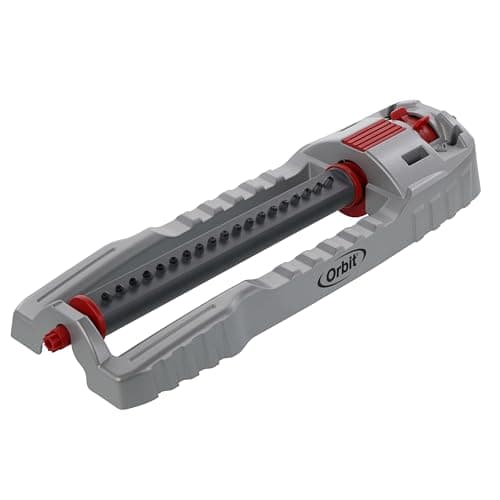
| 1 | Orbit Pro Series 4,000 sq ft Metal Gear-Drive Oscillating Sprinkler (56281) A rectangular 4,000 sq ft pattern on a metal base, which is the shape most front lawns actually are. | Best for rectangular lawns | 8.2 | |
| 2 | 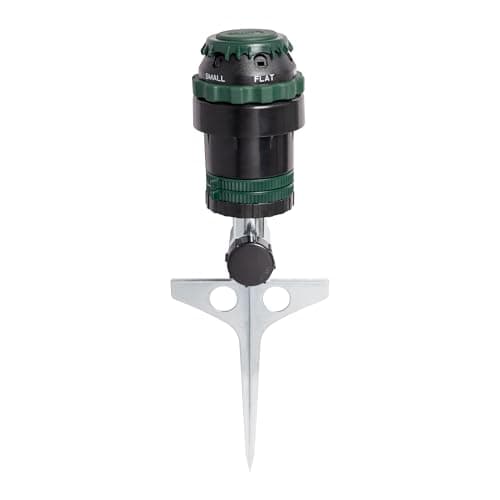 Orbit H2O-Six Gear Drive Sprinkler Head Six patterns and a partial-to-full-circle collar, which is how you water a lawn that is not a rectangle. | Best for odd-shaped lawns | 8.0 | |
| 3 | 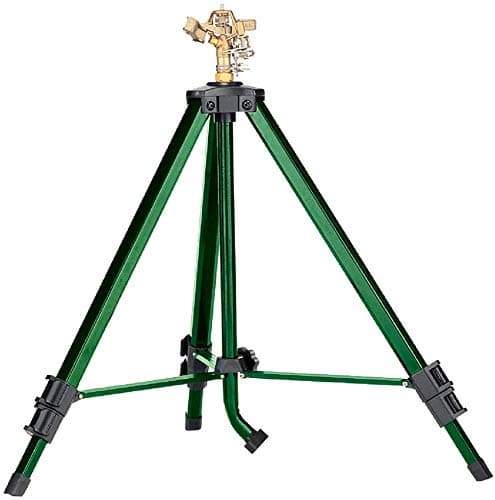 Orbit Brass Impact Sprinkler on Tripod (58308N) Ninety feet of diameter from a brass head lifted up to 48 inches, which is how you water over shrubs. | Best reach | 8.1 |
#ad Buy links are affiliate links. Prices come from a live daily check; where we have no verified price we say "check price" rather than print a stale one.
Sprinkler packaging leads with a coverage number: 4,000 square feet, 5,026 square feet, 6,360 square feet. Those numbers are not test results. They are the area of the circle the sprinkler can throw, worked out from the throw distance — and once you can see that, you buy on pattern shape instead of on the biggest figure.
The short answer
Where the coverage numbers come from
Two of these three sprinklers publish both a throw diameter and a coverage area. Run the circle area on each and the relationship is exact.
So the coverage figure is a restatement of the throw distance, not a measurement of how evenly water lands inside that circle. Distribution uniformity — whether the ring at 35 ft gets the same water as the ring at 10 ft — is the thing that decides whether your lawn ends up striped, and none of these three product pages publishes it.
What one inch of water actually costs you
Watering is measured in depth. Here is what a depth means in gallons, which is the unit your water bill uses.
The three, on published figures
| Spec | Pro Series oscillating | H2O-Six gear drive | Brass impact on tripod |
|---|---|---|---|
| Type | Oscillating, gear driven | Gear-drive rotor head | Brass impact head |
| Published coverage | Up to 4,000 sq ft | 5,026 sq ft at full circle | 6,360 sq ft at full circle |
| Pattern | Rectangle | 6 patterns, partial to 360 degrees | Partial to 360 degrees |
| Throw diameter | Not published | Up to 80 ft | Up to 90 ft |
| Base | Heavy-duty metal, included | Sold separately | Tripod, extends to 48 in |
| Head material | Not published | Plastic | Brass |
| Adjustment | Sliding tabs | Collar tabs plus 4-position diffuser | Arc adjustment |
| Flow rate | Not published | Not published | Not published |
| Pressure requirement | Not published | Not published | Not published |
| Warranty | Not published on the page | Not published on the page | Not published on the page |
Transcribed from the Pro Series oscillating sprinkler, H2O-Six gear drive head and brass impact tripod sprinkler pages, fetched 9 September 2026. Area arithmetic is ours.
1. Orbit Pro Series oscillating — best for rectangular lawns
A rectangular pattern up to 4,000 sq ft on a heavy metal base, with sliding tabs to narrow the throw for a strip of parkway and a clean-out plug for the nozzle blockages that end most oscillators' lives.
The case for it is shape, not size. Most front lawns are rectangles bounded by a sidewalk and a driveway. A circular pattern on a rectangle either leaves the corners dry or waters the pavement; a rectangle does neither. At 623 gallons per inch per 1,000 sq ft, overspray is the most expensive habit in lawn watering.
The gaps: Orbit does not publish the nozzle count, a flow rate or a warranty term on this page. And an oscillator throws a fine spray, which drifts in wind more than a rotor stream does.
#ad Check the Orbit Pro Series 4,000 sq ft Metal Gear-Drive Oscillating Sprinkler (56281) price on Amazon — how we're funded.
2. Orbit H2O-Six gear drive — best for odd shapes
Six patterns — small, medium, large, shower, vertical and flat — a four-position diffuser, and collar tabs that set the arc anywhere from a slice to a full circle. That is the tool for a lawn with a bed in the middle of it or a boundary that is not a straight line.
It is a head only. The base — spike, tripod or wheeled — is a separate purchase, which is either a saving or an annoyance depending on what is already in your shed.
The honest limits: plastic construction where the impact head is brass, and no published pressure requirement for a rotor whose entire 80 ft claim depends on pressure.
#ad Check the Orbit H2O-Six Gear Drive Sprinkler Head price on Amazon — how we're funded.
3. Orbit brass impact on a tripod — best reach
Ninety feet of diameter, a brass head, and a tripod that extends to 48 in. Height is the feature people overlook: a head at ground level waters the first shrub it meets, while a head at four feet throws over it.
Impact heads are also the most tolerant of debris in the supply, which is why they persist on farms and in secondary-water systems long after plastic rotors have clogged.
The costs are noise and footprint. An impact head is the loudest sprinkler type by a wide margin, and a 48 in tripod in the middle of a lawn is a trip hazard and a tipping risk on a windy day. On a small lawn, 90 ft of throw simply waters the neighbors.
#ad Check the Orbit Brass Impact Sprinkler on Tripod (58308N) price on Amazon — how we're funded.
How to set a run time without a published flow rate
None of the three publishes gallons per minute, so run time cannot be calculated. It can be measured, and the method takes one piece of equipment you already own.
- Put three or four straight-sided cans (a tuna can works) around the wetted area, one near the sprinkler and one near the edge of the pattern.
- Run the sprinkler for 15 minutes.
- Measure the depth in each can. Multiply by four to get the hourly rate, and note the difference between the near can and the far can — that difference is your distribution uniformity, the thing the coverage claim never told you.
- Divide your target depth by the hourly rate to get the run time. Check the result against soil depth with a screwdriver: it should push in easily to six inches.
Who should skip all three
- Anyone with an in-ground system. Hose-end sprinklers are for lawns without one, or for the strip an existing system misses.
- New seedings. Fresh seed needs light, frequent watering, which is the opposite of the deep-and-infrequent pattern these are sized for — see how to overseed.
- Low-pressure supplies. A rotor that cannot reach its rated diameter waters a doughnut, and none of these pages tells you the pressure it needs.
What we cannot tell you
We have not run catch-can tests on these sprinklers. Orbit publishes no flow rate, no pressure requirement and no distribution uniformity for any of the three, and no warranty term appears on any of the three product pages. That means we can tell you how far each one throws and what shape it throws, and we cannot tell you how evenly it lands — which is why the run-time method above measures rather than assumes.
The picks in full
Specs are the manufacturer's own and linked to the page they came from. Prices come from a live daily check; where we have no verified price we say so rather than print a stale one.
Orbit Pro Series 4,000 sq ft Metal Gear-Drive Oscillating Sprinkler (56281)
Orbit · Hose-end sprinkler · Our score 8.2/10
#ad Price as of October 25, 2026. Prices change; we check daily. How we're funded.
A rectangular 4,000 sq ft pattern on a metal base, which is the shape most front lawns actually are.
Published specs
| Type | Oscillating, gear drive |
|---|---|
| Coverage | Up to 4,000 sq ft, rectangular |
| Base | Heavy-duty metal |
| Width adjustment | Sliding tabs, full to partial |
| Nozzles | Precision nozzles, count not published |
| Maintenance | Clean-out plug |
| Connection | Swivel hose connection |
| Warranty | Not published on the product page |
Source: Pro Series 4000 Sq Ft Metal Gear-Drive Oscillating Sprinkler 56281, orbitonline.com
One inch of water over 4,000 sq ft is 4,000 x (1/12) = 333 cu ft. A cubic foot is 7.48 US gallons, so 333 x 7.48 = about 2,490 gallons. That is the number behind the standard one-inch-a-week guidance, and it is why placement matters more than pattern shape: water that lands on the driveway is charged to you at the same rate.
What the numbers favor
- Rectangular pattern matches rectangular lawns with less overspray than a circle
- Metal base resists tipping when the hose tugs
- Clean-out plug for the nozzle clogs that end most oscillators' lives
- Sliding tabs narrow the pattern for a strip of parkway
What they don't
- Nozzle count is not published, so you cannot compare distribution against rivals
- No published flow rate, so run time for one inch has to be measured with a rain gauge
- No warranty term on the product page
your lawn is an irregular shape or you have beds inside it. A gear-drive rotor with an adjustable arc wastes less water on odd geometry.
How it scores
Scores are our editorial weighting of the published specs above, not a test result. They are deliberately kept out of this page's structured data.
Orbit H2O-Six Gear Drive Sprinkler Head
Orbit · Hose-end sprinkler · Our score 8.0/10
#ad Price as of October 25, 2026. Prices change; we check daily. How we're funded.
Six patterns and a partial-to-full-circle collar, which is how you water a lawn that is not a rectangle.
Published specs
| Type | Gear-drive rotor head |
|---|---|
| Spray diameter | Up to 80 ft |
| Coverage | 5,026 sq ft at full circle |
| Patterns | 6 (small, medium, large, shower, vertical, flat) |
| Diffuser | 4-position |
| Arc | Collar tabs, partial to 360 degrees |
| Base | Sold separately (spike, tripod or wheeled) |
| Pressure requirement | Not published |
Source: H2O-Six Gear Drive Sprinkler Head - No Base, orbitonline.com
An 80 ft diameter circle has a 40 ft radius, and pi x 40^2 = 5,027 sq ft. Orbit's published coverage is that area to within a square foot, so the claim is the geometric consequence of the throw distance rather than an independent measurement of how evenly the water lands. Useful for sizing; useless for judging distribution uniformity.
What the numbers favor
- Six patterns cover strips, beds and full lawns from one head
- Adjustable arc means less water on the sidewalk
- Gear drive is quiet next to an impact head
- Head-only pricing if you already own a spike or tripod base
What they don't
- Base sold separately -- the head alone will not stand up
- No published pressure requirement or flow rate
- Plastic construction where the impact heads use brass
your supply pressure is low. Rotors need pressure to reach their rated diameter, and Orbit does not publish the figure this one needs.
How it scores
Scores are our editorial weighting of the published specs above, not a test result. They are deliberately kept out of this page's structured data.
Orbit Brass Impact Sprinkler on Tripod (58308N)
Orbit · Hose-end sprinkler · Our score 8.1/10
#ad Price as of October 25, 2026. Prices change; we check daily. How we're funded.
Ninety feet of diameter from a brass head lifted up to 48 inches, which is how you water over shrubs.
Published specs
| Type | Brass impact head on tripod |
|---|---|
| Spray diameter | Up to 90 ft |
| Coverage | 6,360 sq ft at full circle |
| Arc | Partial section to 360 degrees |
| Tripod height | Extends up to 48 in |
| Head material | Brass |
| Inlet | 1/2 in |
| Flow rate | Not published |
Source: Brass Impact Tripod Sprinkler Heads, orbitonline.com
Ninety feet of diameter is a 45 ft radius, and pi x 45^2 = 6,362 sq ft against Orbit's published 6,360. Same method as the gear-drive head: the coverage number is the circle the throw distance describes, so treat it as maximum reach rather than as evenly watered ground.
What the numbers favor
- Largest published diameter of the three -- 90 ft against 80 and a rectangle
- Brass head instead of plastic
- Tripod lifts the head clear of shrubs and tall grass
- Arc adjusts down from a full circle
What they don't
- Impact heads are the loudest of the three types
- No published flow rate or pressure requirement on the page
- A tripod at 48 in is a trip hazard and a tipping risk on a windy day
you water a small flat lawn. Ninety feet of throw on a 30 ft yard puts most of your water on the fence and the neighbors' driveway.
How it scores
Scores are our editorial weighting of the published specs above, not a test result. They are deliberately kept out of this page's structured data.
Where to buy the tools on this page
Amazon affiliate links, except where a product has no Amazon listing — those go direct to the maker and earn us nothing, and the button says so. We show no price we have not verified today, so where there is no live figure the link says "check price" and takes you to the listing to read it there.
Best for rectangular lawns
Orbit Pro Series 4,000 sq ft Metal Gear-Drive Oscillating Sprinkler (56281)
Orbit · Hose-end sprinkler
Best for odd-shaped lawns
Orbit H2O-Six Gear Drive Sprinkler Head
Orbit · Hose-end sprinkler
Best reach
Orbit Brass Impact Sprinkler on Tripod (58308N)
Orbit · Hose-end sprinkler
#ad As an Amazon Associate we earn from qualifying purchases, at no extra cost to you. How we're funded.
Common questions
What is the best lawn sprinkler?
How long should I run a sprinkler?
How many gallons is one inch of water?
Are coverage claims on sprinklers accurate?
Do sprinklers need a certain water pressure?
Sources
Read next
- Lawn Care
Cutting the grass is a third of the job. This is the other two thirds.
- How much should you water a lawn?
Once a week or less, to a six inch soil depth, in the morning. The catch-can method explained.
- Best garden hose
Working pressure, temperature limits and carry weight for the two hoses that publish them.
- How to measure your lawn (and why every other decision needs it)
Three methods for an irregular lawn, plus the sq ft to acres conversions everything else needs.
- Doing your own lawn care: what to do, and when
Four jobs, the right order, the right season. The sequence matters more than the equipment.
- Best hose timer
Pressure range, ingress rating and what the hub actually adds, on two Orbit B-hyve XD timers.