Lawn Care
How much should you water a lawn?
Deep and infrequent beats little and often, and the target is a soil depth rather than a number of minutes. Here is the extension guidance with the arithmetic attached.
Affiliate disclosure: we earn a commission if you buy through our links, at no extra cost to you. It never changes which product we rank first — here is how we're funded.
We have not tested these units. Every spec on this page comes from the manufacturer's own documentation and is linked to it. Every computed figure is arithmetic you can redo. Prices are checked daily — last verified October 20, 2026. Here is exactly how we pick.
Lawn watering advice is usually delivered as a weekly inch, which is a figure precise enough to sound authoritative and vague enough to be unusable. The extension guidance is more specific in a more useful way: it gives you a soil depth to hit, and a way to find out whether you hit it.
The short answer
Six inches of soil, not an inch of water
The target being a soil depth rather than a water volume is the important shift. Six inches is roughly where a healthy cool-season root system lives, and watering to that depth is what encourages roots to go and stay there. Watering little and often keeps moisture in the top inch or two, and roots follow the moisture up — which is exactly what you do not want in July.
The practical check is a screwdriver or a soil probe. Push it in after watering: it slides easily through moist soil and resists dry soil, and where it stops is your wetting depth.
The catch-can method
You cannot manage what you have not measured, and almost nobody knows their sprinkler's output rate. Extension guidance recommends auditing an irrigation system with catch cans; the same method works for a single hose sprinkler and takes half an hour.
- Set out five or six straight-sided containers across the sprinkler's coverage, some close in and some at the edge. Straight sides matter — a tapered container reads high.
- Run the sprinkler for exactly 15 minutes.
- Measure the depth in each container with a ruler and note them.
- Average them. The spread between the highest and lowest tells you how evenly the sprinkler covers, which is often the bigger problem.
- Scale up. If 15 minutes gave you a quarter inch, an hour gives you an inch.
Morning, and why the middle of the day is the worst option
The extension guidance is direct: set irrigation to water during the morning hours, because watering in the heat of the day reduces the amount of water absorbed by the soil. Water applied at midday is partly lost before it reaches the root zone.
Morning also gets the grass blades dry during the day. Evening watering leaves the canopy wet overnight, which is not what you want on a lawn you are trying to keep disease-free.
When the lawn goes brown
Cool-season grass responds to heat and moisture stress by going dormant. Penn State Extension describes summer dormancy as reversible: the grass stops growing and the leaves turn brown, and when cooler temperatures and moisture return it re-grows from the crown. Its guidance for dormant turf is to reduce foot and machinery traffic.
UMN adds the reassurance that it is very rare to have extended droughts that completely compromise the integrity of a lawn. A brown lawn in August is usually a resting lawn, not a dead one.
| Situation | What the extension guidance supports | What it does not support |
|---|---|---|
| Established lawn, normal summer | One irrigation a week or less, wetting soil to 6 in, in the morning | Daily short cycles |
| Established lawn, drought and dormant | Reducing foot and machinery traffic; dormancy is reversible | Reviving it with frequent light watering |
| Unknown sprinkler output | A catch-can audit before setting any timer | Guessing a run time from a neighbor's |
| Wanting less irrigation overall | Mowing at 3 in or higher with a sharp blade | Cutting short to slow growth |
From UMN Extension water-saving strategies, Penn State Extension lawn management through the seasons and UMN Extension mowing practices, fetched 6 September 2026.
The watering lever that is actually a mower setting
Two pieces of published extension guidance connect here. UMN recommends maintaining a residential lawn at 3 inches or higher, and separately notes that sharp blades help grass conserve water, reducing the need for irrigation. Height and blade condition are both watering decisions.
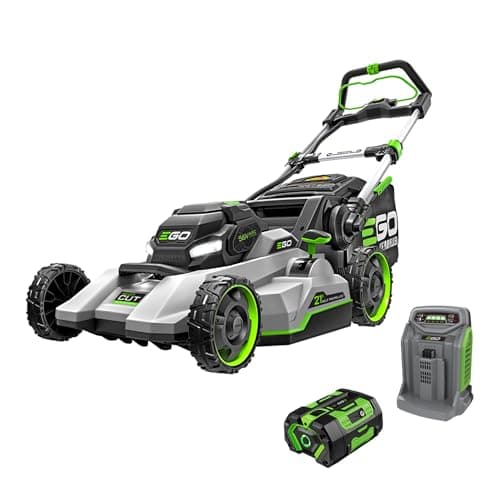
Which turns this into a hardware question, because not every mower can reach that height. The EGO LM2135SP publishes 1 to 4 inches over eight positions; the Greenworks LM2054 tops out at 3.6 inches and the LM2108S at 4.0. A deck whose ceiling is below 3 inches cannot follow the guidance at all — the full comparison is in the mowing height guide.
#ad Check the EGO Power+ 21" Select Cut LM2135SP price on Amazon — how we're funded.
Where watering and soil condition meet
If water pools on the surface or runs off rather than soaking in, no watering schedule will fix it. That is compaction, and the tool for it is a core aerator that pulls plugs from two to three inches down, not a dethatcher working at 0.4 inches. We untangle those in dethatching vs aerating.
Autumn is also when the two jobs pair up: aerate, then overseed, then feed. That sequence is in the lawn care schedule.
#ad Check the Scotts Elite Spreader price on Amazon — how we're funded.
What we cannot tell you
We cannot tell you how many minutes to run your sprinkler, because that depends on your sprinkler's output and your soil, and both are things only a catch can and a probe can establish. Any site that gives you a run time has invented it.
The guidance that is published, and that we have cited above, is consistent: water infrequently, water deeply enough to wet six inches of soil, water in the morning, and mow high with a sharp blade so you need less of it.
The products discussed
Specs are the manufacturer's own and linked to the page they came from. Prices come from a live daily check; where we have no verified price we say so rather than print a stale one.
EGO Power+ 21" Select Cut LM2135SP
EGO · EGO 56V ARC Lithium · Our score 9.1/10
#ad Price as of October 20, 2026. Prices change; we check daily. How we're funded.
The most watt-hours in the box of any flagship walk-behind here, on the platform with the widest tool range to grow into.
Published specs
| Deck | 21 in |
|---|---|
| Cutting torque | Up to 7.0 ft-lbs |
| Battery included | 56V 7.5Ah |
| Cut height | 1-4 in, 8 positions |
| Self-propel speed | 0.9-3.1 MPH |
| Runtime claim | Up to 60 min |
| Warranty | 5-yr tool / 3-yr battery |
Source: EGO POWER+ 21" Select Cut System (LM2135SP), egopowerplus.com
56V x 7.5Ah = 420Wh, using EGO's advertised pack voltage.
What the numbers favor
- 420Wh in the box -- the largest included pack of any flagship walk-behind on this page
- Eight cut-height positions from 1 to 4 in, the widest published range here
- Three interchangeable lower blades (mulching, high-lift bagging, extended runtime)
- 5-year tool warranty, the longest published on this page
What they don't
- EGO publishes torque (7.0 ft-lbs), not motor wattage, so it cannot be compared directly against Greenworks' 1500W figure
- The 7.5Ah pack that earns the runtime claim is also the expensive one to replace
your yard is under a quarter acre. You would be paying for 420Wh of headroom you will never discharge, and a 20 in push mower cuts the same grass.
How it scores
Scores are our editorial weighting of the published specs above, not a test result. They are deliberately kept out of this page's structured data.
Scotts Elite Spreader
Scotts · Manual (push) · Our score 8.5/10
#ad No verified live price right now, so we show none rather than a stale one. How we're funded.
A 6 ft dual-rotor pattern over 20,000 sq ft, with EdgeGuard to keep product off the sidewalk.
Published specs
| Type | Broadcast (rotary), dual rotor |
|---|---|
| Spread width | 6 ft |
| Coverage per fill | Up to 20,000 sq ft |
| Hopper capacity | 80 lb |
| Edge control | EdgeGuard (blocks right side) |
| Tires | 10 in, foam filled |
Source: Scotts Elite Spreader (75902), scotts.com
5,000 sq ft at a 6 ft spread width needs about 833 linear feet of walking. On a 60 ft run that is roughly 14 passes -- versus 17 passes at a standard 5 ft width. That is the whole practical difference the dual rotor buys.
What the numbers favor
- 6 ft pattern against the 5 ft standard -- about 20% fewer passes
- 80 lb hopper covers 20,000 sq ft without a refill
- EdgeGuard keeps fertilizer off hard surfaces, which is where runoff starts
- Foam-filled tires cannot go flat in the shed over winter
What they don't
- 80 lb loaded is heavy to push on soft or sloped ground
- Broadcast spreaders are harder to control near beds than a drop spreader
your lawn is under about 2,000 sq ft or heavily bordered by beds. A drop spreader puts product exactly where you steer it and nowhere else.
How it scores
Scores are our editorial weighting of the published specs above, not a test result. They are deliberately kept out of this page's structured data.
Where to buy the tools on this page
Amazon affiliate links, except where a product has no Amazon listing — those go direct to the maker and earn us nothing, and the button says so. We show no price we have not verified today, so where there is no live figure the link says "check price" and takes you to the listing to read it there.
Best overall
EGO Power+ 21" Select Cut LM2135SP
EGO · EGO 56V ARC Lithium
Best overall
Scotts Elite Spreader
Scotts · Manual (push)
#ad As an Amazon Associate we earn from qualifying purchases, at no extra cost to you. How we're funded.
Common questions
How often should I water my lawn?
How much water does a lawn need per week?
What is the best time of day to water a lawn?
How do I know how much water my sprinkler puts out?
Should I water a brown, dormant lawn?
Does mowing height affect watering?
Sources
Read next
- Lawn Care
Cutting the grass is a third of the job. This is the other two thirds.
- Doing your own lawn care: what to do, and when
Four jobs, the right order, the right season. The sequence matters more than the equipment.
- How to measure your lawn (and why every other decision needs it)
Three methods for an irregular lawn, plus the sq ft to acres conversions everything else needs.
- What height should you mow your lawn?
The one-third rule, the 3-inch recommendation, and every published cut-height range checked against them.
- What the three numbers on a fertilizer bag mean
N-P-K decoded, UMN's published nitrogen rates, and the maths that turns a bag into pounds.
- Best lawn aerator (and why most of them are not aerators)
Core aeration pulls 2-3 inch plugs; dethatchers work at 0.4 inches. Which one you need.
- Best garden hose
Working pressure, temperature limits and carry weight for the two hoses that publish them.
- Best lawn sprinkler
Coverage, throw and pattern for three sprinkler types, with the circle-area check on each claim.
- Best garden hose reel
Hose capacity, pressure rating and rewind method for a crank reel and an automatic one.
- Best hose nozzle
Two metal hose nozzles on published specs, and the three patterns you will actually use.
- Best hose timer
Pressure range, ingress rating and what the hub actually adds, on two Orbit B-hyve XD timers.
- Watering a new lawn
Germination windows from three seed makers, and the watering pattern that has to change once they close.