Lawn Care
Moss and shady lawns
Moss is not the problem, it is the result. Extension guidance for shaded turf changes four things, and one of them is knowing when to give up.
Affiliate disclosure: we earn a commission if you buy through our links, at no extra cost to you. It never changes which product we rank first — here is how we're funded.
We have not tested these units. Every spec on this page comes from the manufacturer's own documentation and is linked to it. Every computed figure is arithmetic you can redo. Prices are checked daily — last verified October 23, 2026. Here is exactly how we pick.
The shaded strip under a tree is the part of the lawn people fight hardest and lose most often. Extension guidance for turf in shade is specific, and it starts by changing four things about how you manage that area rather than what you apply to it.
Moss first, because it is misunderstood
That is the same logic extension weed guidance applies more broadly: find out the reasons behind the invasion before treating it, because treating without correcting only invites continued and increased invasion. Moss is simply the clearest example.
The four things extension guidance changes in shade
| Practice | In sun | In shade, per Penn State Extension |
|---|---|---|
| Mowing height | Species range, or UMN's 3 in or higher | Approximately one inch higher than in sun; never remove more than one third of the leaf surface |
| Watering | Deep and infrequent | Water deeply and infrequently; frequent shallow irrigation may develop shallow tree roots |
| Fertility | Species rate | Slightly higher than the normal rate for that species, at a 2-1-1 or 1-1-1 ratio with 30% or more slow-release nitrogen |
| Species | Kentucky bluegrass, ryegrass, tall fescue | Fine fescues, or rough bluegrass in wet conditions |
From Penn State Extension, Growing Turf Under Shaded Conditions, fetched 7 September 2026.
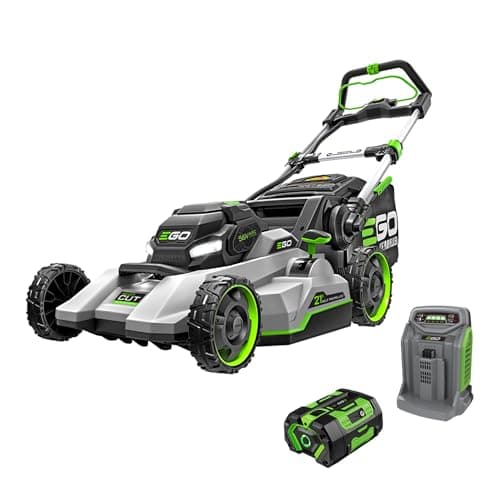
#ad Check the EGO Power+ 21" Select Cut LM2135SP price on Amazon — how we're funded.
Matching species to shade level
Penn State separates shade into three levels with a different species answer for each, which is more useful than a single "shade mix" recommendation.
| Shade level | Recommended species | Notes |
|---|---|---|
| Heavy shade | Fine fescues (creeping, red, Chewings, hard, sheep), or rough bluegrass in wet conditions | Fine fescues are described as ideal for shaded conditions |
| Medium shade | Fine fescues, tall fescues or rough bluegrass | Tall fescue is more shade tolerant than bluegrass or ryegrass |
| Light shade | Fine fescues, tall fescues, or shade-tolerant Kentucky bluegrass (Glade, Bensun) | Bluegrass becomes viable only at this level |
From Penn State Extension. Species characteristics are in the grass types guide.
Fine fescues come with a published trade worth planning for: Penn State rates their wear tolerance as poor and notes they are not typically used for sports turf or high-traffic areas. A shaded fine-fescue area is also an area to route foot traffic away from.
They are also the lowest-input species in the table, at a published 1.0 to 2.0 lb of nitrogen per 1,000 sq ft per growing season against 2.0 to 4.0 for Kentucky bluegrass.
#ad Check the Scotts Elite Spreader price on Amazon — how we're funded.
The tree side of the problem
Shade is only half of what a tree does to a lawn. The other half is root competition for water and nutrients in the same soil volume, which is why the watering advice for shade is counter-intuitive.
Penn State's guidance on the trees themselves is direct: remove those trees that are not essential to the beauty, prune tree branches as much as possible without destroying their aesthetic function, and prune shallow tree roots as much as possible.
When to stop growing grass there
The most useful sentence in the shade guidance is the one that gives you permission to stop. Penn State: use other types of ground covers where environmental modifications are difficult, or the cost is prohibitive, naming periwinkle, pachysandra, purple wintercreeper and English ivy as suitable.
- The area has been reseeded twice and thinned out both times
- Canopy thinning is not possible or not wanted
- It is under a mature evergreen, where shade is dense and year-round
- It is a narrow strip that also takes traffic
- You are watering it separately from the rest of the lawn to keep it alive
A mulched bed or a groundcover in that strip is less work, looks deliberate, and stops you buying seed for it every autumn.
#ad Check the Greenworks 40V 20" Push LM2054 price on Amazon — how we're funded.
A shaded-area routine
- Raise the deck about an inch for that area, if the mower can reach it.
- Water deeply and infrequently, the same as the rest of the lawn.
- Feed slightly above the species rate, at a 2-1-1 or 1-1-1 ratio with 30% or more slow-release nitrogen.
- Overseed with fine fescues in the late-summer window rather than in spring.
- Keep traffic off it, because fine fescues are poor on wear.
- Thin the canopy if you can, which changes the shade level and therefore the species options.
- Give it two seasons. If it still fails, plant a groundcover.
What we cannot tell you
Penn State's shade guidance does not state a minimum number of hours of sunlight turf needs, so neither do we. We also will not recommend moss-control products; that is regulated and regional, and the conditions are the actual target anyway.
What is published: mow about an inch higher, never remove more than a third of the leaf surface, water deeply and infrequently, feed slightly above the species rate at 2-1-1 or 1-1-1 with 30% or more slow release, choose fine fescues, and use groundcover where modification is impractical.
The products discussed
Specs are the manufacturer's own and linked to the page they came from. Prices come from a live daily check; where we have no verified price we say so rather than print a stale one.
EGO Power+ 21" Select Cut LM2135SP
EGO · EGO 56V ARC Lithium · Our score 9.1/10
#ad Price as of October 23, 2026. Prices change; we check daily. How we're funded.
The most watt-hours in the box of any flagship walk-behind here, on the platform with the widest tool range to grow into.
Published specs
| Deck | 21 in |
|---|---|
| Cutting torque | Up to 7.0 ft-lbs |
| Battery included | 56V 7.5Ah |
| Cut height | 1-4 in, 8 positions |
| Self-propel speed | 0.9-3.1 MPH |
| Runtime claim | Up to 60 min |
| Warranty | 5-yr tool / 3-yr battery |
Source: EGO POWER+ 21" Select Cut System (LM2135SP), egopowerplus.com
56V x 7.5Ah = 420Wh, using EGO's advertised pack voltage.
What the numbers favor
- 420Wh in the box -- the largest included pack of any flagship walk-behind on this page
- Eight cut-height positions from 1 to 4 in, the widest published range here
- Three interchangeable lower blades (mulching, high-lift bagging, extended runtime)
- 5-year tool warranty, the longest published on this page
What they don't
- EGO publishes torque (7.0 ft-lbs), not motor wattage, so it cannot be compared directly against Greenworks' 1500W figure
- The 7.5Ah pack that earns the runtime claim is also the expensive one to replace
your yard is under a quarter acre. You would be paying for 420Wh of headroom you will never discharge, and a 20 in push mower cuts the same grass.
How it scores
Scores are our editorial weighting of the published specs above, not a test result. They are deliberately kept out of this page's structured data.
Scotts Elite Spreader
Scotts · Manual (push) · Our score 8.5/10
#ad No verified live price right now, so we show none rather than a stale one. How we're funded.
A 6 ft dual-rotor pattern over 20,000 sq ft, with EdgeGuard to keep product off the sidewalk.
Published specs
| Type | Broadcast (rotary), dual rotor |
|---|---|
| Spread width | 6 ft |
| Coverage per fill | Up to 20,000 sq ft |
| Hopper capacity | 80 lb |
| Edge control | EdgeGuard (blocks right side) |
| Tires | 10 in, foam filled |
Source: Scotts Elite Spreader (75902), scotts.com
5,000 sq ft at a 6 ft spread width needs about 833 linear feet of walking. On a 60 ft run that is roughly 14 passes -- versus 17 passes at a standard 5 ft width. That is the whole practical difference the dual rotor buys.
What the numbers favor
- 6 ft pattern against the 5 ft standard -- about 20% fewer passes
- 80 lb hopper covers 20,000 sq ft without a refill
- EdgeGuard keeps fertilizer off hard surfaces, which is where runoff starts
- Foam-filled tires cannot go flat in the shed over winter
What they don't
- 80 lb loaded is heavy to push on soft or sloped ground
- Broadcast spreaders are harder to control near beds than a drop spreader
your lawn is under about 2,000 sq ft or heavily bordered by beds. A drop spreader puts product exactly where you steer it and nowhere else.
How it scores
Scores are our editorial weighting of the published specs above, not a test result. They are deliberately kept out of this page's structured data.
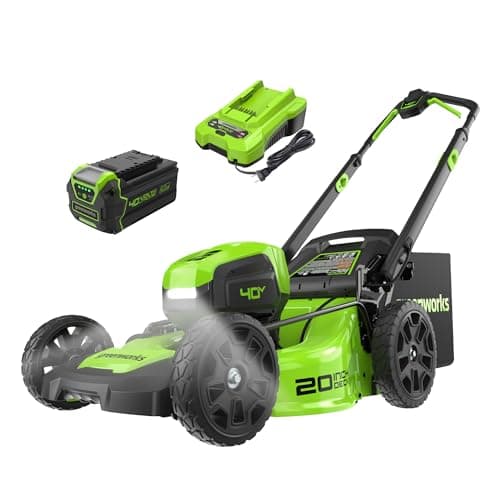
Greenworks 40V 20" Push LM2054
Greenworks · Greenworks 40V · Our score 8.0/10
#ad Price as of October 23, 2026. Prices change; we check daily. How we're funded.
40 minutes on a 160Wh pack and 57.5 lb to push -- the honest answer for a third of an acre and nothing more.
Published specs
| Model / SKU | LM2054 / 2549902 |
|---|---|
| Deck | 20 in |
| Max blade speed | 3200 RPM |
| Battery included | 40V 4.0Ah |
| Cut height | 1.2-3.6 in, 7 positions |
| Runtime claim | Up to 40 min |
| Weight | 57.5 lb |
| Rated for | Up to 1/3 acre |
| Warranty | 3-yr tool / 3-yr battery |
Source: 40V 20" 4-in-1 Push Lawn Mower (LM2054), greenworkstools.com
40V x 4.0Ah = 160Wh. Note it claims 40 minutes on 160Wh where the 80V flagship claims 33 minutes on 320Wh -- a 20 in deck and no self-propel drive motor is why.
What the numbers favor
- Lightest published weight on this page at 57.5 lb, and the only sub-60 lb mower here
- Claims 40 minutes from 160Wh -- the best published minutes-per-watt-hour of any mower on this page
- Same 3200 RPM blade speed as the 80V flagship
- 4-in-1 deck at the entry price
What they don't
- Push only -- no drive assist on any slope
- 1.2 in minimum cut height is lower than most cool-season lawns should ever be cut
- 120-minute recharge, three times the 80V model's 40 minutes
your lawn is over a third of an acre or has any real slope. Greenworks rates it to 1/3 acre and you will be pushing all 57.5 lb of it up the hill yourself.
How it scores
Scores are our editorial weighting of the published specs above, not a test result. They are deliberately kept out of this page's structured data.
Where to buy the tools on this page
Amazon affiliate links, except where a product has no Amazon listing — those go direct to the maker and earn us nothing, and the button says so. We show no price we have not verified today, so where there is no live figure the link says "check price" and takes you to the listing to read it there.
Best overall
EGO Power+ 21" Select Cut LM2135SP
EGO · EGO 56V ARC Lithium
Best overall
Scotts Elite Spreader
Scotts · Manual (push)
Best for small yards
Greenworks 40V 20" Push LM2054
Greenworks · Greenworks 40V
#ad As an Amazon Associate we earn from qualifying purchases, at no extra cost to you. How we're funded.
Common questions
How do I get rid of moss in my lawn?
What grass grows best in shade?
How high should I mow a shaded lawn?
Should I water a shaded lawn more?
Should I fertilize shaded grass differently?
When should I stop trying to grow grass in shade?
Sources
- Growing Turf Under Shaded Conditions, Penn State Extension
- Turfgrass Species for Pennsylvania, Penn State Extension
- Mowing practices for healthy lawns, University of Minnesota Extension
- EGO POWER+ 21" Select Cut System (LM2135SP), egopowerplus.com
- Greenworks 40V 20" Push Lawn Mower (LM2054), greenworkstools.com
Read next
- Lawn Care
Cutting the grass is a third of the job. This is the other two thirds.
- Cool-season grass types, and how to tell which you have
Published mowing heights, nitrogen rates and tolerances for each cool-season species.
- What height should you mow your lawn?
The one-third rule, the 3-inch recommendation, and every published cut-height range checked against them.
- How much should you water a lawn?
Once a week or less, to a six inch soil depth, in the morning. The catch-can method explained.
- How to overseed a lawn
Published extension seeding rates, the late-summer window, and the passes-per-lawn arithmetic.
- Lawn weed control starts with the lawn
Weeds signal a condition. The cultural fixes, and the published timing windows.
- Best grass seed for shade
Shade tolerance, sunlight hours and seeding rates for three cool-season mixes under trees.