Lawn Care
Cool-season grass types, and how to tell which you have
Species decides your mowing height, your fertilizer rate and whether your shady corner will ever work. It is the input every other lawn decision assumes.
Affiliate disclosure: we earn a commission if you buy through our links, at no extra cost to you. It never changes which product we rank first — here is how we're funded.
We have not tested these units. Every spec on this page comes from the manufacturer's own documentation and is linked to it. Every computed figure is arithmetic you can redo. Prices are checked daily — last verified October 23, 2026. Here is exactly how we pick.
Almost every piece of lawn advice you will read assumes a species and does not say which. Mowing height, fertilizer rate, shade tolerance and how quickly a repair fills in are all species properties, and extension services publish them plainly.
The cool-season species, compared
| Species | Mowing height | Nitrogen per 1,000 sq ft/season | Shade | Drought | Wear |
|---|---|---|---|---|---|
| Kentucky bluegrass | 1.5-2.5 in | 2.0-4.0 lb | Poor | Moderate; semi-dormant in heat | Good |
| Perennial ryegrass | 1.5-2.5 in (lawn use) | About 3.0 lb | Moderate | Moderate | Good |
| Tall fescue | 2.0-3.0 in | 2.5-3.0 lb | Moderate; better than bluegrass or rye | Best of the cool-season types | Good |
| Fine fescues | 2.0 in or above | 1.0-2.0 lb | Excellent | Good on droughty soils | Poor |
| Rough bluegrass | 1.5-2.5 in | 2.0-3.0 lb | Highly shade tolerant | Poor | Not stated |
| Bentgrasses | 3/16-3/4 in | 2.0-4.0 lb | Not stated | Moderate | Moderate |
All figures from Penn State Extension, Turfgrass Species for Pennsylvania, fetched 7 September 2026. These are Pennsylvania recommendations; your own state extension service is the authority for your region.
What each species is actually for
Kentucky bluegrass
The classic lawn grass: wear tolerant, used on home lawns, parks and athletic fields. Its two published limitations are shade, which it does not tolerate heavily, and establishment speed — Penn State notes it is slower than most turfgrasses, requiring up to two weeks for emergence. It goes semi-dormant during prolonged heat and drought, which is normal rather than a failure.
Perennial ryegrass
The fast one. It germinates rapidly, in 5 to 7 days, and establishes quickly, which is why Penn State describes it as excellent for overseeding. It is wear tolerant and heat tolerant but only moderately shade and drought tolerant, and it wants about 3.0 lb of nitrogen per 1,000 sq ft per growing season.
Tall fescue
The most heat and drought tolerant of the cool-season types, persistent and durable, with a published mowing height of 2.0 to 3.0 inches. Penn State lists it for home lawns, athletic fields, playgrounds, utility areas and low-maintenance situations. It is somewhat slow to establish extensive root systems, so patience at establishment is the trade.
Fine fescues
The shade and low-input specialists: creeping red, Chewings, hard and sheep. Penn State calls them ideal for shaded conditions and publishes the lowest fertility requirement of any species here at 1.0 to 2.0 lb of nitrogen. The catch is wear — they are not typically used for sports turf or high-traffic areas.
#ad Check the Scotts Elite Spreader price on Amazon — how we're funded.
Why seed comes as a mixture
Read the table across and the logic of a blended seed product becomes obvious. No single species is good at everything, and a lawn is rarely uniform in light, traffic or moisture.
Penn State's shade guidance follows the same logic explicitly: shade-tolerant seed mixtures contain fescues along with shade-tolerant Kentucky bluegrasses, and it names Glade and Bensun as bluegrass varieties that tolerate light shade.
Working out what you have
Most established lawns are a mixture that has sorted itself out by conditions, so the useful question is not "what species is my lawn" but "what is thriving where".
| What you observe | What it suggests | What to do about it |
|---|---|---|
| Deep shade area that thins every year | Bluegrass in a spot it cannot tolerate | Overseed with fine fescues; consider groundcover if it fails again |
| Area that browns first in summer and recovers | Bluegrass going semi-dormant | Normal. Mow high and reduce traffic. |
| Area that stays green through heat | Tall fescue | Manage at 2.0-3.0 in and enjoy it |
| Fine-bladed, thin, low-fertility area doing fine | Fine fescue | Do not over-fertilize it; 1.0-2.0 lb N is the published rate |
| Coarse patches that stand out in a fine lawn | Tall fescue clumps in a bluegrass lawn | A cosmetic issue rather than a health one |
Species characteristics from Penn State Extension as cited above. Positive identification is a job for your state extension service, not for a website.
#ad Check the EGO Power+ 21" Select Cut LM2135SP price on Amazon — how we're funded.
What species changes about your equipment
- Cut height ceiling. If you are managing tall fescue at 3.0 inches or following the UMN 3 inches or higher guidance, a deck topping out at 3.6 inches leaves little headroom. EGO publishes 1 to 4 inches; Greenworks publishes 1.2 to 3.6 on the 40V push mower.
- Fertilizer quantity. A fine fescue lawn at 1.0 lb of nitrogen and a bluegrass lawn at 4.0 lb are four times apart, which changes how much product goes through the spreader — the conversion is in fertilizer numbers explained.
- Overseeding species. Perennial ryegrass's 5 to 7 day germination is why it dominates overseeding mixes.
- Traffic planning. Fine fescues are poor on wear, so a shaded fine-fescue area is also the area to keep foot traffic off.
What we cannot tell you
We cannot identify your grass, and we are not going to recommend cultivars. The extension figures above are Pennsylvania and Minnesota recommendations; species adaptation is regional, and warm-season grasses — which dominate the southern United States — are outside the sources we hold.
What is published and portable: the mowing height ranges, the nitrogen rates, the germination speeds and the shade, drought and wear rankings. Those explain most of why one part of your lawn behaves differently from another.
The products discussed
Specs are the manufacturer's own and linked to the page they came from. Prices come from a live daily check; where we have no verified price we say so rather than print a stale one.
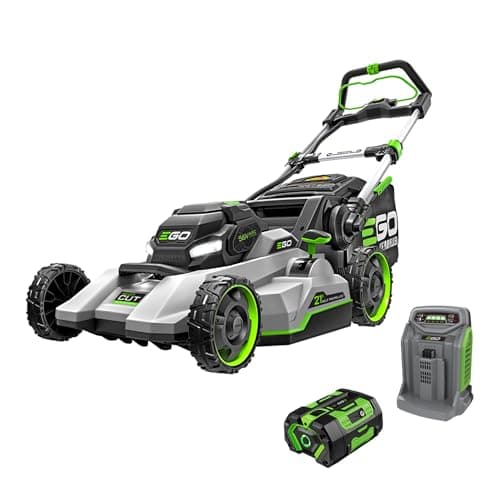
EGO Power+ 21" Select Cut LM2135SP
EGO · EGO 56V ARC Lithium · Our score 9.1/10
#ad Price as of October 23, 2026. Prices change; we check daily. How we're funded.
The most watt-hours in the box of any flagship walk-behind here, on the platform with the widest tool range to grow into.
Published specs
| Deck | 21 in |
|---|---|
| Cutting torque | Up to 7.0 ft-lbs |
| Battery included | 56V 7.5Ah |
| Cut height | 1-4 in, 8 positions |
| Self-propel speed | 0.9-3.1 MPH |
| Runtime claim | Up to 60 min |
| Warranty | 5-yr tool / 3-yr battery |
Source: EGO POWER+ 21" Select Cut System (LM2135SP), egopowerplus.com
56V x 7.5Ah = 420Wh, using EGO's advertised pack voltage.
What the numbers favor
- 420Wh in the box -- the largest included pack of any flagship walk-behind on this page
- Eight cut-height positions from 1 to 4 in, the widest published range here
- Three interchangeable lower blades (mulching, high-lift bagging, extended runtime)
- 5-year tool warranty, the longest published on this page
What they don't
- EGO publishes torque (7.0 ft-lbs), not motor wattage, so it cannot be compared directly against Greenworks' 1500W figure
- The 7.5Ah pack that earns the runtime claim is also the expensive one to replace
your yard is under a quarter acre. You would be paying for 420Wh of headroom you will never discharge, and a 20 in push mower cuts the same grass.
How it scores
Scores are our editorial weighting of the published specs above, not a test result. They are deliberately kept out of this page's structured data.
Scotts Elite Spreader
Scotts · Manual (push) · Our score 8.5/10
#ad No verified live price right now, so we show none rather than a stale one. How we're funded.
A 6 ft dual-rotor pattern over 20,000 sq ft, with EdgeGuard to keep product off the sidewalk.
Published specs
| Type | Broadcast (rotary), dual rotor |
|---|---|
| Spread width | 6 ft |
| Coverage per fill | Up to 20,000 sq ft |
| Hopper capacity | 80 lb |
| Edge control | EdgeGuard (blocks right side) |
| Tires | 10 in, foam filled |
Source: Scotts Elite Spreader (75902), scotts.com
5,000 sq ft at a 6 ft spread width needs about 833 linear feet of walking. On a 60 ft run that is roughly 14 passes -- versus 17 passes at a standard 5 ft width. That is the whole practical difference the dual rotor buys.
What the numbers favor
- 6 ft pattern against the 5 ft standard -- about 20% fewer passes
- 80 lb hopper covers 20,000 sq ft without a refill
- EdgeGuard keeps fertilizer off hard surfaces, which is where runoff starts
- Foam-filled tires cannot go flat in the shed over winter
What they don't
- 80 lb loaded is heavy to push on soft or sloped ground
- Broadcast spreaders are harder to control near beds than a drop spreader
your lawn is under about 2,000 sq ft or heavily bordered by beds. A drop spreader puts product exactly where you steer it and nowhere else.
How it scores
Scores are our editorial weighting of the published specs above, not a test result. They are deliberately kept out of this page's structured data.
Where to buy the tools on this page
Amazon affiliate links, except where a product has no Amazon listing — those go direct to the maker and earn us nothing, and the button says so. We show no price we have not verified today, so where there is no live figure the link says "check price" and takes you to the listing to read it there.
Best overall
EGO Power+ 21" Select Cut LM2135SP
EGO · EGO 56V ARC Lithium
Best overall
Scotts Elite Spreader
Scotts · Manual (push)
#ad As an Amazon Associate we earn from qualifying purchases, at no extra cost to you. How we're funded.
Common questions
What are the cool-season grasses?
Which grass is best for shade?
Which grass is most drought tolerant?
What height should I mow my grass species at?
Which grass needs the least fertilizer?
Why are lawn seed products a mixture?
Sources
Read next
- Lawn Care
Cutting the grass is a third of the job. This is the other two thirds.
- Moss and shady lawns
Mow an inch higher, water deeply, switch to fine fescues, and know when to plant something else.
- How to overseed a lawn
Published extension seeding rates, the late-summer window, and the passes-per-lawn arithmetic.
- What the three numbers on a fertilizer bag mean
N-P-K decoded, UMN's published nitrogen rates, and the maths that turns a bag into pounds.
- What height should you mow your lawn?
The one-third rule, the 3-inch recommendation, and every published cut-height range checked against them.
- Soil testing for lawns, step by step
4 inches deep, 8 to 10 locations, every three to five years. What the report tells you.
- Best grass seed
Coverage claims converted to pounds per 1,000 sq ft, checked against Extension seeding rates.
- Best mower for bermuda grass
Which cordless mowers publish a cut height low enough for bermudagrass, and which do not.