Riding & Robot Mowers
Setting up a wire-free robot mower
Nothing gets buried, which removes the worst part of the old installation and replaces it with three decisions you have to get right in software.
Affiliate disclosure: we earn a commission if you buy through our links, at no extra cost to you. It never changes which product we rank first — here is how we're funded.
We have not tested these units. Every spec on this page comes from the manufacturer's own documentation and is linked to it. Every computed figure is arithmetic you can redo. Prices are checked daily — last verified October 23, 2026. Here is exactly how we pick.
The old robot mower installation involved burying a perimeter wire around the entire lawn and repairing it every time an aerator or a spade found it. Wire-free navigation removes that job completely, and replaces it with three decisions you make once and live with.
What setup actually involves now
Before you start: the two published limits
Both are hard, and both are worth confirming before anything is unboxed.
| Limit | Published figure | How to check |
|---|---|---|
| Coverage | Up to 1/8 acre (Segway notes up to 0.15 acre depending on layout) | Measure the mown grass only; 1/8 acre is 5,445 sq ft |
| Maximum slope | 16 degrees | Measure the worst bank, not the average; 16 degrees is roughly a 29% grade |
| Cutting width | 7.1 in | Sets how many passes the area needs, and so how much of the day it uses |
| Cut height range | 2 to 3.6 in | Check it reaches the height you want to maintain |
From the Segway Navimow i105N product page, checked 3 September 2026. Measuring method in how to measure your lawn.
Step one: siting the base station
This is the decision that most affects whether the system works well, and it is the one people rush.
- Clear sky above the reference point. RTK positioning depends on satellite reception. A base under dense canopy or tight against a two-storey wall is the most likely source of trouble.
- Mains power within reach, routed so the cable is not across a mowing path.
- Level, firm ground so the docking approach is consistent.
- Out of the mowing line, ideally at an edge, so the mower is not navigating around its own dock all day.
- Somewhere you can reach it. You will be lifting a 24 lb machine on and off it more often in the first fortnight than afterwards.
Step two: the boundary
Drawing a boundary in an app is faster than burying wire and is easier to get subtly wrong, because there is nothing physical stopping the machine at the line.
- Leave margin at hard edges. Walls, curbs and fences want a little clearance; you will trim those with a string trimmer regardless.
- Leave generous margin at drops. Ponds, retaining walls, steps and open driveways deserve more clearance than looks necessary.
- Exclude beds and soft planting explicitly rather than relying on the mower to notice them.
- Exclude anything above 16 degrees, even if it is inside the lawn. The limit is a machine limit, not a boundary preference.
- Walk it again after the first week. The places it gets stuck are never the places you predicted.
#ad Check the Segway Navimow i105N Robot Mower price on Amazon — how we're funded.
Step three: height and schedule
A robot mower is the one machine where frequent light cutting is the design intent rather than a discipline, which lines up neatly with the extension guidance.
On height, Segway publishes 2 to 3.6 inches. University of Minnesota Extension recommends maintaining a typical residential lawn at 3 inches or higher and removing no more than one third of the leaf tissue per cut, so set 3 inches or above and let frequency do the rest. The reasoning is in the mowing height guide.
Living with it: the first month
| What happens | Why | What to do |
|---|---|---|
| It stops in the same corner repeatedly | Boundary too tight, or an obstacle it cannot see | Redraw that section with more margin |
| Coverage looks patchy | Not enough hours for a 7.1 in swath over the area | Extend the schedule, or accept the coverage rating is the limit |
| It struggles on one bank | That bank is at or past 16 degrees | Exclude it and trim it by hand |
| Positioning drifts under trees | Satellite reception at the base or in that zone | Re-site the base for clearer sky |
| Clippings visible on the lawn | Cutting less often than growth requires | Increase frequency; the one-third rule still applies |
Behaviors follow from the published coverage, swath, duty cycle and slope figures. Segway publishes no troubleshooting figures, so nothing here is a fault code.
What you still need
A robot mower does not finish a garden. It cuts the open lawn and nothing else, so the rest of the kit stays relevant: a string trimmer for edges and around obstacles, an edger if you want a defined line, and a blower for hard surfaces.
It also does not handle a heavy autumn leaf fall. That remains a mower-and-blower job — the extension-backed method is in best mower for mulching leaves.
#ad Check the EGO Power+ 21" Select Cut LM2135SP price on Amazon — how we're funded.
What we cannot tell you
We have not installed or run this machine. Segway publishes no setup time, no positioning accuracy figure, no minimum satellite requirement and no obstacle-detection specification, so anything specific about how well the navigation works in practice would be invented.
What is published: 1/8 acre, 7.1 inches, 2 to 3.6 inches of cut height, 60 minutes against 90, 16 degrees, 58 dB(A) and 24 lb. Design the installation inside those and the rest is boundary drawing.
The products discussed
Specs are the manufacturer's own and linked to the page they came from. Prices come from a live daily check; where we have no verified price we say so rather than print a stale one.
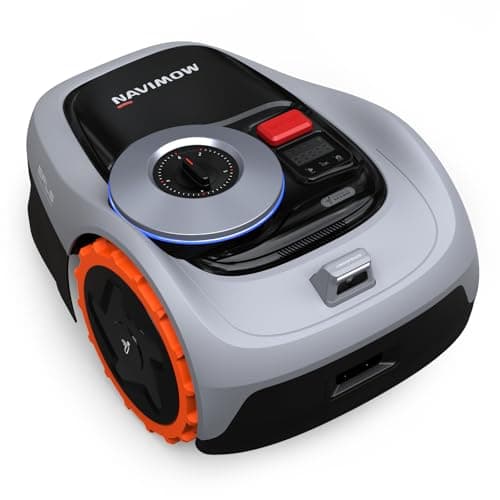
Segway Navimow i105N Robot Mower
Segway · Navimow (self-contained) · Our score 8.0/10
#ad Price as of October 23, 2026. Prices change; we check daily. How we're funded.
No perimeter wire, 58 dB published, and an eighth of an acre it will cut while you are at work.
Published specs
| Coverage | Up to 1/8 acre |
|---|---|
| Cutting width | 7.1 in |
| Cut height | 2-3.6 in |
| Runtime / charge | 60 min run / 90 min charge |
| Navigation | RTK + Vision, wire-free |
| Max slope | 16 degrees |
| Noise | 58 dB(A) |
| Weight | 24 lb |
Source: Navimow i105N, navimow.com
60 minutes of run against 90 minutes of charge is a 60/150 duty cycle -- about 40%. Over a 12-hour window that is roughly 4.8 hours of actual cutting, which is the number that decides whether 1/8 acre is realistic for your grass growth rate.
What the numbers favor
- No perimeter wire to bury, cut or repair -- boundaries are set in the app
- 58 dB published, quiet enough to run while people are outside
- Publishes both runtime and charge time, so the duty cycle is computable
- 24 lb, light enough to carry to storage single-handed
What they don't
- 1/8 acre is a genuinely small lawn; Segway's own 0.15 acre figure is layout-dependent
- 7.1 in cutting width means many passes
- 16 degree maximum slope rules out a lot of real gardens
your lawn has slopes over 16 degrees or is over an eighth of an acre. Both are hard published limits, not soft ones.
How it scores
Scores are our editorial weighting of the published specs above, not a test result. They are deliberately kept out of this page's structured data.
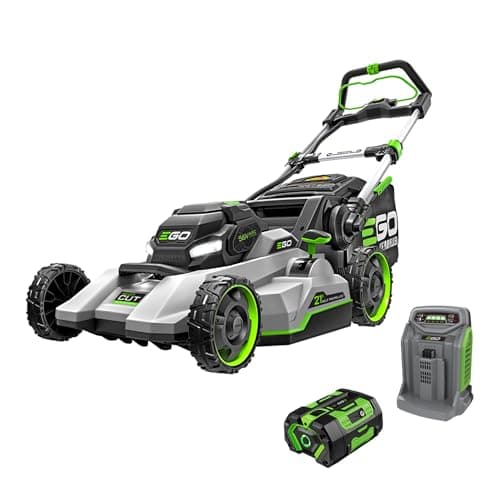
EGO Power+ 21" Select Cut LM2135SP
EGO · EGO 56V ARC Lithium · Our score 9.1/10
#ad Price as of October 23, 2026. Prices change; we check daily. How we're funded.
The most watt-hours in the box of any flagship walk-behind here, on the platform with the widest tool range to grow into.
Published specs
| Deck | 21 in |
|---|---|
| Cutting torque | Up to 7.0 ft-lbs |
| Battery included | 56V 7.5Ah |
| Cut height | 1-4 in, 8 positions |
| Self-propel speed | 0.9-3.1 MPH |
| Runtime claim | Up to 60 min |
| Warranty | 5-yr tool / 3-yr battery |
Source: EGO POWER+ 21" Select Cut System (LM2135SP), egopowerplus.com
56V x 7.5Ah = 420Wh, using EGO's advertised pack voltage.
What the numbers favor
- 420Wh in the box -- the largest included pack of any flagship walk-behind on this page
- Eight cut-height positions from 1 to 4 in, the widest published range here
- Three interchangeable lower blades (mulching, high-lift bagging, extended runtime)
- 5-year tool warranty, the longest published on this page
What they don't
- EGO publishes torque (7.0 ft-lbs), not motor wattage, so it cannot be compared directly against Greenworks' 1500W figure
- The 7.5Ah pack that earns the runtime claim is also the expensive one to replace
your yard is under a quarter acre. You would be paying for 420Wh of headroom you will never discharge, and a 20 in push mower cuts the same grass.
How it scores
Scores are our editorial weighting of the published specs above, not a test result. They are deliberately kept out of this page's structured data.
Where to buy the tools on this page
Amazon affiliate links, except where a product has no Amazon listing — those go direct to the maker and earn us nothing, and the button says so. We show no price we have not verified today, so where there is no live figure the link says "check price" and takes you to the listing to read it there.
Best wire-free robot for a small lawn
Segway Navimow i105N Robot Mower
Segway · Navimow (self-contained)
Best overall
EGO Power+ 21" Select Cut LM2135SP
EGO · EGO 56V ARC Lithium
#ad As an Amazon Associate we earn from qualifying purchases, at no extra cost to you. How we're funded.
Common questions
How does a wire-free robot mower know where to go?
Where should the base station go?
How long does robot mower setup take?
What cut height should I set?
How often should a robot mower run?
What will stop a robot mower working?
Sources
Read next
- Riding & Robot Mowers
Above an acre the question stops being which mower and starts being how many watt-hours.
- Seven things to measure before you buy a robot mower
Area, slope, passage width, cut height and duty cycle -- the checks that decide before you spend.
- Best robot lawn mower (and the limits nobody puts on the box)
Coverage, slope limit and duty cycle -- the three published numbers that decide if a robot mower fits.
- Is a robot mower worth it?
The hours-per-season arithmetic, and the published limits that decide it before price does.
- Robot mower or riding mower: two answers to different problems
1/8 acre run continuously against 2 acres in an afternoon. Rarely a real choice.
- What height should you mow your lawn?
The one-third rule, the 3-inch recommendation, and every published cut-height range checked against them.
- Best wire-free robot mower
Wire-free RTK navigation against a buried boundary wire, on published specs and install reality.