Yard Tools
Best outdoor extension cords, by the numbers makers actually print
Gauge decides how far you can go at full current. Jacket decides whether the cord coils in January. Almost nobody publishes both.
Affiliate disclosure: we earn a commission if you buy through our links, at no extra cost to you. It never changes which product we rank first — here is how we're funded.
We have not tested these units. Every spec on this page comes from the manufacturer's own documentation and is linked to it. Every computed figure is arithmetic you can redo. Prices are checked daily — last verified October 19, 2026. Here is exactly how we pick.
Quick picks
Ranked on the published specs and the arithmetic below. Tap any row to jump to the full write-up. We have not tested these units -- here is exactly how we pick.
| # | Product | Best for | Score | Price |
|---|---|---|---|---|
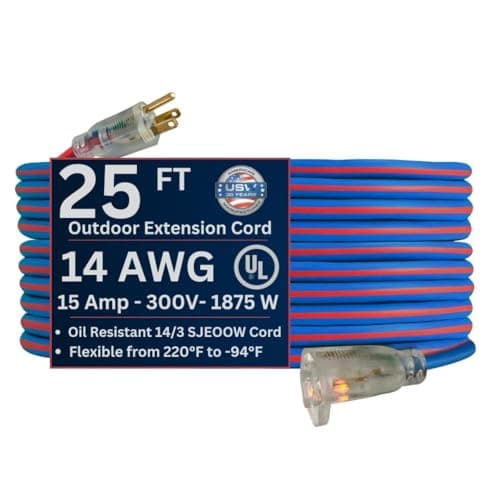
| 1 | US Wire EXTREME All-Weather Cord, 14/3 x 25 ft (98025) Flexible to -94 degrees F, which is 54 degrees past the best SJTW cord here, and the only cord on this page whose jacket is TPE rather than vinyl. | Best for deep cold | 8.7 | |
| 2 | 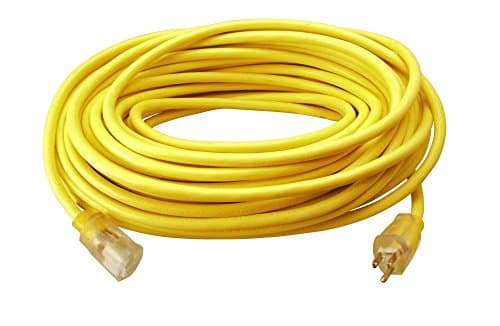 Southwire 12/3 SJTW Outdoor Cord, 100 ft, Lighted End A hundred feet of 12-gauge that still carries 15 A at the far end, and the only cord here whose maker publishes a UL rated operating temperature rather than a flexibility claim. | Best for a long run | 8.4 | |
| 3 | 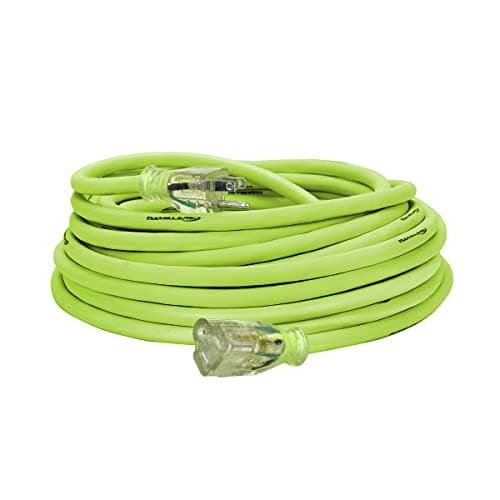 Flexzilla Pro Extension Cord, 12/3 x 50 ft (FZ512830) Rated flexible to -58 degrees F in an ordinary SJTW jacket, which is 18 degrees better than the other vinyl cord here and the reason it still coils when it is freezing. | Best to handle in the cold | 7.9 |
#ad Buy links are affiliate links. Prices come from a live daily check; where we have no verified price we say "check price" rather than print a stale one.
An extension cord is two specifications, and the yard-tool buyer needs both: gauge, which sets how far you can go at full current, and jacket, which sets whether the thing coils at all in January. Makers in this category publish one or the other, almost never both, and they do not even publish the cold figure in the same kind of units — two of the three cords here state a flexibility claim and the third states a UL rated temperature. Those are different things. This page sorts out which number is which.
The short answer
What actually decides an outdoor cord
- Gauge against length. Not gauge alone. 14/3 and 12/3 are both 15 A cords at 25 ft; at 100 ft only one of them still is. Published by US Wire per SKU.
- Jacket material. Vinyl (the T in SJTW) or TPE (the E in SJEOOW). This is the cold-handling spec, and it is a material fact rather than a marketing claim.
- Published cold figure, and which kind. A flexibility claim from the maker, or a UL rated temperature verified by a listing body. Both useful, not interchangeable.
- Amps or watts stated. A snow blower's plate is in amps or watts, so a cord that publishes neither cannot be matched to it. US Wire and Southwire publish amps; Southwire and Iron Forge publish watts.
- Plug construction. Lighted ends tell you the circuit is live. Reinforced blades are the prongs not bending when someone pulls the cord by the cable.
The arithmetic: why 12 gauge and not 14
This is normally argued from first principles. It does not have to be — US Wire publishes the answer in its own SKU table, and the table disagrees with itself across lengths in exactly the way the physics says it should.
14/3 at 10 ft: 15 A
14/3 at 15 ft: 15 A
14/3 at 25 ft: 15 A
14/3 at 50 ft: 15 A
14/3 at 100 ft: 13 A <- the derate
12/3 at 10, 15, 25, 50 and 100 ft: 15 A at every length
So 14 gauge loses 13% of its rating between 50 and 100 ft and 12 gauge loses nothing. That is the entire gauge argument, stated by a manufacturer rather than inferred. If your tool draws near 15 A — a corded snow blower, a 13 A pressure washer, a corded mower — and the run is long, 12 gauge is not an upgrade, it is the requirement.
Southwire 12/3, 100 ft: $96.56 / 100 = $0.97 per foot
Flexzilla Pro 12/3, 50 ft: $92.40 / 50 = $1.85 per foot
US Wire EXTREME 14/3, 25 ft: $30.13 / 25 = $1.21 per foot
Long cords are cheaper per foot, every time. And a single 100 ft cord beats two 50 ft cords joined for a second reason that is not about money: the joint is one more place for water to sit, outdoors, in winter.
Three cold numbers, three different kinds of number
This is the subtlety that makes cord listings so hard to compare, and it is worth three sentences.
| Cord | Published figure | What kind of claim | Jacket |
|---|---|---|---|
| US Wire EXTREME 14/3 | Flexible to -94 F | Maker's flexibility claim | SJEOOW, 100% TPE |
| Flexzilla Pro 12/3 | -58 F to 140 F | Maker's flexibility claim | SJTW (vinyl) |
| Southwire 12/3 | -40 C to 60 C | UL RATED temperature | SJTW (vinyl) |
A flexibility figure is the maker telling you how the cord handles when cold. A UL rated temperature has been verified by a listing body and is about what the cord is certified to survive. A cord can be certified for a temperature at which it is horrible to coil — which is precisely why TPE exists.
1. US Wire EXTREME All-Weather 14/3, 25 ft — best for deep cold
The only cord here with a jacket that is not vinyl. US Wire builds the EXTREME line from a 100% TPE compound in an SJEOOW jacket and publishes it as flexible down to −94 degrees F, tested, it says, in Alaskan conditions. Fifty-four degrees past the best vinyl figure on this page. If you have ever tried to uncoil a stiff yellow cord at 10 degrees F and had it hold the shape of the reel, that is the problem this solves.
US Wire is also the best documenter in this category by a wide margin: item number, full description, gauge, wire type, length, color, amp rating, case pack and UPC for every single SKU, including the 13 A derate on the 100 ft 14-gauge that most makers would have quietly printed as 15 A. Oil resistant, with a lighted female plug.
Two limits. It is 14 gauge, so 15 A and 1,875 W — fine for a blower, a trimmer or a hedge trimmer, tight behind a corded snow blower, and US Wire's own table tells you why. And the readily stocked size is 25 ft; the 50 and 100 ft versions exist in the catalogue and are harder to find listed. Note also that −94 degrees F is a flexibility claim, not a UL rated operating temperature.
#ad Check the US Wire EXTREME All-Weather Cord, 14/3 x 25 ft (98025) price on Amazon — how we're funded.
2. Southwire 12/3, 100 ft — best for a long run
A hundred feet of 12 gauge that still carries 15 A at the far end, at the lowest cost per foot on this page. This is the cord for the back of a yard: a corded mower, a pressure washer, a snow blower on the far end of the drive. Southwire publishes model number 2589SW0002, UPC, 15 A, 125 V, NEMA 5-15 plug and receptacle, SJTW jacket, 12.627 lb, UL and CUL listed, and a lighted receptacle.
And it publishes its cold figure as a UL rated temperature of −40 C to 60 C, which is a different and in some ways stronger kind of statement than a flexibility claim: a listing body has verified it. What it does not tell you is how the cord coils at that temperature, and a vinyl jacket is the worst of the three here on that count.
One sourcing note we will not paper over. Southwire does not print the model number on the retail listing, so we matched the listing to 2589SW0002 on published construction — 12/3, SJTW, 100 ft, yellow, lighted end — and not on part number. The listing additionally claims reinforced blades, which Southwire's own page for this cord does not mention, so we do not publish that as a Southwire specification. Also worth a smile: Southwire's spec table lists "Depth: 100.0 inch" for a 100-FOOT cord. The length has landed in the wrong field.
#ad Check the Southwire 12/3 SJTW Outdoor Cord, 100 ft, Lighted End price on Amazon — how we're funded.
3. Flexzilla Pro 12/3, 50 ft — best to handle in the cold
Flexzilla publishes its Pro cord line as flexible from −58 degrees F to 140 degrees F in a conventional SJTW jacket, which is 18 degrees better than any other vinyl cord here, and the whole Flexzilla proposition is handling: this is the brand whose garden hose is on our yard tools under $100 page for exactly the same reason. Twelve gauge at 50 ft, so it carries the same 15 A as the 100 ft Southwire at half the length and a quarter of the weight. Lighted grounded plug. Full published SKU grid: 25, 50 and 100 ft in 14, 12 and 10 gauge.
It is the most expensive cord per foot on this page by a wide margin, the temperature range is published for the Pro line rather than per SKU, and — oddly, for a cord — Flexzilla's own page states no amp or watt rating at all, where both other makers do. Flexibility is a handling spec. It tells you nothing about voltage drop.
#ad Check the Flexzilla Pro Extension Cord, 12/3 x 50 ft (FZ512830) price on Amazon — how we're funded.
Which cord for which tool on this site
| Tool | Cord | Why |
|---|---|---|
| Corded leaf blower or trimmer | 14/3, 25 to 50 ft | Low draw, short runs. The US Wire EXTREME is the cold-weather version of this |
| Corded electric mower | 12/3, 100 ft | The run is the whole lawn, and 12 gauge holds 15 A at that length |
| Corded pressure washer | 12/3, as short as the job allows | High continuous draw; see our corded vs cordless pressure washer page |
| Corded snow blower | 12/3, TPE jacket if you can find one | Worst case: high draw, long run, coldest day of the year |
| Heated snow melting mats | The maker's own cable extenders | HeatTrak sells watertight extenders in fixed lengths; do not improvise on a continuous heater |
| A battery tool | None | Which is the argument our corded vs cordless page makes at length |
Four rules that matter more than the brand
- Never run a tool from a coiled cord. A coil under load cannot shed heat. Unroll the whole thing even if you only need ten feet.
- One long cord, not two short ones joined. Cheaper per foot, and one fewer connection sitting in the slush.
- Outdoor tools go on a GFCI. The cord is not the protection; the receptacle or breaker is.
- Unplug by the plug. Pulling by the cable is what bends prongs and breaks strain relief, which is why reinforced blades are a feature worth having.
Verdict
US Wire EXTREME if the cord has to work when it is genuinely cold — TPE at −94 degrees F is not matched by anything else here, and US Wire publishes more per SKU than any other maker in the category. Southwire 12/3 100 ft for reach at full current and the lowest cost per foot, with the honest caveat that we matched its listing on construction rather than part number. Flexzilla Pro if you will coil and uncoil it often and the handling is worth the premium. And the one thing to take away even if you buy none of them: at 100 ft, 14 gauge is a 13 A cord. The maker says so.
The picks in full
Specs are the manufacturer's own and linked to the page they came from. Prices come from a live daily check; where we have no verified price we say so rather than print a stale one.
US Wire EXTREME All-Weather Cord, 14/3 x 25 ft (98025)
US Wire & Cable · Corded · Our score 8.7/10
#ad Price as of October 19, 2026. Prices change; we check daily. How we're funded.
Flexible to -94 degrees F, which is 54 degrees past the best SJTW cord here, and the only cord on this page whose jacket is TPE rather than vinyl.
Published specs
| Flexible to | -94 degrees F (maker's published figure) |
|---|---|
| Jacket | SJEOOW, 100% TPE compound |
| Gauge | 14/3 |
| Length | 25 ft |
| Rating | 15 A |
| Plug | Lighted female plug |
| Other | Oil resistant |
| Item number | 98025 (UPC 044882700122) |
Source: EXTREME All-Weather Cords with Lighted Plug, item 98025, uswireandcable.com
US Wire publishes 15 A for every 14/3 length up to 50 ft and 13 A for the 100 ft -- a 13% derate for length, in the maker's own table. Its 12/3 line holds 15 A at all lengths including 100 ft. That is the whole gauge argument, published rather than argued.
What the numbers favor
- The only cord here with a published cold-flexibility figure in the double digits below zero: -94 degrees F
- TPE jacket, not vinyl. Vinyl is what goes stiff and then cracks when you coil a cold cord
- US Wire publishes an item number, UPC, gauge, wire type, length, color and amp rating for every single SKU in the line
- Publishes the amp derate at 100 ft instead of quietly printing 15 A on everything
- Lighted female plug, so you can see the circuit is live from across the drive
What they don't
- 14/3 at 15 A is a 1,875 W limit -- fine for a blower or a trimmer, tight for a corded snow blower
- 25 ft is short. The 50 ft and 100 ft versions exist but are harder to find in stock
- Flexible to -94 degrees F is a flexibility claim, not a UL rated operating temperature; they are different things
- The cheapest-looking cord on a shelf is never this one
you are feeding a corded snow blower or a 13 A pressure washer on a long run. Go to 12/3, which US Wire rates 15 A at every length it sells.
How it scores
Scores are our editorial weighting of the published specs above, not a test result. They are deliberately kept out of this page's structured data.
Southwire 12/3 SJTW Outdoor Cord, 100 ft, Lighted End
Southwire · Corded · Our score 8.4/10
#ad Price as of October 19, 2026. Prices change; we check daily. How we're funded.
A hundred feet of 12-gauge that still carries 15 A at the far end, and the only cord here whose maker publishes a UL rated operating temperature rather than a flexibility claim.
Published specs
| UL rated temperature | -40 C to 60 C (-40 F to 140 F) |
|---|---|
| Jacket | SJTW, weather resistant |
| Gauge | 12/3 |
| Length | 100 ft |
| Rating | 15 A, 125 V |
| Connectors | NEMA 5-15 plug and receptacle, lighted receptacle |
| Weight | 12.627 lb |
| Certification | UL and CUL listed |
| Model | 2589SW0002 (UPC 029892825898) |
$96.56 over 100 ft = $0.97 per foot, against $1.85/ft for the Flexzilla Pro 12/3 at 50 ft. Buying length in one piece is always cheaper per foot than joining two cords -- and a joint is a second place for water to get in.
What the numbers favor
- 15 A at 100 ft in 12 gauge, which is the one combination that reaches the back of a yard without derating
- Publishes a UL RATED temperature range, which is a safety rating a listing body has verified -- not a flexibility claim the maker wrote itself
- Publishes model number, UPC, maximum amps, gauge, length and weight in a structured table
- UL and CUL listed, with a lighted receptacle so you can see the circuit is live
- Cheapest per foot of any cord on this page
What they don't
- Southwire does not print the model number on the retail listing, so we matched the listing to 2589SW0002 on published construction (12/3, SJTW, 100 ft, yellow, lighted end) and not on part number
- The listing claims reinforced blades; Southwire's own page for this cord does not mention them, so we do not publish that as a Southwire spec
- Southwire's spec table lists Depth 100.0 inch for a 100-FOOT cord -- the length has been dropped into the wrong field
- A vinyl SJTW jacket, so cold handling is the worst of the three here
- 12.6 lb of cord is a real thing to coil and carry
the run is under 50 ft. You are paying for 50 ft of copper you will leave coiled, and a coiled cord under load is the one way a cord gets hot.
How it scores
Scores are our editorial weighting of the published specs above, not a test result. They are deliberately kept out of this page's structured data.
Flexzilla Pro Extension Cord, 12/3 x 50 ft (FZ512830)
Flexzilla · Corded · Our score 7.9/10
#ad Price as of October 19, 2026. Prices change; we check daily. How we're funded.
Rated flexible to -58 degrees F in an ordinary SJTW jacket, which is 18 degrees better than the other vinyl cord here and the reason it still coils when it is freezing.
Published specs
| Temperature range | -58 degrees F to 140 degrees F |
|---|---|
| Jacket | SJTW |
| Gauge | 12/3 AWG |
| Length | 50 ft |
| Plug | Grounded, with lighted power indicator |
| Line | Flexzilla Pro, industrial grade |
| Part number | FZ512830 |
Source: Flexzilla Pro Extension Cords (FZ512830, 50 ft / 12 gauge), flexzilla.com
US Wire publishes its TPE jacket as flexible to -94 degrees F and Flexzilla publishes this one to -58 degrees F. Southwire publishes something different in kind: a UL RATED TEMPERATURE of -40 C to 60 C. A flexibility figure is the maker's own claim about handling; a UL rated temperature has been verified by a listing body. Two of these cords tell you how they coil in the cold, one tells you what it is certified to survive, and none tells you both.
What the numbers favor
- -58 degrees F flexibility in a conventional SJTW jacket, which is unusually good for vinyl
- Flexzilla publishes both ends of the range and the full SKU grid: 25, 50 and 100 ft in 14, 12 and 10 gauge
- 12 gauge at 50 ft, so it carries the same 15 A load as the 100 ft Southwire at half the length and half the weight
- Lighted grounded plug
- Same maker as the garden hose on our yard tools under $100 page, and the same reason to buy it: it actually coils
What they don't
- Most expensive cord per foot on this page
- Flexzilla publishes the temperature range for the Pro cord line as a whole, not per SKU
- No published amp or watt rating on the maker's own cord page -- US Wire and Southwire both give one
- Flexibility is a handling spec, not a capacity spec; it tells you nothing about voltage drop
the cord lives on a reel in a shed and gets unrolled twice a winter. You are paying for flexibility you will not feel, and the Southwire cord carries the same current for less per foot.
How it scores
Scores are our editorial weighting of the published specs above, not a test result. They are deliberately kept out of this page's structured data.
Where to buy the tools on this page
Amazon affiliate links, except where a product has no Amazon listing — those go direct to the maker and earn us nothing, and the button says so. We show no price we have not verified today, so where there is no live figure the link says "check price" and takes you to the listing to read it there.
Best for deep cold
US Wire EXTREME All-Weather Cord, 14/3 x 25 ft (98025)
US Wire & Cable · Corded
Best for a long run
Southwire 12/3 SJTW Outdoor Cord, 100 ft, Lighted End
Southwire · Corded
Best to handle in the cold
Flexzilla Pro Extension Cord, 12/3 x 50 ft (FZ512830)
Flexzilla · Corded
#ad As an Amazon Associate we earn from qualifying purchases, at no extra cost to you. How we're funded.
Common questions
What is the best outdoor extension cord for cold weather?
What gauge extension cord do I need for a snow blower?
How long an extension cord can I use?
What does SJTW mean on an extension cord?
Is a flexibility rating the same as a temperature rating?
Do I need a lighted plug?
Can I use an extension cord with heated snow melting mats?
Sources
Read next
- Yard Tools
The tools you buy third and fourth. This is where a platform choice pays off or bites.
- Corded or cordless: where a cord still wins
Duty cycle decides it. The two jobs where a cable still beats a pack, on published numbers.
- Corded or cordless pressure washer: which should you buy?
6,000 cleaning units for 30 minutes against 2,436 that never stop. The published comparison.
- Best pressure washer for a home yard
PSI x GPM is the cleaning-power number. Corded and cordless compared on both.
- Best snow melting mats, and the part the price does not include
Heated walkway and stair mats on published melt rate, amp draw and the 13-amp circuit limit -- with the separately sold power unit and the running cost worked out.
- The winter yard tool handover, in order
Summer kit away, winter kit ready, and the last lawn jobs on their published timings.
- The best yard tools under $100
Where the hundred-dollar line actually falls in a yard, and the four tools worth buying below it.