Yard Tools
Is a pressure washer worth it?
The honest answer is a list of jobs. If you have three of them, yes; if you have one, rent.
Affiliate disclosure: we earn a commission if you buy through our links, at no extra cost to you. It never changes which product we rank first — here is how we're funded.
We have not tested these units. Every spec on this page comes from the manufacturer's own documentation and is linked to it. Every computed figure is arithmetic you can redo. Prices are checked daily — last verified September 24, 2026. Here is exactly how we pick.
A pressure washer is a tool people buy for one job and then either use constantly or never again. The deciding factor is not the machine. It is how many recurring jobs you actually have, and it is worth being honest with yourself before spending anything.
The short answer
What the gap over a hose actually is
That last line is the one most buying guides skip. A pressure washer does not give you more water; it gives you the same water arriving much harder over a much smaller area. Which is why it strips paint, and why it will not fill a pond.
The job list, honestly
| Job | Does a washer help? | Frequency for most households |
|---|---|---|
| Concrete driveway or path | Yes, substantially | Once or twice a year |
| Deck or fence before sealing | Yes, with care on softwood | Every few years |
| Siding | Yes, but it is a detergent job | Once a year at most |
| Cars and bikes | Yes, at low pressure with soap | Frequently |
| Garden furniture, bins, planters | Yes, and quickly | Seasonally |
| Windows and glazing | No -- makers caution against it | n/a |
| Roofs | No | n/a |
| Gutters from a ladder | No | n/a |
Job suitability follows the guidance on our by-surface pages, each of which cites the relevant maker or trade body. Frequency is a description of typical household use, not a published figure.
Rent or buy
- One job, once: rent. A day rate beats a purchase, and you get a bigger machine than you would buy.
- One job, annually: borderline. Three or four rentals cost roughly what the gentlest machine here does, and you also spend four return trips.
- Three or more recurring jobs: buy. The real argument for ownership is not cost per use, it is that a machine in the garage gets used and a machine at the rental counter does not.
The same reasoning applied to every tool class is in renting versus buying.
The costs nobody counts
A pressure washer is cheap to run and not free to own, and the ongoing items rarely appear in a buying decision.
- Water. At a published 1.1 to 2.0 GPM, an hour of continuous trigger time is 66 to 120 gallons. In practice the trigger is not held continuously, but it is not nothing either, and on a metered supply it is a real line.
- Detergent. The jobs that actually need a washer are mostly soap jobs, and soap is a recurring purchase. Only the Sun Joe publishes a tank capacity to plan it against.
- Storage and winter. A pump with water left in it through a freeze is a dead pump. None of the three makers publishes a winterizing procedure on the pages we cite.
- Hoses and fittings. The quick-connects are the part that leaks first, and no maker publishes a service-life figure for them.
- The repairs you cause. Water behind siding and sand out of paver joints are both fixable and neither is cheap.
What does the job without one
| Job | The non-washer option | How it compares |
|---|---|---|
| Siding | Soft brush on a pole and a bucket | Slower; explicitly preferred by one paver maker for its own products |
| Paver patio | Stiff brush and a hose | Slower; does not risk the joint sand |
| Car | Two-bucket wash | Gentler on paint; more effort |
| Driveway | Hose and a deck brush | Genuinely much worse -- this is the job a washer wins |
| Deck before sealing | Sanding or a deck cleaner | Different result, sometimes a better one |
The alternatives are described rather than measured; no comparative study is cited because we found none.
Note the shape of that table: the washer decisively wins one row. If the driveway is your only job and you do it once a year, that is the clearest rental case there is.
If you buy, size it to the jobs not the biggest number
- Mostly soap jobs — siding, cars, furniture — means detergent capacity and a 40 degree nozzle matter more than PSI.
- Mostly grit jobs — concrete, block paving, masonry — means cleaning units, and more of them.
- Delicate surfaces in the mix means you want a low floor, and the certified 1,980-unit machine is the one that provides it.
- Work away from the house is the only genuine case for cordless, and it costs you a published 30 minute runtime.
If you are buying, which end of the range
The gentlest machine in our registry is also the only one carrying an independent certification, which is an unusual combination and worth knowing about.
#ad Check the Greenworks GPW1800 1800 PSI Corded Pressure Washer (PWMA Certified) price on Amazon — how we're funded.
The middle machine is the one with detergent capacity, which decides the siding and vehicle jobs rather than the concrete one.
#ad Check the Sun Joe SPX3000 Electric Pressure Washer price on Amazon — how we're funded.
The cordless machine buys freedom from the cord and 6,000 cleaning units at full output, against a published 30 minutes of runtime.
#ad Check the Greenworks 60V 3000 PSI Cordless Pressure Washer price on Amazon — how we're funded.
Which to pick by surface is worked through on the main roundup, and the cord question on corded versus cordless.
The answer, restated as a test
Write down the jobs you would actually use it for this year — not the ones you can imagine, the ones already on your list. If there are three or more and at least one recurs seasonally, buy. If there is one, rent it and spend the difference on something you will use weekly.
The failure mode in this category is not buying the wrong machine. It is buying a good one for a single job and then finding it in the back of the garage three years later, which is the same outcome as having rented it, at several times the cost.
What we cannot tell you
We have not run a cost comparison against local rental rates, which vary by region and by day, and we print no prices in this text. The 40 to 60 PSI figure for house supply is a general range rather than a measurement of your tap. Frequency in the table above is a description of typical use, not a published statistic, and your list of jobs is the part of this decision only you can fill in.
The products discussed
Specs are the manufacturer's own and linked to the page they came from. Prices come from a live daily check; where we have no verified price we say so rather than print a stale one.
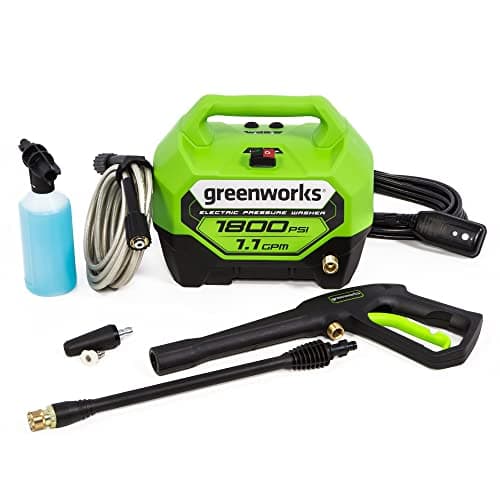
Greenworks GPW1800 1800 PSI Corded Pressure Washer (PWMA Certified)
Greenworks · Corded 120V · Our score 8.5/10
#ad Price as of September 24, 2026. Prices change; we check daily. How we're funded.
The lowest published output of any pressure washer in our registry, and the only one carrying a PWMA certification -- which is what makes the low number trustworthy.
Published specs
| Model / SKU | GPW1800 / 5124102 |
|---|---|
| Max pressure | 1800 PSI |
| Max flow | 1.1 GPM |
| Certification | PWMA Certified |
| Motor | 13 A universal |
| Nozzles | Five: 0, 25, 40 degree, soap and turbo |
| Hose | 25 ft high-pressure |
| Power cord | 35 ft with inline GFCI |
| Wheels | 8 in |
| Max inlet water temperature | 104 F (40 C) |
| Dimensions | 33 in L x 15 in W x 15.75 in H |
| Warranty | 3-year limited tool warranty |
| Weight / soap tank capacity | Not published |
Source: 1800 PSI 1.2 GPM Pressure Washer (Open Frame) PWMA Certified, greenworkstools.com
1800 PSI x 1.1 GPM = 1,980 cleaning units. That is the lowest figure in our registry -- 19% under the Sun Joe SPX3000's 2,436 and a third of the Greenworks 60V's 6,000 at full output. On a driveway that is a shortcoming. On vinyl siding, where the Polymeric Exterior Products Association publishes no safe PSI at all and warns that water forced behind the panels rots the sheathing, the lowest certified output in the class is the one you want.
What the numbers favor
- PWMA Certified, so the 1800 PSI and 1.1 GPM are independently verified rather than marketing maximums
- 1,980 cleaning units -- the gentlest output we hold specs for
- 25 ft hose plus a 35 ft cord gives 60 ft of working radius, the longest here
- Inline GFCI on the cord, published rather than implied
- 8 in wheels roll over a lawn between elevations instead of digging in
- 3-year tool warranty, a year longer than the Sun Joe
- Publishes a maximum inlet water temperature, which most makers omit
What they don't
- 1.1 GPM is the lowest flow here, and rinsing a two-story wall is a flow job
- Ships a turbo nozzle and a 0 degree tip, neither of which belongs anywhere near vinyl
- No published weight, so you cannot judge how it carries around a house
- No published soap tank capacity, which is the specification that matters most on siding
- No published Total Stop System detail
your main job is a concrete driveway or a stripped-paint deck. At 1,980 cleaning units you will be there a long time.
How it scores
Scores are our editorial weighting of the published specs above, not a test result. They are deliberately kept out of this page's structured data.
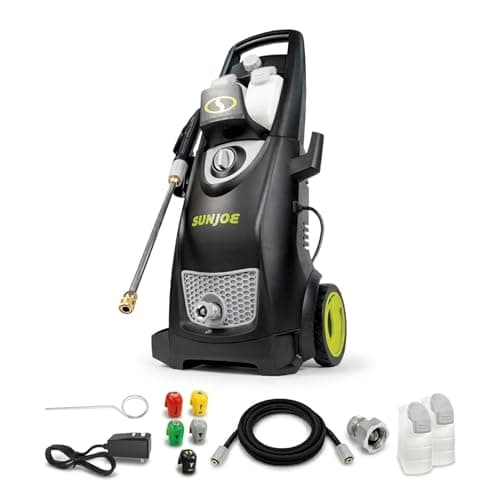
Sun Joe SPX3000 Electric Pressure Washer
Sun Joe · Corded 120V · Our score 7.9/10
#ad Price as of September 24, 2026. Prices change; we check daily. How we're funded.
2030 PSI rated with five nozzles and a 35 ft cord -- and no battery to size, because it does not have one.
Published specs
| Rated pressure | 2030 PSI (max) |
|---|---|
| Rated flow | 1.2 GPM (certified rated) |
| Motor | 13 A |
| Nozzles | 5 quick-connect (0/15/25/40/soap) |
| Detergent tanks | 2 x 0.9 L, removable |
| Hose / cord | 20 ft hose, 35 ft cord |
| Safety | Total Stop System trigger |
| Weight | 24.3 lb |
Source: Sun Joe SPX3000 Electric Pressure Washer, shopjoe.com
What the numbers favor
- Runs indefinitely -- no pack to discharge, no runtime figure to reconcile
- Five nozzles included rather than sold separately
- Two removable detergent tanks
- Total Stop System shuts the pump off between trigger pulls
What they don't
- Corded: a 35 ft cord plus an extension is the real working radius
- Sun Joe lists this model at both 13 A and 14.5 A across variants -- confirm the amperage on the exact SKU before buying
- Not on any battery platform, so it shares nothing with the rest of your yard kit
your working area is beyond easy reach of an outdoor outlet. A cordless washer trades runtime for the ability to walk away from the house.
How it scores
Scores are our editorial weighting of the published specs above, not a test result. They are deliberately kept out of this page's structured data.
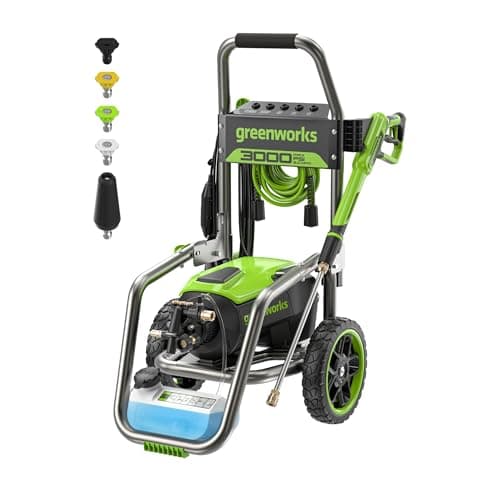
Greenworks 60V 3000 PSI Cordless Pressure Washer
Greenworks · Greenworks 60V · Our score 8.2/10
#ad Price as of September 24, 2026. Prices change; we check daily. How we're funded.
3000 PSI and 2.0 GPM with no cord, and a published Eco mode that trades pressure for the runtime you actually need.
Published specs
| Max pressure | Up to 3000 PSI |
|---|---|
| Max flow | 2.0 GPM |
| Eco mode | 2200 PSI / 1.0 GPM |
| Runtime | Up to 30 min |
| Power | 60V battery (dual-battery kits available) |
Source: 60V 3000-PSI 2.0 GPM Electric Pressure Washer, greenworkstools.com
What the numbers favor
- Highest published pressure of the two washers here, by nearly 1000 PSI
- No cord -- works anywhere on the property
- Eco mode is published with real numbers (2200 PSI / 1.0 GPM), not just a label
- Shares the Greenworks 60V pack with the rest of that platform
What they don't
- 30 minutes of published runtime against a corded washer's unlimited
- Greenworks publishes several 60V washers at different pressures; check the SKU matches the PSI you are paying for
you wash a driveway twice a year within reach of an outlet. You would be buying 60V packs to solve a problem an extension cord already solves.
How it scores
Scores are our editorial weighting of the published specs above, not a test result. They are deliberately kept out of this page's structured data.
Where to buy the tools on this page
Every link below is an Amazon affiliate link. We show no price we have not verified today, so where there is no live figure the link says "check price" and takes you to the listing to read it there.
Gentlest certified output
Greenworks GPW1800 1800 PSI Corded Pressure Washer (PWMA Certified)
Greenworks · Corded 120V
Best corded value
Sun Joe SPX3000 Electric Pressure Washer
Sun Joe · Corded 120V
Best cordless
Greenworks 60V 3000 PSI Cordless Pressure Washer
Greenworks · Greenworks 60V
#ad As an Amazon Associate we earn from qualifying purchases, at no extra cost to you. How we're funded.
Common questions
Is a pressure washer worth buying?
How much more pressure is a pressure washer than a hose?
Can you damage things with a pressure washer?
Should you rent or buy a pressure washer?
Is a cheap pressure washer worth it?
Sources
Read next
- Yard Tools
The tools you buy third and fourth. This is where a platform choice pays off or bites.
- Best pressure washer for a home yard
PSI x GPM is the cleaning-power number. Corded and cordless compared on both.
- PSI, GPM and cleaning units: how to choose a pressure washer
Cleaning units computed for every washer here, plus gallons per charge on the cordless one.
- Which yard tools to rent instead of buying
Frequency, storage and whether you own a tow vehicle. The rent-or-buy test in three questions.
- How to pressure wash a driveway
Nozzle, overlap and runtime arithmetic, plus the CPSC electrical guidance.
- Sun Joe SPX3000 review
A specification review: 2,436 cleaning units, two 0.9 L tanks, and a certified-versus-max PSI discrepancy.