Lawn Care
Soil testing for lawns, step by step
It is the one lawn job that replaces guessing with a number, and extension guidance says to do it every three to five years.
Affiliate disclosure: we earn a commission if you buy through our links, at no extra cost to you. It never changes which product we rank first — here is how we're funded.
We have not tested these units. Every spec on this page comes from the manufacturer's own documentation and is linked to it. Every computed figure is arithmetic you can redo. Prices are checked daily — last verified October 23, 2026. Here is exactly how we pick.
Every fertilizer decision on this site depends on a number nobody has: what is actually in your soil. A soil test is the only way to get it, it costs very little, and extension guidance is specific about how to do it properly.
What the report actually contains
| What is reported | What it tells you | What you do with it |
|---|---|---|
| Soil texture (estimated) | Sand, silt and clay balance | Explains drainage and how often to water |
| pH | Acidity or alkalinity | Drives whether lime is recommended |
| Organic matter, percent | Biological activity and structure | Context for thatch, compaction and drainage |
| Phosphorus | Whether the P in fertilizer is needed at all | Only apply phosphorus if the test indicates a need |
| Potassium | The third number on a fertilizer bag | Informs which analysis to buy |
| Recommendations | Rates and amendments for your result | The part that makes the test worth doing |
From UMN Extension, soil testing for lawns and gardens, fetched 7 September 2026.
How to take the sample
The sampling method matters more than most people expect, because a single scoop from one spot describes one spot rather than a lawn.
- Use a clean plastic bucket. Extension guidance is explicit that metal buckets can contaminate the sample and affect results.
- Take a slice or core 4 inches deep with a soil probe or a garden trowel. Gardens are sampled deeper, at 6 to 8 inches; lawns are 4.
- Repeat at 8 to 10 random locations across the lawn, spread out rather than clustered.
- Mix the cores together thoroughly in the bucket.
- Dry the mixture spread over a tarp or cardboard, removing stones and breaking up clumps.
- Submit about one to two cups in the sample bag or container.
When and how often
| Question | Extension guidance |
|---|---|
| How often | Every three to five years |
| Also when | You are making a change, such as converting lawn to a garden bed |
| Best season | Spring before planting, or fall after harvest |
| Consistency | Test in the same season each time, so results stay comparable |
From UMN Extension. The consistency point matters because biological activity varies through the year.
For a lawn specifically, autumn is the convenient choice, because it lands alongside the window extension guidance gives for core aeration, vertical mowing and seeding — late August through early October. That sequence is in the fall lawn care guide.
The phosphorus question, which is the main event
This is the decision a soil test exists to make, and it is the one where guessing has consequences beyond your own lawn.
- Extension guidance: only apply phosphorus if a soil test indicates a need. Not "probably", not "a balanced feed is fine" — only if the test says so.
- There is a published threshold. UMN states that if soil phosphorus levels are above 25 on the Bray test or 18 on the Olsen test, do not use a phosphorus-containing fertilizer for a few years.
- Many jurisdictions restrict it on established lawns, so a bag with a middle number above zero may not be legal to apply where you are.
- Runoff is why. Phosphorus landing on hard surfaces goes into storm drains, which is also the argument for a spreader with edge control — the Scotts Elite publishes EdgeGuard, which blocks the right side of the spread pattern.
#ad Check the Scotts Elite Spreader price on Amazon — how we're funded.
Acting on the result
| Result | What it typically means | What follows |
|---|---|---|
| pH outside the recommended range | Nutrients present but less available to the plant | The report will recommend lime or another amendment |
| Phosphorus high | No P needed, possibly for years | Buy a zero-middle-number fertilizer |
| Phosphorus low | P genuinely warranted | Follow the report's rate, not a general figure |
| Potassium low | The third bag number matters for you | Choose the analysis accordingly |
| Low organic matter | Structure and biology are limited | Return clippings; mulch leaves in; consider topdressing |
| Heavy clay texture | Drainage and compaction risk | Core aeration is the tool, not a dethatcher |
The right-hand column follows from extension guidance cited across this site; specific rates come from your own report, which is calibrated to your result.
The compaction row is worth expanding, because it is the one people solve with the wrong tool. Core aeration pulls plugs from 2 to 3 inches down — the Agri-Fab 45-0299 publishes up to 3 inches across a 48 inch width — where a dethatcher works the top 0.4 inches and cannot relieve compaction at all. The distinction is in dethatching vs aerating.
#ad Check the Agri-Fab 48" Tow-Behind Plug Aerator (45-0299) price on Amazon — how we're funded.
What we cannot tell you
We cannot interpret your report and we will not publish target pH ranges or nutrient thresholds beyond the phosphorus figures UMN states, because those are regionally calibrated. Your state extension service runs the test, sets the thresholds and writes the recommendations, and that is exactly the service to use.
What is published and portable: what the test reports, a 4 inch sampling depth, 8 to 10 locations, a plastic bucket, one to two cups submitted, every three to five years, in a consistent season.
The products discussed
Specs are the manufacturer's own and linked to the page they came from. Prices come from a live daily check; where we have no verified price we say so rather than print a stale one.
Scotts Elite Spreader
Scotts · Manual (push) · Our score 8.5/10
#ad No verified live price right now, so we show none rather than a stale one. How we're funded.
A 6 ft dual-rotor pattern over 20,000 sq ft, with EdgeGuard to keep product off the sidewalk.
Published specs
| Type | Broadcast (rotary), dual rotor |
|---|---|
| Spread width | 6 ft |
| Coverage per fill | Up to 20,000 sq ft |
| Hopper capacity | 80 lb |
| Edge control | EdgeGuard (blocks right side) |
| Tires | 10 in, foam filled |
Source: Scotts Elite Spreader (75902), scotts.com
5,000 sq ft at a 6 ft spread width needs about 833 linear feet of walking. On a 60 ft run that is roughly 14 passes -- versus 17 passes at a standard 5 ft width. That is the whole practical difference the dual rotor buys.
What the numbers favor
- 6 ft pattern against the 5 ft standard -- about 20% fewer passes
- 80 lb hopper covers 20,000 sq ft without a refill
- EdgeGuard keeps fertilizer off hard surfaces, which is where runoff starts
- Foam-filled tires cannot go flat in the shed over winter
What they don't
- 80 lb loaded is heavy to push on soft or sloped ground
- Broadcast spreaders are harder to control near beds than a drop spreader
your lawn is under about 2,000 sq ft or heavily bordered by beds. A drop spreader puts product exactly where you steer it and nowhere else.
How it scores
Scores are our editorial weighting of the published specs above, not a test result. They are deliberately kept out of this page's structured data.
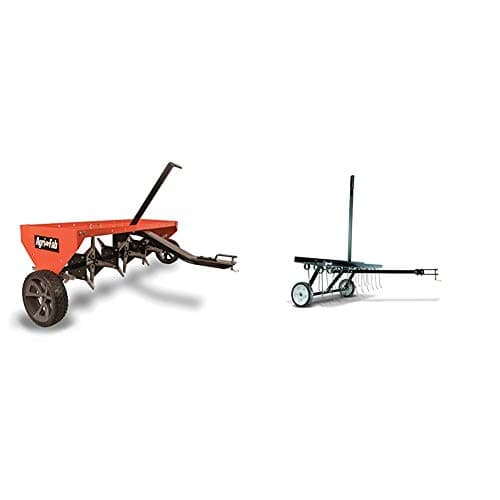
Agri-Fab 48" Tow-Behind Plug Aerator (45-0299)
Agri-Fab · Tow-behind (needs a tractor) · Our score 8.0/10
#ad Price as of October 23, 2026. Prices change; we check daily. How we're funded.
32 galvanized knives pulling 3 in plugs across 48 in -- the only tool here that actually relieves compaction.
Published specs
| Working width | 48 in |
|---|---|
| Knives | 32, galvanized |
| Plug depth | Up to 3 in |
| Weight tray capacity | 175 lb |
| Unit weight | 94 lb |
| Tires | 10 in flat-proof |
Source: 48" Tow Behind Plug Aerator (45-0299), agri-fab.com
10,000 sq ft at a 48 in (4 ft) working width needs 2,500 linear feet. On a 48 ft run that is about 52 passes -- an hour or so behind a tractor, against a full day with a walk-behind core aerator.
What the numbers favor
- Pulls genuine 3 in cores, which is what aeration means
- 48 in width covers ground fast
- 175 lb weight tray lets you force depth in hard soil
- Flat-proof tires
What they don't
- Needs a lawn tractor or riding mower to tow it -- useless on its own
- 94 lb empty is awkward to move and store by hand
you have no tow vehicle. Without a tractor this is a 94 lb ornament; rent a walk-behind core aerator for the weekend instead.
How it scores
Scores are our editorial weighting of the published specs above, not a test result. They are deliberately kept out of this page's structured data.
Where to buy the tools on this page
Amazon affiliate links, except where a product has no Amazon listing — those go direct to the maker and earn us nothing, and the button says so. We show no price we have not verified today, so where there is no live figure the link says "check price" and takes you to the listing to read it there.
Best overall
Scotts Elite Spreader
Scotts · Manual (push)
Best real aeration
Agri-Fab 48" Tow-Behind Plug Aerator (45-0299)
Agri-Fab · Tow-behind (needs a tractor)
#ad As an Amazon Associate we earn from qualifying purchases, at no extra cost to you. How we're funded.
Common questions
What does a soil test tell you?
How do I take a lawn soil sample?
How often should I test my soil?
When is the best time to soil test?
Do I need a soil test before fertilizing?
Why not use a home test kit?
Sources
- Soil testing for lawns and gardens, University of Minnesota Extension
- Lawn & Garden Step-by-Step Soil Sampling Guide, University of Minnesota Extension
- Fertilizing lawns, University of Minnesota Extension
- Scotts Elite Spreader (75902), scotts.com
- Agri-Fab 48" Tow Behind Plug Aerator (45-0299), agri-fab.com
Read next
- Lawn Care
Cutting the grass is a third of the job. This is the other two thirds.
- What the three numbers on a fertilizer bag mean
N-P-K decoded, UMN's published nitrogen rates, and the maths that turns a bag into pounds.
- How to measure your lawn (and why every other decision needs it)
Three methods for an irregular lawn, plus the sq ft to acres conversions everything else needs.
- Cool-season grass types, and how to tell which you have
Published mowing heights, nitrogen rates and tolerances for each cool-season species.
- Best lawn aerator (and why most of them are not aerators)
Core aeration pulls 2-3 inch plugs; dethatchers work at 0.4 inches. Which one you need.
- Fall lawn care, in the order the guidance puts it
Aeration, seeding, weeds and most feeding all land between late August and mid-October.
- Best soil test kit
Two mail-in lab kits on nutrients reported, nitrogen detail, turnaround and recommendations.