Lawn Care
Scotts Turf Builder EdgeGuard DLX review: calibrated, capacious, undocumented
It solves the two things people actually get wrong with a spreader. Then it declines to tell you how wide it throws.
Affiliate disclosure: we earn a commission if you buy through our links, at no extra cost to you. It never changes which product we rank first — here is how we're funded.
We have not tested these units. Every spec on this page comes from the manufacturer's own documentation and is linked to it. Every computed figure is arithmetic you can redo. Prices are checked daily — last verified October 7, 2026. Here is exactly how we pick.
Quick picks
Ranked on the published specs and the arithmetic below. Tap any row to jump to the full write-up. We have not tested these units -- here is exactly how we pick.
| # | Product | Best for | Score | Price |
|---|---|---|---|---|
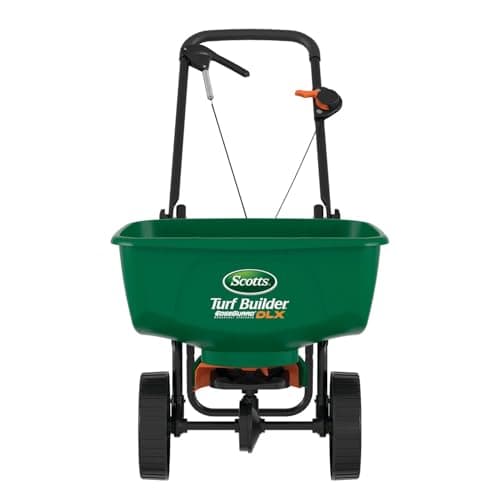
| 1 | Scotts Turf Builder EdgeGuard DLX Broadcast Spreader The only spreader in our registry that arrives calibrated and can block one side of its own pattern -- and the one whose maker publishes no spread width at all. | Best hopper for the money | 8.7 |
#ad Buy links are affiliate links. Prices come from a live daily check; where we have no verified price we say "check price" rather than print a stale one.
Most spreader failures are not spreader failures. They are calibration errors and edge errors — the setting was wrong, or the product went on the driveway. The EdgeGuard DLX is built to remove both of those, and on its published specification it does. What it will not do is tell you how wide it throws, which is the one figure you need to space your passes.
The verdict, first
Everything Scotts publishes
| Specification | What Scotts states |
|---|---|
| SKU | 76232B |
| Type | Broadcast (rotary) spreader |
| Hopper | Holds up to 15,000 sq ft of product |
| EdgeGuard | Blocks the right side of the spread pattern |
| Calibration | Comes fully calibrated and ready to go right out of the box |
| Assembly | None required |
| Wheels | Plastic, open-spoke design |
| Spreads | Fertilizer, grass seed, granular weed / insect / disease controls, ice melt, salt |
| Guarantee | ScottsMiracle-Gro No-Quibble Money Back Guarantee |
| List price | $114.99 |
| Spread width | Not published |
| Weight | Not published |
| Hopper capacity in pounds | Not published |
| Wheel diameter | Not published |
| Mechanical warranty | None -- the guarantee is a refund window |
Every cell transcribed from the Scotts product page for SKU 76232B, cited below. The five "not published" rows are as important as the nine above them: a 5-foot spread width and a 13.33 lb assembled weight circulate widely for this spreader and neither figure appears on any Scotts page we can find, so neither is quoted as a spec here.
What a 15,000 square foot hopper actually weighs
Scotts rates the hopper in area rather than in pounds, which is unusual and, on reflection, sensible: a hopper full of grass seed and a hopper full of ice melt are nothing like the same weight. The catch is that you cannot plan a refill schedule from an area figure, so here is the conversion for the one product Scotts publishes a coverage figure for.
Thirty pounds is a meaningful number for the reader this matters to. If you are buying a spreader because carrying bags is the hard part, a full DLX hopper is most of a bag of fertilizer on wheels — easier than carrying it, and not nothing to start and stop on a slope. The accessibility angle is covered in yard tools for limited grip strength.
EdgeGuard: what it is, and the one thing it is not
A broadcast spreader throws granules in a circle, which means half the circle lands wherever the machine is pointed and the other half lands behind and beside it. Walk a boundary pass along a driveway and you fertilize the driveway. EdgeGuard is a shutter that blocks the right side of the pattern so the boundary pass throws inward only.
- It is a right-side block, which means direction matters. Scotts specifies the right side. Walk the boundary with the hard edge on your left and the shutter does nothing useful. This is a one-line fact that decides whether the feature works for you, and it is the reason to read it before your first pass rather than after.
- It saves product and it saves staining. Iron-containing products — including the Mag-I-Cal Plus acidic amendment, which publishes iron humate among its ingredients — can mark concrete. The cheapest fix is not sweeping; it is not throwing them there.
- It is not a drop spreader. The interior passes still broadcast, and precision around a flower bed in the middle of a lawn is not what this machine is for. Scotts publishes no pattern diagram.
Pre-calibrated, and the limit of that claim
"Comes fully calibrated and ready to go right out of the box" is a real advantage and a bounded one. It means the numbered settings on the dial correspond to the settings printed on Scotts bags. It does not mean the spreader knows the flow rate of a bag from another maker.
Of the five products in our registry you would put through this machine, Scotts prints a setting for its own two and the other three makers each handle it differently. That is the normal state of the category, and our spreader settings guide exists because of it: when a bag gives you a rate per 1,000 sq ft and no Scotts number, the way to resolve it is a measured test pass, not a guess at the dial.
Who it is for, and who should skip it
Buy it if your lawn is between about 2,000 and 15,000 sq ft; you spread more than once a year, because the calibration advantage compounds; you have driveways, paths or beds adjacent to grass, which is what EdgeGuard is for; you also want to spread ice melt in winter, making it a two-season tool; or you mostly buy Scotts products, in which case the pre-calibration is exactly as useful as advertised.
Skip it if your lawn is under about 2,000 sq ft, where a hand-held spreader is quicker and stores smaller. Skip it if you need a published spread width before you buy — some makers publish one, and our spreader roundup ranks on exactly that figure. Skip it if you need a mechanical warranty rather than a refund window. And skip it if your lawn is over 15,000 sq ft and you have a tractor, where a tow-behind is the right machine.
#ad Check the Scotts Turf Builder EdgeGuard DLX Broadcast Spreader price on Amazon — how we're funded.
Where it sits against the rest of the category
On published figures the DLX wins the hopper column outright at 15,000 sq ft and loses the spec-depth column, which is the same trade the Kobalt 80V platform makes on the power-tool side of this site. The comparisons worth reading next:
- Best spreaders — ranked on published spread width, which is the figure this machine will not give you.
- Best spreaders for small lawns — the under-2,000 sq ft answer.
- Best spreaders for the money — the value ranking.
- Best tow-behind spreaders — past 15,000 sq ft.
What we cannot tell you
We have not pushed this spreader. Scotts publishes no spread width, so we cannot tell you how far apart to walk; no weight, so we cannot tell you what it is like to lift into a car; no hopper capacity in pounds, so the 30 lb figure on this page is our conversion through one specific product and holds for nothing else; and no wheel diameter, which is what decides whether a spreader rolls over a root or stops dead. There is no mechanical warranty, only a refund window, so we cannot tell you what Scotts expects the machine's service life to be. We have not verified the 5-foot spread width that circulates for this model and we do not publish it as a spec because Scotts does not. And the pre-calibration claim is one we can only report, not test: whether the dial numbers are accurate for a given bag is exactly the kind of thing that needs a scale and a measured plot, which is work we have not done.
The picks in full
Specs are the manufacturer's own and linked to the page they came from. Prices come from a live daily check; where we have no verified price we say so rather than print a stale one.
Scotts Turf Builder EdgeGuard DLX Broadcast Spreader
Scotts · Push broadcast spreader · Our score 8.7/10
#ad Price as of October 7, 2026. Prices change; we check daily. How we're funded.
The only spreader in our registry that arrives calibrated and can block one side of its own pattern -- and the one whose maker publishes no spread width at all.
Published specs
| SKU | 76232B |
|---|---|
| Type | Broadcast (rotary) spreader |
| Hopper | Holds up to 15,000 sq ft of product |
| EdgeGuard | Blocks the right side of the spread pattern |
| Calibration | Fully calibrated out of the box; no assembly |
| Wheels | Plastic, open-spoke design |
| Spreads | Fertilizer, grass seed, granular weed/insect/disease controls, ice melt, salt |
| Guarantee | ScottsMiracle-Gro No-Quibble Money Back Guarantee |
| Spread width | Not published by Scotts |
| Weight and hopper capacity in pounds | Not published by Scotts |
| Scotts list price | $114.99 |
Source: Scotts Turf Builder EdgeGuard DLX Broadcast Spreader (76232B), scottsmiraclegro.com
Scotts rates the hopper at 15,000 sq ft of product and publishes Halts at 10,000 sq ft per 20.12 lb bag. 15,000 / 10,000 x 20.12 = about 30 lb. Scotts publishes the hopper only in square feet, never in pounds, so this conversion is ours and it holds only for the specific product you are spreading -- grass seed and ice melt have different densities entirely.
What the numbers favor
- Arrives calibrated, which removes the single largest source of error in spreading
- EdgeGuard blocks one side of the pattern, so a bed edge or a driveway does not get fertilized
- The largest published hopper rating of any spreader in our registry at 15,000 sq ft
- Rated for ice melt and salt as well as lawn product, so it works twice a year
- Scotts publishes a list price, which gives the live Amazon figure something to be checked against
What they don't
- Scotts publishes no spread width, so pass spacing has to come from a retailer listing or from walking it
- No published weight and no hopper capacity in pounds
- Plastic open-spoke wheels, and no wheel diameter is published
- The guarantee is a refund window, not a mechanical warranty
your lawn is under about 2,000 sq ft. A 15,000 sq ft hopper on a small lawn is a storage problem, and a hand-held spreader finishes the job faster.
How it scores
Scores are our editorial weighting of the published specs above, not a test result. They are deliberately kept out of this page's structured data.
Where to buy the tools on this page
Every link below is an Amazon affiliate link. We show no price we have not verified today, so where there is no live figure the link says "check price" and takes you to the listing to read it there.
Best hopper for the money
Scotts Turf Builder EdgeGuard DLX Broadcast Spreader
Scotts · Push broadcast spreader
#ad As an Amazon Associate we earn from qualifying purchases, at no extra cost to you. How we're funded.
Common questions
Is the Scotts EdgeGuard DLX spreader worth it?
How much does the Scotts EdgeGuard DLX hold?
What is the spread width of the Scotts EdgeGuard DLX?
What does EdgeGuard actually do?
Do you need to calibrate the Scotts EdgeGuard DLX?
Can the Scotts EdgeGuard DLX spread ice melt?
Sources
Read next
- Lawn Care
Cutting the grass is a third of the job. This is the other two thirds.
- Best lawn spreader for fertilizer and seed
Spread width decides how long the job takes. The passes-per-lawn math, worked out.
- Spreader settings: how to calibrate instead of guessing
Calibrate a spreader by weight in twenty minutes, with the passes and rate arithmetic.
- Best fertilizer spreader for the money
Spread width and hopper capacity converted into passes and refills, which is what a spreader actually saves you.
- Best lawn fertilizer
Analysis and coverage converted to pounds of nitrogen per 1,000 sq ft, against the Extension limit.
- Best crabgrass preventer, by what it actually asks of you
Published application rates, active ingredients and the one product with a post-emergence window -- plus why most lawns should not buy any of them.
- Best lawn lime, and the one product that goes the other way
Published rates by measured pH, 3.6 against 12 lb per 1,000 sq ft, and the only published time to effect in the category.