Lawn Care
Best lawn lime, and the one product that goes the other way
Three bags, two directions. Guess which way your soil needs to move and you have a coin-flip chance of making it worse.
Affiliate disclosure: we earn a commission if you buy through our links, at no extra cost to you. It never changes which product we rank first — here is how we're funded.
We have not tested these units. Every spec on this page comes from the manufacturer's own documentation and is linked to it. Every computed figure is arithmetic you can redo. Prices are checked daily — last verified October 7, 2026. Here is exactly how we pick.
Quick picks
Ranked on the published specs and the arithmetic below. Tap any row to jump to the full write-up. We have not tested these units -- here is exactly how we pick.
| # | Product | Best for | Score | Price |
|---|---|---|---|---|
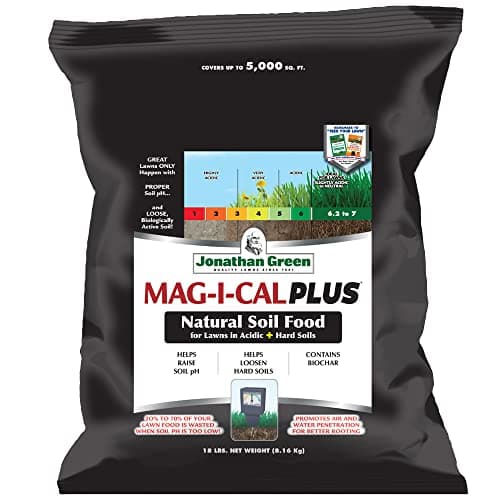
| 1 | Jonathan Green Mag-I-Cal Plus for Lawns in Acidic & Hard Soil, 18 lb The only product here whose application frequency is published as a function of your measured pH -- which is the correct way to sell a soil amendment. | Best for a soil test under 6.7 | 8.5 | |
| 2 | 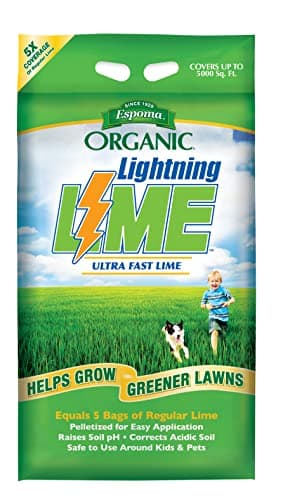 Espoma Organic Lightning Lime, 30 lb The only pH product here that tells you how long it takes -- 6 to 8 weeks -- and the only one approved for organic gardening. | Best published time to effect | 8.0 | |
| 3 | 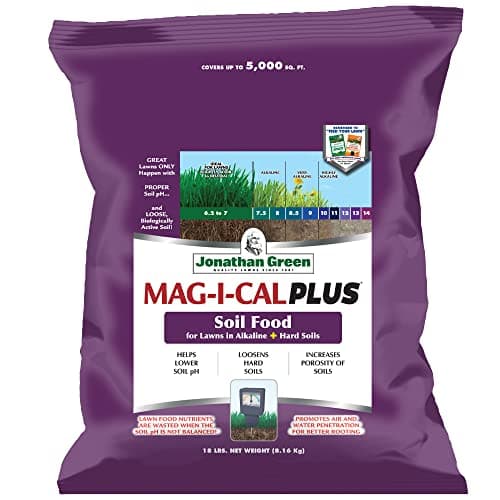 Jonathan Green Mag-I-Cal Plus for Lawns in Alkaline & Hard Soil, 18 lb The product almost nobody stocks: a lawn amendment that lowers pH, published with the same rate-by-pH table as its opposite number. | Best for a soil test over 7.0 | 8.3 |
#ad Buy links are affiliate links. Prices come from a live daily check; where we have no verified price we say "check price" rather than print a stale one.
This is the one product category on the site where buying the wrong bag does not simply waste money — it moves your soil in the wrong direction. Two of the three products here raise pH and one lowers it. Two of them come from the same maker, in near-identical packaging, with identical published application rates and completely opposite chemistry. The soil test is not a nice-to-have on this page. It is the page.
The short answer
Do this before you read the rest of the page
- Test the soil. A lab or mail-in test returns a pH figure and usually a lime recommendation with it. Our soil test kit roundup ranks the kits on what each one actually reports, and the soil testing guide covers how to take a sample that means anything.
- Read the pH, not the color. You need a number, because every rate on this page is banded: 5.9 and below, 5.9 to 6.7, 7.0 to 7.5, above 7.5. "Slightly acidic" is not a band.
- Then pick a direction. Below 6.7, raise it. Above 7.0, lower it. Between 6.7 and 7.0 is where most grasses are happy and no product on this page has a published rate for you — which is the makers' way of saying do nothing.
The three, on published figures
| Product | Direction | Rate per 1,000 sq ft (established) | Coverage | Frequency guidance | Published time to effect |
|---|---|---|---|---|---|
| JG Mag-I-Cal Plus, Acidic & Hard Soil | Raises pH | 3.6 lb (7.2 lb new lawn) | 18 lb covers 5,000 sq ft; 54 lb covers 15,000 | Once/yr at pH 5.9-6.7; twice/yr at 5.9 or below | Not published |
| Espoma Lightning Lime | Raises pH | 12 lb to raise, 6 lb to maintain | 30 lb covers up to 5,000 sq ft | Not tied to a measured pH | 6 to 8 weeks |
| JG Mag-I-Cal Plus, Alkaline & Hard Soil | Lowers pH | 3.6 lb (7.2 lb new lawn) | 18 lb covers 5,000 sq ft; 54 lb covers 15,000 | Once/yr at pH 7.0-7.5; twice/yr above 7.5 | Not published |
Directions, rates, coverage figures, pH bands and the 6-to-8-week claim transcribed from the makers' own product pages, all three cited below. Neither maker publishes a calcium percentage or a calcium carbonate equivalent for any of the three products, which is why the rate differences on this page cannot be traced to chemistry.
Why one product asks for 3.3 times the other
Both Jonathan Green's acidic bag and Espoma's Lightning Lime raise pH, and their published rates for doing it differ by more than three times. We cannot explain the gap from published figures, and that is worth saying out loud rather than papering over.
A quarter acre of grass is about 10,890 sq ft, which turns those rates into roughly 39 lb, 131 lb and 653 lb respectively. The last figure is why lime has a reputation as the heaviest job in lawn care, and why both products on this page that beat it make a point of saying so.
1. JG Mag-I-Cal Plus, Acidic & Hard Soil — for a test under 6.7
Jonathan Green publishes an 18 lb bag covering up to 5,000 sq ft on an established lawn or 2,500 on a new one, a 54 lb bag at 15,000 sq ft, 3.6 lb per 1,000 sq ft existing and 7.2 new, once-a-year application from pH 5.9 to 6.7 and twice a year at 5.9 or below at least a month apart, derivation from calcium sulfate dihydrate (gypsum), calcium carbonate, iron humate and soy protein hydrolysate, calcium, sulfur and iron as the nutrients, biochar in the mix, and a soil-loosening claim for hard, compacted ground.
Who it is for: anyone holding a soil test under 6.7, which across most of the eastern United States is most people. The rate-by-pH table is the reason it leads this page: it is the only product here that treats your measurement as an input rather than decoration, and at 3.6 lb per 1,000 sq ft it is the lightest job in the category.
Who should skip it: anyone above pH 7.0, who needs the alkaline version instead; and anyone who wants to know how long the wait is, because Jonathan Green publishes no time to effect for either version.
#ad Check the Jonathan Green Mag-I-Cal Plus for Lawns in Acidic & Hard Soil, 18 lb price on Amazon — how we're funded.
2. Espoma Lightning Lime — the only published timeline
Espoma publishes a 30 lb bag covering up to 5,000 sq ft, pH adjustment in 6 to 8 weeks, 5x the coverage of regular pelletized limestone, 6 lb per 1,000 sq ft to maintain pH and 12 to raise it, rates for vegetables (30 lb per 1,000 sq ft), tomatoes, trees and shrubs, application in spring, summer or fall anytime the ground is not frozen, and approval for organic gardening.
Who it is for: the reader who wants a date to re-test against, and anyone applying to beds and vegetables as well as grass — it is the only product here with published rates beyond turf. The organic approval matters if that is a constraint you are working under, and the maintenance rate at half the raising rate is a genuinely useful distinction nobody else draws.
Who should skip it: anyone with a large lawn and a steep pH deficit, where 12 lb per 1,000 sq ft becomes a lot of bags; and anyone above pH 7.0, since Espoma has no alkaline-soil counterpart.
#ad Check the Espoma Organic Lightning Lime, 30 lb price on Amazon — how we're funded.
3. JG Mag-I-Cal Plus, Alkaline & Hard Soil — for a test over 7.0
The alkaline version publishes the same 18 lb and 54 lb sizes, the same 5,000 and 15,000 sq ft coverage and the same 3.6 and 7.2 lb rates as its acidic twin — then diverges completely: it lowers pH, is derived from calcium sulfate dihydrate (gypsum), ammonium sulfate and sulfuric acid plus humic acid and polyhydroxycarboxylic acids, is applied once a year from pH 7.0 to 7.5 and twice above 7.5, and requires air temperatures of at least 45 F.
Who it is for: readers in the arid and alkaline-soil West and anyone whose test came back above 7.0 — a group that walks into a garden center, finds four kinds of lime and nothing that goes the other way. This is the product for that problem, and it is the only one in our registry.
Who should skip it: everyone below pH 7.0, emphatically. On acidic soil this bag makes the measured problem worse. It also publishes no handling or re-entry statement despite listing sulfuric acid among its ingredients, which is a documentation gap worth knowing before the bag is open.
#ad Check the Jonathan Green Mag-I-Cal Plus for Lawns in Alkaline & Hard Soil, 18 lb price on Amazon — how we're funded.
Who should not buy any of these
- Anyone without a soil test. Said three times on this page on purpose. One of these three products does the opposite of the other two.
- Anyone whose test came back between 6.7 and 7.0. No product here publishes a rate for that band, which is the makers' own way of telling you to spend the money on fertilizer or seed instead.
- Anyone treating a symptom. Moss, thin turf and weeds all have non-pH causes that are cheaper to fix — moss and shady lawns and weed control basics cover them.
- Anyone without a spreader. At 3.6 lb per 1,000 sq ft an uneven pass is a pH stripe you will be looking at next season. See spreader settings.
What we cannot tell you
Whether any of these will move your soil, and by how much. Not one of the three publishes a calcium percentage or a calcium carbonate equivalent, which is the figure that would make the 3.6-against-12 rate gap explicable and would let you predict a pH shift at all. Neither Jonathan Green product publishes a time to effect, so the only timeline in this category is Espoma's 6 to 8 weeks and we cannot check it. Espoma's 5x-coverage claim is made against "regular pelletized limestone", which is not a specified product, so the 60 lb figure derived from it on this page is arithmetic on an unspecified baseline. We have applied none of these products and measured no pH. And soil pH responds to your soil's buffering capacity, which varies with clay and organic matter content and which no product page here mentions — it is why a lab recommendation beats any rate on this page, including the ones we have ranked.
The picks in full
Specs are the manufacturer's own and linked to the page they came from. Prices come from a live daily check; where we have no verified price we say so rather than print a stale one.
Jonathan Green Mag-I-Cal Plus for Lawns in Acidic & Hard Soil, 18 lb
Jonathan Green · Soil amendment (raises pH) · Our score 8.5/10
#ad Price as of October 7, 2026. Prices change; we check daily. How we're funded.
The only product here whose application frequency is published as a function of your measured pH -- which is the correct way to sell a soil amendment.
Published specs
| Direction | Raises soil pH |
|---|---|
| Coverage, 18 lb bag | Up to 5,000 sq ft established, or 2,500 sq ft new |
| Coverage, 54 lb bag | Up to 15,000 sq ft established |
| Rate, existing lawn | 3.6 lb per 1,000 sq ft |
| Rate, new lawn | 7.2 lb per 1,000 sq ft |
| Frequency at pH 5.9-6.7 | Once per year |
| Frequency at pH 5.9 or below | Twice per year, at least one month apart |
| Derived from | Calcium sulfate dihydrate (gypsum), calcium carbonate, iron humate, soy protein hydrolysate |
| Also published | Contains biochar; helps loosen hard soils |
| Nutrients named | Calcium, sulfur and iron |
| Calcium percentage | Not published on the product page |
Source: Mag-I-Cal Plus for Lawns in Acidic & Hard Soil, jonathangreen.com
Jonathan Green publishes 3.6 lb per 1,000 sq ft to shift pH on an established lawn. Espoma publishes 12 lb per 1,000 sq ft to raise pH. That is 3.33x the material for the same stated direction of travel, from two makers' own published rates. Neither publishes a calcium percentage, so the difference cannot be traced to the chemistry -- only to the instruction.
What the numbers favor
- Application frequency is published as a function of measured pH, so a soil test result maps straight onto a rate
- Publishes separate rates for an existing lawn and a new one
- The lowest application rate of any pH product here at 3.6 lb per 1,000 sq ft
- Names three nutrients and a four-item derived-from list
- Publishes a biochar and soil-loosening claim separately from the pH claim
What they don't
- No calcium percentage and no calcium carbonate equivalent, so the pH shift cannot be computed
- No stated time to effect -- Espoma publishes 6 to 8 weeks and this does not
- The 18 lb bag covers only 2,500 sq ft on a new lawn, half its established-lawn figure
- Useless, and possibly harmful, without a soil test first
you have not tested your soil. Every figure on this product is conditional on a pH number you do not have yet, and the alkaline version of the same product does the exact opposite -- guessing has a 50% chance of making the problem worse.
How it scores
Scores are our editorial weighting of the published specs above, not a test result. They are deliberately kept out of this page's structured data.
Espoma Organic Lightning Lime, 30 lb
Espoma · Soil amendment (raises pH) · Our score 8.0/10
#ad Price as of October 7, 2026. Prices change; we check daily. How we're funded.
The only pH product here that tells you how long it takes -- 6 to 8 weeks -- and the only one approved for organic gardening.
Published specs
| Direction | Raises soil pH |
|---|---|
| Bag and coverage | 30 lb covers up to 5,000 sq ft |
| Time to effect | Adjusts pH fast, in 6 to 8 weeks |
| Coverage claim | 5x the coverage of regular pelletized limestone |
| Rate to maintain pH | 6 lb per 1,000 sq ft |
| Rate to raise pH | 12 lb per 1,000 sq ft |
| Vegetable garden rate | 30 lb per 1,000 sq ft |
| Trees | 5 cups per inch of trunk diameter |
| Certification | Approved for Organic Gardening |
| Application timing | Spring, summer or fall -- anytime the ground is not frozen |
| Calcium percentage | Not published on the product page |
Source: Lightning Lime, fast acting pelletized lime, espoma.com
Espoma's raise-pH rate is 12 lb per 1,000 sq ft and it claims 5x the coverage of regular pelletized limestone. 12 x 5 = 60 lb per 1,000 sq ft for the ordinary product doing the same job -- which is why a lime application on a quarter acre is normally measured in bags rather than scoops. We cannot verify the 5x factor: Espoma publishes no calcium carbonate equivalent for its own product and none for the comparison.
What the numbers favor
- Publishes a time to effect (6 to 8 weeks) -- the only pH product here that does
- Approved for Organic Gardening, published on the product page
- Publishes separate rates to maintain pH and to raise it, plus rates for vegetables, trees and shrubs
- The widest application window of the three: anytime the ground is not frozen
- One 30 lb bag covers 5,000 sq ft at the maintenance rate
What they don't
- 12 lb per 1,000 sq ft to raise pH is 3.3x the Jonathan Green rate for the same direction
- No calcium percentage and no calcium carbonate equivalent, so the 5x claim cannot be checked
- No frequency guidance tied to a measured pH, which both Jonathan Green products publish
- Raises pH only -- there is no Espoma counterpart for alkaline soil
your soil test came back above 7.0. This raises pH and has no alkaline-soil sibling; the Jonathan Green alkaline product is the one that goes the other way.
How it scores
Scores are our editorial weighting of the published specs above, not a test result. They are deliberately kept out of this page's structured data.
Jonathan Green Mag-I-Cal Plus for Lawns in Alkaline & Hard Soil, 18 lb
Jonathan Green · Soil amendment (lowers pH) · Our score 8.3/10
#ad Price as of October 7, 2026. Prices change; we check daily. How we're funded.
The product almost nobody stocks: a lawn amendment that lowers pH, published with the same rate-by-pH table as its opposite number.
Published specs
| Direction | Lowers soil pH |
|---|---|
| Coverage, 18 lb bag | Up to 5,000 sq ft established, or 2,500 sq ft new |
| Coverage, 54 lb bag | Up to 15,000 sq ft established, or 7,500 sq ft new |
| Rate, existing lawn | 3.6 lb per 1,000 sq ft |
| Rate, new lawn | 7.2 lb per 1,000 sq ft |
| Frequency at pH 7.0-7.5 | Once per year |
| Frequency above pH 7.5 | Twice per year, at least one month apart |
| Derived from | Calcium sulfate dihydrate (gypsum), ammonium sulfate, sulfuric acid, humic acid, polyhydroxycarboxylic acids |
| Application temperature | Spring, summer or fall, when air temperatures are at least 45 F |
| Biochar | Not published for this version |
Source: Mag-I-Cal Plus for Lawns in Alkaline & Hard Soil, jonathangreen.com
Both versions publish 3.6 lb per 1,000 sq ft on an established lawn, 7.2 on a new one, 5,000 sq ft per 18 lb bag and the same twice-a-year escalation one pH band out. The ingredient lists then diverge completely: the acidic version carries calcium carbonate and iron humate, this one carries ammonium sulfate and sulfuric acid. Identical packaging, identical rates, opposite effect -- which is exactly why a soil test is not optional.
What the numbers favor
- Addresses high-pH soil at all, which most lawn-lime shelves simply do not
- Same published rate-by-pH structure as the acidic version, so the two are directly comparable
- Publishes a minimum application temperature of 45 F, which neither other product here does
- A five-item derived-from list
- Publishes a new-lawn rate as well as an established-lawn one
What they don't
- No published sulfur percentage or acidifying equivalent, so the pH shift cannot be computed
- No stated time to effect
- Easily confused with the acidic version on a shelf -- the packaging and the rates are the same
- Contains sulfuric acid and ammonium sulfate, and the page publishes no handling or re-entry statement
your soil test came back below 7.0. This product pushes pH down; on already-acidic soil it makes the problem worse, and the acidic version of the same product is the one you want.
How it scores
Scores are our editorial weighting of the published specs above, not a test result. They are deliberately kept out of this page's structured data.
Where to buy the tools on this page
Every link below is an Amazon affiliate link. We show no price we have not verified today, so where there is no live figure the link says "check price" and takes you to the listing to read it there.
Best for a soil test under 6.7
Jonathan Green Mag-I-Cal Plus for Lawns in Acidic & Hard Soil, 18 lb
Jonathan Green · Soil amendment (raises pH)
Best published time to effect
Espoma Organic Lightning Lime, 30 lb
Espoma · Soil amendment (raises pH)
Best for a soil test over 7.0
Jonathan Green Mag-I-Cal Plus for Lawns in Alkaline & Hard Soil, 18 lb
Jonathan Green · Soil amendment (lowers pH)
#ad As an Amazon Associate we earn from qualifying purchases, at no extra cost to you. How we're funded.
Common questions
What is the best lime for a lawn?
How do I know if my lawn needs lime?
How much lime does a lawn need?
How long does lime take to work?
What do you use if your soil pH is too high?
Can you apply lime and fertilizer at the same time?
Sources
Read next
- Lawn Care
Cutting the grass is a third of the job. This is the other two thirds.
- Soil testing for lawns, step by step
4 inches deep, 8 to 10 locations, every three to five years. What the report tells you.
- Best soil test kit
Two mail-in lab kits on nutrients reported, nitrogen detail, turnaround and recommendations.
- Best lawn fertilizer
Analysis and coverage converted to pounds of nitrogen per 1,000 sq ft, against the Extension limit.
- What the three numbers on a fertilizer bag mean
N-P-K decoded, UMN's published nitrogen rates, and the maths that turns a bag into pounds.
- Spreader settings: how to calibrate instead of guessing
Calibrate a spreader by weight in twenty minutes, with the passes and rate arithmetic.
- Scotts Turf Builder EdgeGuard DLX review: calibrated, capacious, undocumented
Everything Scotts publishes about its best-selling spreader, the three figures it does not, and what a 15,000 sq ft hopper weighs when full.