Lawn Care
Best grub control, starting with whether you need any
Dig one square foot and count. Under five grubs and the right purchase on this page is nothing at all.
Affiliate disclosure: we earn a commission if you buy through our links, at no extra cost to you. It never changes which product we rank first — here is how we're funded.
We have not tested these units. Every spec on this page comes from the manufacturer's own documentation and is linked to it. Every computed figure is arithmetic you can redo. Prices are checked daily — last verified October 7, 2026. Here is exactly how we pick.
Quick picks
Ranked on the published specs and the arithmetic below. Tap any row to jump to the full write-up. We have not tested these units -- here is exactly how we pick.
| # | Product | Best for | Score | Price |
|---|---|---|---|---|
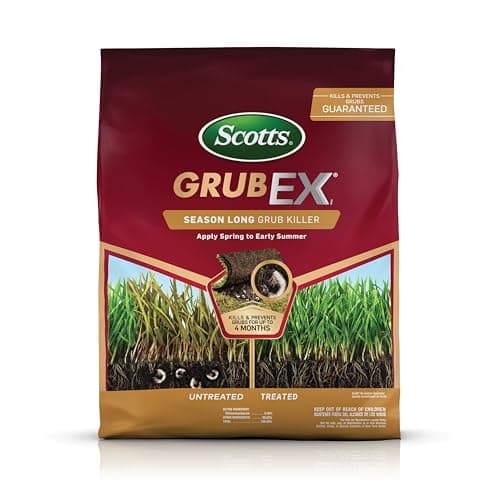
| 1 | Scotts GrubEx1 Season Long Grub Killer Chlorantraniliprole, a named pest list running to a dozen species, a stated watering instruction and a re-entry statement -- the most complete label disclosure of any lawn product in our registry. | Best documented | 8.8 | |
| 2 | 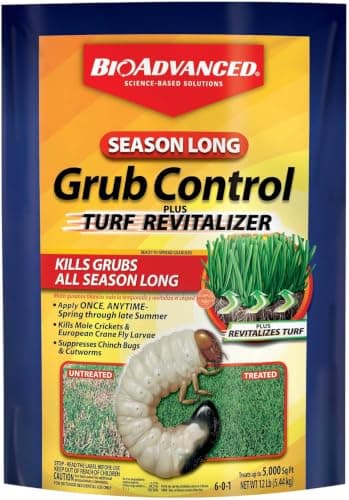 BioAdvanced Season Long Grub Control Plus Turf Revitalizer, 12 lb The only one of the two you can still apply in late summer -- and the one whose own coverage figure is half what the Amazon listing claims. | Best application window | 7.0 |
#ad Buy links are affiliate links. Prices come from a live daily check; where we have no verified price we say "check price" rather than print a stale one.
Grub control is the lawn product most often bought on a hunch, and a hunch is a bad basis because the symptom — a brown patch that lifts like carpet — has at least four other common causes. So this page starts with a count rather than a product, and for a good many readers it ends there too.
The short answer
The count, and the four things grubs get blamed for
Grub damage looks like irregular brown patches in late summer whose turf lifts freely because the roots have been eaten. That is a specific description and it is also what drought stress, dog urine, fungal disease and a thick thatch layer all look like from a standing position.
- Pick the edge of a damaged patch, not the middle. The middle is already dead and the grubs have moved on. The margin is where they are feeding now.
- Cut three sides of a one-foot square with a spade and roll it back. Go down about two to three inches — grubs feed in the root zone, not deep soil.
- Count the white C-shaped larvae. Published extension thresholds for a healthy, well-rooted lawn generally fall around five to ten per square foot. A vigorous lawn tolerates more than a thin one.
- Roll the turf back and water it. It will knit back down within a week or two if you keep it damp.
- Repeat in two or three places. One sample is an anecdote. Grub populations are patchy by nature.
If your count comes in low, the money is better spent on the things that make a lawn tolerate grubs instead: cutting higher, watering deeply and less often, and feeding to build root mass. A deep-rooted lawn survives a population that would flatten a shallow one.
The two, on published figures
| Product | Active ingredient | Coverage | Rate per 1,000 sq ft | Application window | Watering in / re-entry |
|---|---|---|---|---|---|
| Scotts GrubEx1 | Chlorantraniliprole (percentage not published) | 14.35 lb covers 5,000 sq ft; 28.7 lb covers 10,000 | About 2.87 lb | Once a year, spring or early summer | 20-minute soak; family and pets once watered in and dry |
| BioAdvanced Season Long Grub Control Plus Turf Revitalizer | Not published on the product page | BioAdvanced: 12 lb covers 5,000 sq ft, 24 lb covers 10,000. Amazon listing: 10,000 for the 12 lb bag | 2.4 lb on the maker's figure; 1.2 lb on the listing's | Anytime, spring through late summer | Neither published |
Active ingredients, coverage figures, windows and the watering and re-entry statements transcribed from each maker's own page, both cited below. Both rate columns are our division of the published coverage by area. The BioAdvanced row carries two coverage figures because the maker's own page and the Amazon listing disagree by a factor of two, and we cannot reconcile them.
Two products, same shelf, same job, and the second one has four cells where the first has a published figure. That asymmetry is the ranking.
The coverage figure that disagrees with itself
This is worth its own section because it changes what you buy, not just what you read.
For comparison, Scotts' two bag sizes return exactly 2.87 lb per 1,000 sq ft each. Internal consistency across bag sizes is a small thing that tells you a lot, and it is the reason GrubEx1 leads this page.
1. Scotts GrubEx1 — the documented one
Scotts publishes chlorantraniliprole as the active ingredient, one 14.35 lb bag covering 5,000 sq ft and one 28.7 lb bag covering 10,000, application once a year in spring or early summer to prevent grub damage, up to four months of control from a single application, a grub list running to Japanese beetle, Asiatic garden beetle, black turfgrass ataenius, Aphodius spp., European chafer, green June beetle, May/June beetle and northern masked chafer larvae, plus armyworms, cutworms, sod webworms, billbug grubs and crane fly larvae, suppression of chinch bugs, a 20-minute soak to water it in, re-entry for family and pets once watered in and dry, and the ScottsMiracle-Gro No-Quibble Guarantee.
Who it is for: anyone whose count came in over the threshold and who is treating in spring or early summer. Three of those published items are unusual enough to name again: twelve pest species rather than a category, a watering instruction with an actual duration, and a re-entry condition in plain language. On a product you spread across ground children and dogs use, the last one is the whole purchase.
Who should skip it: anyone past early summer, because that is the window Scotts publishes; and anyone who needs a grass-type compatibility list, which Scotts does not provide.
#ad Check the Scotts GrubEx1 Season Long Grub Killer price on Amazon — how we're funded.
2. BioAdvanced Season Long Grub Control — the later window
BioAdvanced publishes a 12 lb bag treating up to 5,000 sq ft and a 24 lb bag up to 10,000, application anytime from spring through late summer, a season-long protective zone that kills grubs before they do damage, control of mole crickets and European crane fly larvae, and a separate claim that it increases turf root mass for thicker, stronger turf. It does not publish an active-ingredient percentage, a watering-in instruction, a re-entry statement or a guarantee on the page we cite.
Who it is for: the reader who got to this in August. That is a real situation and this is the real answer to it — a later window than Scotts publishes is genuinely useful and nothing else in the category offers it. The root-mass claim is published separately from the pest claim rather than folded into it, which is the honest way to make two different claims.
Who should skip it: anyone who wants a re-entry statement before treating a lawn that children or pets use. BioAdvanced does not publish one and Scotts does, and that single absence is the clearest reason to pick the other bag. Skip it too if the coverage ambiguity bothers you — it should, and buying on the maker's 5,000 sq ft figure is the way to be safe.
#ad Check the BioAdvanced Season Long Grub Control Plus Turf Revitalizer, 12 lb price on Amazon — how we're funded.
Getting it on the lawn evenly
Every rate on this page assumes even distribution, and a granular insecticide applied by hand produces bands of overdose next to bands of nothing. Both of these go down through a broadcast spreader.
- Use a spreader, and know your spread width. Our EdgeGuard DLX review covers the calibration question, and spreader settings covers what to do when a bag gives a rate per 1,000 sq ft and no dial number.
- Keep it off hard surfaces. Granules on a driveway wash into a storm drain rather than into your soil. This is what the EdgeGuard shutter is for, and it is also simply the right thing to do with a registered insecticide.
- Water in, if your bag says to. Scotts specifies a 20-minute soak; the product does nothing sitting on top of the turf. BioAdvanced publishes no instruction, which means reading the bag label rather than assuming either way.
- Do not combine it with other applications on a hunch. Neither maker publishes a tank-mix or co-application statement, and neither of these is a fertilizer even where it claims a turf benefit. The season plan is in the lawn care schedule.
Who should not buy either of these
- Anyone who has not counted. Stated again because it is the whole point of the page. Brown patches have four other common causes and only one of them is sold a cure in a bag.
- Anyone whose count came in low. A healthy, deep-rooted lawn tolerates a grub population that would wreck a thin one, and the money that builds those roots is better spent on fertilizer, aeration or a higher cut.
- Anyone looking at active late-season damage. Both of these are preventive. The job in front of you is turf repair — how to overseed and fertilizer for new grass — and the preventive application belongs in next year's calendar.
- Anyone treating a whole lawn for a patch. Grub populations are patchy. Spot-treating the area that failed the count, plus a margin, costs a fraction of a whole-lawn application.
- Anyone overseeding this autumn. That is already a crowded calendar — see crabgrass preventers for the same conflict in the other direction.
What we cannot tell you
Whether either of these will work on your lawn. We have not applied either product and have measured no result. Neither maker publishes a treatment threshold, so the five-to-ten count in this page's short answer is general extension guidance rather than a figure either company stands behind or that we have tied to a specific trial — check your own state extension service, whose number will be local and better. Scotts publishes no active-ingredient percentage and BioAdvanced publishes no active ingredient at all on the page we cite, so for neither product can we tell you how much chemistry reaches the root zone. BioAdvanced publishes no watering-in instruction, no re-entry statement and no guarantee, and its own coverage figure is half what the Amazon listing claims. Neither maker publishes a pollinator statement or any guidance on application near flowering plants, which for a soil-applied insecticide is a real gap. Neither publishes a grass-type compatibility list. And nothing on either page tells you what proportion of a population a single application actually suppresses, which is the figure that would let you decide whether treating was worth it.
The picks in full
Specs are the manufacturer's own and linked to the page they came from. Prices come from a live daily check; where we have no verified price we say so rather than print a stale one.
Scotts GrubEx1 Season Long Grub Killer
Scotts · Granular insecticide · Our score 8.8/10
#ad Price as of October 7, 2026. Prices change; we check daily. How we're funded.
Chlorantraniliprole, a named pest list running to a dozen species, a stated watering instruction and a re-entry statement -- the most complete label disclosure of any lawn product in our registry.
Published specs
| Active ingredient | Chlorantraniliprole (percentage not published) |
|---|---|
| Coverage | 14.35 lb bag covers 5,000 sq ft; 28.7 lb bag covers 10,000 sq ft |
| Application timing | Once a year, in spring or early summer, to prevent damage |
| Duration | Up to 4 months from a single application |
| Grubs killed | Japanese beetle, Asiatic garden beetle, black turfgrass ataenius, Aphodius spp., European chafer, green June beetle, May/June beetle, northern masked chafer |
| Also kills | Armyworms, cutworms, sod webworms, billbug grubs, crane fly larvae |
| Suppresses | Chinch bugs |
| Watering in | "A good 20-minute soak should do the trick" |
| Re-entry | Once watered in and the lawn is dry, family and pets can use it |
| Grass types | Not specified |
| Guarantee | ScottsMiracle-Gro No-Quibble Guarantee |
Source: Scotts GrubEx1 Season Long Grub Killer, scottsmiraclegro.com
14.35 lb over 5,000 sq ft = 2.87 lb per 1,000 sq ft, and the 28.7 lb bag over 10,000 sq ft gives exactly the same figure -- the two bag sizes corroborate each other, which is rare. Scotts publishes the coverage, not the rate, so the rate is our division.
What the numbers favor
- Names twelve pest species rather than saying "grubs" and stopping
- Both published bag sizes return the same application rate, so the figures are internally consistent
- States a watering instruction with a time (a 20-minute soak), which almost no lawn product does
- Publishes a re-entry condition for family and pets in plain language
- One application a year rather than two
What they don't
- No active-ingredient percentage, so the rate cannot be checked against the label
- No grass-type list, so compatibility has to come off the bag
- Preventive only -- it is applied before damage, not in response to it
- No published statement on pollinators or on application near flowering plants
you have not seen grub damage and have not pulled up a square foot of turf to count. This is a preventive treated-once-a-year product; applying it on suspicion is the most common way to spend money on a lawn that did not need it.
How it scores
Scores are our editorial weighting of the published specs above, not a test result. They are deliberately kept out of this page's structured data.
BioAdvanced Season Long Grub Control Plus Turf Revitalizer, 12 lb
BioAdvanced · Granular insecticide · Our score 7.0/10
#ad Price as of October 7, 2026. Prices change; we check daily. How we're funded.
The only one of the two you can still apply in late summer -- and the one whose own coverage figure is half what the Amazon listing claims.
Published specs
| Coverage (BioAdvanced's own figure) | 12 lb treats up to 5,000 sq ft; 24 lb treats up to 10,000 sq ft |
|---|---|
| Coverage (Amazon listing title) | 10,000 sq ft for the 12 lb bag -- double the maker's figure |
| Application window | Anytime, spring through late summer |
| Mechanism as published | Creates a season-long protective zone to kill grubs before they do damage |
| Also kills | Mole crickets and European crane fly larvae |
| Second claim | Increases turf root mass for thicker, stronger turf |
| Active ingredient percentage | Not published on the product page |
| Watering in | Not published on the product page |
| Re-entry | Not published on the product page |
| Guarantee | Not published on the product page |
Source: Season Long Grub Control Plus Turf Revitalizer, bioadvanced.com
On BioAdvanced's own 5,000 sq ft figure: 12 / 5 = 2.4 lb per 1,000 sq ft. On the Amazon listing's 10,000 sq ft: 12 / 10 = 1.2 lb. One of those is wrong by a factor of two and we cannot tell you which, so we use the maker's. Buy on the maker's figure and you will have enough; buy on the listing's and you may be half short. The 24 lb bag at 10,000 sq ft returns 2.4 lb per 1,000 and corroborates the maker.
What the numbers favor
- Applies anytime from spring through late summer, where the Scotts product is spring to early summer only
- Names mole crickets and European crane fly larvae specifically
- Publishes a second, separate claim about root mass rather than folding it into the pest claim
- The 24 lb bag's coverage corroborates the maker's rate, so the maker's figure is the defensible one
What they don't
- BioAdvanced's own coverage figure is half the Amazon listing's, and we cannot reconcile them
- No active-ingredient percentage on the product page
- No watering-in instruction and no re-entry statement published, where Scotts publishes both
- No guarantee stated
- The pest list is shorter than the Scotts one by about eight species
you want a re-entry statement before you treat a lawn children or pets use. BioAdvanced does not publish one on this product page and Scotts does -- that absence is the single clearest reason to pick the other bag.
How it scores
Scores are our editorial weighting of the published specs above, not a test result. They are deliberately kept out of this page's structured data.
Where to buy the tools on this page
Every link below is an Amazon affiliate link. We show no price we have not verified today, so where there is no live figure the link says "check price" and takes you to the listing to read it there.
Best documented
Scotts GrubEx1 Season Long Grub Killer
Scotts · Granular insecticide
Best application window
BioAdvanced Season Long Grub Control Plus Turf Revitalizer, 12 lb
BioAdvanced · Granular insecticide
#ad As an Amazon Associate we earn from qualifying purchases, at no extra cost to you. How we're funded.
Common questions
What is the best grub control for a lawn?
How do I know if I have a grub problem?
When should you apply grub control?
Do you need to water in grub control?
Is grub control safe for pets?
Will grub control kill grubs that are already damaging my lawn?
Sources
Read next
- Lawn Care
Cutting the grass is a third of the job. This is the other two thirds.
- Doing your own lawn care: what to do, and when
Four jobs, the right order, the right season. The sequence matters more than the equipment.
- Best crabgrass preventer, by what it actually asks of you
Published application rates, active ingredients and the one product with a post-emergence window -- plus why most lawns should not buy any of them.
- Lawn weed control starts with the lawn
Weeds signal a condition. The cultural fixes, and the published timing windows.
- Scotts Turf Builder EdgeGuard DLX review: calibrated, capacious, undocumented
Everything Scotts publishes about its best-selling spreader, the three figures it does not, and what a 15,000 sq ft hopper weighs when full.
- Spreader settings: how to calibrate instead of guessing
Calibrate a spreader by weight in twenty minutes, with the passes and rate arithmetic.
- Best lawn fertilizer
Analysis and coverage converted to pounds of nitrogen per 1,000 sq ft, against the Extension limit.