Lawn Care
Best moss killer for lawns, and the job it does not do
Iron kills moss in days. It does nothing about the shade and compaction that put the moss there, and both products are honest about being a treatment.
Affiliate disclosure: we earn a commission if you buy through our links, at no extra cost to you. It never changes which product we rank first — here is how we're funded.
We have not tested these units. Every spec on this page comes from the manufacturer's own documentation and is linked to it. Every computed figure is arithmetic you can redo. Prices are checked daily — last verified October 11, 2026. Here is exactly how we pick.
Quick picks
Ranked on the published specs and the arithmetic below. Tap any row to jump to the full write-up. We have not tested these units -- here is exactly how we pick.
| # | Product | Best for | Score | Price |
|---|---|---|---|---|
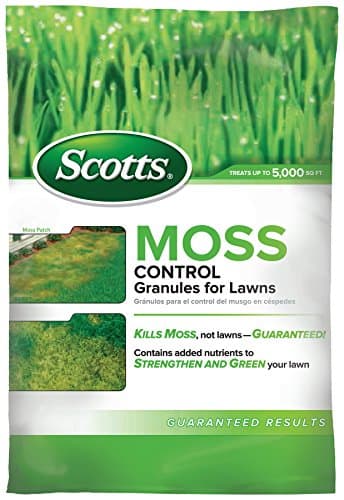
| 1 | Scotts Moss Control Granules for Lawns, 18.37 lb 17.5% ferrous sulfate across 5,000 square feet -- the only moss product here sized for a lawn rather than a patch, and it needs a spreader. | Best for a whole lawn | 8.1 | |
| 2 | 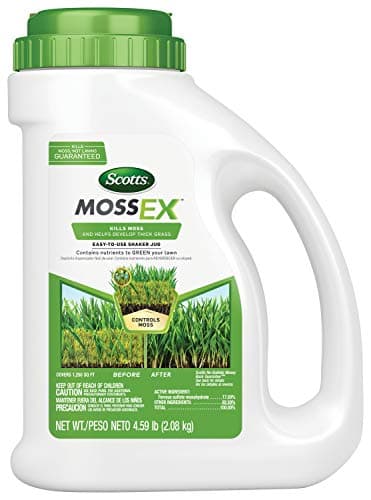 Scotts MossEx Shaker Jug, 4.59 lb The same iron chemistry in a shaker jug you apply by hand -- which is the right package for the way moss actually appears. | Best for patches | 7.4 |
#ad Buy links are affiliate links. Prices come from a live daily check; where we have no verified price we say "check price" rather than print a stale one.
Moss control is the rare lawn product that does exactly what it says and still leaves you with the problem. Ferrous sulfate kills moss reliably and quickly. It has no effect whatsoever on the shade, compaction, drainage or pH that let moss outcompete grass in the first place — so the useful question is not which bag, but which package and what you do in the week after.
The short answer
Which package, and who each is for
| Moss Control Granules, 18.37 lb | MossEx shaker jug, 4.59 lb | |
|---|---|---|
| Active ingredient | Ferrous sulfate monohydrate, 17.50% | Not published for this package |
| Coverage | Up to 5,000 sq ft | Not published by Scotts |
| Rate per 1,000 sq ft | About 3.67 lb (our division) | Not published |
| Application | Granular; needs a spreader | By hand from the jug |
| Scotts' stated purpose | Whole-lawn treatment | Spot treatments or smaller areas |
| When | Winter or spring, moss actively growing | Winter or spring, moss actively growing |
| Conditions | Moist lawn, grass mowed low | Moist lawn, grass mowed low |
| Time to effect | Not published | Not published |
| Grass exclusions | Not published | Not published |
| Buy it for | A shady section, or moss through most of the lawn | Two or three patches, or a first try |
| Skip it if | The moss is in patches -- you will store most of the bag | A whole shady section -- it costs far more per sq ft |
Active ingredient percentage, coverage, timing and conditions transcribed from Scotts' own pages, both cited below. The rate is our division of the published coverage. Note how much the jug does NOT publish: no coverage, no percentage, no rate — which is why the arithmetic below is labeled an inference.
What each package treats
1. Moss Control Granules — for a shady section
Scotts publishes 17.50% ferrous sulfate monohydrate, an 18.37 lb bag treating up to 5,000 sq ft, application in winter or spring when moss is actively growing, and best results on a moist lawn with the grass mowed low.
Who it is for: someone with moss through a whole shady section or most of a small lawn. It is the only package here that publishes its active ingredient percentage, which is the figure that makes the rate checkable at all.
Who should skip it: anyone treating patches, and anyone without a spreader — there is no hand-application option on an 18.37 lb bag, and hand-scattering iron produces stripes you will look at for a season. Spreader settings covers calibration when a bag gives a rate and no dial number.
#ad Check the Scotts Moss Control Granules for Lawns, 18.37 lb price on Amazon — how we're funded.
2. MossEx shaker jug — for how moss actually appears
Scotts describes the 4.59 lb shaker jug as being for spot treatments or smaller areas of the yard, applied by hand from the jug with no spreader. It publishes no coverage figure and no active-ingredient percentage for this package.
Who it is for: the common case. Two or three patches, a strip along a fence, or a first attempt before committing to a bag. No spreader needed is what makes it usable on a patch at all.
Who should skip it: anyone with a whole shady section, where it costs far more per square foot than the bag. And anyone who wants to know the rate they are applying, because for this package Scotts does not publish one.
#ad Check the Scotts MossEx Shaker Jug, 4.59 lb price on Amazon — how we're funded.
The part that decides whether it works
Both products are treatments. Moss grows where grass cannot compete, and there are four usual reasons — only some of which you can change.
- Shade. The commonest cause and the hardest to fix. If the shade is permanent, shade-tolerant seed is the real answer: best grass seed for shade ranks what actually survives under a tree.
- Compaction. Fixable, and worth fixing — core aeration relieves it. Best aerators covers the tools and dethatching vs aerating covers which job you actually have.
- Poor drainage. Sometimes fixable, often structural. Moss in a hollow that holds water is telling you about the hollow.
- Low pH. Testable, and the one people assume without checking. A soil test settles it — the soil testing guide has the method and best lawn lime covers correcting it in either direction.
The honest framing, which moss and shady lawns sets out in full: if the cause is deep shade you may be choosing between a moss lawn, a shade-seed lawn and something that is not lawn at all. Iron does not enter into that decision.
What to do in the week after
- Rake the dead moss out. A mat of dead moss blocks seed-to-soil contact and holds water against the crowns of the grass you want.
- Look at what is underneath. Bare soil needs seed. Thin grass needs overseeding — how to overseed has the method.
- Fix one cause. Aerate, test the pH, or raise the mowing height so the grass shades the soil rather than the other way round.
- Expect to repeat the treatment. If the shade has not changed, the moss has not been told to leave.
What we cannot tell you
How fast either product works. Scotts publishes no time to effect for the bag or the jug, no grass-type exclusions for either, and no coverage figure or active-ingredient percentage for the jug at all — which is why the 1,250 sq ft figure on this page is explicitly our inference from the bag's rate. We have applied neither product and measured no result. Scotts publishes no staining warning, so the caution about concrete is ours, drawn from what iron compounds do rather than from the label. We also hold no non-Scotts moss product with manufacturer-published specifications: a liquid ferric sulfate concentrate exists and is widely sold, but its figures appear only on retailer listings, so it is not ranked here. And no product page will tell you whether your moss problem is shade, compaction, drainage or pH — which is the only thing that decides whether you buy this once or every year.
The picks in full
Specs are the manufacturer's own and linked to the page they came from. Prices come from a live daily check; where we have no verified price we say so rather than print a stale one.
Scotts Moss Control Granules for Lawns, 18.37 lb
Scotts · Granular moss control · Our score 8.1/10
#ad Price as of October 11, 2026. Prices change; we check daily. How we're funded.
17.5% ferrous sulfate across 5,000 square feet -- the only moss product here sized for a lawn rather than a patch, and it needs a spreader.
Published specs
| Active ingredient | Ferrous sulfate monohydrate, 17.50% |
|---|---|
| Coverage | 18.37 lb treats up to 5,000 sq ft |
| When to apply | Winter or spring, when moss is actively growing |
| Conditions | Works best on a moist lawn with the grass mowed low |
| Application | Granular -- needs a spreader |
| Spot treatment | No; the 4.59 lb shaker jug is the spot-treatment package |
| Time to effect | Not published |
| Grass exclusions | Not published |
Source: Scotts MossEx, scotts.com
18.37 lb over 5,000 sq ft = 3.674 lb per 1,000 sq ft. At 17.50% ferrous sulfate monohydrate that is 3.674 x 0.175 = 0.64 lb of active ingredient per 1,000 sq ft. Scotts publishes the coverage and the percentage but not the rate, so the division is ours. Iron compounds at this loading will stain concrete, which is the practical reason to keep it off hard surfaces rather than a claim Scotts makes.
What the numbers favor
- Publishes its active ingredient AND its percentage, which the spot jug's listing does not surface
- 5,000 sq ft of coverage, the only whole-lawn moss package here
- Names the conditions that make it work: moist lawn, grass mowed low
- Iron-based rather than a herbicide, so it is moss-specific
What they don't
- Needs a spreader; there is no hand-application option on an 18.37 lb bag
- No published time to effect
- No published grass-type exclusions, so compatibility has to come off the bag
- Iron will stain concrete, paths and anything else it lands on
- Treats the moss, not the shade and compaction that caused it
the moss is in two or three patches. You would be spreading a 5,000 sq ft bag to treat a few hundred square feet, and the shaker jug exists for exactly that.
How it scores
Scores are our editorial weighting of the published specs above, not a test result. They are deliberately kept out of this page's structured data.
Scotts MossEx Shaker Jug, 4.59 lb
Scotts · Granular moss control · Our score 7.4/10
#ad Price as of October 11, 2026. Prices change; we check daily. How we're funded.
The same iron chemistry in a shaker jug you apply by hand -- which is the right package for the way moss actually appears.
Published specs
| Package | 4.59 lb shaker jug |
|---|---|
| Intended use | Spot treatments or smaller areas of the yard, per Scotts |
| Application | By hand from the jug -- no spreader needed |
| Chemistry | Scotts' MossEx line is ferrous sulfate monohydrate based |
| When to apply | Winter or spring, when moss is actively growing |
| Conditions | Works best on a moist lawn with the grass mowed low |
| Coverage for this package | Not published by Scotts |
| Active ingredient percentage for this package | Not published for the jug |
| Time to effect | Not published |
Source: Scotts MossEx Easy-To-Use Shaker Jug, scotts.com
Scotts publishes 5,000 sq ft for the 18.37 lb bag, which is 3.674 lb per 1,000 sq ft. If the jug is formulated and applied at the same rate, 4.59 / 3.674 = about 1,250 sq ft. We flag this as an inference rather than a spec: Scotts publishes no coverage figure for the jug at all, and a shaker applied by hand is far less even than a calibrated spreader, so treat it as an upper bound.
What the numbers favor
- No spreader required, which is what makes it usable on a patch
- Scotts names its purpose explicitly: spot treatments and smaller areas
- The smallest moss package here, so nothing is left in the shed for three years
- Same application conditions as the bag, so the timing advice carries across
What they don't
- Scotts publishes no coverage figure and no active-ingredient percentage for the jug
- Hand application from a shaker is uneven by nature, and iron shows every stripe
- No published time to effect
- Costs far more per pound than the bag
the moss has taken a whole shady section of lawn. At that scale the 18.37 lb bag is cheaper per square foot and a spreader applies it evenly.
How it scores
Scores are our editorial weighting of the published specs above, not a test result. They are deliberately kept out of this page's structured data.
Where to buy the tools on this page
Every link below is an Amazon affiliate link. We show no price we have not verified today, so where there is no live figure the link says "check price" and takes you to the listing to read it there.
Best for a whole lawn
Scotts Moss Control Granules for Lawns, 18.37 lb
Scotts · Granular moss control
Best for patches
Scotts MossEx Shaker Jug, 4.59 lb
Scotts · Granular moss control
#ad As an Amazon Associate we earn from qualifying purchases, at no extra cost to you. How we're funded.
Common questions
What is the best moss killer for lawns?
Does iron kill moss?
When should you apply moss killer?
Will moss come back after treating it?
Does moss killer stain concrete?
Should you rake moss out after killing it?
Sources
Read next
- Lawn Care
Cutting the grass is a third of the job. This is the other two thirds.
- Moss and shady lawns
Mow an inch higher, water deeply, switch to fine fescues, and know when to plant something else.
- Best grass seed for shade
Shade tolerance, sunlight hours and seeding rates for three cool-season mixes under trees.
- Best lawn aerator (and why most of them are not aerators)
Core aeration pulls 2-3 inch plugs; dethatchers work at 0.4 inches. Which one you need.
- Soil testing for lawns, step by step
4 inches deep, 8 to 10 locations, every three to five years. What the report tells you.
- Best lawn lime, and the one product that goes the other way
Published rates by measured pH, 3.6 against 12 lb per 1,000 sq ft, and the only published time to effect in the category.
- Spreader settings: how to calibrate instead of guessing
Calibrate a spreader by weight in twenty minutes, with the passes and rate arithmetic.