Lawn Care
Watering a new lawn
Everything this site says about deep, infrequent watering is wrong for the first three weeks. Here is what changes, and when it changes back.
Affiliate disclosure: we earn a commission if you buy through our links, at no extra cost to you. It never changes which product we rank first — here is how we're funded.
We have not tested these units. Every spec on this page comes from the manufacturer's own documentation and is linked to it. Every computed figure is arithmetic you can redo. Prices are checked daily — last verified September 24, 2026. Here is exactly how we pick.
Almost every page on this site tells you to water deeply and infrequently. For the first two to three weeks after seeding, that advice will kill your lawn. A seed that takes up water, begins to swell and then dries out does not get a second chance, and the whole job of watering new grass is preventing that one event.
The short answer
The germination window sets the length of the job
| Seed | Published germination | Sunlight required | New-lawn rate |
|---|---|---|---|
| Jonathan Green Black Beauty Sunny | 7-14 days | 6+ hours per day | 3.33 lb / 1,000 sq ft (bag table) |
| Jonathan Green Black Beauty Ultra | 7-14 days | 6+ hours per day | 5 lb / 1,000 sq ft |
| Scotts Turf Builder Sun & Shade | About 6-12 days to first sprouts | Not published | 7.5 lb / 1,000 sq ft |
| Jonathan Green Black Beauty Dense Shade | 14-21 days | 4+ hours per day | 3.33 lb / 1,000 sq ft |
Transcribed from the Black Beauty Sunny, Dense Shade and Scotts Sun & Shade product pages. Rates per 1,000 sq ft are our arithmetic from each coverage table.
The watering pattern, and the switch
- Sowing to germination: several short cycles a day. The target is a damp surface at all times, not a soaked one. Hot, windy or sunny days need more cycles, not longer ones.
- Germination to first mow: begin lengthening and spacing out the cycles. The roots are now short but present, and they follow water downward.
- After the first mow or two: switch fully to deep and infrequent, as our watering guide describes for established lawns. This switch is deliberate; it does not happen on its own.
Timing the first mow is its own question, and the one-third rule decides it rather than the calendar — see best mower for a new lawn.
Hardware that makes the schedule survivable
Two to three weeks of several-times-daily watering is a schedule people abandon on day four. That is the honest reason to automate it.
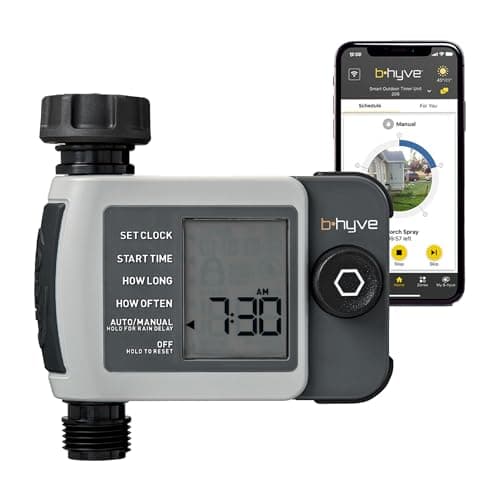
A timer with weather awareness handles the cycles and skips them when rain does the job. The Orbit B-hyve XD publishes a 5-100 PSI operating range and an IPX-5 ingress rating, and runs on AA cells — see best hose timers.
#ad Check the Orbit B-hyve XD 1-Outlet Smart Hose Faucet Timer (24511) price on Amazon — how we're funded.
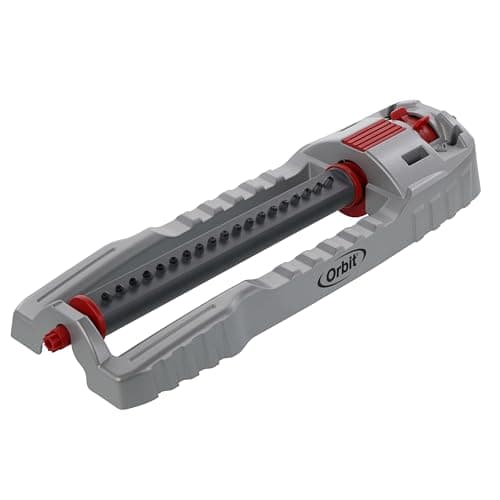
An oscillating sprinkler puts down a gentle, even, wide pattern, which is what seed wants — a hard impact pattern moves it. Our sprinkler roundup compares the patterns.
#ad Check the Orbit Pro Series 4,000 sq ft Metal Gear-Drive Oscillating Sprinkler (56281) price on Amazon — how we're funded.
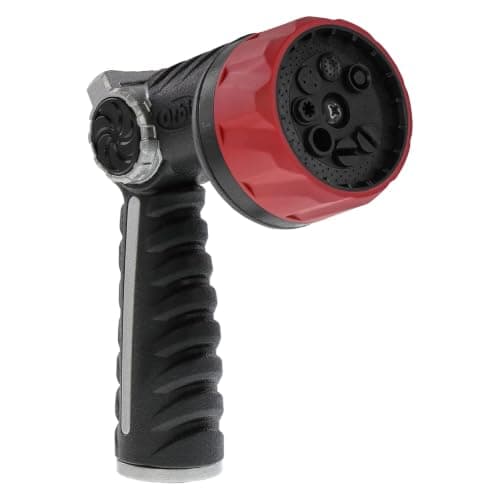
For hand watering a small patch, the nozzle matters: a soft pattern rather than a jet, at a shallow angle. Our hose nozzle page covers the pattern sets.
#ad Check the Orbit Pro Series 8-Pattern Thumb Control Hose Nozzle (26812) price on Amazon — how we're funded.
Why shallow and frequent, and why it reverses
Established-lawn advice is deep and infrequent for a reason: roots grow toward water, so watering deeply and letting the surface dry pulls the root system down where it is safe from heat. That reasoning depends on there being a root system to pull.
A germinating seed has none. It has a radicle a fraction of an inch long sitting in the top layer of soil, and it cannot reach water two inches down no matter how much of it is there. For those two to three weeks the only water that exists, as far as the plant is concerned, is the water in the top half inch — which is also the layer that dries fastest.
The reversal happens because the thing that made shallow watering necessary stops being true. Once the stand is up and rooted, continuing to water shallowly trains exactly the rooting depth you spent the establishment period trying to grow out of.
What changes the schedule
| Condition | Effect on the surface | What to change |
|---|---|---|
| Hot and sunny | Dries in under an hour | More cycles, not longer ones |
| Windy | Dries as fast as sun does, and unevenly | More cycles; check the far side |
| Cool and overcast | Stays damp for hours | Fewer cycles; do not drown it |
| Sandy soil | Drains quickly, holds little | More cycles |
| Heavy clay | Holds water; risks pooling | Shorter cycles, watch for runoff |
| Slope | Runs off before it soaks | Short cycles with gaps to absorb |
Described from soil and weather behavior. No seed maker in our registry publishes a cycle count, a run time or an inches-per-week figure for the establishment period.
Keeping the seed where you put it
- Pattern matters more than volume. An oscillating sprinkler puts down a fine, wide, gentle pattern; an impact sprinkler delivers a hard stream that moves seed. Our sprinkler roundup compares them.
- Runoff carries seed downhill, which is why new lawns on a slope come up thin at the top and thick at the bottom. Short cycles with absorption gaps prevent it.
- Hand watering wants a soft pattern at a shallow angle, never a jet.
- Do not rake or walk on it. Every footprint is a seed depth change.
The four ways new lawns get watered to death
- One long soak a day. It runs off, pools, floats seed into the low spots and leaves the surface dry by mid-afternoon.
- Stopping at first green. The seed you can see has germinated; the seed you cannot has not. Water to the end of the published window.
- Never switching. Shallow daily watering past establishment produces a lawn with roots in the top inch, which is the lawn that browns first in July.
- Watering the shade patch on the sun patch's schedule, when its own bag publishes a window three times as long.
What the lawn needs once it is up
The switch to deep and infrequent is the most important single event in a new lawn's first year, and it is the one most people miss because nothing prompts it. Put it in the calendar when you sow: the top of the published germination window plus two mows.
After that the lawn joins the ordinary schedule — the watering guide for established grass, the annual schedule for everything else, and a soil test before you feed it again rather than after — see soil test kits.
What we cannot tell you
We have not run a seeding trial. No seed maker in our registry publishes an inches-per-week figure, a cycle count or a run time for the establishment period, so this page gives you the published germination windows and a pattern rather than a schedule in minutes — your soil, weather and sprinkler output decide that. Scotts publishes a first-sprout window rather than a full-germination one, which is a softer figure than it looks.
The products discussed
Specs are the manufacturer's own and linked to the page they came from. Prices come from a live daily check; where we have no verified price we say so rather than print a stale one.
Orbit B-hyve XD 1-Outlet Smart Hose Faucet Timer (24511)
Orbit · Hose timer (AA alkaline) · Our score 8.4/10
#ad Price as of September 24, 2026. Prices change; we check daily. How we're funded.
The only hose timer here that publishes both an operating pressure range and an ingress rating, which is what tells you it will survive an outdoor faucet.
Published specs
| Outlets | 1 |
|---|---|
| Control | Bluetooth at the timer; Wi-Fi only with the Gen 2 Hub, sold separately |
| Operating pressure | 5-100 PSI |
| Power | AA alkaline batteries |
| Weather features | WeatherSense, weather delays |
| Ingress rating | IPX-5 |
| EPA WaterSense | Certified when paired with the hub |
| Warranty | Not published (30-day returns) |
Source: B-hyve XD Smart Hose Faucet Timer, orbitonline.com
Most U.S. residential supply sits between 40 and 60 PSI. Against a published 100 PSI ceiling, a 45 PSI faucet leaves the timer running at less than half its rated maximum -- 100 / 45 = 2.2x headroom. The 5 PSI floor matters more than the ceiling for most people: it is the figure that says the valve will still open on a weak rural line or at the end of a long run of 5/8 in hose.
What the numbers favor
- 5-100 PSI published, which almost no consumer hose timer states
- IPX-5 ingress rating published outright
- WeatherSense skips a watering when the weather says not to
- Runs on AA alkalines, so there is no proprietary pack to fail
- WaterSense certified once the hub is added
What they don't
- Wi-Fi needs the Gen 2 Hub, which is a separate purchase
- One outlet, so a second zone means a second timer
- No warranty term published anywhere on the product page
- No published flow rate, dimensions or weight
you want scheduling from your phone away from home on day one. Out of the box this is a Bluetooth timer -- the hub is what makes it a smart one.
How it scores
Scores are our editorial weighting of the published specs above, not a test result. They are deliberately kept out of this page's structured data.
Orbit Pro Series 4,000 sq ft Metal Gear-Drive Oscillating Sprinkler (56281)
Orbit · Hose-end sprinkler · Our score 8.2/10
#ad Price as of September 24, 2026. Prices change; we check daily. How we're funded.
A rectangular 4,000 sq ft pattern on a metal base, which is the shape most front lawns actually are.
Published specs
| Type | Oscillating, gear drive |
|---|---|
| Coverage | Up to 4,000 sq ft, rectangular |
| Base | Heavy-duty metal |
| Width adjustment | Sliding tabs, full to partial |
| Nozzles | Precision nozzles, count not published |
| Maintenance | Clean-out plug |
| Connection | Swivel hose connection |
| Warranty | Not published on the product page |
Source: Pro Series 4000 Sq Ft Metal Gear-Drive Oscillating Sprinkler 56281, orbitonline.com
One inch of water over 4,000 sq ft is 4,000 x (1/12) = 333 cu ft. A cubic foot is 7.48 US gallons, so 333 x 7.48 = about 2,490 gallons. That is the number behind the standard one-inch-a-week guidance, and it is why placement matters more than pattern shape: water that lands on the driveway is charged to you at the same rate.
What the numbers favor
- Rectangular pattern matches rectangular lawns with less overspray than a circle
- Metal base resists tipping when the hose tugs
- Clean-out plug for the nozzle clogs that end most oscillators' lives
- Sliding tabs narrow the pattern for a strip of parkway
What they don't
- Nozzle count is not published, so you cannot compare distribution against rivals
- No published flow rate, so run time for one inch has to be measured with a rain gauge
- No warranty term on the product page
your lawn is an irregular shape or you have beds inside it. A gear-drive rotor with an adjustable arc wastes less water on odd geometry.
How it scores
Scores are our editorial weighting of the published specs above, not a test result. They are deliberately kept out of this page's structured data.
Orbit Pro Series 8-Pattern Thumb Control Hose Nozzle (26812)
Orbit · Hose nozzle (no power) · Our score 8.3/10
#ad Price as of September 24, 2026. Prices change; we check daily. How we're funded.
Eight named patterns and a zinc core, with a thumb lever that lets you change spray without letting go of the hose.
Published specs
| Patterns | 8: High, Medium and Low Pressure, Needle Spray, Rinse, Dual Sweeper, Bucket Fill |
|---|---|
| Core | Heavy-duty zinc |
| Body | Non-corrosive metal |
| Grip | Rubberized non-slip |
| Flow claim | Up to 20% more flow (Orbit's figure, no baseline named) |
| Control | Thumb lever |
| Thread size | Not published |
| Max water temperature | Not published |
| Warranty | Not published |
Source: Pro Series Thumb Control Cannon Nozzle, orbitonline.com
Count the jobs: rinsing a car and watering a bed want a soft pattern, washing a driveway wants the hardest jet, and filling a watering can wants a solid column. That is three. The other five -- and the Dual Sweeper in particular -- are variations on the first three at different pressures. More patterns is not a defect; it is just not the reason to pick a nozzle. Build material is.
What the numbers favor
- Eight patterns, and Orbit names all eight rather than saying '8-pattern'
- Zinc core rather than a plastic insert
- Thumb lever changes pattern one-handed
- Bucket Fill is a genuine pattern, not a marketing name for the jet
- Rubberized grip stays usable with wet hands
What they don't
- The 'up to 20% more flow' claim names no baseline, so it cannot be checked
- No thread size published, which matters if you run quick-connects
- No maximum water temperature published -- do not assume hot-water duty
- No warranty term published
you want a nozzle you can leave running hands-free. This is a squeeze-and-hold design with no lock published.
How it scores
Scores are our editorial weighting of the published specs above, not a test result. They are deliberately kept out of this page's structured data.
Where to buy the tools on this page
Every link below is an Amazon affiliate link. We show no price we have not verified today, so where there is no live figure the link says "check price" and takes you to the listing to read it there.
Best published pressure range
Orbit B-hyve XD 1-Outlet Smart Hose Faucet Timer (24511)
Orbit · Hose timer (AA alkaline)
Best for rectangular lawns
Orbit Pro Series 4,000 sq ft Metal Gear-Drive Oscillating Sprinkler (56281)
Orbit · Hose-end sprinkler
Best pattern set
Orbit Pro Series 8-Pattern Thumb Control Hose Nozzle (26812)
Orbit · Hose nozzle (no power)
#ad As an Amazon Associate we earn from qualifying purchases, at no extra cost to you. How we're funded.
Common questions
How often should you water a new lawn?
How long does grass seed take to germinate?
When do you stop watering a new lawn daily?
Can you overwater new grass seed?
Should you use a timer on a new lawn?
Sources
Read next
- Lawn Care
Cutting the grass is a third of the job. This is the other two thirds.
- How much should you water a lawn?
Once a week or less, to a six inch soil depth, in the morning. The catch-can method explained.
- How to overseed a lawn
Published extension seeding rates, the late-summer window, and the passes-per-lawn arithmetic.
- Best grass seed for full sun
Sunlight hours, germination speed, soil temperature and seeding rates for three open-lawn mixes.
- Best grass seed for shade
Shade tolerance, sunlight hours and seeding rates for three cool-season mixes under trees.
- Best hose timer
Pressure range, ingress rating and what the hub actually adds, on two Orbit B-hyve XD timers.
- Best lawn sprinkler
Coverage, throw and pattern for three sprinkler types, with the circle-area check on each claim.
- Best mower for a new lawn
Top-end cut height, weight and blade condition for the first mow on newly established grass.